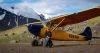
Chilkat River
Outside of Haines, Alaska
We followed "best practice" guidelines for new areas, doing a couple of high "look it over" passes then a low approach. Now it was time to just touch the tires and go around. Short final—everything looked perfect. Over the edge of the river bank—I cut the power and instead committed to a full stop landing; Brakes on a bit and we stopped well short of the end of the gravel bar. What a hoot! The months of building the experimental Cub were all worth it in this one intense experience. 20+ miles to the nearest road—the backcountry Cub was really in the wilderness now.
As the picture and video show, the landing was uneventful. Though the length of the gravel bar certainly didn't leave us with a whole lot of extra room, it was long enough for safe takeoffs. The sense of primeval silence and truly being "out there" was a trip highlight!
Video: Chilkat river landing
It would be nice to play in this whole area at a much lighter weight. We had all of our trip camping and related stuff with us. Next time...
There's something about being in the Alaska wilderness that is, well, simply like being in no other place. Eagles in the trees; Grizzly tracks in the sand—we were "there." True, on our way up from Colorado, we'd often flown for hours over different wilderness—largely trackless muskeg and endless uninhabited forest in Canada. That flying was its own way wonderfully scenic and a very interesting part of the journey. Yet, the very thought of now being in Alaska seemed to add an additional element of wonder.
With me in the Cub was a life-long friend, Joe Dana, whose jovial, easy-going personality makes him the ideal travel partner. A bonus is that Joe retired from the Air Force where he was a navigator. Hence Joe was in charge of the iPad and ForeFlight.
Joe was also on previous trips to Canada and Alaska (with a Murphy Moose that I built). On those trips the focus was on sight-seeing amongst world-class environs which having a private aircraft makes uniquely possible. Now, with an experimental Super Cub, the goal was to go off-airport and explore in the midst of the wilderness.
 Long time friends Ted and Joe enjoying their well-earned beer on the way to Alaska.
Wilderness off-airport operations
In other words...don't screw up
Haines, Alaska is a great place to stage out of for all manner of off-airport flying. We were very fortunate to have a local pilot, George Campbell, give us a guided tour of the river valleys to the N and W of Haines, pointing out possible landing sites, a couple of abandoned yet perhaps useful "strips" as well as one prime gravel bar near a weekend cabin buried deep in the headwaters of the Chilkat River. Two other local charter pilots, Drake and Paul, also helpfully suggested both scenic and challenging options.
 An abandoned airstrip on the Chilkat river.
Seeking out and taking the time to engage local pilots is an essential aspect to the ultimate success of any trip. By any measure, Drake, Paul and George are among the best near Haines. Thanks guys!
We were mindful that going off-airport carries its own set of unique responsibilities. We didn't want to have—or create—a problem while off airport. Bear protection, personal injury prevention and of course overall aircraft safety are paramount. We were over a thousand air miles from home. Having another plane along certainly can add to the overall safety margin, but one still doesn't want to have to fix some damage or spend costly days (weeks?) getting parts to these remote locations. Heaven forbid that one would have to arrange to somehow extricate a severely damaged plane back to town. We did have a SPOT and of course cell phones (we were amazed at the number of otherwise seemingly remote locations where we had some measure of cell service). All things considered, we consistently opted to be ultra-cautious.
The Trip Up
Like Kansas but with trees
After stopping to visit good friends near Calgary, we had options—take the Cassiar route, the Trench or of course the Alaskan highway. For detailed route information, the Alaska Airmen Association used to publish the "Logbook" which is sadly out of print. Get a copy if you can find one! Adverse headwinds, coupled with limited fuel availability in the great distances between airports on those routes, pushed us to the Alaska highway option. Note: Unless you're within gliding distance of the highway itself, the emergency landing choices along the route are very limited with relatively long stretches between viable landing sites.

Flying the highway is very scenic in its own right, particularly after one passes Ft Nelson. Prior to that it can seem like one is in Kansas albeit with endless trees. Nonetheless, each section of the trip does offer engaging views that always captured our interest.
The Liard River valley is noteworthy with the water having cut an interesting course through low hills and mountains. The renowned Laird Hot Springs offers a respite if one wants to land on the highway, taxi to a big open parking area and then visit the springs. Though we gave this stop some thought, we elected not to chance a landing on what seemed like a reasonably busy highway when we were overhead. History: The hot springs facilities were originally developed in 1942 during the construction of the Alaskan highway.
 Liard river valley en route to Carcross, Yukon Territory
In the mid August timeframe, there were gravel bars along the Liard that could seemingly handle any plane. Closer to Watson Lake the hills start. After Watson Lake, one is in truly mountainous terrain. Due to a forecast of rain for the next couple of days, we pushed on past Watson Lake on a direct route to Carcross. The airport at Watson Lake is 10 or so miles from town with limited options to amuse oneself; Carcross on the other hand has numerous bad-weather activity options. The Canadian weather briefer said, "It depends on where you want to get stuck for a couple of days." We happily chose Carcross.
 More Liard river valley en route to Carcross, Yukon Territory
Carcross, Yukon Territory
Great stop!
Carcross is a neat little "town." An excellent coffee shop starts one's day in a friendly setting. A nice yet small museum covering the gold rush of 1898 is also close by. What is billed as the world's smallest desert is about a 2 kilometer walk from the airstrip. Unfortunately, there is no fuel at the airstrip, so plan accordingly.
 Carcross, Yukon Territory
Ed and Dorothy own the hangar and house at the gravel airstrip. Wonderful folks. Ed has many fascinating historical stories of the area to tell. Dorothy works in the local tourist information centre. She has probably 50 or more suggestions of local and nearby activities to keep one occupied for days. Plus she is also fun to talk with! Mountain bike rentals are available too. Finishing the day right, there is an absolutely superb Bistro in Carcross with six tasty Yukon Brewery beers on tap, world class food and—typical of Carcross—very friendly people. The staff there went out of their way to shared their favorite hiking trails with us--we had a wonderful time exploring them!
 Carcross, Yukon Territory
Carcross is an excellent stop to make all of your arrangements for customs. It is only about a half hour over to Skagway, though one has to traverse White Pass and a narrow valley on the Skagway side. "Decent" weather is a must. Tip: Make sure you have access to your email on a phone or tablet so you can provide your proof of eApis filing. The U.S. Customs folks at Skagway were ready to fry us thinking we hadn't filed our requisite eApis until I showed them proof. Apparently they were having computer problems that day.
Skagway is an excellent stop. There are quite a few restaurant options as it is a major cruise ship destination. Interestingly enough, the only fuel available (for transients) is if you walk to the adjacent fuel depot and buy a 50-gallon drum. Then you have to hand pump it—at least that was our experience. Major effort with a high-wing aircraft!

Weather
Fly if you can
We've been lucky on previous Alaskan trips, never having had to sit for more than a day or two on the entire trip due to weather. This time our luck ran out. We had many days of rain and a lot of marginal VFR in and out of clouds.
Another weather issue to thoughtfully consider is the long distances between airports. If ceilings or visibility deteriorated, with the Cub we could land on a gravel bar, maybe a dry meadow or perhaps a beach, but sitting out day(s) of rain in a remote spot wouldn't be a great time. We generally pushed on through if airport route forecasts were at least low VFR for several hours in advance.
 Over White Pass toward Skagway
Though flying in marginal VFR is more work than fun, one could sit for weeks waiting for the rare clear-blue days we're used to in Colorado. I can't imagine the time of yesteryear when there were no accurate forecasts available for the intrepid pilots forging their way through this region.
Glacier Bay
The Scale of the Glaciers is Unimaginable

Waiting for the rare reasonably clear day is well worth it when planning a flight over Glacier Bay National Park. The tourist brochures are correct—the scenery is indeed truly world-class—over the top awesome! Looking at all the water in the inlets now, it is hard to imagine that just a little over 200 years ago, glaciers extended out into the ocean. Now cruise ships ply the deep inland fjords of the park. The lush green forests juxtaposed against the white glaciers and pristine-blue skies made for a spectacular flight. Everyone needs to experience this at least once in their lifetime. Whatever it takes—make it happen, get here and see this area from the air.
Around every corner one is left speechless with a new view that surpasses the previous one. Paul, a Haines charter pilot, suggested we fly up the Takhin Valley then into the park over the Tahkin glacier, then down the McBride glacier toward Muir inlet. Interestingly enough, as we were turning into the Takhin glacier valley, around the corner comes Paul in his pristine deHavilland Beaver running one of his daily flight tours. Small world! As this picture illustrates, the scale of the huge Brady Icefield is, well, indescribable! We fortunately lucked out with absolutely perfect weather.

Beach Landings
Truly lifetime moments
 On approach to land the beach near the Perouse glacier
We had been told that we'd perhaps see plane tracks on the beach below the terminus of the La Perouse glacier. Indeed we did see tracks, which emboldened us to land. Again, this might be old hat for many of you, but for this Colorado land-locked pilot, landing on the beach for the first time ever was yet another truly memorable experience (video link below).
Video: Beach landing
We marveled at the patterns in driftwood and of course walked around a bit. I had flown this section of the coast in 2005; I knew that the scenery would be spectacular on a day with perfect weather—so we pressed on North toward Yakutat. I'm sure there are very few days a year when one can see 10 to 18 thousand foot mountains so close to the ocean. Breathtaking—a "Must Have" lifetime memory.
Next trip I think I'd base out of Haines and, if the forecast is good for a couple of days, I'd fly, land and camp this section of coast. There are endless areas to land and explore. We didn't see bear tracks on this particular spot, but we did see them on other beach spots we landed. We were sure the bears were nearby though as we soon confirmed spotting them at most stream crossings as we worked our way up the coast.
Low-level along the SE coast
Bears and moose
 Imagine beautiful, picture-perfect weather with almost no wind. We were going to keep an eye out for wildlife as we flew up the coast. We saw a few Moose—surprised we didn't see more. That being said, it was the middle of the day so perhaps they were in the bushes napping.
Mid-to-late August is the height of the Silver Salmon run. Almost every stream had bears feasting on scrumptious salmon. We found ourselves glad to be in the air and not on the ground! We saw not just individual bears, but sows with cubs as well. What a treat.
We landed at a couple of Forest Service strips, such as Tanis Mesa, just S of Yakutat. No mosquitoes (too late in the season we surmised), but unless one was going to fish (we weren't) not a lot to do hiking or otherwise in the Alsek River area. The strips are mostly in low-lying areas with thick brush and bog-like, very wet soil.
We got fuel in Yakutat (nice diner right at the airport) and landed a few miles N at Cape Yakataga. Just North of Cape Yakataga is a shipwreck now largely buried in the sand. Fun to visit, and a seemingly endless beach to safely set down on. Again we walked around and explored a bit. With a weak front projected to start pushing inland the next afternoon, we wanted to get up to the Cordova area. While we were having lunch at Yakutat, we talked to some Coast Guard crewmembers who were on an area familiarization flight (lucky them on such a great day). They told us about a superb bistro in Cordova with an excellent beer selection—we were on a mission to check that out! Again, seeing Mt St Elias and the Malaspina Glacier along the way were capstones on a mind-boggling set of lifetime must-see views. The Malaspina is the largest piedmont glacier in the world (Definition: a steep valley glacier which spills out into relatively flat plains, where it then spreads out into bulb-like lobes).
 Malaspina Glacier and Mt. St Elias (18,009')
Cordova
Elves in the Forest
Cordova is a special destination—only reachable by plane or boat—with a nice, 1,800' gravel runway sandwiched between Eyak Lake and Mt Eyak. There is fuel here, but, interestingly enough, no 100LL available at the larger paved-runway "Mudhole Smith" airport that is perhaps 10 miles S of town. We were able to get a rental car. Bruce, a local pilot, graciously stopped by our tent the first morning and offered to let us "camp" in his shop, due the project bad weather moving in for the next few days.
 Hiking the Heney Ridge trail near Cordova
The Heney Ridge trail offered us an easy day-hike. A breathtaking, hard to believe, amount of moss covered everything—so much so that we oft remarked that surely an elf would pop out of the forest at any moment. Every corner brought a new sight of overwhelmingly vibrant green flora. Best hike of our trip. Even if you only have time for a ½ mile of this trail, make a point to do it if you're in Cordova.
We saw a ton of salmon at the few stream crossings along our trail but, interestingly enough, no bear or eagles. The seemingly total lack of carnivores with salmon galore left us highly curious. While there are a couple of traditional cafes and restaurants, a small bistro, built beside an old bus (now the kitchen) named Baja Taco proved to have the best food and beer—perhaps on our entire trip. This by the way is the one recommend by the Coast Guard crew members. The staff was outgoing, full of local activity suggestions and absolutely wonderful to talk with as well. Highly recommended.
 More hard-earned beers in Cordova
McCarthy
High Expectations—Bad Weather
After a few days waiting on weather, and a day of high winds which precluded heading over the pass(es) inland, we finally were able fly up the Scott Glacier toward McCarthy. After landing at Tebay Lakes, we headed over to check out "The Fosse" which is a neat strip on the upper side of the Kennicott glacier. The Fosse is a special spot—incredibly scenic yet a somewhat short curved strip—you wouldn't want to try to land nor takeoff with much wind flowing down glacier.
 The Fosse airstrip on the upper side of the Kennicott glacier
We were looking forward to staying in this area for several days and thoroughly exploring the many off-airport locations one can visit in a Super Cub. Alas, we were again skunked with rain one day, and high winds two other days. It was so windy one day that even the local Wrangell Air charter operation wasn't flying. We wisely took the opportunity to hike, visit the Kennecott Copper Mine area and to walk around the small "town" of McCarthy.
Finally the weather broke, but was only projected to last for a day. We tried to visit some strips up the Nizina and Chitistone River valleys. We again found the local pilots on the radio turning around due to extreme turbulence in the upper reaches of these relatively narrow valleys—exploring this area just wasn't meant to be. We fueled up and headed for the coast, chased by a 40+ mph "outflow" wind. Once along the coast, it seemed that every valley we crossed meant moderate+ turbulence and 30+ winds flowing toward the ocean across our course.
Icy Bay
Remote—Worth Camping & Exploring
 One of the many Alaskan glaciers terminating at the sea, this one near Icy Bay.
Flying South along the coast, we decided to circle inland around the edges of Icy Bay. This bay has to be one of the most beautiful spots on Earth—lush green forests extend down to cobalt blue water all of which are flanked by enormous white glaciers. We landed on a beach for a while and soaked in the surrounding grandeur.

We saw a massive waterfall exiting out of one of the glaciers, which we were able to capture on video. Alas, incoming weather, increasing winds and a forecast for several days of rain dictated we press on rather than camp. Next time...
Video: Massive icefall near Icy Bay
Parting Thoughts
Just Do It
From anywhere in the lower 48 states, getting to Alaska is a major trip. Every pilot I know and talk to avidly expresses a desire to fly to Alaska. Yet, seemingly few pilots ever make their dream happen. Why?
Prior to this trip, I know we both had many reasons why we couldn't go. Time, money, being away from home, concerns over "What if" events, ...all manner of excuses kept cropping up. We both had "stuff to do." The easy option was to say, "Next Year." Unfortunately, I personally know a couple of pilots where, due to medical issues, "Next Year" became "Never." We resolved to "Make It Happen." No one is going to come knock on your door and drag you off for your dream. Just Do It!
 Take a good friend, and your Alaskan adventure will be one you'll never forget.