The greenhorn
Flying above the Knik glacier, admiring the dramatic landscape below me, I found myself thinking back on the past couple years — my journey, and how thankful I was to be experiencing this beauty. Born and raised in Tennessee, the Appalachians just didn't compare to the towering snow-capped mountains of Alaska. Glaciers in the eyes of a good ole' Southern boy seem to have a mind-blowing effect. Not to mention, three years prior to this very moment I had never even flown in a plane before, let alone piloted one.
In 2016, I took my first flight to visit my sister in NYC. I quickly found that the concrete jungle wasn't for me, although I did find the plane ride to be quite thrilling. So much that after the trip I knew I wanted to be a pilot. Fast forward a year, I had just graduated from college and landed a software engineering job in Anchorage. I wanted to learn how to fly, and where better than Alaska? I began flight training within a week of arriving at my new home. After work, I would go to a local flight school and take lessons in a rented Cessna 172 until I eventually received my Private Pilot certificate.

While flying over the glacier that moment, in the very same 172, I knew I wanted to be closer. I wanted to be down there landing on Inner Lake George, a beautiful glacial lake. Or joining other bush pilots at the Picnic Table strip near the mouth of the glacier. Unfortunately, the stock tires on my rental 172's tricycle gear weren't going to do that for me.
Upon landing that day, it became obvious that I needed to buy my own plane. The problem was, I didn't have the knowledge or experience to decide what type of plane I needed or even wanted. After thinking it over, I decided I'd first seek out that knowledge and experience rather than jumping at an opportunity to buy some random aircraft. I couldn't think of a better way to get this experience than to get a tailwheel endorsement and a float rating. Couldn't be that hard, I thought.
Next step: float rating
With winter rapidly approaching, the window of opportunity was dwindling. I set aside two separate weekends to get the tailwheel instruction. The following weekend, I signed myself up for a three-day float rating course, where I'd take the checkride on the third day. Unfortunately, Mother Alaska had other plans. She was gusting up to 30 knots both weekends that I had lined up for the tailwheel lessons — blew those plans straight into next April's snow melt.
 The summer camp scene at Alaska Floats and Skis often involves a domestic pig wandering around.
I still had the float rating to look forward to, and at a week out, the weather was looking great. I was taking off Friday from work for this endeavor, so I was really hoping for a break in the weather. I couldn't sleep a wink Thursday night, I was so excited. I felt like a 6-year-old on Christmas Eve. 7:00 a.m. finally came around, we hopped in the truck and headed for Alaska Floats and Skis at Christiansen lake (AK8) in Talkeetna. I was scheduled for a ground lesson at 10:00 a.m. with a flight at noon.
 Frost on the cowl and lenticulars in the distance...
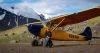
After arriving I met my flight instructor, Carlisle, about whom I cannot speak highly enough. Known informally as "Lisle," she's a great pilot and an even better instructor! I was then introduced to the plane, a 1954 Piper PA-22. Immediately, I started noticing all the new things here and there, and it suddenly wasn't only about flying floats. I mean, hell, the plane was covered in fabric. I had certainly seen this on plenty of aircraft, but had never actually flown one myself.
So much was new and different, like: near the rear of the aircraft, there was a ventral fin. Inside the cockpit, I noticed that there wasn't a little flap toggle like I'm used to, but a whole handle on the floor. On the bright side, there were a lot less buttons on the panel.
 The humble instrument panel of a PA-22
A bumpy first go
I was fired up. So ready to fly. We finished a couple hours of ground instruction and then checked the weather — 20 knot gusts. Great, just what I needed. We decided to break for lunch and meet back up at 3:00 p.m., hoping the weather would improve by then, but a few hours later, the gusts persisted.
Carlisle decided that we'd go up anyway just to check it out. I'm used to flying in Alaska — let's just say I've known no better. Windy days here are quite common. Plus, lakes are much wider than runways, so it seemed fine to me.
 The author with N3321B, a bird well-known by many fledgling float pilots worldwide.
I practically backflipped into the plane with excitement.
We started it up and immediately started floating toward the center of the lake. I needed to make a right turn to start heading downwind toward the south side of the lake. I sat there, pressing full right rudder, and the damned thing wouldn't even turn a degree. Shit, the rudder must be broken or something. Turned out that this was the so-called "weathervaning effect" which I hadn't fully conceptualized on water yet. It's just the tendency for the airplane to naturally orient its nose into the wind.
The few seconds of bewilderment passed, though I was headed directly toward the shore. Obviously, no brakes in a float plane, so to counteract the weathervane, I performed my first Plow Turn, using it to come around to the left so that I could get aligned to taxi downwind toward the takeoff end of the lake.
Once there, I made a 180 degree turn to line up for takeoff. Lisle told me to be aware of the waves and to be prepared if we were to abruptly become airborne after hitting one. Full throttle I went, we got onto the step of the floats, then out of nowhere the engine died. I was so done at that point. I swam to the shore and packed my stuff up...
Just kidding! The engine was fine. We took off, held ground effect for a bit, then up and away we went. As we popped out above the trees, there she was: Mt. Denali looking at us in all her glory; a magnificent day, not a cloud in sight.
 Takeoff on Christiansen Lake
Once we got up around 1,000' AGL, I could really feel that wind a-howlin'. I was quite surprised by the amount of rudder input needed to keep the plane flying straight. I couldn't tell if this was because of the fabric covering, the massive floaty devices below us, or the lower-powered engine. Honestly, I felt more like a kite in this thing. I was getting my fair share of stick and rudder practice in, that's for sure. I loved it!
Lisle decided the turbulence was too bad though, so we circled back for a landing. I was already surprised by the differences in flying the 172 versus the PA-22, especially when it came to landings.
On descent, the thing basically felt as if it were a rock falling from the sky. I'm not going to lie, it felt sensational. I could fly a shorter downwind and turn base sooner in this puppy, diving down right over the trees towards the lake below. A swan was sitting right by the shore in a swampy area, Lisle told me to dive at it. I couldn't believe the pitch attitude we held — much more aggressive than any landings I had previously done in the 172.
 On final to land Christiansen Lake...though it looks like the airplane is in the trees, it's an illusion. There's a little bay back there.
We talked quite a bit during ground instruction about the pitch attitude required when landing the aircraft on water. Our goal was to essentially land on the step of the floats and she really wanted me to get that sight picture engraved in my head. The reason being, if you land slightly too far forward on the floats you could easily flip the plane nose-first and capsize. Coming from a trike, this felt like a familiar landing attitude already, though I've heard this can be a difficult area for some pilots during transition.
After landing, Lisle had me perform a step taxi down the lake and then head back toward the dock. The docking process is one of the most enjoyable parts of float flying, and the way we practiced was pretty exciting.
Basically, once close enough to the dock, I pulled the mixture to kill the engine, used the water rudders to steer the aircraft with whatever momentum existed prior to the prop stopping. When the plane was aligned and close enough to the dock, I jumped out onto the float. I stepped to the dock, and grabbed the aircraft to stop it from drifting away. I can totally see how docking a plane on your own could be a challenge with strong wind, currents, waves, and especially other planes/boats around to avoid.
 Docking can be one of the more challenging, yet fun, aspects of float flying, depending on the wind.
After flying, we had an hour or so more ground instruction, until finally deciding the wind wasn't going to die down. Beer:thirty came a bit earlier than expected, which was okay, because I was provided with two different books to read for my exam on Sunday, one of which was Notes of a Seaplane Instructor, by Burke Mees. Much of the downtime was spent studying, fortunately the material is interesting. There's truly a lot to learn about the water aspect of aviation. Never thought I'd say that.
Relentless wind
After spending much of the previous night studying, I was really looking forward to flying again. We had another cloudless day but, the vexatious wind was still blustering. It was going to be hard to get good quality water work with the conditions. We decided that we'd try to fly to some remote lakes southwest of Talkeetna, on the prospect of fairer winds, but to no avail; the wind was still relentless. We went for it anyway.
Within a 10 mile stretch, there's a line of about five or six lakes, which we hopped one after another. I'd trade Nashville bar-hopping for lake-hopping in the Alaskan wilderness any day! This easily topped some of my fondest flight experiences, I couldn't think of a better way to spend a Saturday. Take off from one lake, get above the trees, stare at Denali for a few minutes, then land at another. I was completely on cloud nine, falling in love with float flying. I couldn't believe more pilots don't partake. Supposedly, only 3 percent of pilots have their seaplane rating.
 Stunning views from Talkeetna – Mount Foraker (17,400 feet), Mount Hunter (14,573 feet) and Denali (20,310 feet).
Photo: USARAK @ Flickr.com
Stunning views from Talkeetna – Mount Foraker (17,400 feet), Mount Hunter (14,573 feet) and Denali (20,310 feet).
Photo: USARAK @ Flickr.com
After logging another 20 landings at the remote lakes, we headed back to Christiansen, brawling with the yoke the whole way. Upon landing, we practiced some step taxiing and plow turns before docking. The goal was to go out for another flight after lunch, but the wind was holding steady and wouldn't subside until the next day. We ended up just going over more ground instruction and then called it a night. I was beginning to think that this float rating wasn't actually in the cards.
After we overindulged in pizza and beer, my girlfriend (and photographer) was very supportive and helped me study the flight materials the rest of the night.
 Beer time
Final day, and a welcome respite from wind
The objective for the next (and last) day was to get two more training flights in and then the checkride, if I was prepared. I figured this would be easy, i.e. "smooth sailing," if only the wind cooperated. Our first flight was scheduled for 10:00 a.m., but damn was I wrong. After a deep frost overnight, we didn't get started until around noon, which left about 6 ½ hours to get everything in. We still needed to train for glassy water landings, emergency procedures, and step turns.
 Perfect, a frosty morning to delay the day's flying
We started out with glassy water landings. Not nearly as bad as others had been making them out to be, I could absolutely see the usefulness.
For those unaware of this procedure, the technique is used on days when the water has a glassy (aptly named) appearance, devoid of texture or shadow or any of the usual aids to depth perception. Height above the surface is nearly impossible to judge.
When approaching the landing, once below the trees and past the shoreline, a stabilized, minimal rate descent at landing attitude is initiated and held with power. This allows an almost automatic touchdown without having to necessarily see the water. As Lisle says: "It should come as a pleasant surprise that you're touching water." The downside to this is that the landing distance is usually longer, so it's important to be prepared for a go-around at any time.
Regarding emergency procedures, we practiced various scenarios. This of course included everyone's favorite: engine failures, which means power-off landings.
On downwind for Fish Lake in Talkeetna at about 1,000 AGL, Lisle pulled the power all the way back and told me to land the plane. The standard procedure for power-off landings is to immediately pitch for best glide, find a place to land, and turn there. Because the PA-22 is basically a flying rock, it felt as if all three of these things required a much faster response. Pull back on that yoke just a little too long and airspeed and AOA plummet fast, getting into the danger zone for the short wing. Instead of trying to bleed off speed to achieve best glide, instead we immediately pitched down to gain speed and turned 180° to align with the lake for landing. Diving directly for the shore, we flared softly above the water. The aircraft easily lost any excess speed before putting it down, and once touching, the drag of the water was an amazing brake.
After practicing the engine-outs a few more times, the realization of what a real-life engine failure would be like was spine-chilling. Of course, we were practicing right above a lake. The obvious consequences are good food for thought as far as the routes I fly and why I should always be looking for places to land. Overall, a great exercise and I would highly advocate that pilots seek the training and/or practice to stay proficient in the event and emergency occurs.
One of the last things we covered was step turns, which of course gave me the most trouble. I was crunched for time with only 45 minutes left to practice them; the checkride was approaching rapidly.
The practice exercise of a step turn is to remain planing on the step of the floats while making a sweeping 180° turn. This is quite an unstable state for the airplane and it can certainly be felt. The centrifugal force pushes your body to the outside of the turn, just like a hard turn in a car. The challenge is in maintaining a high enough rate of turn to complete the turn within the usable area, without sinking a float from the increased pressure on that outside float. It's a delicate balance that takes practice. An interesting note about these: there's quite a bit of aileron use throughout the turn, turning the yoke to the inside of the turn, similar to steering a car, in an effort to use available airspeed to lighten that wing and thus the float. We ended the practice by transitioning the step taxi into a confined area takeoff.
Checkride
Once we landed back at Christiansen, I beelined it to the office to start the oral portion of the seaplane rating examination with the DPE, the man himself: Don Lee. He's been teaching floats for many years and out of any group of pilots, likely a few have his signature in their logbook if they've got a float rating.
It was terrific; it went well and I felt super confident about everything. After some pre-flight planning discussion, we headed out to the plane to begin the practical portion of the test. It was still beautiful outside; the sun was probably only 45 minutes from setting when we took off. I couldn't believe all these puzzle pieces were falling into place and that I might actually get my rating!
 The checkride takeoff
We began with a regular landing at Fish Lake, which went remarkably well considering how nervous I was. I then performed a step taxi to the end of the lake and back to the other side. We took off, and I was told to execute a confined area landing, which I nailed cleanly! Into the air again, we headed back around for another landing, this time a glassy water landing. Unfortunately, I felt as if I had a bad approach setup, so I called it and went around. The next attempt I nailed a smooth "glassy."
Don then wanted to see the step turn, and this was the thing which I was most nervous about, as I didn't yet have the confidence in my abilities. But to my surprise, I finished the turn without coming off the step. As we were headed back to the other side of the lake, he directed me to demonstrate a confined area takeoff, which I somehow managed to pull off too.
Headed back towards Christiansen, I knew the checkride was coming to an end. I just needed to nail this last landing and dock the airplane successfully. On downwind for the final landing, he cut the power and said: "Your engine just died!" We were only 900 AGL or so; I knew I needed to make everything happen quickly. I pitched down and was making a tight 180° turn to set up for the landing, all while spouting off my memory items for an engine failure. After landing, I was so overjoyed...but I knew I had to collect myself because I still had to dock the plane.
Video
My girlfriend films my emergency landing from the dock. The audio is every bit as important as the visuals in this video.Once we were close enough to the dock, Don climbed out of the plane ahead of me to clear the way (a PA-22 only has a right side door) and stood on the back of the right float. I cut the mixture, slid over to the right seat of the plane, and began to maneuver with the water rudders. While looking out the open door, I waited until we were aligned perfectly with the dock and then swiftly jumped out onto the float. Sadly, I tripped and tumbled into the water. Completely covered in leeches, I crawled my way up onto the dock, as I watched the aircraft drift away... Kidding again! I made the leap onto the dock and caught the wing successfully. Whew!
Video
The fine art of docking...I was elated, I had passed! I honestly couldn't have asked for a better checkride or a better instructor. We walked inside, Don gave me the temporary certificate and I was on my way!
 Walking back to base to get my temporary certificate
New insight
On the drive back to Anchorage I couldn't stop thinking about how cool an experience it all was. It really made me realize that exposure to new and different aircraft, and different types of flying, was an important prerequisite to shopping for my own plane. Flying the PA-22 on floats was so incredibly different than the standard C-172, that in just a few hours of flying it I learned a lot and gained some valuable insight.
I may not be sure about which type aircraft I want yet, but I feel a step closer. One thing is for sure: I want something that I can put on floats. Take this solid recommendation from a greenhorn: all pilots should take a departure from their comfort zone and give floats a try. Even if it doesn't result in flying floats frequently, the experience of learning something so radically different from the everyday wheeled undercarriage is a great way to broaden your horizon as a pilot.