Above the Summit: An Antique Airplane Conquers Colorado's Fourteeners
I would wager than many of us dream about someday flying a major cross-country trip, the kind where you set forth encumbered by an equal combination of excitement and trepidation, and powered by a thirst for the unknown. Any such trip in a Piper Cub variant is made even more so, with its ever-present visceral elements of noise and doors that leak cold air. My dad used to ease my anxiety of such trips in my 1950's Cessna by saying: "This airplane has been doing this for 50 years, it's more experienced than either of us."
I can only imagine that Garrett Fisher, pilot and author of his self published Above the Summit: An Antique Airplane Conquers Colorado's Fourteeners, felt similarly when launching for the mountains of Colorado in his 1949 PA-11 Cub Special, making the move from the relatively mellow terrain of the east coast to his new home in the Rockies. The following is a chapter excerpt from the book, which is an aerial guide to the mountain peaks of Colorado that reach higher than 14,000 feet above sea level, dubbed the "Fourteeners." The book features a narrative of his journey, along with more than 100 images of all 58 Fourteener peaks with their names and locations, and provides a magestic context to Fisher's flirtation with mountains. --Editor
My Mountain Flying Experience
It all begins in 2010, when I took my first flight into mountainous terrain. A new client situation in West Virginia materialized, so I took the flight from Charlotte, NC in a rented Cessna 152. My previously longest flight was 75 miles, and this had been over 10 years prior. While I had gotten current with a couple of lessons, I had effectively flown 5 times in the entire decade. I was rusty and eager for adventure, a gloriously lethal combination.
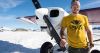
 Author Garrett Fisher with his PA-11 Cub Special
It had snowed all over the southeast, and it was cold. There was no GPS, merely a map and VOR navigation, which is ground-based navigation using 1960s-era radio signals. The flight would be 150 miles over the Appalachians in NC, VA, and into WV. I got the airplane started despite the cold, went through the exhaustive checklists and was ready to taxi. Adding power, I went nowhere. More power….and I looked down to see the wheel chocks were still in. Power down, take them out, power up. I was nervous and it was showing. I finally took off with great anticipation, tracking my pencil line I had drawn onto the map as I headed north into the higher terrain.
 My aviation mountain virginity lost... Wytheville, VA
It was breezy at both surface airports. That meant that the winds were going pretty good at altitude. I knew that rotors were the tools of the devil, invisible beasts that lurk in the Appalachians and swallow airplanes. So, just to be safe, I flew a mile above the terrain. That is correct, I had 5,000 feet of terrain clearance. Ironically, the rotors were still going up there – strong up and downdrafts – oscillating just like I had read in the aviation magazines.
Map-based navigation seemed to be fine, though I did configure the VOR to cross check, just in case. Visibility was over 100 miles – clear March 6 air – with snow all over the mountains and valleys. It was a beautiful sight, though I feared the landing. What kind of turbulence would be over the mountains? Would it break the airplane in half?
Sure enough, the final ridge near the airport banged the plane around good. Winds were quite erratic and strong and the surface, and I managed to do a landing that I at least wasn’t ashamed of. After concluding my business for the day, I flew back with a giant smile on my face. Upon landing, my instructor asked, "Where did you go on a day like this?" "West Virginia." "Did you have a GPS?" "No." "Oh my god…" I thought he was being dramatic, though I am a nut for maps.
 New York to North Carolina flight, highest terrain, Virginia
I made the same flight about 8 times over the next 4 months, with all sorts of weather: thunderstorms, low clouds, fog issues, and the like. My confidence grew with each trip, and I began to fear the mountains less and less, traversing them with 1,500’ to 2,000’ clearance instead of a mile. My grandfather did not like the concept one bit, and made his thoughts known constantly, suggesting that I just "forget those mountains."
Later in 2010, I took possession of the PA-11 that I now fly. That required a flight from Buffalo, NY to Charlotte, NC. I was content to make the flight in October. My grandfather suggested disassembling the aircraft and driving it down, for which I couldn’t understand the purpose of aviation at that point. Other family members tried to impose various edicts and rules. They finally collectively got their nerves in order when I agreed to take my grandfather’s GPS and file a flight plan, the latter of which proved to cause more problems than solve. The tallest mountain I crossed was no higher than 3,000 feet above sea level. It was uneventful, and as of then my longest trip at 500 miles.
I did some flying in the NC Mountains, though not too frequently, even though they are the tallest in the eastern part of the US. I had one notable incident over Lake Lure, NC, at 3,000’ altitude, where downdrafts in a snow shower were so strong that the airplane was slowly losing altitude at full power. I was in a canyon and pulled what is effectively an aerobatic maneuver, a wingover, to turn 180 degrees without smashing into the canyon side. Between that and the rotors from some years prior, what the magazines wrote about was real. It is ironic that the downdraft on that day in NC would exceed anything I got myself into in CO.
The next flirtation with mountains was the flight from NC to CO. On my third day of flying, I was crossing the forlorn and desolate sections of western Kansas and eastern Colorado. These are plains of such dryness and desolation that it is hard to describe, grasslands of the harshest aspect, bordering on desert. It is windswept, baked land of tornados and blizzards, a crucible of humanity. With temperatures well over 100 degrees, engine oil at 210 degrees, and engine heat blowing into the cockpit, it was everything not to pass out when I got to Boulder. Ground temps were 96 degrees at 5,300’ elevation, with a looming thunderstorm at the Continental Divide. At the advice of the airport manager, I opted to come back and get the airplane another day.
 Entering the Rockies for first time, Rollins Pass, CO
Weeks later, that day came amidst a rather busy Colorado monsoon season. I would be crossing at Rollins Pass, an elevation of less than 12,000’. I had previously taken the PA-11 in the 1990s up to 14,000’ in NY, an experience of remarkable sluggishness. I knew it could be done and it had to be done to get it to its new home airport in Kremmling. As I powered up on takeoff in Boulder, the engine started coughing and sputtering just after I got airborne, usually not a good outcome. Seeing as it had never done such a thing, I figured altitude was to blame and tried adjusting the carburetor fuel mixture from full rich to a leaner setting. The coughing stopped and the engine dragged its way into a slow climb. This was the first time I had ever adjusted mixture on takeoff.
As I climbed into the foothills at 8,000’, the view was remarkable, though the climb was sluggish. I found that the thermals were very strong vertically, both up and down, and I found upward air currents anywhere a cumulus cloud sat over a hill. Thus, I circled my way up following the clouds and the hawks. At 10,500’, the airplane wouldn’t climb or put out a reasonable RPM. With my newfound lesson on takeoff, I tried aggressive mixture adjustments and was shocked to see the engine offer 2400 RPM, very close to full RPM (not quite full HP due to altitude). Sluggishly, we made our way to 13,000’ as I got closer to the Divide. The terrain was stunning, an alpine cornucopia of incredible scenery, eye candy of a magnitude that cannot be appreciated from the ground.
As I approached the pass, my concern was emergency landing locations. It was evident the timberline was gentle and grassy, with loads of 4x4 vehicles offroading. I would be in good company if I had to land. My next concern was the cloud deck that was pressing in over the pass. Being that I was about to enter the lion’s mouth, my concern was clouds that would swoop down and instantly envelop my flight path, an intentional act of malicious sky spirits.
 Peak 1 (12,997'), en route to Leadville, Frisco CO
It was uneventful. I flew over the pass. No bumps. No downdrafts. No Satan-induced cloud problems. The other side was sunny, and the terrain dropped below, making it seem awkward that I would remain 6,000’ above the ground. Although "in the mountains," it seemed more like rolling hill country in Grand County than a sawtooth death trap of orography. The demons with pitchforks I had imagined were not, in fact, lurking behind granite spires of death. There were no alligators, nor were there piles of plane wrecks with rotting pilot corpses. It was a pleasant summer day in the high country. I had a feeling of accomplishment as well as the nagging suspicion that I was a drama queen. Maybe mountains aren’t so bad.
As the wife had quite a drive from Boulder to Kremmling, I decided to fly around for fun. I am used to the quintessential Piper Cub experience, flying with the door open at low cruise RPM. That was not happening at 9,000’ with sunbaked terrain. I needed 30% more power to fly, and it was an alternation between rising air and descending air. One could not rest flying up here, it was a constant exercise tracking what the wind was doing vertically. After many hours of practice over several months, I finally fell into a routine where flying got fun and easy at the same time.
 Leadville airport with Mt. Sherman (14,035')
Four months later, the airplane would move to its most amazing home to date: Leadville CO, the highest airport in North America with a field elevation of 9,927’. The flight over was lots of fun, wedging between mountain peaks and snow showers, over passes, under tight clouds, and into the valley. When I got there, the wind was blowing around in swirls, with all three airport windsocks blowing in different directions. I managed to land like I was flying a refrigerator, a distinctly different experience at 10,000’ compared to sea level. After some practice rounds, the folks at the airport advised that, absent flying during a snow storm or howling wind, this is as bad as a flyable day gets.
The thing about Leadville is that it is surrounded by peaks over 14,000’, all visible from the hangar. A pilot with the slightest shred of adventure will take very little time before desiring to find out what flying over there is like. The airplane arrived in late October to Leadville and the 14ers project started in mid-November. You can see how long the connection took to fire in my mind. From "hmmm…. I wonder about those mountains" to a full-fledged book in a remarkably short period of time.
 The highest peaks in CO, just a few miles west of Leadville airport
The actual flying to get the photos was a progressive process of experience and getting comfortable with what I was doing. I first elected to photograph the 14ers of the Mosquito Range, between Leadville airport and Breckenridge. I chose those mountains as I was most familiar with them from the ground. Initially quite nervous, I kept my distance and the photos I acquired that day did not make it into the book, as they weren’t all that dynamic. After that flight, I photographed the two most looming peaks from the airport: Mt. Elbert and Mt. Massive. This was the first flight where I got close enough that the photos were worth publishing.
The floodgates opened at that point. The following flight featured calm upper level winds, so I went up to Mount of the Holy Cross as well as some of the Mosquito Range again. This flight was quite a blast, as I carved around peaks in the Tenmile Range and got quite up close and personal.
 Too risky-- Collegiate Peaks and Elk Mountains
Next up was a somewhat breezy day, where I did the peaks in the mid Front Range as well as Pike’s Peak. The first clue that the engine was getting erratic on me was while between Grays and Torreys Peak, when the winds shifted from accelerating the aircraft to putting the engine under load. It sputtered some, and was resolved with a mixture change. I thought nothing of it, only had to get my nerves back where they belong.
The next flight was the best out of all of them. I had intended to go to the area south of Aspen and photograph the 14ers in the Elk Mountains. As I ascended over Twin Lakes in the Collegiate Range, all I saw was an endless sea of peaks stretching to the horizon. While an awesome sight, it was also minus 5 degrees Fahrenheit when I took off at 10,000’ and these ranges had just received over three feet of snow. An engine failure would likely mean death, so I opted to photograph the Collegiate Peaks in the Sawatch Range. An engine out there would be a pleasant glide to the inhabited valley beneath, so I was far more comfortable with the idea.
The visibility was incredible, and the peaks were almost crystalized in their visual purity. The photographs were amazing, so beautiful that I was not noticing that I was utterly freezing. Minus 5 at the ground means something like minus 20 at altitude. While the aircraft has "heat," it does not function at such low exterior temperatures; hence, I was in double ski gear and carried a load of survival equipment. In order to get clear photographs, I have to open the window, offering a blast of 85mph wind in the cockpit. It certainly was unimaginably cold; yet, for those that know me, when I am in pursuit of something, I am not to be stopped. A little chilly air would not be interrupting this trip!
Visibility was at least 100 miles. It was the clearest air I had ever flown in, a blue sky so clear and iridescent that it could be put in a bottle and drank. As I got to the southern reaches of the Sawatch Range, I could see the Sangre de Cristo Range in its glorious splendor, with the next 14ers being about 50 miles away. Although I did not have my 14ers map printed out for these reaches, I had a rough idea of where they were in the range. I texted the wife that I won’t be home until after dark, I am heading to the New Mexico border.
 Blanca Peak viewed from San Luis Valley
The Sangre de Cristo Range was something that words cannot describe. It is by far my favorite range in the state from the ground, and now occupies that spot from the air. The peaks rapidly rise up to 7,000 feet from a surrounding valley, a dry former lakebed that is flat as a pancake. Most ranges in the state have some sort of process where they progressively get to elevation, as opposed to such a near vertical presence. To top the entire experience off, there were low clouds that were in the small valleys between peaks on the range, making it an experience and a series of photographs one could not ever expect.
I passed along the beautiful range and over Great Sand Dunes National Park, down to the peaks around Blanca Peak. I had first laid eyes on these mountains in 2005 from the ground, and wanted to fly around them since. That goal was now fulfilled. It is truly a stunning series of peaks south of Great Sand Dunes, all in its own right, and in its own style.
The last one in this flight was Culebra Peak, down near the New Mexico border. Without the 14ers map, I had a rough idea where it was and photographed everything I saw. There was one clear prominence, though I had a hard time believing it was a 14er. It just didn’t seem appropriately as dramatic. Further research showed that the timberline is well over 1,000’ higher this far south, thus confusing the apparent majesty I was expecting. The amount of peak above the trees was far less.
The return trip took awhile, all told over 3 hours of flying in harsh, wickedly cold air. When I came back to land, I could barely feel my feet and had to extricate myself from the aircraft like I was literally frozen. It took a few hours to loosen up, rehydrate, and become human again. Some post-flight troubleshooting of the engine indicated an ignition problem had developed, so the aircraft ended up being down for maintenance for a few months as the issue was sourced and fixed. As is usual with airplane engines, they provide some bit of a warning that something is brewing, and the finicky mixture requirements were indicative of what turned out to be a very rare and bizarre malfunction of the magneto, requiring overhaul.
 Rocky Mountain National Park
When the airplane finally was back in one piece, the next flight was to get Longs Peak, a forlorn single peak hiding in the northeast section of the mountains, far from any other 14er, and logistically impractical to combine with anything else. It required a 90-minute one-way flight to get there, with quite some wind along the way. It was my most harrowing takeoff at Leadville yet. As I cleared 200 feet above the ground, I hit a downdraft and began descending while at full power, with the airspeed indicator reading 38mph. I settled back into the nose high configuration, already on approach to land back down on the runway (at full power) and then the winds changed and I was climbing again. A rotor had worked its way 10 miles from Mt. Elbert over to the airfield. Most modern aircraft would have had to push the nose forward to avert a stall, making it a dramatic situation to avoid the ground at the same time. Cubs have such a high lift ratio that the air coming off the engine effectively prevents a full stall; the airplane merely descends. I had to find the location of the updraft section of the rotor to get any altitude, and use some creative techniques to climb along the ridgelines to get altitude. It was the most problematic day yet trying to climb out of Leadville, until I finally got altitude over Climax Mine and crossed the Tenmile Range.
 Independence Pass (12,095’)
When I finally did get to the Continental Divide, there were clouds. Not to be deterred, I pressed on toward Longs Peak and found that it was visible. The clouds were forming at the ridge and moving east, where they would become angry thunderstorms over the plains. I weaved around them and found Longs Peak attempting to hide from my camera. The photographs had a special mysticism being above the clouds and proved to be worth it. Rocky Mountain National Park featured aggressive terrain, providing a psychological baptism into the mindset of planning both surviving an unplanned landing and surviving the terrain afterwards. I followed the Colorado River on the return flight home for another project, and after having landed at Kremmling for fuel, I realized I had finally figured out the trick to cruising and enjoying the flight like I used to at lower altitudes. It is a careful subconscious tracking of where the winds are, what they should be doing, what they are doing instead, and working the throttle to keep the flight gentle and pleasant.
It became time to conquer the 14ers of the Elk Mountains. Winds had been rather strong, and a window of decent weather finally opened to tackle the trip. On this particular day, thunderstorms were forecast over the peaks, and I intended to also photograph a section of the Colorado River, so it was a matter of timing – hoping to get past the high peaks area before noon to avoid any nasty weather.
 The Milky Way from Independence Pass
As I climbed through Twin Lakes, I passed over Independence Pass, where I had taken some photographs after snowshoeing at night up a ridge to 12,800’. Truly a remarkable place, it was surprisingly docile from the air compared to some of the terrain I was about to embark on.
The Elk Mountains are rather severe, such that landing above timberline is generally not going to be a viable option in the event of engine failure. Most sections afforded the opportunity to glide within a reasonable enough range to Aspen that survival in the wilderness was not an issue, except it was quite rough near Maroon Peak and over toward Capitol Peak, what I am told is the hardest 14er ascent in the state. The entire exercise of flying in these expanses of death is a constant tracking of what few locations exist to land, and what direction to go to get out of the wilderness. On top of all of that, I am photographing and flying in turbulent air. After returning from these adventures, I am usually completely worn out and have to spend the rest of the day to recharge physically and mentally, though every bit is worth it.
 The Elk Mountains
The final flight was the San Juans. They are the farthest, and also appeared to be the most inhospitable. Peaks are in sections that make the Elk Mountains look like a cakewalk – 10 mile+ hikes to the nearest road, not necessarily the nearest piece of civilization. I initially photographed San Luis Peak, which is rather isolated and dry. This means that landing would have been fine, even on top of a peak. The hike out would not be deadly, simply very long. Umcompaghre and Wetterhorn Peaks were islands in the sky, surrounded by what looked like glaciers (and I know are not, merely residual snowpack from a very snowy year), and extremely isolated from any form of help. At least the mountains around them were hospitable enough to permit a landing without certain death. These peaks were the farthest from civilization yet. My willpower was tested over Windom Peak and the associated 14ers around it. The terrain there is unlike any other in the rest of the state: extremely rough, spires of vertical rock, unforgiving valleys, extremely rugged terrain. That ruggedness translated into a beating in the air, with the airplane getting tipped left and right to very severe degrees, simply due to wind patterns. Trying to photograph was a real challenge, and I was quite uncomfortable with being over that terrain. I remember thinking "I am never doing this again." That is usually a sign that I somehow will, so stay tuned until I get the idea to do something silly there again.
 The southern San Juan mountains
El Diente Peak was fairly innocuous after Windom and its buddies. I came over a ridgeline into the valley around Telluride and then passed north to Mt. Sneffels, the final peak of the project. It also was benign in that it was isolated and I could glide down to Telluride airport if need be. After completing those photographs, I had the warmest feeling of satisfaction one could imagine. I had done it! The 14ers were photographed, a project of incredible magnitude. Smiling quite happily, I landed at Telluride to fuel up.
As I taxied toward the terminal area, I passed a small airliner loading passengers. The gawking was priceless on the part of the passengers, looking at that antique "thing" taxiing by. When I went in the terminal, a corporate jet pilot noted the aircraft and commented, "You flew in here with a Cub? You’re nuts." He, of course, thought I flew into the valley like a normal pilot would. When I advised I came over a 13,000’ ridge after photographing the 14ers, he was speechless.

After "completing" the project, I squirreled myself away into my office to begin the equally as challenging prospect of putting the book together, requiring not only the writing and organization of it, also the process of digging through all of the photos, identifying the peaks, post processing and the like. In the process, I could not find a good photo of two 14ers: Mt. Sherman and Mt. Bross. In an act of profound retardation, I failed to get a decent shot of the closest two to the airport. By this point, I was in the process of moving to the next adventure out of state. Thankfully, I had to return and get the airplane for the long flight out, so I was able to get both of these peaks on a cold summer morning flight in July.
After the actual completion of the project, it became evident that each flight was not just a piece of the overall puzzle, it was an experience in and of itself. I started with flights that I could handle safely with my flying skill, knowledge, and experience, and each additional flight increased all of those abilities. By progressively pushing my personal limits further, I had become a better and more resilient pilot all around, carefully refining my approach to remove unnecessary fears and to strengthen ones that belonged. I was no longer dominated by the drama of inexperience and ignorance; the days of imaginary demons lurking behind mountain peaks with spears were gone. I have asked if the process is simply an acceleration of normal pilot experience building, and I find that isn’t the case. Many pilots have a goal to fly faster, with greater precision, on time, and safely, with our entire commercial airline system built on those foundations. No where in that framework do the limits get pushed intentionally, they do so only occasionally when protocols fail the pilot and suddenly the aircraft is in a mechanical or meteorological situation that had always been sought to be avoided. Adventure and bush flying is far different than the precision of airline travel, yet it is those that push the frontiers of engineering, skill, and aeronautical environment that help to progressively push the refined and precise boundaries of the normal. Behind every pleasant airline flight is a history book filled with test pilots and airplane designers who have pushed the boundaries one step further. I would recommend that each pilot be tasked with the duty to push the boundaries of aviation, as I am certain that the experienced gained in such harsh conditions serves the pilot and the community well. With only a handful of pilots living above 9,000 feet, and with 5 aircraft based at Leadville, I doubt many will play with these 14ers.
Above the Summit: An Antique Airplane Conquers Colorado's Fourteeners features this excerpt and many more chapters like it. It can be purchased on Amazon.com.