- No comments found
The Cessna 175 Skylark is a four-seat, high-wing, single-engine aircraft that Cessna built from 1958 through 1962 to slot between the economical 172 and the pricier, more capable 182. Rather than simply installing a bigger engine in a 172 airframe, Cessna equipped the 175 with the Continental GO-300, a geared version of the 172's O-300 that ran the crankshaft at up to 3200 rpm while reducing the propeller to a more efficient 2400 rpm through a built-in gearbox. On paper this gave the 175 a real edge over the 172: 175 hp instead of 145, a 15-mph faster cruise, and noticeably better climb performance with a full cabin.
In practice, the geared engine became the airplane's undoing. Pilots accustomed to direct-drive engines routinely throttled back to what felt like a "normal" cruise rpm, well below the 2900+ rpm the GO-300 actually needed to run smoothly. Operated this way, the reduction gear set up a harmonic vibration that chewed through parts far short of its rated 1200-hour TBO, and the 175 picked up a reputation for unreliability that it never fully shook, fair or not. Cessna built 2,106 of them before quietly discontinuing the model in 1962, and today a large share of survivors have been re-engined with direct-drive Continental or Lycoming powerplants under STC.
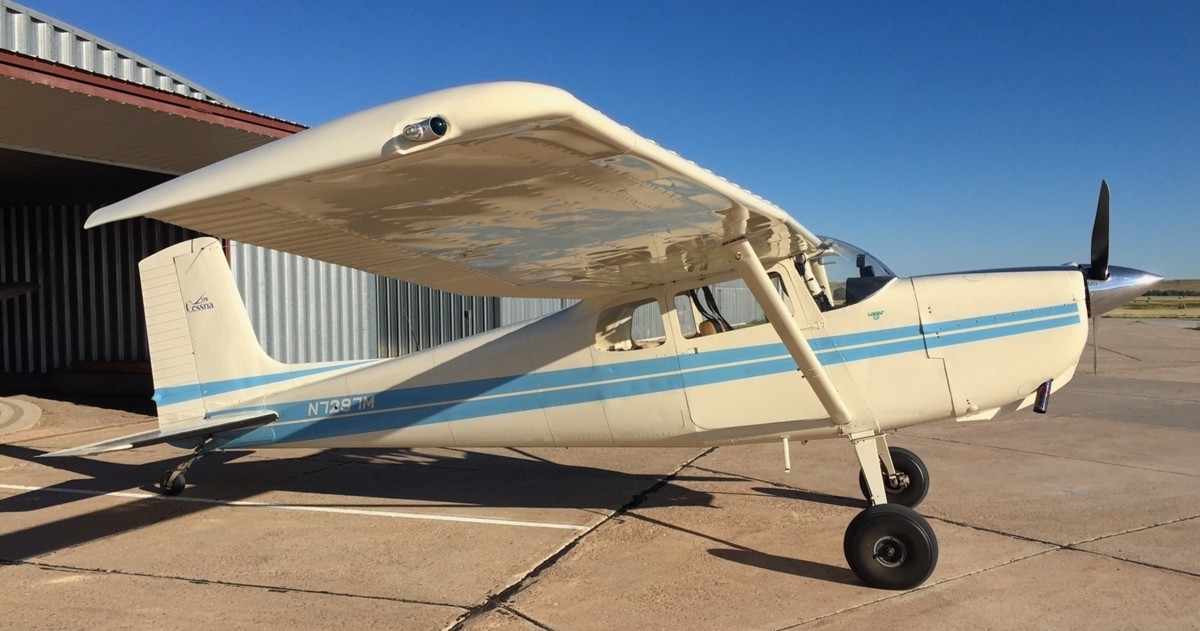
Engine upgrade, combined with a fuselage and wing that are nearly identical to the contemporary straight-tail 172 (and share a great deal of part commonality with the Cessna 170), has made the 175 an appealing basis for a tailwheel conversion. A 175 converted to a taildragger bears a strong resemblance to its bigger sibling, the straight-tail Cessna 180 Skywagon, at a fraction of the acquisition cost — hence its growing following in the backcountry community as a budget "baby 180", at least aesthetically. It remains useful load-challenged.
The 175's factory fuel tanks (52 gallons total / 42 usable) are also larger than what a stock 170 or early 172 carries, which matters more than it might seem once an owner is looking at an engine upgrade: a thirstier direct-drive conversion eats into range and endurance, and starting from the 175's larger tankage helps offset that rather than compounding it. It's why some owners converting a 170 or 172 to a bigger engine have gone looking for 175 wings or tanks.
The 175 went through four production years, with changes concentrated in the tail, cowling, starting system, and propeller:
175 / "Skylark" trim (1958–1959) — Serial numbers 1 through 1238. The original model had a straight ("square") vertical fin shared with the contemporaneous 172, a fixed-pitch McCauley propeller, and the Continental GO-300-A or GO-300-C engine. Certified January 14, 1958. Gross weight 2,350 lb. 702 built in 1958 and 536 in 1959. The "Skylark" name denoted the deluxe trim and equipment package; all Skylarks are 175s, but not every 175 was ordered as a Skylark.
175A (1960) — Introduced the swept ("slant") vertical fin, along with an engine cowling reshaped to fit more closely around the GO-300 (partly to close off a gap that had become a favorite nesting spot for birds). An external baggage door and reduced nose gear oleo strut travel were added. The 175A was the first variant approved for seaplane operations, at a 2,450 lb gross weight on floats. Engine options were the GO-300-A, -C, or -D.
175B (1961) — Continued the slant-tail airframe and added push-button electric starting in place of the earlier key/ignition arrangement.
175C (1962) — The final and most refined 175, adding a constant-speed McCauley propeller, cowl flaps, and a 100 lb gross weight increase to 2,450 lb, along with full "Skylark" fuselage branding. Powered by the GO-300-E. Only 117 were built before Cessna ended the line.
Because the straight-tail 1958–1959 airframe is the one most commonly converted to tailwheel configuration (it more closely resembles the 170/180 tail group and doesn't require removing the later slant fin), it tends to command a premium among buyers specifically shopping for a conversion candidate. Owners occasionally also encounter 172-parts cross-references in maintenance literature — the fuselage aft of the firewall, wings, and most systems are close enough to the contemporary straight-tail 172 that many components are listed as interchangeable, though the 175 was certificated under its own type certificate (3A17) and the two are not identical.
| Aircraft specs | 175 / 175A / 175B | 175C |
|---|---|---|
| Make, Model | Cessna 175 "Skylark" | Cessna 175C "Skylark" |
| Produced | 1958–1961 | 1962 |
| Engine model | Continental GO-300-A/-C/-D (geared) | Continental GO-300-E (geared) |
| Rated power | 175 hp @ 3200 crank rpm / 2400 prop rpm | 175 hp @ 3200 crank rpm / 2400 prop rpm |
| Propeller(s) | Fixed-pitch, McCauley | Constant-speed, McCauley |
| Landing gear | Tricycle, spring-steel main gear | Tricycle, spring-steel main gear |
| Tires/wheels/brakes | 6.00-6 mains, single-disc brakes (typical) | 6.00-6 mains, single-disc brakes (typical) |
| Wing span | 36 ft 2 in | 36 ft 2 in |
| Length | 26 ft 6 in | 26 ft 6 in |
| Wing area | ~174 sq ft | ~174 sq ft |
| Max gross weight | 2,350 lb (2,450 lb on floats, 175A/B) | 2,450 lb |
| Approximate empty weight | ~1,310–1,410 lb | ~1,400–1,450 lb |
| Approximate useful load | ~950–1,040 lb | ~1,000–1,050 lb |
| Fuel capacity | 52 gal total / 42 gal usable | 52 gal total / 42 gal usable |
Figures above are compiled from period type-data sheets and owner-reported numbers; actual empty weight and useful load vary considerably by equipment and modification history, so always weigh the specific airplane. An 18-gallon auxiliary baggage-compartment fuel tank was also available as a factory option on some years.
Geared engine (GO-300) care and feeding. The GO-300's reliability problems are well documented and are almost entirely a function of how the engine is operated. Running it at direct-drive-style cruise rpm settings (2300–2700) rather than the POH-specified higher range induces a torsional vibration in the reduction gear train that accelerates wear on the gears and can shock-load the propeller drive. Pilots and mechanics unfamiliar with the type should read the type-specific operating guidance closely before flying or maintaining one, particularly regarding recommended cruise rpm and descent technique — the reduction drive allows the propeller to windmill and drive the engine during a poorly managed descent, which is also a known cause of problems. Parts and overhaul support for the GO-300 is thinner than for direct-drive Continental/Lycoming engines of similar vintage, which is the main reason so many 175s have been re-engined.
Engine conversions. Given the above, a large fraction of flying 175s have been converted away from the factory GO-300 to a direct-drive Lycoming or Continental engine under STC (see Modifications, below). A converted airplane is a different animal from a stock GO-300 175 in terms of parts support, useful load, and resale, so it's worth confirming exactly which STC and engine model is installed, along with the paperwork trail, before buying or maintaining one.
Tailwheel conversions and airframe pedigree. Because there is no single dominant STC holder for the 175-to-tailwheel conversion, and some historical STCs have changed hands or lapsed over the decades, it's worth verifying that a given conversion's paperwork (STC or 337 field approval) is complete and still traceable to a current holder before relying on it. Converted airframes may also incorporate 170- or 180-series tailwheel gear, springs, and tailwheel assemblies; as with the Skywagon series, part numbers alone don't guarantee a physical match, so cross-check the installed hardware against the STC's parts list.
Corrosion and age. As with any 1958–1962 airframe, corrosion in the wing carry-through structure, tailcone, and (for float- or ski-equipped aircraft) float attach fittings is an important pre-buy inspection item, especially on aircraft with a history of coastal or wet operations.
| Document | Aircraft Model | Description | Download |
|---|---|---|---|
| Cessna 175 Bolen STC | 175 | Bolen tailwheel conversion Supplemental Type Certificate |  |
| Bolen Landing Gear Drawings | 172/175 | Landing gear drawings for the Bolen tailwheel conversion | |
Thank you to the member who forwarded these documents — this entry was prompted by their submission. If you have paperwork, part numbers, or aircraft history that adds context to the Bolen conversion (or confirms whether it's still traceable to an active STC holder), please add it in the comments below.
This is a section of suggested modifications for backcountry and off-airport use, not necessarily all that exist. Many of these mods are shared with the contemporary straight-tail Cessna 172 and, in some cases, the Cessna 170 — confirm the STC's specific model/serial-number applicability before ordering parts, since 175-specific approval is not automatic just because a 172 or 170 kit exists.
For certified/STC'd mods:
| Modification | Applicability | STC Number | STC Holder |
|---|---|---|---|
| Tailwheel conversion (gear, tailwheel, reinforcement kit) | 175, 175A, 175B, 175C | SA02376AK | Stoots Aviation |
| Tailwheel conversion (Bolen) — see Documentation tab above for scanned STC and drawings | 175 | See attached STC PDF (number to be confirmed against FAA records) | Bolen; historically associated with Bush Conversions / Avcon Conversions (Udall, KS) |
| Modification | STC Number | STC Holder |
|---|---|---|
| Auxiliary baggage-compartment fuel tank (factory-style, 18 gal) | — | Factory option; aftermarket auxiliary tank kits also exist for the type |
| Modification | STC Number | STC Holder |
|---|---|---|
| Modification | Applicability | STC Number | STC Holder |
|---|---|---|---|
| Continental IO-360-C direct-drive conversion | 175 (TC 3A17) | SA3890NM | Richard W. & Dana L. Barclay |
| Lycoming/Continental IO-360-series direct-drive conversion (various HP) | 170, 170A, 170B, 172 (multiple), 175, 175A, 175B, 175C | Contact holder for current STC number | Stoots Aviation |
| Continental Prime IO-370 direct-drive conversion, 195 hp | 170/170A/170B, 172 (multiple), P172D, 175/175A/175B/175C | SA02539AK | Stoots Aviation |
| Modification | STC Number | STC Holder |
|---|---|---|
| Modification | STC Number | STC Holder |
|---|---|---|
| Modification | STC Number/Reference | STC Holder |
|---|---|---|
| Wipline 2100 floats (straight or amphibious) | Contact Wipaire for model-specific STC | Wipaire Inc |
| Wipline 2350 floats (straight or amphibious) | Contact Wipaire for model-specific STC | Wipaire Inc |
| Edo 2000 floats | Type-certificated option (original equipment era) | Edo Aircraft Corporation (legacy) |
| Modification | STC Number | STC Holder |
|---|---|---|
| Hartzell Trail Blazer composite propeller (paired with Continental Prime IO-370 conversion) | Included with SA02539AK | Stoots Aviation / Hartzell Propeller |
| Modification | STC Number | STC Holder |
|---|---|---|
| Modification | STC Number | STC Holder |
|---|---|---|
| Type-certificated ski provision (original equipment era) | — | Consult period Cessna 175 documentation for approved ski models |
| Modification | STC Number | STC Holder |
|---|---|---|
| Micro Vortex Generator Kit | SA01646SE | Micro AeroDynamics Inc |
| STOL leading-edge cuff / wingtip kit | Confirm specific STC for 175 applicability | Horton STOL-Craft, Sportsman STOL (Stene Aviation), or similar |
| Modification | STC Number | STC Holder |
|---|---|---|
Comments