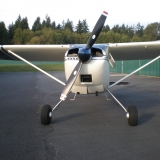
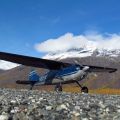
Can't compare a 180hp 170 to a 182, but I can compare my 180hp CS-equipped 172 to a 182, as I have about 450 hours or more in my airplane, another 800 or so in standard 172s, 700 or so in 182s, and a couple hundred in Mooneys and other airplanes. I've been told that the in-flight handling of a 172 is similar to a 170's, so this might be helpful.
As a load carrier, a 182 beats my airplane totally. Any 182 will handle 4 adults and reasonable baggage, and the older ones with smaller tanks can be filled to the brim. Newer ones might have to carry less than full tanks, because their empty weight is higher and their tank capacity is about 25 gallons greater. My airplane can handle 3 adults and full (52 gallons) tanks, and a little baggage.
Loaded the same, any 182 will outclimb my airplane at all altitudes, whether at Vx or Vy--roughly 2:3 (for instance, if mine is climbing at 400 fpm, the 182 is at 600 fpm). Especially at higher elevation airports, the climb rate of any 182 is noticeably better than my airplane's. Additionally, any 182 can carry a larger load to a higher altitude. With only 2 aboard and 3/4 tanks, I've had my airplane to 14,500' on a summer day; I've had a fully loaded 182 to 16,500' on a summer day.
My airplane burns 9.8 gph, or a little less, at cruise (21", 2400 rpm) at 8000', 115 knots. A 182 running the same MP/rpm at 8000' will be slightly over 130 knots, burning about 13.5+ gph. For flight plan purposes, those figures work out remarkably close. If you slow down the 182 to 115 knots, its fuel burn will be slightly over 10.5 gph. Of course, I've only known one pilot ever who did that routinely, because most of us take advantage of whatever speed we can get out of our machines.
A 182 is a lot more truck-like to handle than a 172. Older ones have lighter feeling controls than newer ones. I regularly flew a 1958 model for awhile, but most of my experience is in models built in the 1970s--the difference is very noticeable.
Cary