ACS Ground Reference Maneuvers
Wed May 20, 2020 9:36 am
Re: ACS Ground Reference Maneuvers
I never plan to go 70-90 degrees of bank in my aircraft. What would cause that much upset? Gusty wind? LLWS? Stalling the low wing?
- FFSchooley offline
- Posts: 30
- Joined: Mon Feb 03, 2020 3:00 pm
- Location: Martinez
- Aircraft: Piper PA-22 150
Wed May 20, 2020 12:49 pm
Re: ACS Ground Reference Maneuvers
Base to final in back seat of non-electrician L-2 Taylorcraft. Student up front didn't see twin on half mile final. When I picked him up rolling out of quarter mile base turn and student had started turn to quarter mile final, I continued to 90 degree bank to miss him. Actually to allow him to miss us. He never saw us.
From 1200' over loach in Vietnam, many turns to cover. We circled with Cobra at 40 knots. The 90-120 degree bank to roll in caused an unusually quick whamp whamp of the 540 rotor system to cause Charlie to take cover and quit firing on my low bird. Levelled, fired two or three pairs of rockets, and pulled up at treetop level with level tip path plane.
About three or four of my engine failures were to adjoining crop fields requiring energy management 90 degrees bank.
Steep banks with none or light back pressure will lose altitude quickly but not stall. Not for everybody, but the aircraft will continue to fly. Fly to target without stall and missing obstructions or other aircraft.
From 1200' over loach in Vietnam, many turns to cover. We circled with Cobra at 40 knots. The 90-120 degree bank to roll in caused an unusually quick whamp whamp of the 540 rotor system to cause Charlie to take cover and quit firing on my low bird. Levelled, fired two or three pairs of rockets, and pulled up at treetop level with level tip path plane.
About three or four of my engine failures were to adjoining crop fields requiring energy management 90 degrees bank.
Steep banks with none or light back pressure will lose altitude quickly but not stall. Not for everybody, but the aircraft will continue to fly. Fly to target without stall and missing obstructions or other aircraft.
- contactflying offline
- Posts: 4972
- Joined: Wed Apr 03, 2013 7:36 pm
- Location: Aurora, Missouri 2H2
Download my free "https://tinyurl.com/Safe-Maneuvering" e-book.
Wed May 20, 2020 1:13 pm
Re: ACS Ground Reference Maneuvers
FFS, unplanned 70-90 deg banks can happen closer to the ground than imagined.
~ 35 years ago I was sitting in my 172 on a one way airstrip getting ready to take off with a bit of a tailwind. I spotted a large low level heavy lift helicopter, that was not on 122.9, coming at me from a mile out. I cringed in anticipation of a upset while I was sitting on the ground. Nothing happened, not even a bounce. I waited for ~ 5 minutes regaining my composure and to ensure the event was over. It wasn't. The friend that had dropped me off at my airplane was waiting to see my departure and later described what happened. The helicopter pilot spent a few minutes making some maneuvers behind me and then made a high power climb over the mountain pass. The physics were right for the air disturbance created by the high power climb of the helicopter along with the tailwind to create severe turbulence / wind shear over the last half of the runway. I lost control of my airplane ~ 100 feet above the runway with flight controls that did not work. To this day, I believe that luck was on my side because I recovered with my wing being a few feet above the swamp that was adjacent to the runway.
~ 35 years ago I was sitting in my 172 on a one way airstrip getting ready to take off with a bit of a tailwind. I spotted a large low level heavy lift helicopter, that was not on 122.9, coming at me from a mile out. I cringed in anticipation of a upset while I was sitting on the ground. Nothing happened, not even a bounce. I waited for ~ 5 minutes regaining my composure and to ensure the event was over. It wasn't. The friend that had dropped me off at my airplane was waiting to see my departure and later described what happened. The helicopter pilot spent a few minutes making some maneuvers behind me and then made a high power climb over the mountain pass. The physics were right for the air disturbance created by the high power climb of the helicopter along with the tailwind to create severe turbulence / wind shear over the last half of the runway. I lost control of my airplane ~ 100 feet above the runway with flight controls that did not work. To this day, I believe that luck was on my side because I recovered with my wing being a few feet above the swamp that was adjacent to the runway.
Wed May 20, 2020 1:27 pm
Re: ACS Ground Reference Maneuvers
I just watched motoadve's video on difficult strips. Going into crooked river ingress, he uses whatever bank is necessary to miss trees on each bank. Coming out of crooked river egress, he uses as much rudder as necessary to miss trees on each bank. He neither attempts to outclimb terrain and stall nor does he overbank and put a wing into the river.
On the flight test, you will not be landing and taking off on gravel bars. You will have a radio to help with the twin on final. The radio will not guaranteed he will not be there. If necessary to prevent collision, bank 90 degrees and allow the nose to go down naturally. The airplane will not stall and I am confident you will level the wing and pull up before flying into the ground.
Dogday's experience is possible with helicopter or even wind devil or whirlwind. Stuff happens.
On the flight test, you will not be landing and taking off on gravel bars. You will have a radio to help with the twin on final. The radio will not guaranteed he will not be there. If necessary to prevent collision, bank 90 degrees and allow the nose to go down naturally. The airplane will not stall and I am confident you will level the wing and pull up before flying into the ground.
Dogday's experience is possible with helicopter or even wind devil or whirlwind. Stuff happens.
- contactflying offline
- Posts: 4972
- Joined: Wed Apr 03, 2013 7:36 pm
- Location: Aurora, Missouri 2H2
Download my free "https://tinyurl.com/Safe-Maneuvering" e-book.
Wed May 20, 2020 1:40 pm
Re: ACS Ground Reference Maneuvers
My normal canyon turn involves a 70+ degree back. Put the bank in early you can take it out if needed. Letting the nose drop makes it a non event. As noted in other posts this is not training for you PPL (it should be, but it is not) Just more advanced knowledge once you get your license to learn.
DENNY
DENNY
DENNY
Wed May 20, 2020 3:55 pm
Re: ACS Ground Reference Maneuvers
Ah, I see! Makes sense. Awesome replies! Thank you all so much. I love learning this stuff
- FFSchooley offline
- Posts: 30
- Joined: Mon Feb 03, 2020 3:00 pm
- Location: Martinez
- Aircraft: Piper PA-22 150
Wed May 20, 2020 4:11 pm
Re: ACS Ground Reference Maneuvers
And here is the result of high altitude orientation without equal amount of low altitude orientation. Because indoctrination and primacy of techniques is totally level, climbing, and descending turns of limited bank with back pressure on the stick to replace lift lost to bank, nowhere near full rudder is ever needed or experienced. As Denny points out, in turns to target with limited horizontal and limited vertical space available, it is safer to get much of turn in early. Late need of more bank to get around, to miss obstructions, is upsetting. Not good.
We need to overturn initially in tight spaces and we need to acquire heavy rudder muscle memory. In teaching the energy management turn to crop duster students, the absolute most common error was insufficient rudder. With limited horizontal and vertical space available, we cannot accept the slow rate of turn caused by slipping. Push that nose around with rudder, lots of rudder. Nobody skids and with the nose going down naturally, there is absolutely no problem with skidding.
We need to overturn initially in tight spaces and we need to acquire heavy rudder muscle memory. In teaching the energy management turn to crop duster students, the absolute most common error was insufficient rudder. With limited horizontal and vertical space available, we cannot accept the slow rate of turn caused by slipping. Push that nose around with rudder, lots of rudder. Nobody skids and with the nose going down naturally, there is absolutely no problem with skidding.
- contactflying offline
- Posts: 4972
- Joined: Wed Apr 03, 2013 7:36 pm
- Location: Aurora, Missouri 2H2
Download my free "https://tinyurl.com/Safe-Maneuvering" e-book.
Thu May 21, 2020 8:27 pm
Re: ACS Ground Reference Maneuvers
Contactflying, went back up with our last writings in mind. Found that rudder was what was missing in previous attempts in energy management turns. Not that I didn’t use any, but that I didn’t use enough! And when you say use plenty - that’s what you mean!! Thanks again for being patient enough to keep explaining what you mean. Some of us just need to hear things differently! And more than once. Thanks to other respondents as well for providing the ‘differently’. Ken
Thu May 21, 2020 9:33 pm
Re: ACS Ground Reference Maneuvers
Hang in there Ken. When the nose is moving enough for the angle of bank, it feels and sounds right. The look, on near targets requiring steep bank with lots of rudder, is different until practiced. There is no horizon out there...just earth.
- contactflying offline
- Posts: 4972
- Joined: Wed Apr 03, 2013 7:36 pm
- Location: Aurora, Missouri 2H2
Download my free "https://tinyurl.com/Safe-Maneuvering" e-book.
Sun Sep 27, 2020 3:36 am
Re: ACS Ground Reference Maneuvers
This thread evolved to mostly energy management turn concepts, which is fine. Concerning ground reference maneuvers and wind management, thinking about using a downwind of target approach to target might help. The problem with turn about a point is that this maneuver is the most dangerous and least effective way to engage a target either for observation or with the purpose of overflying that target. When trying to safely look things over, approach the target by turning onto it from a downwind downwind. Use the energy management turn to take full advantage of the reduced airspeed of pulling up wings level first and the reduced groundspeed of an upwind approach to target. In order to do this we must anticipate the need to turn to that target so as to have time to pitch up wings level more for a steep turn or less for a shallow turn to target.
It is obvious why most pilots would buzz or observe friends from a turn about a point kind of maneuver. This, however, is the most dangerous, most fatal way to do visual reconnaissance.
Wind management in the field and around the airport, or anywhere, is all about groundspeed control. Use the wind, the more of it the better, to make maneuvering the airplane easier and more effective. With common winds in the mountains in the heat of day, an energy management canyon turn using wind management as well as the law of the roller coaster should be easily accomplished at zero diameter of turn. Pitching up to Vy prior to turn while allowing the nose to go down naturally into 20 knots of crosswind will result our ability to stay over the middle of the canyon the entire time in small airplanes.
Wind management takes prior planning in order to be downwind of target and to have time for the pitch up, if airspeed is high, in the beginning of the turn to target. Position controls groundspeed and pitch controls airspeed. We gunnieys love that increased time on target. And remember to fall off the target downwind so as to be in position to return to target upwind.
It is obvious why most pilots would buzz or observe friends from a turn about a point kind of maneuver. This, however, is the most dangerous, most fatal way to do visual reconnaissance.
Wind management in the field and around the airport, or anywhere, is all about groundspeed control. Use the wind, the more of it the better, to make maneuvering the airplane easier and more effective. With common winds in the mountains in the heat of day, an energy management canyon turn using wind management as well as the law of the roller coaster should be easily accomplished at zero diameter of turn. Pitching up to Vy prior to turn while allowing the nose to go down naturally into 20 knots of crosswind will result our ability to stay over the middle of the canyon the entire time in small airplanes.
Wind management takes prior planning in order to be downwind of target and to have time for the pitch up, if airspeed is high, in the beginning of the turn to target. Position controls groundspeed and pitch controls airspeed. We gunnieys love that increased time on target. And remember to fall off the target downwind so as to be in position to return to target upwind.
- contactflying offline
- Posts: 4972
- Joined: Wed Apr 03, 2013 7:36 pm
- Location: Aurora, Missouri 2H2
Download my free "https://tinyurl.com/Safe-Maneuvering" e-book.
Tue Sep 29, 2020 12:59 am
Re: ACS Ground Reference Maneuvers
Instructors, every student should be given the opportunity to see and even fly the airplane at zero groundspeed at altitude with headwind greater than Vso and at six inches over a long runway with headwind greater than the airspeed at which the airplane will stall in low ground effect.
Over the runway using hover taxi technique is a bit more difficult but much more vivid and infectious. Regardless of whether teaching the apparent rate of closure approach technique or the round out and hold off technique, just before touchdown add a bit of power to prevent touchdown and manipulate the elevator dynamically and proactively enough to maintain six inches above the runway. Manipulation of the elevator is necessary because power is too slow to catch gust or elevator error changes to airspeed and altitude + or - six inches. Power will have to be reduced, however, to transition from hover taxi with some forward groundspeed to zero groundspeed at six inch hover. This is actually easier from the deceleration of the apparent brisk walk rate of closure approach because both pitch to decelerate and power to control descent rate is already there and very slow groundspeed is quite normal in headwind components. Slow groundspeed should be normal at the end of the long hold off (of the round out and hold off technique,) but pilots often allow touchdown earlier than the airspeed at which the wing will stall in low ground effect.
As with any low airspeed maneuver, rudder to bracket the centerline and thus both keep the airplane moving the same direction as the longitudinal axis is pointed and keep the wing level is critical. Yes, in a crosswind the wing will be banked but stable at that bank. Getting pilots to use the rudder properly is actually easier in a sideslip to touchdown. In this hover taxi maneuver, it is fine to crab. In the crab, however, the rudder is still the control that keeps the wing level most efficiently. Aileron is a messy control ant any airspeed (adverse yaw) and pretty much a useless control at very slow airspeed.
Over the runway using hover taxi technique is a bit more difficult but much more vivid and infectious. Regardless of whether teaching the apparent rate of closure approach technique or the round out and hold off technique, just before touchdown add a bit of power to prevent touchdown and manipulate the elevator dynamically and proactively enough to maintain six inches above the runway. Manipulation of the elevator is necessary because power is too slow to catch gust or elevator error changes to airspeed and altitude + or - six inches. Power will have to be reduced, however, to transition from hover taxi with some forward groundspeed to zero groundspeed at six inch hover. This is actually easier from the deceleration of the apparent brisk walk rate of closure approach because both pitch to decelerate and power to control descent rate is already there and very slow groundspeed is quite normal in headwind components. Slow groundspeed should be normal at the end of the long hold off (of the round out and hold off technique,) but pilots often allow touchdown earlier than the airspeed at which the wing will stall in low ground effect.
As with any low airspeed maneuver, rudder to bracket the centerline and thus both keep the airplane moving the same direction as the longitudinal axis is pointed and keep the wing level is critical. Yes, in a crosswind the wing will be banked but stable at that bank. Getting pilots to use the rudder properly is actually easier in a sideslip to touchdown. In this hover taxi maneuver, it is fine to crab. In the crab, however, the rudder is still the control that keeps the wing level most efficiently. Aileron is a messy control ant any airspeed (adverse yaw) and pretty much a useless control at very slow airspeed.
- contactflying offline
- Posts: 4972
- Joined: Wed Apr 03, 2013 7:36 pm
- Location: Aurora, Missouri 2H2
Download my free "https://tinyurl.com/Safe-Maneuvering" e-book.
Thu Oct 01, 2020 10:24 am
Re: ACS Ground Reference Maneuvers
contactflying wrote:.... an energy management canyon turn using wind management as well as the law of the roller coaster should be easily accomplished at zero diameter of turn....
"Zero diameter of turn"...another new term!
And "the law of the roller coaster"!
It's a two-fer!

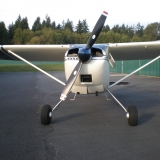
Cessna Skywagon -- accept no substitute!
Thu Oct 01, 2020 11:51 am
Re: ACS Ground Reference Maneuvers
Zero diameter of turn = turn back (like reversing course in a canyon) while remaining over the same spot because of turning into a strong crosswind.
"The Law of the Roller Coaster." Chapter 5 "Stick and Rudder." page 79. It is a really good explanation of the physics behind "airspeed is altitude and altitude is airspeed," also a Wolfgang Langewiesche idea and terms. If we have too much airspeed to make the canyon turnaround without hitting the other side we can pitch up wings level before turning at whatever bank will prevent hitting the other side while allowing the nose to go down naturally to prevent load factor. Pitch up, bank and release back pressure, dive toward bottom of canyon going the other way, pull up wings level.
These "Stick and Rudder" terms are unfamiliar today because while many have the book on their bookshelf, they don't read it. It is the aerodynamic basis of everything I teach.
Thanks for your comment, Hotrod 180. I can count on you.
"The Law of the Roller Coaster." Chapter 5 "Stick and Rudder." page 79. It is a really good explanation of the physics behind "airspeed is altitude and altitude is airspeed," also a Wolfgang Langewiesche idea and terms. If we have too much airspeed to make the canyon turnaround without hitting the other side we can pitch up wings level before turning at whatever bank will prevent hitting the other side while allowing the nose to go down naturally to prevent load factor. Pitch up, bank and release back pressure, dive toward bottom of canyon going the other way, pull up wings level.
These "Stick and Rudder" terms are unfamiliar today because while many have the book on their bookshelf, they don't read it. It is the aerodynamic basis of everything I teach.
Thanks for your comment, Hotrod 180. I can count on you.
- contactflying offline
- Posts: 4972
- Joined: Wed Apr 03, 2013 7:36 pm
- Location: Aurora, Missouri 2H2
Download my free "https://tinyurl.com/Safe-Maneuvering" e-book.
Thu Oct 01, 2020 12:09 pm
Re: ACS Ground Reference Maneuvers
contactflying wrote: Thanks for your comment, Hotrod 180. I can count on you.
LIkewise.
Cessna Skywagon -- accept no substitute!
DISPLAY OPTIONS
Who is online
Users browsing this forum: No registered users and 1 guest
Latest Features
-
-
Featured Bush Planes
As one of the undisputed legends of bush flying, the Cessna 180 hauls a…Read More -
Aircraft Ownership and Maintenance
9 modification mistakes aircraft owners make when trying to "bush out" their birds—why some…Read More -
Live to Tell
A Minnesota pilot is surprised to learn that the sudden asymmetric drag of an…Read More


Latest Knowledge Base
-
Destinations
Canada offers some of the most spectacular backcountry flying on the continent. Here's what you need to know before you go.Read More -
Safety and Survival
Hope that you never have to use your survival vest but knowing you have it and knowing how to use…Read More -
Destinations
A regional guide with ideas for winter camping destinations in California, Nevada, New Mexico, and Arizona.Read More -
Aircraft
Finding an affordable aircraft that can handle the backcountry for $80K or less? A challenge for sure, but with the…Read More