Air-Ground
Air-Ground! Air-Ground! Air-Ground! Bomber Command, and later Strategic Air Command didn't like to admit there was a ground. They wanted to “Aim High”er than that and didn't want any part of the “blood, sweat, and tears” Winston Churchill had to offer. It didn't seem proper, to them, to “reach out and touch the face of God” from low level. When I attended USAF Air Ground School in Heidelberg, FRG, most of the students were Army, Marine, and Allies. That (higher is better) concept has certainly transferred to civilian flight training, where no maneuvering flight training is offered. Rather it is deemed taboo.
Pitch attitude, gravity thrust, engine thrust, adverse yaw, forward and side slips, wings level rudder turns, energy management turns to target, ground effect, thermal and orographic lift, wind management, load factor, knowledge of which way is down hill, weight and balance, leaning, density altitude, slope, obstructions, crooked takeoff and crooked approach paths, section lines, topography, rudder usage, and a multitude of things become extra important when near terrain. Here we must fly by contact reference to the terrain while severely limiting or eliminating reference to any instruments.
Considering steep and/or crooked approach and departure paths to high mountain airports and landing zones, many of the above factors come into play. On a steep approach, we may have enough terrain clearance to use normal techniques. On a steep approach down a steep hill, like Ruidoso, NM used to be, making normal balanced turns could put a wing into the steep hill. Slope, ground effect, leaning to max rpm, down drainage departure, rudder turns on final, and natural energy can become extremely important in high density altitude and/or short and irregular field operations.
Because most fatalities, in our end of aviation, result from falling (not flying) to the ground, energy management, rather than normal level, turns increase safety significantly. Because cartwheeling is very dangerous, there are situations where rudder turns while holding the wing level with aileron increase safety.
Flying high is safer than flying low. Maneuvering flight is taboo. With the piles I flew in the mountains, flying high was 90% out of reach with the fuel I had available.
Air-Ground
Wed Apr 06, 2016 8:23 am
- contactflying offline
- Posts: 4972
- Joined: Wed Apr 03, 2013 7:36 pm
- Location: Aurora, Missouri 2H2
Download my free "https://tinyurl.com/Safe-Maneuvering" e-book.
Wed Apr 06, 2016 9:15 am
Re: Air-Ground
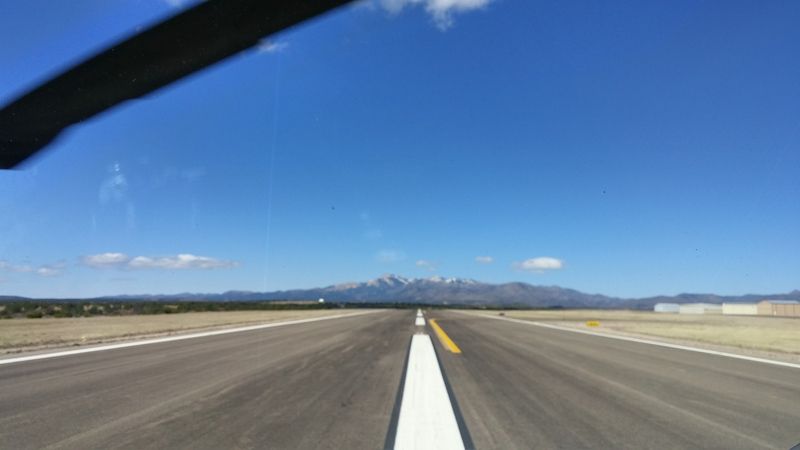
Ruidoso last week:
- CamTom12 offline

- Posts: 3705
- Joined: Sun Jul 08, 2012 1:08 pm
- Location: Huntsville
- FindMeSpot URL: https://share.delorme.com/camtom12
- Aircraft: Ruppe Racer
Experimental Pacer
home hand jam "wizard"
Wed Apr 06, 2016 9:42 am
Re: Air-Ground
Cam,
Thanks for the picture of the Apache homeland. I have a T-shirt with the famous picture of Geronimo and the boys with their rifles. The caption says, "Homeland Security."
The old airport was just north of the main tourist part of town in the canyon south of tower 7760 where is says street patterns now. Tower 7760 was not there but the steep mountain was. If you didn't stay about 50' AGL approaching south down drainage, you would miss the displaced threshold. There wasn't a lot of runway beyond the displaced threshold, so I just got really low going down the mountain and landed on the very beginning of the pavement. The displaced markings were not there originally anyway. Landing to the north was a one way deal, but the wind came down north very hard from White Mountain (Sierra Blanca) 11973 most of the time anyway.
I ran into Dale Roberson, host of "Death Valley Days" at the time, at the airport there. I was flying a Tri-Pacer. He was flying a Bananza. Both would come down the mountain in a really steep descent really well. Just had to get lined up with rudder and not put a wing into the ground.
Thanks for the picture of the Apache homeland. I have a T-shirt with the famous picture of Geronimo and the boys with their rifles. The caption says, "Homeland Security."
The old airport was just north of the main tourist part of town in the canyon south of tower 7760 where is says street patterns now. Tower 7760 was not there but the steep mountain was. If you didn't stay about 50' AGL approaching south down drainage, you would miss the displaced threshold. There wasn't a lot of runway beyond the displaced threshold, so I just got really low going down the mountain and landed on the very beginning of the pavement. The displaced markings were not there originally anyway. Landing to the north was a one way deal, but the wind came down north very hard from White Mountain (Sierra Blanca) 11973 most of the time anyway.
I ran into Dale Roberson, host of "Death Valley Days" at the time, at the airport there. I was flying a Tri-Pacer. He was flying a Bananza. Both would come down the mountain in a really steep descent really well. Just had to get lined up with rudder and not put a wing into the ground.
- contactflying offline
- Posts: 4972
- Joined: Wed Apr 03, 2013 7:36 pm
- Location: Aurora, Missouri 2H2
Download my free "https://tinyurl.com/Safe-Maneuvering" e-book.
Wed Apr 06, 2016 12:54 pm
Re: Air-Ground
I thought that Ronald Reagan hosted "Death Valley Days". Oh where has my memory gone....
Ok, it was hosted by Robert Taylor, Ronald Reagan, and Dale Robertson....in turn, with Robert Taylor catching the duties the most often. Taylor did it 78 times, Reagan 52 times and Robertson 26 times.
Most of you whippersnappers don't know what we're talking about do you?
Ok, it was hosted by Robert Taylor, Ronald Reagan, and Dale Robertson....in turn, with Robert Taylor catching the duties the most often. Taylor did it 78 times, Reagan 52 times and Robertson 26 times.
Most of you whippersnappers don't know what we're talking about do you?
Wed Apr 06, 2016 2:20 pm
Re: Air-Ground
20 Mule Team Borax!
- 48RagwingPilot offline
- Posts: 140
- Joined: Tue Dec 19, 2006 12:27 am
Wed Apr 06, 2016 3:53 pm
Re: Air-Ground
Not a flipping clue, but it sounds like an old silent cliffhanger series. https://www.youtube.com/watch?v=XXQyqFLLNv0
- Headoutdaplane offline
- Posts: 526
- Joined: Thu May 29, 2008 5:21 pm
- Location: Homer, AK
The winner is the person with the most stories when he dies, not the most gold.
www.belugaair.com
www.belugaair.com
DISPLAY OPTIONS
Who is online
Users browsing this forum: No registered users and 3 guests
Latest Features
-
-
Featured Bush Planes
As one of the undisputed legends of bush flying, the Cessna 180 hauls a…Read More -
Aircraft Ownership and Maintenance
9 modification mistakes aircraft owners make when trying to "bush out" their birds—why some…Read More -
Live to Tell
A Minnesota pilot is surprised to learn that the sudden asymmetric drag of an…Read More




Latest Knowledge Base
-
Destinations
Canada offers some of the most spectacular backcountry flying on the continent. Here's what you need to know before you go.Read More -
Safety and Survival
Hope that you never have to use your survival vest but knowing you have it and knowing how to use…Read More -
Destinations
A regional guide with ideas for winter camping destinations in California, Nevada, New Mexico, and Arizona.Read More -
Aircraft
Finding an affordable aircraft that can handle the backcountry for $80K or less? A challenge for sure, but with the…Read More



