Just a question regarding public access. Does anyone know the specific Idaho statute or legal clause allowing for public access to Idaho lands up to the "high water mark"? This law has been around forever and varies state to state. Oregon State for example does not have this provision. I believe it is a statute in Part 36 of the Idaho Code pretaining to the Fish & Game dept. The Limitation of Landowner Liablity listed below however a great document does not apply to the publics access to lands up to the "normal high water mark".
Thanks,
James
- Code: Select all
The states own these rivers up to the "ordinary high water mark."the mark that people can actually see on the ground, where the high water has left debris, sand, and gravel during its ordinary annual cycle. (Not during unusual flooding.) It is not a theoretical line requiring engineering calculations. Where the river banks are fairly flat, this mark can be quite a distance from the edge of the water during medium water flows. There is often plenty of room for standing, fishing, camping, and other visits.
States cannot sell or give away these rivers and lands up to the ordinary high water mark. Under the "Public Trust Doctrine," they must hold them in perpetuity for public use.
The three public uses that the courts have traditionally mentioned are navigation, fishing, and commerce. But the courts have ruled that any and all non-destructive activities on these land are legally protected, including picnics, camping, walking, and other activities. The public can fish, from the river or from the shore below the "ordinary high water mark." (Note that the fish and wildlife are owned by the state in any case.) The public can walk, roll a baby carriage, and other activities, according to court decisions.
States do have authority and latitude in the way they manage rivers, but their management must protect the public uses mentioned above. They can (and must) prohibit or restrict activities that conflict with the Public Trust Doctrine. "Responsible recreation" must be allowed, but activities that could be harmful, such as building fires, leaving trash, and making noise, can legally be limited, or prohibited, in various areas. Motorized trips and commercial trips can legally be limited or prohibited by state governments.
State and local restrictions on use of navigable rivers have to be legitimately related to enhancing public trust value, not reducing it. Rivers cannot be closed or partially closed to appease adjacent landowners, or to appease people who want to dedicate the river to fishing only, or to make life easier for local law enforcement agencies.
State governments (through state courts and legislatures) cannot reduce public rights to navigate and visit navigable rivers within their borders, but they can expand those rights, and some states have done so. They can create a floatage easement, a public right to navigate even on rivers that might not qualify for state ownership for some reason, even if it is assumed that the bed and banks of the river are private land. Note that this floatage easement is a matter of state law that varies from state to state, but the question of whether a river is navigable, for title purposes, and therefore owned by the state, is a matter of federal law, and does not vary from state to state. Note that a state floatage easement is something that comes and goes with the water: When the water is there, people have a right to be there on it, and when it dries up, people have no right to be there. But rivers that are navigable for title purposes are public land up to the ordinary high water mark, so that even when the river runs dry, people still have the right to walk along the bed of the river
2005 Idaho Code - 36-1604 — LIMITATION OF LIABILITY OF LANDOWNER
Share | TITLE 36
FISH AND GAME
CHAPTER 16
RECREATIONAL TRESPASS -- LANDHOLDER LIABILITY LIMITED
36-1604. LIMITATION OF LIABILITY OF LANDOWNER. (a) Statement of Purpose.
The purpose of this section is to encourage owners of land to make land,
airstrips and water areas available to the public without charge for
recreational purposes by limiting their liability toward persons entering
thereon for such purposes.
(b) Definitions. As used in this section:
1. "Airstrips" means either improved or unimproved landing areas used by
pilots to land, park, take off, unload, load and taxi aircraft. Airstrips
shall not include landing areas which are or may become eligible to
receive federal funding pursuant to the federal airport and airway
improvement act of 1982 and subsequent amendments thereto.
2. "Land" means private or public land, roads, airstrips, trails, water,
watercourses, irrigation dams, water control structures, headgates,
private or public ways and buildings, structures, and machinery or
equipment when attached to or used on the realty.
3. "Owner" means the possessor of a fee interest, a tenant, lessee,
occupant or person in control of the premises.
4. "Recreational purposes" includes, but is not limited to, any of the
following activities or any combination thereof: hunting, fishing,
swimming, boating, rafting, tubing, camping, picnicking, hiking, pleasure
driving, the flying of aircraft, bicycling, running, playing on playground
equipment, skateboarding, athletic competition, nature study, water
skiing, animal riding, motorcycling, snowmobiling, recreational vehicles,
winter sports, and viewing or enjoying historical, archeological, scenic,
geological or scientific sites, when done without charge of the owner.
(c) Owner Exempt from Warning. An owner of land owes no duty of care to
keep the premises safe for entry by others for recreational purposes, or to
give any warning of a dangerous condition, use, structure, or activity on such
premises to persons entering for such purposes. Neither the installation of a
sign or other form of warning of a dangerous condition, use, structure, or
activity, nor any modification made for the purpose of improving the safety of
others, nor the failure to maintain or keep in place any sign, other form of
warning, or modification made to improve safety, shall create liability on the
part of an owner of land where there is no other basis for such liability.
(d) Owner Assumes No Liability. An owner of land or equipment who either
directly or indirectly invites or permits without charge any person to use
such property for recreational purposes does not thereby:
1. Extend any assurance that the premises are safe for any purpose.
2. Confer upon such person the legal status of an invitee or licensee to
whom a duty of care is owed.
3. Assume responsibility for or incur liability for any injury to person
or property caused by an act of omission of such persons.
(e) Provisions Apply to Leased Public Land. Unless otherwise agreed in
writing, the provisions of this section shall be deemed applicable to the
duties and liability of an owner of land leased to the state or any
subdivision thereof for recreational purposes.
(f) Provisions Apply to Land Subject to a Conservation Easement. Unless
otherwise agreed in writing, the provisions of this section shall be deemed
applicable to the duties and liability of an owner of land subject to a
conservation easement to any governmental entity or nonprofit organization.
(g) Owner Not Required to Keep Land Safe. Nothing in this section shall
be construed to:
1. Create a duty of care or ground of liability for injury to persons or
property.
2. Relieve any person using the land of another for recreational purposes
from any obligation which he may have in the absence of this section to
exercise care in his use of such land and in his activities thereon, or
from legal consequences or failure to employ such care.
3. Apply to any person or persons who for compensation permit the land to
be used for recreational purposes.
(h) User Liable for Damages. Any person using the land of another for
recreational purposes, with or without permission, shall be liable for any
damage to property, livestock or crops which he may cause while on said
property.
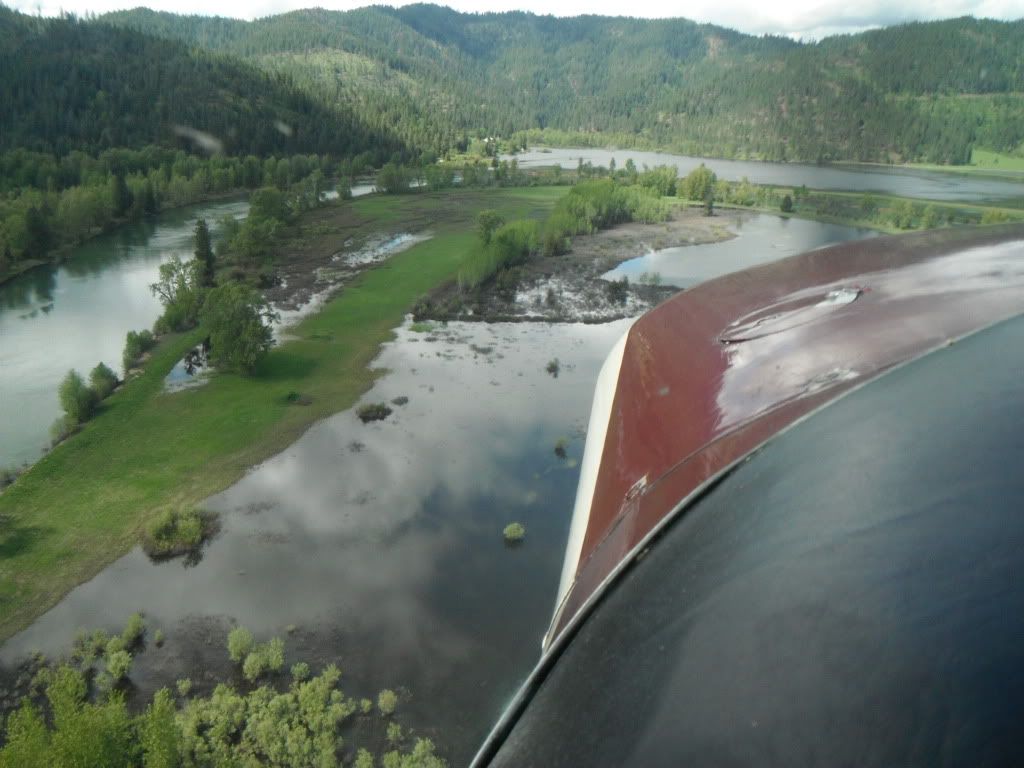
 Followed the Snake for 80 miles or so on the way back, my favorite way to spend a Sunday morning!


