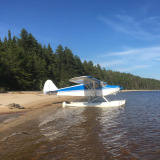
Saw this in a news article. Can't figure out what kind of airplane is in the photo. Seems to have a Champ-like fuselage with cub like gear but the wings seem different...
Here is the photo: https://i.cbc.ca/1.4982888.1547768519!/ ... escued.jpg
here is the article: https://www.cbc.ca/news/canada/manitoba ... -1.4981683
Anyone familiar with this type?
Any one know what kind of plane this is?
Sun Jan 20, 2019 10:15 pm
Any one know what kind of plane this is?
Last edited by map on Mon Jan 21, 2019 10:16 pm, edited 2 times in total.
Sun Jan 20, 2019 10:52 pm
Re: Any know what kind of plane this is?
Looks like a Taylorcraft L-2 maybe?
Mon Jan 21, 2019 1:33 am
Re: Any know what kind of plane this is?
WWII liaison Taylorcraft or some combo of airframes with Taylorcraft wings. Looks nice and in good condition. Modified per Canadian regs note 4-pipe exhaust and covered rear fuselage. One pull and a pop but no start? Depending on carb, primer, idle mixture setting for winter, or magneto timing and impulse magneto setup they can be finicky as far as air and fuel. They flood easy and need to be primed at the cylinder not the induction spider upstream of the carb. I carried spray starting fluid for my PA-11 as it makes the process of determining best air/fuel ratio simpler. Add a shot of fluid and see if it pops. If not then back up prop to clear cylinders of fuel and start over.
Gary
Gary
Mon Jan 21, 2019 9:28 am
Re: Any know what kind of plane this is?
I would say 1943 (..ish) L-2M with modified exhaust and observer glass removed. A number of these airplanes had a turtleback added during a rebuild/recover after entering the civil fleet. Also notice the jury strut has a back piece added.
(I used to fly one, loved it.)


(I used to fly one, loved it.)
Mon Jan 21, 2019 10:42 am
Re: Any know what kind of plane this is?
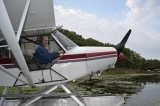
1942 DCO65 / L2. Call sign is C-GCER.

Mon Jan 21, 2019 1:51 pm
Re: Any know what kind of plane this is?
One caution about his admittedly "finicky" to start engine (view the CBC article and video above) is that they can cool off quickly on descent and landing. If the carb heat is kept off then cold (like potentially real cold given the location in January) can chill down the intake system during the descent and taxi. It'll continue to cool as cold air from the lower cowl replaces warm air exiting the cowl intakes.
Then during restart if the priming fuel comes from below the cylinders (sourced from the carb or typical induction spider primer port), the fuel can condense out on the cold metal and leave the incoming air/fuel mixture too lean for combustion. Alternatively too much priming fuel may not vaporize and cause a too rich mixture. There's an air/fuel balance that's not easy to achieve.
Not sure what he did when adding fuel and receiving himself but I found with my small Continentals that covering the engine would help rewarm the parts and make a warm engine start procedure easier.
So if he spent an hour+ fussing with it then maybe something needs to be adjusted or dual impulse mags installed if not already. Hard to tell what happened tho.
I spent 45 minutes at +30*F trying to cold start my C90-8F in a PA-11 - once. Next trip to town I had the mechanic move the primer outlets to the cylinders which helped.
The location of his adventure: https://www.google.com/maps/@52.6644843 ... a=!3m1!1e3
Gary
Then during restart if the priming fuel comes from below the cylinders (sourced from the carb or typical induction spider primer port), the fuel can condense out on the cold metal and leave the incoming air/fuel mixture too lean for combustion. Alternatively too much priming fuel may not vaporize and cause a too rich mixture. There's an air/fuel balance that's not easy to achieve.
Not sure what he did when adding fuel and receiving himself but I found with my small Continentals that covering the engine would help rewarm the parts and make a warm engine start procedure easier.
So if he spent an hour+ fussing with it then maybe something needs to be adjusted or dual impulse mags installed if not already. Hard to tell what happened tho.
I spent 45 minutes at +30*F trying to cold start my C90-8F in a PA-11 - once. Next trip to town I had the mechanic move the primer outlets to the cylinders which helped.
The location of his adventure: https://www.google.com/maps/@52.6644843 ... a=!3m1!1e3
Gary
Tue Jan 22, 2019 10:33 am
Re: Any one know what kind of plane this is?
I just saw an 85-8 on a Commonwealth that had primer lines to the cylinders.
First 4 banger Continental that I've ever seen that didn't prime down below.
First 4 banger Continental that I've ever seen that didn't prime down below.
Cessna Skywagon -- accept no substitute!
Tue Jan 22, 2019 11:30 am
Re: Any one know what kind of plane this is?
Primer ports over the intake valve may be a recent development. Not sure if all cylinders have them but if tapped and plugged it's an easy job to plumb in upper lines to 2-4 cylinders.
The problem with a lower induction spider port or carb accelerator pump is by the time the hand prop gets flipped the fuel drains down and if cold may not vaporize. I found that if I set my throttle to give 650-700 rpm at idle hand propping became easier. Too slow and there's not enough airflow and crank momentum to move to fire the next cylinder.
I'll never own another -8 Continental and expect to fly in real cold. Starters (even if only a battery and no charging) have their place.
Gary
The problem with a lower induction spider port or carb accelerator pump is by the time the hand prop gets flipped the fuel drains down and if cold may not vaporize. I found that if I set my throttle to give 650-700 rpm at idle hand propping became easier. Too slow and there's not enough airflow and crank momentum to move to fire the next cylinder.
I'll never own another -8 Continental and expect to fly in real cold. Starters (even if only a battery and no charging) have their place.
Gary
Tue Jan 22, 2019 12:35 pm
Re: Any one know what kind of plane this is?
When it's cold and I stop to pee out in the bush, I just leave the plane running. Why tempt fate?
That said, little Continentals can be pretty finicky to start when cold, no doubt. Cylinder mounted primer lines and a Marvel carb help with that.
They flood REALLY easy when "warm" (defined in my book as having been run in the last hour or so). With the C-90s I've run, if the engine was run in the last hour or so, I first try starting with just the throttle cracked, and NO prime. And, don't move that throttle fast. If the engine has been shut down for some time, like overnight, I prime between 3 and 4 strokes of prime and crack the throttle.
But, as Gary noted, it's important to get these things set up near perfect and learn what YOUR engine likes if you're hand propping.
MTV
That said, little Continentals can be pretty finicky to start when cold, no doubt. Cylinder mounted primer lines and a Marvel carb help with that.
They flood REALLY easy when "warm" (defined in my book as having been run in the last hour or so). With the C-90s I've run, if the engine was run in the last hour or so, I first try starting with just the throttle cracked, and NO prime. And, don't move that throttle fast. If the engine has been shut down for some time, like overnight, I prime between 3 and 4 strokes of prime and crack the throttle.
But, as Gary noted, it's important to get these things set up near perfect and learn what YOUR engine likes if you're hand propping.
MTV


Tue Jan 22, 2019 1:30 pm
Re: Any one know what kind of plane this is?
Many small Continental 65, 75, 85, and 90 HP engines I flew had no primer and Stromberg carburetor. I pulled through cold until I heard wet gurgle or saw gas dripping from carburetor. Like MTV said, throttle setting is critical. None or just cracked when cold and butterfly open enough to get some air when hot. Yes, stand by door and pee toward tail with engine running. Real cold, lower 48 cold not Alaska, required heating engine first. Primer helped when cold, but I usually got too much.
- contactflying offline
- Posts: 4972
- Joined: Wed Apr 03, 2013 7:36 pm
- Location: Aurora, Missouri 2H2
Download my free "https://tinyurl.com/Safe-Maneuvering" e-book.
Tue Jan 22, 2019 2:11 pm
Re: Any one know what kind of plane this is?
The other challenge with these small Continentals is their low compression ratios. Air-fuel-compression-ignition all combine to create fire in the cylinders. Fire makes heat and increases air pressure which pushes the piston down and rotates the crankshaft. The A-65 and C-85's are 6.3:1 and that increases to 7:1 in the C-90 and O-200. Small Lycomings generally range from 7-8.5:1. It takes good compression to create fire. A proper air/fuel ratio (not to rich or lean in the cylinder) and a retarded ignition timing via an impulse coupling in one or both magnetos help as well.
If there's any cylinder leak down due to piston ring or valve seal the effective compression ratio can be lower. If we install a compression gauge in a cylinder and start cranking the engine one test is to see how quickly the pressure rises. If it takes a few compression cycles to max out the reading imagine how many flips of the prop it'll take to do the same.
That's one reason electric starters help starting by quickly bringing up compression needed especially on a worn engine. They also overcome internal friction from cold oil easier than doing it by hand.
Gary
If there's any cylinder leak down due to piston ring or valve seal the effective compression ratio can be lower. If we install a compression gauge in a cylinder and start cranking the engine one test is to see how quickly the pressure rises. If it takes a few compression cycles to max out the reading imagine how many flips of the prop it'll take to do the same.
That's one reason electric starters help starting by quickly bringing up compression needed especially on a worn engine. They also overcome internal friction from cold oil easier than doing it by hand.
Gary
Wed Jan 23, 2019 10:35 am
Re: Any one know what kind of plane this is?
PA1195 wrote:...and a retarded ignition timing via an impulse coupling in one or both magnetos help as well. ...
A combination of non-impulse mags and a light wood prop isoften found on the small Continentals,
that can really make for hard starting- esp when warm.
The light prop often doesn't have enough inertia to overcome cylinder compression and rotate through the firing stroke-
they'll kick back instead.
This lack of inertia kickback phenomenon has also reared it's ugly head with some lightweight starter / lightweight prop combinations on bigger Continentals, sometimes resulting in damage to the starter or starter drive.
Cessna Skywagon -- accept no substitute!
Wed Jan 23, 2019 11:52 am
Re: Any one know what kind of plane this is?
Here's an oral interview: https://www.cbc.ca/player/play/1427736643573
He's an interesting fellow. I would like to have a visit with him over tea and learn something about flying that country. He likely has some good stories and now a recommendation for what to do next time he goes.
Gary
He's an interesting fellow. I would like to have a visit with him over tea and learn something about flying that country. He likely has some good stories and now a recommendation for what to do next time he goes.
Gary
Sat Jan 26, 2019 10:22 pm
Re: Any one know what kind of plane this is?
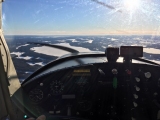
Another instance of aviation being a small world. I was put in touch with Hap from the article a few weeks ago, through a mutual pilot friend. I ended up buying some tires from him and told him I'd like to see some pictures of his tandem t-craft. Didn't think I'd see it on the news....
Sun Jan 27, 2019 8:01 am
Re: Any one know what kind of plane this is?
Thanks for the information on low compression in small Continentals Gary. Too late now but I would have felt better about starting problems back when I flew those daily. I did learn to really tweak the throttle setting before propping. All my airplanes, in those days, had tired engines. It really helped to be outside (propping) where you could hear the dry sounds and finally the gurgle when enough fuel sucked into the cylinder.
Also, thanks for the "Happy" story. In my youth I sat on the kitchen counter with my brother to listen to the radio. Hadn't listened to radio much since until Dave's (dpadvo) radioflyin podcasts.
Also, thanks for the "Happy" story. In my youth I sat on the kitchen counter with my brother to listen to the radio. Hadn't listened to radio much since until Dave's (dpadvo) radioflyin podcasts.
- contactflying offline
- Posts: 4972
- Joined: Wed Apr 03, 2013 7:36 pm
- Location: Aurora, Missouri 2H2
Download my free "https://tinyurl.com/Safe-Maneuvering" e-book.
Mon Mar 04, 2019 6:42 pm
Re: Any one know what kind of plane this is?
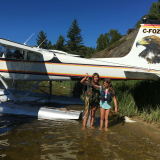
Hey Hozer, aviation is a small world!! I know Hap as well, he gave me my float endorsement down here in Southern Manitoba when I bought my J-3 Cub. He was flying Otters for Gov. Air Services about 15 years ago when I bought the cub. A hell of a pilot and a great guy. I called him after seeing his story on the news...sounds like it wasn't a pleasant experience, but a good ending! At least the temperatures weren't in the -30C range when it happened...that cold moved in a day or two after the rescue.
DISPLAY OPTIONS
Who is online
Users browsing this forum: No registered users and 0 guests
Latest Features
-
-
Featured Bush Planes
As one of the undisputed legends of bush flying, the Cessna 180 hauls a…Read More -
Aircraft Ownership and Maintenance
9 modification mistakes aircraft owners make when trying to "bush out" their birds—why some…Read More -
Live to Tell
A Minnesota pilot is surprised to learn that the sudden asymmetric drag of an…Read More




Latest Knowledge Base
-
Destinations
Canada offers some of the most spectacular backcountry flying on the continent. Here's what you need to know before you go.Read More -
Safety and Survival
Hope that you never have to use your survival vest but knowing you have it and knowing how to use…Read More -
Destinations
A regional guide with ideas for winter camping destinations in California, Nevada, New Mexico, and Arizona.Read More -
Aircraft
Finding an affordable aircraft that can handle the backcountry for $80K or less? A challenge for sure, but with the…Read More



