Anyone have scientific data on what tires are needed in what circumstance? What tire is needed to go over a log of a certain diameter at a certain speed? What tire is recommended to reduce wear and tear on the gear from many landings on smaller rocks? That kind of thing.
Seems like tires keep getting bigger, but I haven't been able to google up anything as to why. Certainly the vast majority of the photos and videos I've seen show big tires on terrain that would have been handled fine by smaller ones. I'm a newbie, it's going to be a year or two before I upgrade, but I'd love to have some science behind my decision at that point.
Big tires
Tue Apr 16, 2013 8:58 pm
- rw2 offline
- Posts: 1799
- Joined: Sat Dec 22, 2012 1:10 pm
- Location: San Miguel de Allende
- FindMeSpot URL: https://share.delorme.com/LaNaranjaDanzante
- Aircraft: Experimental Maule
Follow my Flying, Cooking and Camping adventures at RichWellner.com
Tue Apr 16, 2013 9:51 pm
Re: Big tires
I'm new to the big tire scene and I'm still learning the in's and out's so to speak. Like you, I began looking into them long before purchasing. Being trained as an engineer, I considered the technical aspects as you are now with out resting on any conclusions other than the larger the tire, the bigger the object it will roll over and the larger the foot print so the more flotation. I worked up some numbers, but in the end decided there are just to many variables. So I began asking friends who were using them and also would observe them when we flew together. I also listened a lot around the campfires.
Here are some of my observations since the technical aspects you ask about are elusive:
- Most everyone who has them really likes them and plans to continue using them,
- For rough field operations, bigger is better,
- For really soft surfaces, bigger is better,
- Most with 29's or 31's want larger; a few with 35's want to go back to 29's or 31's to regain AC handling qualities or speed,
- How extreme you can get with them depends on your skill level, good judgement, airplane, and risk tolerance,
- The bigger the tire, the larger the impact on empty weight/useful load, cruise, climb, and roll rate - there are trade off's,
- Tire air pressure makes a difference on what they will absorb,
- They do add a safety factor in the event of a forced landing,
- They are all hand-made in the USA; a factory visit/tour was well worth my time and expense,
- I'm told going from 31's to 35's, in terms of rough field capabilities is the same as the increment between going from 8:50x6's to 31's,
- Pavement landings and pavement taxing (especially with poor gear alignment) will cause more tire wear than on dirt or turf, and
- They look cool.
As far as what they will roll over, I'm no expert, and have little experience with them so far, however consider axle height as the maximum height of a steep-sided obstacle that they can overcome (simple physics of a rolling tire). Axle height is less than 1/2 the tire diameter due to sag at lower tire pressures (about 2 inchs of sag, but depends on the tire and air pressure). For 35's that would be about 15 inches - MAX in theory, not that I want to try that however.
I've flown similar planes; one with 31's and one with 35's. No extreme landing conditions with either of them. I can't say one is better than the other, it just depends on your mission and what you are willing to give up in trade. Both sizes are huge improvements over smaller tires for rough strips or off airport landings. I had 8:50's on the Bearhawk before jumping up to 35's. Everyplace I've landed so far with 35's, I think 29's or 31's would have worked fine there too. If I miss judge obstacle size on landing or otherwise run into a surprise, I'll be glad to have the larger tire.
Blackrock
Here are some of my observations since the technical aspects you ask about are elusive:
- Most everyone who has them really likes them and plans to continue using them,
- For rough field operations, bigger is better,
- For really soft surfaces, bigger is better,
- Most with 29's or 31's want larger; a few with 35's want to go back to 29's or 31's to regain AC handling qualities or speed,
- How extreme you can get with them depends on your skill level, good judgement, airplane, and risk tolerance,
- The bigger the tire, the larger the impact on empty weight/useful load, cruise, climb, and roll rate - there are trade off's,
- Tire air pressure makes a difference on what they will absorb,
- They do add a safety factor in the event of a forced landing,
- They are all hand-made in the USA; a factory visit/tour was well worth my time and expense,
- I'm told going from 31's to 35's, in terms of rough field capabilities is the same as the increment between going from 8:50x6's to 31's,
- Pavement landings and pavement taxing (especially with poor gear alignment) will cause more tire wear than on dirt or turf, and
- They look cool.
As far as what they will roll over, I'm no expert, and have little experience with them so far, however consider axle height as the maximum height of a steep-sided obstacle that they can overcome (simple physics of a rolling tire). Axle height is less than 1/2 the tire diameter due to sag at lower tire pressures (about 2 inchs of sag, but depends on the tire and air pressure). For 35's that would be about 15 inches - MAX in theory, not that I want to try that however.
I've flown similar planes; one with 31's and one with 35's. No extreme landing conditions with either of them. I can't say one is better than the other, it just depends on your mission and what you are willing to give up in trade. Both sizes are huge improvements over smaller tires for rough strips or off airport landings. I had 8:50's on the Bearhawk before jumping up to 35's. Everyplace I've landed so far with 35's, I think 29's or 31's would have worked fine there too. If I miss judge obstacle size on landing or otherwise run into a surprise, I'll be glad to have the larger tire.
Blackrock
- blackrock offline
- Posts: 1576
- Joined: Tue Jan 29, 2008 6:54 pm
- Location: Elko, NV
- FindMeSpot URL: http://share.findmespot.com/shared/face ... BFmtASxjeV
- Aircraft: Bearhawk
Wed Apr 17, 2013 7:20 am
Re: Big tires
Excellent summary. Thanks much.
- rw2 offline
- Posts: 1799
- Joined: Sat Dec 22, 2012 1:10 pm
- Location: San Miguel de Allende
- FindMeSpot URL: https://share.delorme.com/LaNaranjaDanzante
- Aircraft: Experimental Maule
Follow my Flying, Cooking and Camping adventures at RichWellner.com
Wed Apr 17, 2013 8:26 am
Re: Big tires
Anyone have any thoughts on the comparison between 29s and 31s? I know the standard response is "bigger is always better," but I don't need 35s for the kind of flying I do, nor do I want to drag my cruise speed down quite that much. I'm just looking for a comparison about how much of an actual difference there is between 29 and 31.
(Background info: I've flown 26s on several different Rans S-7s, and liked them very much. However, I found them to be a little on the short side for romping through sagebrush. I've also flown 35s on a PA-18, which were sexy and cool, but way more tire than I need.)
(Background info: I've flown 26s on several different Rans S-7s, and liked them very much. However, I found them to be a little on the short side for romping through sagebrush. I've also flown 35s on a PA-18, which were sexy and cool, but way more tire than I need.)
- RanchPilot offline
- Posts: 974
- Joined: Mon Jan 24, 2011 5:18 pm
- Location: Wyoming
Experience is the knowledge that enables you to recognize a mistake when you make it again.
RanchPilot Facebook Community: http://www.facebook.com/ranchpilot777
RanchPilot Facebook Community: http://www.facebook.com/ranchpilot777
Wed Apr 17, 2013 9:21 am
Re: Big tires
blackrock wrote:As far as what they will roll over, I'm no expert, and have little experience with them so far, however consider axle height as the maximum height of a steep-sided obstacle that they can overcome (simple physics of a rolling tire). Axle height is less than 1/2 the tire diameter due to sag at lower tire pressures (about 2 inchs of sag, but depends on the tire and air pressure). For 35's that would be about 15 inches - MAX in theory, not that I want to try that however.
You can only call the axle height the max obstacle height if the wheel is driven and you have 100% traction. For undriven wheels, the max obstacle height is far less (and traction of course doesn't matter).
I have no expertise with big low-pressure tires, but I did work briefly in the transportation industry, and there were various formulas for running over stuff. There were numerous variables such as driven vs. undriven wheels, weight, speed, inertia, elasticity, etc., and of course the shape of the obstacle also factors into the ability to roll over it.
For undriven wheels and the "steep-sided obstacle" that you mention, the max obstacle height was considered to be about 30% of the axle height, plus or minus a fudge factor depending on a bunch of variables. Why 30%? Because if you take a cube that is 30% of the height of the axle and set it in front of the tire like a chock, the point of contact will be on the line that comes down and forward from the axle at a 45 degree angle. (Sine of 45 degrees is .7071..., which is the vertical distance from the axle down to the point of contact, ergo from that point to the ground is .2929...) Anything higher than that will produce more rebound force on the backwards vector than on the upwards vector.
Obviously, a big low-pressure tire will deform and allow the obstacle to pass under it for a ways before the pressure against the obstacle builds to the point of rebound force. Ergo, it will handle more than the average 30% of axle height.
So, what's the tallest obstacle anyone has run over with their airplane, and how big were your tires?
Wed Apr 17, 2013 9:34 am
Re: Big tires
This will just further confuse the issue, but I can't tell any difference in handling or airspeed when I went from 26" to 29" Airstreaks. Logic and others tell me there must be, but it must be small enough to not be a big deal or noticable.
I gradually realized there was a pretty big difference in what obstacles I could roll over and still not feel much (or anything) as compared to the 26's, which were a huge step up over the 8:00's I started with in utility.
One of you engineers should do the math (I know, it isn't rocket science!): what's the volume of air contained difference in the different sized tires? It's not just outside diameter. By that I mean my eyeball tells me there is quite a bit more VOLUME in the, in my case, 29's versus the 26's. I suspect the same is true between the 31's and 35's, thus the big difference in what you can do with them, and the cushier effect of going big. I was harrowing my runway a week ago and kinda wondered why I bother anymore, it feels smooth regardless!
I've said it before but damn, I hope ABW doesn't come out with Airstreak 31's! I think a lot of the guys on 35's probably agonized over their size choice and then finally just went "screw it, I'll just get the biggest ones they make". I will be flying in a few weeks with another S-7S, (actually the new S-7S like plane called "The Outcast", so named because it is a dead ringer for a Super Cub, but based on a S-7S type airframe and powerplant, thus not fish or fowl, "NotaCub" was one of the other names considered) but he has 31's, it will be interesting to see what difference there is in our cruise etc.
8 to 10" is the biggest rock I have hit, with the 29's, the bigger one was sloped though, not straight up and down, and on a beach. Cantalope sized ones, a lot, and barely feel them.
I gradually realized there was a pretty big difference in what obstacles I could roll over and still not feel much (or anything) as compared to the 26's, which were a huge step up over the 8:00's I started with in utility.
One of you engineers should do the math (I know, it isn't rocket science!): what's the volume of air contained difference in the different sized tires? It's not just outside diameter. By that I mean my eyeball tells me there is quite a bit more VOLUME in the, in my case, 29's versus the 26's. I suspect the same is true between the 31's and 35's, thus the big difference in what you can do with them, and the cushier effect of going big. I was harrowing my runway a week ago and kinda wondered why I bother anymore, it feels smooth regardless!
I've said it before but damn, I hope ABW doesn't come out with Airstreak 31's! I think a lot of the guys on 35's probably agonized over their size choice and then finally just went "screw it, I'll just get the biggest ones they make". I will be flying in a few weeks with another S-7S, (actually the new S-7S like plane called "The Outcast", so named because it is a dead ringer for a Super Cub, but based on a S-7S type airframe and powerplant, thus not fish or fowl, "NotaCub" was one of the other names considered) but he has 31's, it will be interesting to see what difference there is in our cruise etc.
8 to 10" is the biggest rock I have hit, with the 29's, the bigger one was sloped though, not straight up and down, and on a beach. Cantalope sized ones, a lot, and barely feel them.
- courierguy offline

- Posts: 4197
- Joined: Thu Mar 31, 2005 6:52 pm
- Location: Idaho
"Its easier to apologize then ask permission"
Tex McClatchy
Tex McClatchy
Wed Apr 17, 2013 9:54 am
Re: Big tires
When you ask a non-driven wheel to roll over an obstacle or stay afloat on a soft surface, there is a component of force introduced that acts in the aft direction. This will result in the tendency for the airplane to decelerate at some rate proportional to the obstacle size or softness of sand/mud/gravel. Gear position with respect to the center of gravity will have a lot to do with the airplane's tendency to nose over. A taildragger rolling slowly with a far forward CG will behave quite differently than the same machine moving fast with an aft CG. This element of the equation considers the forces and their moment arms. If you look at a Helio, the mains are about where the nose gear is on a lot of tricycle aircraft. You don't hear about those planes nosing over very often, though I did hear of it once. The size of the tire is only one variable in the stew.
There is always liability in providing actual numbers for others to use. If you put anything in writing, and have anything of value, it is likely that the lawyers will sniff you out. Great discussion though!
There is always liability in providing actual numbers for others to use. If you put anything in writing, and have anything of value, it is likely that the lawyers will sniff you out. Great discussion though!
- Scolopax offline

- Posts: 1696
- Joined: Tue Sep 27, 2005 5:02 pm
- Location: Nottingham
- FindMeSpot URL: http://share.findmespot.com/shared/face ... 4aYqSexnZC
Wed Apr 17, 2013 10:01 am
Re: Big tires
The bigger the better. This applies to everything. Just ask your girlfriend?
- patrol guy offline

- Posts: 1749
- Joined: Wed Apr 11, 2007 2:52 pm
- Location: east of the river
...remember, life is uncertain, eat desert first!
... and, those that pound their guns into plows, will plow for those who don't.
... and, those that pound their guns into plows, will plow for those who don't.
Wed Apr 17, 2013 10:09 am
Re: Big tires
Big is good, bigger is better, and too big is just about right.
Cessna Skywagon -- accept no substitute!
Wed Apr 17, 2013 10:18 am
Re: Big tires
courierguy wrote: This will just further confuse the issue, but I can't tell any difference in handling or airspeed when I went from 26" to 29" Airstreaks. Logic and others tell me there must be, but it must be small enough to not be a big deal or noticable..........
My C150/150TD had 800's when I bought it, I went to 850's. Been thinking about getting some 26" Goodyears, since I already have a field-approved 337 for them from the airplane's past. Besides being bigger & draggier, as near as I can figure they're also gonna be about 15# heavier installed than the 850's. (51# vs 36#). Besides the weight itself, that'll move the empty CG on my airplane forward by about 1/4". Not much, but the more of an increase and/or the farther the wheels are from the CG the more the effect. It's bound to have an effect on handling too, with all that extra weight & drag hanging down on the end of the gear-- if nothing else, I expect the roll rate would be slower.
Regarding airspeed, you may be seeing the same airspeed at the same rpm with bigger tires, but I'd bet that your manifold pressure is higher and therefore your engine is working harder & you're burning more fuel.
Cessna Skywagon -- accept no substitute!
Wed Apr 17, 2013 10:42 am
Re: Big tires
I fly two super cubs one on 31s the other on 35s both with 160 hp and borer props we fly them side by side for about a 15 hour trip every summer and every fall and there is no noticeable speed difference. Now that being said the drag goes up with the square of the speed so a faster plane like a maule or bear hawk you would likely see some difference, but I doubt it is much.
For me it came down to the fact that they are on there to protect my very expensive airplane so why not have the most protection possible?
For me it came down to the fact that they are on there to protect my very expensive airplane so why not have the most protection possible?
tricycles are for little girls
Wed Apr 17, 2013 12:19 pm
Re: Big tires
courierguy wrote:This will just further confuse the issue, but I can't tell any difference in handling or airspeed when I went from 26" to 29" Airstreaks. Logic and others tell me there must be, but it must be small enough to not be a big deal or noticable.
I gradually realized there was a pretty big difference in what obstacles I could roll over and still not feel much (or anything) as compared to the 26's, which were a huge step up over the 8:00's I started with in utility.
One of you engineers should do the math (I know, it isn't rocket science!): what's the volume of air contained difference in the different sized tires? It's not just outside diameter. By that I mean my eyeball tells me there is quite a bit more VOLUME in the, in my case, 29's versus the 26's. I suspect the same is true between the 31's and 35's, thus the big difference in what you can do with them, and the cushier effect of going big. I was harrowing my runway a week ago and kinda wondered why I bother anymore, it feels smooth regardless!
I've said it before but damn, I hope ABW doesn't come out with Airstreak 31's! I think a lot of the guys on 35's probably agonized over their size choice and then finally just went "screw it, I'll just get the biggest ones they make". I will be flying in a few weeks with another S-7S, (actually the new S-7S like plane called "The Outcast", so named because it is a dead ringer for a Super Cub, but based on a S-7S type airframe and powerplant, thus not fish or fowl, "NotaCub" was one of the other names considered) but he has 31's, it will be interesting to see what difference there is in our cruise etc.
8 to 10" is the biggest rock I have hit, with the 29's, the bigger one was sloped though, not straight up and down, and on a beach. Cantalope sized ones, a lot, and barely feel them.
Does this guy with the new s7s have any pics or videos of this new plane? Did a search for it and couldn't find anything. Got me curious......
- Crzyivan13 offline
- Posts: 1811
- Joined: Sat Nov 24, 2012 9:50 pm
- Location: Ohio- OI27 Checkpoint Charlie
- FindMeSpot URL: https://share.delorme.com/EvanDavis
- Aircraft: 1957 Cessna 182A
Wed Apr 17, 2013 9:27 pm
Re: Big tires
hotrod150 wrote:courierguy wrote: This will just further confuse the issue, but I can't tell any difference in handling or airspeed when I went from 26" to 29" Airstreaks. Logic and others tell me there must be, but it must be small enough to not be a big deal or noticable..........
My C150/150TD had 800's when I bought it, I went to 850's. Been thinking about getting some 26" Goodyears, since I already have a field-approved 337 for them from the airplane's past. Besides being bigger & draggier, as near as I can figure they're also gonna be about 15# heavier installed than the 850's. (51# vs 36#). Besides the weight itself, that'll move the empty CG on my airplane forward by about 1/4". Not much, but the more of an increase and/or the farther the wheels are from the CG the more the effect. It's bound to have an effect on handling too, with all that extra weight & drag hanging down on the end of the gear-- if nothing else, I expect the roll rate would be slower.
Regarding airspeed, you may be seeing the same airspeed at the same rpm with bigger tires, but I'd bet that your manifold pressure is higher and therefore your engine is working harder & you're burning more fuel.
I went from 8.50's to 26" airstreaks, it was only a few pound increase in tires. The 26's are big enough for what i do.

Thu Apr 18, 2013 8:25 am
Re: Big tires
Thought about 26" Airstreaks but at 1760# gross I'm a little too heavy for them (they're advertised for LSA's under 1700)). Don't want the higher weight or price of the regular BW's.
Cessna Skywagon -- accept no substitute!
Thu Apr 18, 2013 8:29 am
Re: Big tires
Regarding rolling over stuff...I wonder if a trailing gear like the Wilga's will allow you to roll over stuff better than the same tire/wheel set-up on a Cessna or Cub? I know you can pull a wheel (like a tailwheel) over bigger stuff than you can push it over.
Cessna Skywagon -- accept no substitute!
Thu Apr 18, 2013 4:31 pm
- Barnstormer offline
- Posts: 2700
- Joined: Sun Oct 14, 2012 7:42 am
- Location: Alaska
- Aircraft: C185
Thu Apr 18, 2013 4:41 pm
Re: Big tires
My calculations say 1/3 the height of the tire for obstacles.
- shortfielder offline

- Posts: 2350
- Joined: Sun Mar 05, 2006 7:14 pm
- Location: Durango, Colorado
- FindMeSpot URL: http://share.findmespot.com/shared/face ... D263l9HKFb
If you want to go up, pull back on the controls. If you want to go down, pull back farther.
My SPOT page
My SPOT page
Thu Apr 18, 2013 4:44 pm
Re: Big tires
shortfielder wrote:My calculations say 1/3 the height of the tire for obstacles.
That is as valid as anything else that has been thrown out here...
- blackrock offline
- Posts: 1576
- Joined: Tue Jan 29, 2008 6:54 pm
- Location: Elko, NV
- FindMeSpot URL: http://share.findmespot.com/shared/face ... BFmtASxjeV
- Aircraft: Bearhawk
Thu Apr 18, 2013 7:20 pm
Re: Big tires
rw2 wrote:Anyone have scientific data on what tires are needed in what circumstance? What tire is needed to go over a log of a certain diameter at a certain speed? What tire is recommended to reduce wear and tear on the gear from many landings on smaller rocks? That kind of thing.
Seems like tires keep getting bigger, but I haven't been able to google up anything as to why. Certainly the vast majority of the photos and videos I've seen show big tires on terrain that would have been handled fine by smaller ones. I'm a newbie, it's going to be a year or two before I upgrade, but I'd love to have some science behind my decision at that point.
REALLY good question, I am in the same boat. I see lots of places I think I could land while I'm out hunting, and where I would want to land in future to save the walk, but I don't have a good feel for what sized tires buys what kind of insurance?
When you have a faster plane than your average Cub, and given the price of the things once you ship them overseas... I don't think a guy can afford to just go as big as possible, unless that is what you wanted (Mike
 ). It would be good to know what you're enabling.
E.g. from easy to hard questions:
Will a 35 roll over something a 31 wont? Yes.
How often do you really land somewhere that the 35 would go but 31's wont?
How often do you want to be landing places like that...? Hmmmmm....
All I have grafted from this forum on this subject in the past 12 months, is that 26's aren't any better than 8.5's in real terms (! not my words but it seems to keep coming up). The rest is pretty vague to me?
Maybe this picture will help:
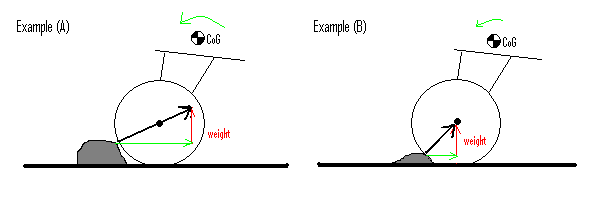
The green arrow is the force (resistance) created when the weight of the plane tried to roll over the obstacle. The higher up the wheel the obstacle hits, the larger the black force needs to become to get over it while supporting the same weight (red), and the larger the green arrow becomes (black arrow always acts through the centreline of the axle). This effect can be lessened by the tire changing shape (deforming around the obstacle) - that's why lower pressure helps.. There will come a point where the overturning moment (green arrow about the CoG) that gets created is large enough to overcome the weight of the tail (including control forces) and flip the plane onto it's nose. You can see, the location of the CoG effects what size this critical force is, and also the design (dimensions) of the aircraft play a part. The size of the tire is just one factor in the equation.

Thu Apr 18, 2013 8:19 pm
Re: Big tires
I think you can analyze all you want; I know I did. When the rubber meets the road (pun intended), there are just too many variables to consider to make this a purely analytical decision. Consider what those who are using the tires are saying too:
http://www.backcountrypilot.org/forum/posting.php?mode=reply&f=13&t=11781
What would you choose if all tires cost the same?
http://www.backcountrypilot.org/forum/posting.php?mode=reply&f=13&t=11781
What would you choose if all tires cost the same?
- blackrock offline
- Posts: 1576
- Joined: Tue Jan 29, 2008 6:54 pm
- Location: Elko, NV
- FindMeSpot URL: http://share.findmespot.com/shared/face ... BFmtASxjeV
- Aircraft: Bearhawk
DISPLAY OPTIONS
Who is online
Users browsing this forum: No registered users and 1 guest
Latest Features
-
Live to Tell
A Minnesota pilot is surprised to learn that the sudden asymmetric drag of an out-of-rig ski can…Read More -
Creators
Working in some of the Yukon's most beautiful and remote environments, photographer Simon Blakesley captures aircraft in…Read More -
Aircraft Ownership and Maintenance
Upgrading to big tires can make a huge difference in backcountry performance, but with those gains come…Read More -
Tales from Yesteryear
In this tale from bush flying yesteryear, Don Cogger signs up to help Atlee Dodge Jr recovery…Read More


Latest Knowledge Base
-
Destinations
A regional guide with ideas for winter camping destinations in California, Nevada, New Mexico, and Arizona.Read More -
Aircraft
Finding an affordable aircraft that can handle the backcountry for $80K or less? A challenge for sure, but with the…Read More -
Aircraft
01.29.2018 - Zane - Updated tire diameter graphic to add 8.50x10 Guide to tires for use in the backcountry and off-airport landing…Read More -
Pilots
12.22.2013 - Initial article format Operating aircraft on skis and negotiating a snow-covered landscape is an entirely unique skillset and environment.…Read More


