Thu Aug 27, 2015 11:27 am
You’ll never make sense of how someone else spends their money.
And it’s confirmed: 170’s are not 180’s…probably why they have different model numbers. Converting a 170 to 180hp vs buying a 180 is an interesting economic yin and yang, but that’s a pretty narrow view of the entire decision process, especially for someone who already owns a 170 that they are fond of. Like a lot of people, I’ve spent the years I’ve owned my plane making it better… Everything from avionic and instrument upgrades to new wires all the way to the P-leads, fine wire spark plugs, Bass harnesses, new tail springs and axel hardware and brake lines and gas lines and pretty much anything else that I ever saw and thought I could improve on… and I started out with a very, very nicely restored airplane to begin with. Lots of those improvement are not things I’m ever going to get my money back out of in a sale; they’re things I did because it makes me feel better when I look out the window and see nothing but rocks and trees for miles and miles. Hitting the reset button with a unknown airplane is not a small decision, especially for a backcountry bird. Something as simple as a broken tail spring probably won’t hurt you, but the cost of getting it repaired in the backcountry sure could sting a bit. On the other hand, a corroded 30-cent wire from the ignition switch can kill you a sure as a bullet if it fails at the wrong time.
As for economic hogwash, I think that cuts both ways. If it’s just as cheap to run a 180, I’m hard pressed to understand why anyone is flying anything smaller. There are lots of old sticks that USED to own 180’s and now fly something smaller, and it’s not because the 180 ever let them down. To be fair, I believe that the fuel cost per mile is about the same between the 180hp 170 and a 180. But acquisition costs, insurance, property tax, airframe maintenance, time to TBO, cost of overhaul, and expected engine maintenance before TBO are not the same between the two planes. That stuff counts, too. If I’m completely wrong then please pardon my ignorance. I did the math and decided the 170 was considerably less expensive to own and operate over the long haul, and I had no reason to try and convince myself one way or another. I could easily pay cash for any 180 or 185 on the market if I so desired. But I’ve got a lot of hobbies and there’s a finite amount of money I want to spend on aviation. Again…forgive me if my conclusions don’t match yours.
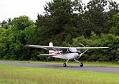
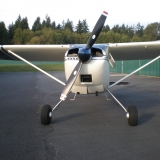
Mike, you’ve probably forgotten more about flying than I’ve ever learned, and I don’t doubt for a minute that you could hop in my plane and show me a thing or two or ten, but I respectfully disagree about a 180hp 170 being a capable backcountry performer at GROSS weight, at least where I like to play. Lightly loaded my STOL 170 gets off the ground like a flea and climbs faster than Russian inflation, but there’s just a limit to what 180hp can do and a couple hundred pounds makes a huge difference.
Any of the Middle Fork or Big Creek airstrips are going to have an average summertime DA of between 4500 and 6000 feet, at DAWN. Lots of them also have a down-canyon tailwind until it warms up ten degrees, and +/- 1,000 foot, rough airstrips. Add to that some serious obstacle clearance issues, downdrafts over the rivers, and the need for maneuvering immediately after take off, and I sure won’t use the tighter ones at anything close to gross weight in my 170. You’re a better stick than I am and maybe you would, but I kind of doubt it.
Even the wide open, super-long airstrips like Chamberlain Basin (5,765 msl), Cold Meadows (7,030 msl), Meadow Creek (3,984 msl) or Schafer (4,856 msl) require a substantial rate of climb to clear terrain after take off. At gross weight on a typical summer morning I’d be pretty unhappy if I wasn’t flying just as soon as it was light enough to see, and even then I’d be cursing myself for being heavy. I’ve gotten close enough to the trees at a couple hundred pounds under gross, thank you very much. Now I’m no hot stick and I get that, but I’ve got about 1000 hours in my 170 and a pretty intimate understanding of what it does and how to get the most out of it. Maybe I’m overly cautious. Clearing the tree tops by 50 feet isn’t good enough for me, especially if I have to do it for an extended period of time with the CHT’s and oil temp creeping up to the red line.
Hence my aversion to larger fuel tanks. Even stock tanks cary too much fuel with two people and camping gear n' food for most of these strips, most of the time, at least for me. My fuel bladders are no more likely to get contaminated and easier to inspect and clean than a tip tank is…I don’t see the risk there. Fuel bladders don’t make for the most comfortable cargo I agree, but those wing tanks inches from our heads are anything but crash worthy. And I’ve seen tip tank’s getting installed…brand new they are worse than the vintage Cessna tanks they feed into. I guess if it bothered me enough I’d go back to steel jerry cans strapped into the Atlee Dodge rear seat rails, which, in my opinion, are less likely to rupture in a crash than the wing tanks. But at the end of the day I rarely cary extra fuel at all, and if I do it’s a forgone conclusion I’m going into a pretty easy strip, so I accept the risk.
Whether it’s economically prudent for Fishdoc to convert his 170A vs buy a already converted 170B or a 180 is a question only he can answer. I’d rather have syphilis than take on a project that big, but I also know people who would have as much fun doing the conversion as they’d have owning the end result. To each his own.
But in the event he does convert his 170A, my humble opinion is that he should seriously consider keeping the 39 gallon tanks…
 . So, starting with a known quantity that you're happy with is a good idea.





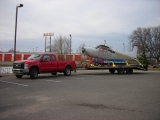

 ) O-360, a fixed Mac climb prop and 8.50's. I remember being overwhelmed how cool it was. I always kind of the liked the "clean" economy of how simple that plane was. Of course, that's coming from me....the guy who bought a 185 that only flies solo, locally and 30 gallons of gas. My "mission" selector is broken.