Well this is sad.
http://www.kathrynsreport.com/2017/07/zenith-stol-ch-701-sp-n701xl-fatal.html
Condolences, and best wishes to those affected by this tragedy.
Camp fire story...
Tue Aug 08, 2017 9:18 am
- Scolopax offline

- Posts: 1696
- Joined: Tue Sep 27, 2005 5:02 pm
- Location: Nottingham
- FindMeSpot URL: http://share.findmespot.com/shared/face ... 4aYqSexnZC
Tue Aug 08, 2017 12:50 pm
Re: Camp fire story...
Sounds like wires or weather or a combination. Sad sad deal
Akt
Akt
- aktahoe1 offline
- Posts: 2052
- Joined: Sun Jul 13, 2008 8:22 am
- Location: Alaska and Lake Tahoe = aktahoe
If it looks smooth, it might be. If it looks rough, it is...www.bigtirepilot.com ...www.alaskaheliski.com
Tue Aug 08, 2017 2:44 pm
Re: Camp fire story...
It is very sad. I would have thought that if this pilot was going to buy the farm, it would have been doing his ski stunt or something similar. I can't see in K's report what the weather was like, but even if it was VFR, if they did take off really early in the morning when it was still dark, it's a lot like instrument flying. He wasn't IR, and likely neither was his airplane.
It's a reminder that no matter what our skill level may be in one area of aviation, there's always something else that can bite us if we stray into some area in which we aren't skilled.
Cary
It's a reminder that no matter what our skill level may be in one area of aviation, there's always something else that can bite us if we stray into some area in which we aren't skilled.
Cary
"I have slipped the surly bonds of earth..., put out my hand and touched the face of God." J.G. Magee
Tue Aug 08, 2017 3:02 pm
Re: Camp fire story...
From article:
"On July 27, 2017, about 0415 central daylight time, a Zenith CH 701SP, N701XP, piloted by a non-instrument rated sport pilot, was destroyed when the it impacted terrain approximately 6.5 miles north of Laddonia, and 16.5 miles northeast of Mexico, Missouri. Instrument meteorological conditions prevailed at the time of the accident."
Man, that article is hard to read, so sad. Inadvertent IMC in the dark has always been a big fear of mine. Sounds like a true nightmare, not being able to see the clouds before you're in them, or feeling forced to scud run without being able to tell how high you are since it's dark. Not saying this is what happened since no one will ever know, but it's what comes to mind. Hard to determine visibility at night, especially in rural areas.
"On July 27, 2017, about 0415 central daylight time, a Zenith CH 701SP, N701XP, piloted by a non-instrument rated sport pilot, was destroyed when the it impacted terrain approximately 6.5 miles north of Laddonia, and 16.5 miles northeast of Mexico, Missouri. Instrument meteorological conditions prevailed at the time of the accident."
Man, that article is hard to read, so sad. Inadvertent IMC in the dark has always been a big fear of mine. Sounds like a true nightmare, not being able to see the clouds before you're in them, or feeling forced to scud run without being able to tell how high you are since it's dark. Not saying this is what happened since no one will ever know, but it's what comes to mind. Hard to determine visibility at night, especially in rural areas.
Thu Aug 10, 2017 9:47 am
Re: Camp fire story...
This quote from the linked article, from an LEO describing the search for the airplane, might be key:
"...As you can tell out here there is no artificial lighting at all.."
Rural areas away from towns and houses can be darker than the inside of a cow's ass, if there are no stars or moonlight
Pitch black is IMC in my book.
"...As you can tell out here there is no artificial lighting at all.."
Rural areas away from towns and houses can be darker than the inside of a cow's ass, if there are no stars or moonlight
Pitch black is IMC in my book.
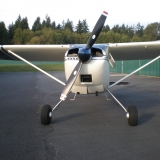
Cessna Skywagon -- accept no substitute!
Thu Aug 10, 2017 4:23 pm
Re: Camp fire story...
hotrod180 wrote:This quote from the linked article, from an LEO describing the search for the airplane, might be key:
"...As you can tell out here there is no artificial lighting at all.."
Rural areas away from towns and houses can be darker than the inside of a cow's ass, if there are no stars or moonlight
Pitch black is IMC in my book.
One day about 13 years ago, my younger son and I flew from Fort Collins to Sidney, NE, a "Cabela's run". We were delayed on the departure by a glitch in the airplane, so by the time my IA could fix it, it was dark by the time we got to Sidney. After having dinner and perusing the Cabela's store, we took off from Sidney to return.
It was a clear but moonless night--pretty easy flying, but very few lights on the ground between there and here. We'd been in the air for a little while when my son asked "Dad, how can you fly in the dark like this?" I misinterpreted his question, thinking he was asking about navigation, and so I launched into an explanation of VORs and headings and such. He stopped me and said, "No, how do you keep the airplane upright?" Although he'd flown with me many times over the years, he was not a pilot, and from his vantage point in the right seat, he couldn't see any horizon, and he admitted that he was suffering from vertigo!
To him, it felt like the airplane was cocked in a steep bank, and yet he knew that I wouldn't be flying it that way. So I pointed to the AI, and suggested that if he would watch that for awhile and imagine that it was showing him the horizon, his vertigo would soon go away. And it did, within just a few minutes.
I suspect that most of us who are IR and who fly in IMC, whether occasionally like I do or often like many others here do, have had bouts with sensory illusions, when the feelings in the body don't jibe with the instruments. But we've learned to ignore those kinesthetic responses and believe the instruments--and sometimes that isn't easy. Sometimes the kinesthesia is enormously strong, especially when the airplane is accelerating as in shortly after take off or decelerating as in going from level to climb attitude (somatogravic illusions).
But then you take a sport pilot who might not have had any IFR training at all, flying an airplane that likely had nothing more than basic VFR instrumentation, in the dark that he wasn't legally authorized to fly in anyway, and the accident chain gets longer and longer. This fellow obviously had a lot of stick and rudder skills, but those don't count for much when you can't see what is happening and all you have to go on is how your body feels.
Although he was pushing the envelope of legality, it's likely that he really didn't know how much he didn't know. He wouldn't be the first.
Cary
"I have slipped the surly bonds of earth..., put out my hand and touched the face of God." J.G. Magee
Thu Aug 10, 2017 7:59 pm
Re: Camp fire story...
Only in the Pretend VFR that MTV wrote about, night, and over water do integration of instrument and contact flying work well. Most of the time we need to be totally committed to one or the other.
- contactflying offline
- Posts: 4972
- Joined: Wed Apr 03, 2013 7:36 pm
- Location: Aurora, Missouri 2H2
Download my free "https://tinyurl.com/Safe-Maneuvering" e-book.
DISPLAY OPTIONS
Who is online
Users browsing this forum: Jaredwhamm66 and 20 guests
Latest Features
-
Live to Tell
A Minnesota pilot is surprised to learn that the sudden asymmetric drag of an out-of-rig ski can…Read More -
Creators
Working in some of the Yukon's most beautiful and remote environments, photographer Simon Blakesley captures aircraft in…Read More -
Aircraft Ownership and Maintenance
Upgrading to big tires can make a huge difference in backcountry performance, but with those gains come…Read More -
Tales from Yesteryear
In this tale from bush flying yesteryear, Don Cogger signs up to help Atlee Dodge Jr recovery…Read More


Latest Knowledge Base
-
Destinations
A regional guide with ideas for winter camping destinations in California, Nevada, New Mexico, and Arizona.Read More -
Aircraft
Finding an affordable aircraft that can handle the backcountry for $80K or less? A challenge for sure, but with the…Read More -
Aircraft
01.29.2018 - Zane - Updated tire diameter graphic to add 8.50x10 Guide to tires for use in the backcountry and off-airport landing…Read More -
Pilots
12.22.2013 - Initial article format Operating aircraft on skis and negotiating a snow-covered landscape is an entirely unique skillset and environment.…Read More


