Cowl flaps for a C172E
Wed Sep 28, 2016 4:35 pm
Cowl flaps for a C172E
I've a little problem with CHT's at high deck angles like Vx. The aircraft has a Lyc O-360 & powerflow. A DER suggested looking for a faring STC (he wasn't aware of one) to redirect air away from the firewall in high deck angle/high power situations. I also wonder if a cowl mod that includes cowl flaps might be a solution... if suc a mod exists? Has anyone run into this problem? Baffles look good, no obvious leaks. The high CHTs are in the rear cylinders.
- PapernScissors offline
- Posts: 419
- Joined: Sun Mar 06, 2016 8:49 pm
- Location: Spokane
- Aircraft: Cessna 172
Wed Sep 28, 2016 6:58 pm
Re: Cowl flaps for a C172E
I'd take another look at your top cowl baffle seals. Do they actually SEAL against the top of the cowl?
There's no way you'll get cowl flaps approved. That said, a fairly common modification on Huskys and Super Cubs is to install a "lip" on the rear of the bottom cowling. This creates a bit of turbulence just aft of the "lip", which creates lower pressure in the lower cowl exit, thereby creating higher flow through the cowling.
This is a very simple mod, and many mechanics might simply call it a minor and sign it off.....I would hope so at least. No moving parts, very simple. I've seen these lips made from aluminum, but more frequently from fiberglass, and riveted in place.
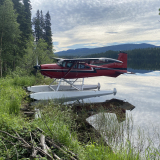
Here's a picture of a Husky with that mod:

Look at the aft end of the lower cowl, just aft of the exhaust pipe. You'll notice a lip there, which deflects outside air downward, creating a low pressure area in the lower cowl opening. Works pretty well on these airplanes when mounted on floats. And, it's easy to do.
Cowl flaps....not so easy to do....waaaaay too complex and will surely get a big NO from the feds and your mechanic.
But, first, make absolutely certain that your top baffle seals are actually bending forward when you close the cowling. Take a flashlight and look in from the front cowl openings. The top baffles should be angled forward, forced there by the top cowl. If there are ANY gaps back there, fix those FIRST. Also, check your inter-cylinder baffles. I've found a fair number of those loose, and not doing their jobs, and that will also screw up CHTs.
In other words, check and fix the simple stuff first....and you may already have done so, no offense intended.
Good luck.
MTV
There's no way you'll get cowl flaps approved. That said, a fairly common modification on Huskys and Super Cubs is to install a "lip" on the rear of the bottom cowling. This creates a bit of turbulence just aft of the "lip", which creates lower pressure in the lower cowl exit, thereby creating higher flow through the cowling.
This is a very simple mod, and many mechanics might simply call it a minor and sign it off.....I would hope so at least. No moving parts, very simple. I've seen these lips made from aluminum, but more frequently from fiberglass, and riveted in place.
Here's a picture of a Husky with that mod:
Look at the aft end of the lower cowl, just aft of the exhaust pipe. You'll notice a lip there, which deflects outside air downward, creating a low pressure area in the lower cowl opening. Works pretty well on these airplanes when mounted on floats. And, it's easy to do.
Cowl flaps....not so easy to do....waaaaay too complex and will surely get a big NO from the feds and your mechanic.
But, first, make absolutely certain that your top baffle seals are actually bending forward when you close the cowling. Take a flashlight and look in from the front cowl openings. The top baffles should be angled forward, forced there by the top cowl. If there are ANY gaps back there, fix those FIRST. Also, check your inter-cylinder baffles. I've found a fair number of those loose, and not doing their jobs, and that will also screw up CHTs.
In other words, check and fix the simple stuff first....and you may already have done so, no offense intended.
Good luck.
MTV


Thu Sep 29, 2016 2:37 am
Re: Cowl flaps for a C172E
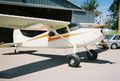
When I updated to a DelAir "front mount" muffler on my 170B - the old one was essentially up against the firewall - I ended up with the exhaust pipe exiting up front like a lot of 172s. I did not like the idea of even the possibility of there being any "ram" air pushing UP into the front of the cowling. Spotted an exhaust fairing on a 180 - believe the fairing came from a Texas company. Since I was near the end of the revival process it got added in as part of repaired cowling IAW --- Not only stops the ram air but should generate some vacuum in the area.
Either standard gallery or a For Sale "gallery should have a close up.
Chris C
Either standard gallery or a For Sale "gallery should have a close up.
Chris C
53 C-170-B+
It is better to be late in this world, than early in the next.
It is better to be late in this world, than early in the next.
Thu Sep 29, 2016 12:49 pm
Re: Cowl flaps for a C172E
Make a strip that rests onto the existing small lip on the rear of the lower cowl. The strip should be about 2 or 3 inches "wide". You can put it on temporarily with a series of small C clamps and take the airplane around the pattern a coupe of times to see whether it is worth pursuing a field approval or not. This is a low risk experiment, if the C clamps come loose they will not go through the propeller, flight controls, etc. and create any real safety hazard, If it makes a noticeable reduction in temperatures, THEN you can decide if it is worth putting the modification on permanently, the legality, the IA signoff, etc.

.
Thu Sep 29, 2016 8:03 pm
Re: Cowl flaps for a C172E
The easiest way to reduce CHT is to retard the timing slightly. In any event the timing is the first thing I would look at, a few degrees too much advance and up go the CHT's.
Lycoming put out some data on this once and a limit on how much to retard but sorry, I can't seem to find it or remember where it was.
Lycoming put out some data on this once and a limit on how much to retard but sorry, I can't seem to find it or remember where it was.
- aussie bob offline
- Posts: 66
- Joined: Mon Jul 07, 2014 2:23 am
- Location: Sheffield, Tasmania, Australia
Thu Sep 29, 2016 10:52 pm
Re: Cowl flaps for a C172E
Thanks to all for very helpful suggestions. I'll follow up on 'em.
- PapernScissors offline
- Posts: 419
- Joined: Sun Mar 06, 2016 8:49 pm
- Location: Spokane
- Aircraft: Cessna 172
Thu Sep 29, 2016 11:34 pm
Re: Cowl flaps for a C172E
There is an O-360 powered 175 out there somewhere that has the lip, a bump on the lower firewall, and some aerodynamic smoothing inside the front cowl opening to improve airflow. If your easier ideas don't produce all the results you need, perhaps I can try to sketch some off what I understood about the improvements made.
An old cattle feed salesman in NE owned it. I've seen words here in reference to him, so perhaps someone knows the airplane and can get photos?
An old cattle feed salesman in NE owned it. I've seen words here in reference to him, so perhaps someone knows the airplane and can get photos?
Mon Oct 03, 2016 6:05 pm
Re: Cowl flaps for a C172E
My P172D has cowl flaps, and they certainly make a difference when open. In pretty warm weather, I'll run with them part way open, and in cooler weather, I close them all the way. My engine is a Lycoming 360 with CS prop.
My IA redid the baffle seals with better materials, because I was having overheat problems with the back two CHTs. The biggest improvement in CHTs came from setting the timing back, from 25 BTDC to 20 BTDC. I received this advice from Mike Busch, well known as some sort of engine guru, and although my IA wasn't too happy doing it, he did as requested. He was afraid that I'd lose some power, but if I have, I can't tell it. Since doing that, I've had the airplane in and out of Marble, CO, and La Garita Ranch, several times, carrying a pretty good load (I'm a glamper--everything including the kitchen sink).
All was well for the next 3 years. The recent annual required some cylinder work and mag rebuild along with a new exhaust system, and he forgot about setting it back. First flight after the annual, the back CHTs were high again--and on asking him, he said "it's right on", meaning 25 BTDC. I ran out about 10 hours at high power settings before leaving for OSH, to break in the rebuilt cylinder, keeping the CHTs reasonable by very shallow climbs, running rich, cowl flaps wide open, etc. So I had him set it back again, just before I left for OSH in July. That brought the CHTs back to reasonable limits, still warmish (right around 400 degrees) but not like they were, even with the cowl flaps closed other than when climbing.
All that FWIW, to use as you might in your situation. To me, the lip makes good sense on a stock 172E, unless you could find a P172D cowl with cowl flaps and get a field approval to install it. But even if approved, it wouldn't be a slam dunk installation.
Cary
My IA redid the baffle seals with better materials, because I was having overheat problems with the back two CHTs. The biggest improvement in CHTs came from setting the timing back, from 25 BTDC to 20 BTDC. I received this advice from Mike Busch, well known as some sort of engine guru, and although my IA wasn't too happy doing it, he did as requested. He was afraid that I'd lose some power, but if I have, I can't tell it. Since doing that, I've had the airplane in and out of Marble, CO, and La Garita Ranch, several times, carrying a pretty good load (I'm a glamper--everything including the kitchen sink).
All was well for the next 3 years. The recent annual required some cylinder work and mag rebuild along with a new exhaust system, and he forgot about setting it back. First flight after the annual, the back CHTs were high again--and on asking him, he said "it's right on", meaning 25 BTDC. I ran out about 10 hours at high power settings before leaving for OSH, to break in the rebuilt cylinder, keeping the CHTs reasonable by very shallow climbs, running rich, cowl flaps wide open, etc. So I had him set it back again, just before I left for OSH in July. That brought the CHTs back to reasonable limits, still warmish (right around 400 degrees) but not like they were, even with the cowl flaps closed other than when climbing.
All that FWIW, to use as you might in your situation. To me, the lip makes good sense on a stock 172E, unless you could find a P172D cowl with cowl flaps and get a field approval to install it. But even if approved, it wouldn't be a slam dunk installation.
Cary
"I have slipped the surly bonds of earth..., put out my hand and touched the face of God." J.G. Magee
Mon Oct 03, 2016 8:14 pm
Re: Cowl flaps for a C172E
Please forgive any unintentional "pointedness" or harshness of this comment...
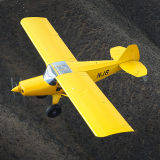
Why do you think this aircraft below has this type of cooling system?

You have an airplane with a lot of power, that climbs at very slow speeds, and operating in the middle of back country nowhere they really don't want you to burn up the engine. The Super Cub basic aircraft platform has existed for 60+ years, and the only possible reason for someone to go through the effort to re-design it is because the new design would cool the engine better than the old standby time-honored system. Putting the cowl flaps on the side of the cowl was not a mistake, or a wild guess, or a gamble. The Cub Crafters team are pretty f***ing good at what they do.
I'm pretty sure that they did a computer CFD ("clown puke") pressure survey first, to verify that the pressure on the side of the cowl was indeed lower than the pressure at the bottom of the cowl, at slow speed and high AoA. When they verified that, I'm pretty sure they tested the two cooling systems (bottom exit and side exit), and verified that the side exits were worth the extra effort, because more air flowed through the cowling. When you have an over-powered airplane, and extremely slow speed capability, you need to use the cooling system that works better.
So if there are problems cooling a back country 172, and all the usual suspects (baffle seals, inter-cylinder baffles, etc.) are not the problem, and adding a "seaplane lip" at the bottom of the stock cowling doesn't solve the problem... then the problems that were built in to the factory cooling system may have to be looked at. Retarding the ignition timing is a price that you shouldn't have to pay. You could just as soon take off with the throttle 3/4 of the way forward, and at least have the full engine power available in cruise-climb, or on cold days.
If you put duct tape over the opening where the air comes in or out of the cowling, how much would you have to retard the timing then?
Sorry to be the guy with the bad news, I believe that you might be looking in the wrong area to solve the problem.
Why do you think this aircraft below has this type of cooling system?
You have an airplane with a lot of power, that climbs at very slow speeds, and operating in the middle of back country nowhere they really don't want you to burn up the engine. The Super Cub basic aircraft platform has existed for 60+ years, and the only possible reason for someone to go through the effort to re-design it is because the new design would cool the engine better than the old standby time-honored system. Putting the cowl flaps on the side of the cowl was not a mistake, or a wild guess, or a gamble. The Cub Crafters team are pretty f***ing good at what they do.
I'm pretty sure that they did a computer CFD ("clown puke") pressure survey first, to verify that the pressure on the side of the cowl was indeed lower than the pressure at the bottom of the cowl, at slow speed and high AoA. When they verified that, I'm pretty sure they tested the two cooling systems (bottom exit and side exit), and verified that the side exits were worth the extra effort, because more air flowed through the cowling. When you have an over-powered airplane, and extremely slow speed capability, you need to use the cooling system that works better.
So if there are problems cooling a back country 172, and all the usual suspects (baffle seals, inter-cylinder baffles, etc.) are not the problem, and adding a "seaplane lip" at the bottom of the stock cowling doesn't solve the problem... then the problems that were built in to the factory cooling system may have to be looked at. Retarding the ignition timing is a price that you shouldn't have to pay. You could just as soon take off with the throttle 3/4 of the way forward, and at least have the full engine power available in cruise-climb, or on cold days.
If you put duct tape over the opening where the air comes in or out of the cowling, how much would you have to retard the timing then?
Sorry to be the guy with the bad news, I believe that you might be looking in the wrong area to solve the problem.
.
Mon Oct 03, 2016 9:12 pm
Re: Cowl flaps for a C172E
I have a cool running engine - due to effective baffles I think (more luck than design experience). I have cowl flaps too, and yes they make quite a difference.
But...
I still can't climb at Vx for more than a few minutes.
There are some physical limits, I think. It's hard to cool an engine at full power without high velocity airflow through the cowl.
But...
I still can't climb at Vx for more than a few minutes.
There are some physical limits, I think. It's hard to cool an engine at full power without high velocity airflow through the cowl.
Tue Oct 04, 2016 4:01 am
Re: Cowl flaps for a C172E
I fly a C175b with O-360. My CHT's never climb over 360 in a climb, and 320 in cruise, even on hot summer days. Baffle material is good with no gaps anywhere. Now, my Lower cowl has louvers, installed by the original dealer in Kansas to help cool the then GO-300. Can't tell you how much this helps, but my engine does run cool. Now, to figure out how to get it warmer in winter.
Dave
Dave
- RangeFlyer offline
- Posts: 75
- Joined: Tue Jan 20, 2009 5:23 pm
- Location: El Paso
Dave R.
Tue Oct 04, 2016 5:13 am
Re: Cowl flaps for a C172E
RangeFlyer wrote:I fly a C175b with O-360. My CHT's never climb over 360 in a climb, and 320 in cruise, even on hot summer days. Baffle material is good with no gaps anywhere. Now, my Lower cowl has louvers, installed by the original dealer in Kansas to help cool the then GO-300. Can't tell you how much this helps, but my engine does run cool. Now, to figure out how to get it warmer in winter.
Dave
Make block off plates for your louvers!
You could experiment with tape on the inside of the cowl until you figure out how much you need.
- CamTom12 offline

- Posts: 3705
- Joined: Sun Jul 08, 2012 1:08 pm
- Location: Huntsville
- FindMeSpot URL: https://share.delorme.com/camtom12
- Aircraft: Ruppe Racer
Experimental Pacer
home hand jam "wizard"
Tue Oct 04, 2016 7:13 am
Re: Cowl flaps for a C172E
EZFlap wrote:Please forgive any unintentional "pointedness" or harshness of this comment...
Why do you think this aircraft below has this type of cooling system?
You have an airplane with a lot of power, that climbs at very slow speeds, and operating in the middle of back country nowhere they really don't want you to burn up the engine. The Super Cub basic aircraft platform has existed for 60+ years, and the only possible reason for someone to go through the effort to re-design it is because the new design would cool the engine better than the old standby time-honored system. Putting the cowl flaps on the side of the cowl was not a mistake, or a wild guess, or a gamble. The Cub Crafters team are pretty f***ing good at what they do.
I'm pretty sure that they did a computer CFD ("clown puke") pressure survey first, to verify that the pressure on the side of the cowl was indeed lower than the pressure at the bottom of the cowl, at slow speed and high AoA. When they verified that, I'm pretty sure they tested the two cooling systems (bottom exit and side exit), and verified that the side exits were worth the extra effort, because more air flowed through the cowling. When you have an over-powered airplane, and extremely slow speed capability, you need to use the cooling system that works better.
So if there are problems cooling a back country 172, and all the usual suspects (baffle seals, inter-cylinder baffles, etc.) are not the problem, and adding a "seaplane lip" at the bottom of the stock cowling doesn't solve the problem... then the problems that were built in to the factory cooling system may have to be looked at. Retarding the ignition timing is a price that you shouldn't have to pay. You could just as soon take off with the throttle 3/4 of the way forward, and at least have the full engine power available in cruise-climb, or on cold days.
If you put duct tape over the opening where the air comes in or out of the cowling, how much would you have to retard the timing then?
Sorry to be the guy with the bad news, I believe that you might be looking in the wrong area to solve the problem.
Methinks you give CC a bit more credit than is due. They make a good product, but sometimes they are faced with issues they have to fiddle with to resolve. Early CC airplane's had cooling issues, even the O 200 powered ones, and the 340 powered ones with a plenum.
It took them a while to add those "cheek cowl vents" ( not adjustable in flight), but that seems to have helped.
Cooling issues can be tough to fix. That said, my 170 with 180 hp ran extremely cool with no mods to the cowling.
I'd just start running down the list mentioned to date, from easiest to hardest.
Frankly the most common thing I see with old airplane's is crappy baffle seals, bad or missing inter cylinder baffles and holes in baffles. Usually fixing those things fixes many cooling issues.
DISPLAY OPTIONS
Who is online
Users browsing this forum: No registered users and 3 guests
Latest Features
-
Live to Tell
A Minnesota pilot is surprised to learn that the sudden asymmetric drag of an out-of-rig ski can…Read More -
Creators
Working in some of the Yukon's most beautiful and remote environments, photographer Simon Blakesley captures aircraft in…Read More -
Aircraft Ownership and Maintenance
Upgrading to big tires can make a huge difference in backcountry performance, but with those gains come…Read More -
Tales from Yesteryear
In this tale from bush flying yesteryear, Don Cogger signs up to help Atlee Dodge Jr recovery…Read More


Latest Knowledge Base
-
Destinations
A regional guide with ideas for winter camping destinations in California, Nevada, New Mexico, and Arizona.Read More -
Aircraft
Finding an affordable aircraft that can handle the backcountry for $80K or less? A challenge for sure, but with the…Read More -
Aircraft
01.29.2018 - Zane - Updated tire diameter graphic to add 8.50x10 Guide to tires for use in the backcountry and off-airport landing…Read More -
Pilots
12.22.2013 - Initial article format Operating aircraft on skis and negotiating a snow-covered landscape is an entirely unique skillset and environment.…Read More


