Just across the hill from our Dean Channel place, and down the road from Nimpo Cub.
Gump
Crusoe of Lonesome Lake. Bella Coola, BC
Sat Feb 18, 2012 9:52 am
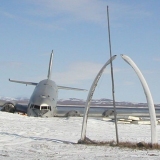
Sat Feb 18, 2012 11:16 am
Re: Crusoe of Lonesome Lake. Bella Coola, BC
Awesome story/vid.
I only knew 2 of Ralph's kids John & Trudy. Stanley died in his outhouse before my time here. Lots of folks/planes from around here went into his (Stillwater) lake & cleaned up after him. (mtns of tin cans, etc) Trudy is still living in Bella Coola, she's the last of the Edwards.
Ol' John was kinda part of the landscape around here for a long time. He's call in here on a handheld FM radio on Sundays & Wed's @ 6pm to let us know he was OK. Whenever he went to "town" he'd stop & share wildlife stories for a couple hours! He had manuscripts & vid's of wildlife that were fascinating & funny. He has proof that discredits written stuff by biologists about several critter types. He used to like to say "They don't know what the hell they're talking about." He was scheduled to give a talk @ our BC Floatplane AGM weekend about 5 yrs ago, but he called Mary & said he was too sick to make the trip. Two days later he died.
He has only been swatted by a griz once, and said he doesn't fault the bear, as he surprised it on the trail. This, in response to my question about the scar on his nose/cheek. He was so proud of the potatoes he raised, but they were awful! We used to fly in boxes of frozen meat scraps for his foxes & pine martens, etc. He'd yack from the time you opened the door until you taxied away! If you ever arrived unannounced tho, he definitely let you know you weren't welcome in his valley! Built a T-Craft & taught himself to fly it. Very well read man. Fascinating character.
If you ever see anything written about the Edwards family (s'pecially John) or about Lonesome Lake, grab it for sure. Fascinating, funny, bazillion stories about life & "activities" on/near the Atnarko river.
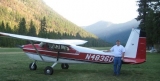
Here's a pic of the ol' phart about 10 yrs ago:

I only knew 2 of Ralph's kids John & Trudy. Stanley died in his outhouse before my time here. Lots of folks/planes from around here went into his (Stillwater) lake & cleaned up after him. (mtns of tin cans, etc) Trudy is still living in Bella Coola, she's the last of the Edwards.
Ol' John was kinda part of the landscape around here for a long time. He's call in here on a handheld FM radio on Sundays & Wed's @ 6pm to let us know he was OK. Whenever he went to "town" he'd stop & share wildlife stories for a couple hours! He had manuscripts & vid's of wildlife that were fascinating & funny. He has proof that discredits written stuff by biologists about several critter types. He used to like to say "They don't know what the hell they're talking about." He was scheduled to give a talk @ our BC Floatplane AGM weekend about 5 yrs ago, but he called Mary & said he was too sick to make the trip. Two days later he died.
He has only been swatted by a griz once, and said he doesn't fault the bear, as he surprised it on the trail. This, in response to my question about the scar on his nose/cheek.
He was so proud of the potatoes he raised, but they were awful! We used to fly in boxes of frozen meat scraps for his foxes & pine martens, etc. He'd yack from the time you opened the door until you taxied away! If you ever arrived unannounced tho, he definitely let you know you weren't welcome in his valley! Built a T-Craft & taught himself to fly it. Very well read man. Fascinating character.If you ever see anything written about the Edwards family (s'pecially John) or about Lonesome Lake, grab it for sure. Fascinating, funny, bazillion stories about life & "activities" on/near the Atnarko river.
Here's a pic of the ol' phart about 10 yrs ago:
- NimpoCub offline
- Posts: 487
- Joined: Thu Dec 22, 2011 1:04 pm
- Location: Nimpo Lake, BC 52.22N 125.14W
- FindMeSpot URL: www.tinyurl.com/loganspot
Nimpo Lake Logan... boonie SuperCubber
Sat Feb 18, 2012 11:30 am
Re: Crusoe of Lonesome Lake. Bella Coola, BC
Sadly, it appears the original homestead was destroyed during a forest fire back in 2004. 
http://www.saltspringnews.com/index.php?name=News&file=article&sid=10478
http://www.saltspringnews.com/index.php?name=News&file=article&sid=10478
Commentary
Lonesome Lake fire: Putting the emotion back into it. Pat Burkette talks to Trudy Turner
Posted at Wednesday, August 04, 2004 - 09:57 AM, by: Jim Scott
The Lonesome Lake fire is still burning having so-far consumed about 200 square kilometres of forest, and is now threatening homes and cabins at Charlotte Lake, near the southern end of Tweedsmuir Park. Pat Burkette, a Salt Spring Island writer, sees the larger issues in the small as her work consistently proves. She is dismayed and felt moved to learn more. Here is the note that accompanies her story.
Below you'll find a story I've written about the loss of Fogswamp in the Lonesome Lake fire. I was interested in what happened, perhaps dismayed by would be a better phrase and got Trudy Turner's number and gave her a call. Perhaps the moment is passed for this story, but I thought maybe you might like it for your site--just wrote it because I wanted to--so if if passes muster, and you want it, go for it.
The moment is not passed. It remains, in our opinion, we should be choking on more than the smoke spreading southward above our province. The condition accompanying this fire offers an essential concomitant--the sum of all factors in our present social situation. The handling of the Lonesome Lake fire is a damning indictment of the fundamental lack of caring within the inner circle of the Campbell coalition and within their ideological ilk worldwide. That is one reason we think this regional circumstance has become an international story.
Pat is not a polemicist. She is a skilled writer who lets the story tell itself. Thanks, Pat, for adding an important dimension to a story that has consumed more than forests, animals, homesteads, and ideas of how we live in this world. Click on full story for Pat's submission.
Fogswamp - a story
By Pat Burkette
Once, in the forested kingdom that is known as British Columbia, there was a place called Fogswamp. A woman lived there, not a princess, although she was skilled with swans. No, this was one real live Canadian woman, who could build a log house, ride a horse, and fly a plane.
Now, Fogswamp is no more. But the woman, whose name is Trudy Turner, is still alive and kicking. Fogswamp was vapourized in the flames of the Lonesome Lake fire, along with The Birches, the Ralph Edwards Lonesome Lake homestead. In the nineteen thirties, Edwards brought the plight of the trumpeter swans, nearing extinction, to public attention. Edwards suggested that since many swans starved to death in harsh winters when their feeding areas stayed frozen, feeding the swans might make the difference to their survival. In 1932/33, The Canadian Wildlife Service appointed Edwards Migratory Bird Warden , with the task of feeding and protecting the flock of trumpeter swans which had wintered at Stillwater and the mudflats of Big Lagoon, Lonesome Lake for as long as people could remember.
Trudy Turner is Ralph Edwards' daughter. She became keeper of the trumpeter swans, carrying on her father's work. Fogswamp was the farm she built up in the wilderness, about a mile and a half away by trail from The Birches, with her husband Jack, and later, her daughter Susan. Trudy built her own log cabin on the property when she pre-empted it in 1951. She completed a second log home following her marriage to Jack in 1957. Trudy wrote a book in 1977 about her experiences, co-authored by Ruth McVeigh, called Fogswamp, Living with Swans in the Wilderness, which is out of print. Fogswamp might sound like a strange name for a farm, but it has nothing to do with the place being foggy or swampy. When Trudy was felling trees, her first dog got caught under an alder and died instantly. In memory of the dog, she named the farm with the dreariest name she could think of at the time, and never changed it.
Nowadays, Trudy Turner lives near Hagensborg, outside Bella Coola. But she went back to Lonesome Lake a week ago, flown in by helicopter, along with her brother John Edwards, who'd continued to live at The Birches, to see what was left of both homesteads. "There's nothing left, not even a charred bit of log left," she said over the phone, her voice strong. And angry.
The smoke was thick as brother and sister tried to view their properties. "What I saw, was a wall of fog, a wall of smoke in front of me. We had to creep along from fir branch to fir branch. You could make out the white line the water leaves along the shore," said Turner. "It needn't have happened," she maintains.
She says that when the fire started on June 21st, the argument that the terrain was too steep for firefighters didn't apply. "It started on relatively flat land. It started on the ridge between Turner Lake and Lonesome Lake. There was no danger when it started. The problem is they didn't want to fight it. They fiddled while Rome burned."
She added emphatically "I hate waste. I hate anything being destroyed. I've had sixty years of living in that valley- that's my home." Turner questions the decision to not fight the fire, reasoning that what was to come was obvious. "That early in the summer, with that magnitude of fuel available and all the heat left to come? It's going to take a thousand years to grow that forest again." Turner says action against the fire was too little too late. "They put retardant on it finally, after it had been burning for a month and a week."
"I've been shocked by the devastation and the lack of caring." Turner is quick to add she doesn't mean caring by the people of the community who have poured out their sympathy to her and her brother. She means the powers that be in government.
What will her brother John do now that his home is gone? "I don't think he knows," says Turner. " All his animals and his tools are gone. He's got 160 acres at Stillwater- he's got that place, but its' right under the fire. Right now, he's in shock. It's just my opinion, but as long as you're in shock, you can cope. He seems quite optimistic to see if he can attract some more furry creatures somewhere."
Trudy sold Fogswamp to the province in 1989, when she and husband Jack were going their separate ways and Trudy was sixty and feeling that if she had to rebuild somewhere, she better do it while she was still able. The trumpeter swans have moved to more coastal areas, like Comox and, they no longer come to Lonesome Lake, where they haven't been winter fed since 1989. Turner says it took from the early thirties to the bottom of the nineteen-fifties to recover any numbers, but even then a group of 30 swans only increased to 45.
Her book tells many stories about her take-over of feeding duties from her father, sometimes in minus thirty degree F temperatures when ice had to be repeatedly broken to keep holes of open water available for the swans to feed. Husband Jack and daughter Susan were a big part of the swan-feeding team. But Turner cautions that the book provides the facts and statistics, but only tells part of the tale. "My book has been castrated. They took my emotions out of it."
She tries to explain those emotions, the family's closeness to nature and animals, recently illustrated by the pictures of John and his fox on tv, during coveage of the Lonesome Lake fire, a closeness that is just part of them, but perhaps unfathomable to city slickers. " City people don't consider a cow a sensitive creature, but cows are quite intelligent," says Turner. If you think about looking out your window and seeing huge, beautiful, white , long-necked birds flying in to where you'll soon be standing on a frozen lake instead of cars and trucks and people, maybe you'll understand how Turner's life has been different than yours.
That life has been led near water, first beside Lonesome Lake and now by the Saloompt River outside Hagensborg. She's been flooded out a couple of times in-between when she tried to build a home on low lying areas. When I say it seems both sad and odd that such a water person has been hit so hard by fire, Trudy says "It must be something about me." Fire has hit the Edwards family before.
"Six months after I was born, the house burned. John was about three years old and he was sick. He wanted to watch our mother work while he was lying down, so she pulled a curtain back from his sleeping area, and then went down to the cellar to get something. When she came back, the room was on fire, the curtain must have touched a lamp. She got us out of there. She crossed the creek with us. This was in November, and the fire didn't go anywhere. All our food was gone. All we had for a house was an eight- by- ten trapper's cabin that was there when Daddy got his pre-emption. We got through the winter."
Trudy still lives close to nature. She has to use a cane, and she packs in her water in buckets. She has a cow, a calf, a horse and an aged dog. She built her current 4800 sq. ft. home herself from logs.
And Trudy quickly demonstrates that the pioneering spirit of the Edwards family, that intangible tough stuff that kept them going in the wilderness, didn't go up in flames along with The Birches and Fogswamp. She says the Lonesome Lake fire has been a wake-up call.
She's looking at pushing nature back a bit around her place. with an eye to fire safety. She's removed all the coniferous trees from near the house. "It was demonstrated on John's trail (into The Birches), where grass grew," she says, "Most of that trail stayed green, yet the fire took away all the fields of dead grass and brush around the place. If you maintain green grass, you might stop your fire."
Sat Feb 18, 2012 1:23 pm
Re: Crusoe of Lonesome Lake. Bella Coola, BC
I used to fly over their place a lot when coming in from the Fraser River/Williams Lake pre-GPS days. If the WX was down I'd hug Hwy 20 until I got to Charlotte Lake, cross the lake and squirt through the notch on the west side, then fly the the hillside down to the Atnarko River, and just follow the water to Hagensborg. What a beautiful trip that is.
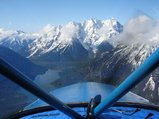
Hunlen Falls

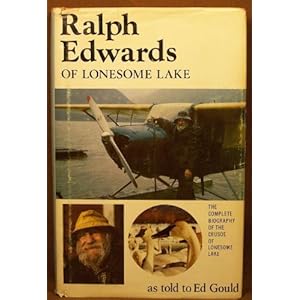
Ralph at the old Bella Coola float dock.
Gump
Hunlen Falls
Ralph at the old Bella Coola float dock.
Gump
Sat Feb 18, 2012 7:58 pm
Re: Crusoe of Lonesome Lake. Bella Coola, BC
Thanks Gump,
I gave up on TV several years ago and enjoy stuff like this that Hollywood has not tarnished.
Long live the T-Craft.
46tcrft
I gave up on TV several years ago and enjoy stuff like this that Hollywood has not tarnished.
Long live the T-Craft.
46tcrft
Sat Feb 18, 2012 8:39 pm
Re: Crusoe of Lonesome Lake. Bella Coola, BC
I think I got 37 minutes in and got called away. I really enjoyed it so far. When I was a high schooler I dreamt of living that sort of life. Adolf Muir in Alaska with the bears. I must have read that book ten times. John Muir in Yosemite. Somehow I never heard of that guy and his family. I't's quite a story. I feel bad for the daughter though. Dad took the airplane away.
Sat Feb 18, 2012 8:45 pm
Re: Crusoe of Lonesome Lake. Bella Coola, BC
Nice pic of the falls Gump. That's about 20 mins from my dock, & about 5 mi. from ol' John's cabin site. John said he'd only killed ONE griz, and that's because he couldn't chase it out of his kitchen! Foxes & martens were welcome in there tho. He was very proud of his rustic home, and had designed & built a generator with water power coming down a long ABS pipe from a creek above. He had a huge stash of clear cedar cants (about 10X12 timbers) stacked in the old barn that were cut (mostly) by hand many years ago. It was awesome to just stare at that treasure.
When the fire started on the ridge near Hunlen falls, (lightning strike) one neighbor here reported it to Parks & fire control, but the Parks policy is to let fires burn in the parks, as it's a natural phenomenon. They'd send in crews & copters to save buildings & "improvements" that were authorized, but Parks & John had a longstanding feud, so they just let his place burn down. That's why everyone is so pissed. He hired a liar in Vancouver to "deal with" Parks, and he made an agreement on John's behalf without consulting John, so John hired another liar to sue the Vancouver one. When the smoke cleared, his "Birches" property went to some nature conservency & NOT revert to Parks (which is what Parks wanted).
After the burn, John built a 8X16 shack to live in until he decided what he wanted to do. That's still there.
I've done the "B Coola loop" a few times, I like going up over Ape lake & over the Monarch icefields & then down to So. Bentick arm & then up the Atnarko valley to either hiway 20 or Charlotte lake. Haven't been over to your side of the inlet tho. Here's a pic of "beautiful downtown Bella Coola"

When the fire started on the ridge near Hunlen falls, (lightning strike) one neighbor here reported it to Parks & fire control, but the Parks policy is to let fires burn in the parks, as it's a natural phenomenon. They'd send in crews & copters to save buildings & "improvements" that were authorized, but Parks & John had a longstanding feud, so they just let his place burn down. That's why everyone is so pissed. He hired a liar in Vancouver to "deal with" Parks, and he made an agreement on John's behalf without consulting John, so John hired another liar to sue the Vancouver one. When the smoke cleared, his "Birches" property went to some nature conservency & NOT revert to Parks (which is what Parks wanted).
After the burn, John built a 8X16 shack to live in until he decided what he wanted to do. That's still there.
I've done the "B Coola loop" a few times, I like going up over Ape lake & over the Monarch icefields & then down to So. Bentick arm & then up the Atnarko valley to either hiway 20 or Charlotte lake. Haven't been over to your side of the inlet tho. Here's a pic of "beautiful downtown Bella Coola"
- NimpoCub offline
- Posts: 487
- Joined: Thu Dec 22, 2011 1:04 pm
- Location: Nimpo Lake, BC 52.22N 125.14W
- FindMeSpot URL: www.tinyurl.com/loganspot
Nimpo Lake Logan... boonie SuperCubber
Wed Feb 26, 2014 1:03 am
Re: Crusoe of Lonesome Lake. Bella Coola, BC
Here's a pic of "beautiful downtown Bella Coola"
Man oh man... In that pic, the Bella Coola River runs to the ocean water from left to right, with the Burke Channel a mile or two away, and the airport up in Hagensborg ten miles up river. I've made trips from my place on the Dean Channel when the wx was down (in the days before there were sat phones to get wx reports) flying up that river to the airport where I'd be looking up the bank at the trees and buildings. Unlike the Arctic, surrounded by all that big narrow rock, you didn't dare lose ground contact. Once airborne you were committed. No wires to hit in those days, and I'd drive that C180 at 20 feet for 80 miles. Rock on the left wing going to town, rock on the right wing going home. Literally... Dean Channel to Labouchere Channel to the Burke Channel, then up the Bella Coola River. Who needs GPS?
Gump
Man oh man... In that pic, the Bella Coola River runs to the ocean water from left to right, with the Burke Channel a mile or two away, and the airport up in Hagensborg ten miles up river. I've made trips from my place on the Dean Channel when the wx was down (in the days before there were sat phones to get wx reports) flying up that river to the airport where I'd be looking up the bank at the trees and buildings. Unlike the Arctic, surrounded by all that big narrow rock, you didn't dare lose ground contact. Once airborne you were committed. No wires to hit in those days, and I'd drive that C180 at 20 feet for 80 miles. Rock on the left wing going to town, rock on the right wing going home. Literally... Dean Channel to Labouchere Channel to the Burke Channel, then up the Bella Coola River. Who needs GPS?
Gump
Wed Feb 26, 2014 11:17 am
Re: Crusoe of Lonesome Lake. Bella Coola, BC
Logan: The animals are one of many things we miss about BC. Feeding the foxes and martins by Ralph brings fond memories back. In the winter we feed lots of birds. An unpleasant result of the bird feeding is the rats and mice that swing by for a meal, to date this season, N the body count is 147 mice and 38 rats!! No snakes, yet.


- FloatFlyer offline
- Posts: 438
- Joined: Tue Dec 13, 2005 9:42 pm
- Location: Whidbey Island, WA,
Wed Feb 26, 2014 11:35 am
Re: Crusoe of Lonesome Lake. Bella Coola, BC
That was a great story.
Having gotten just a taste last year, I cannot wait to return to BC. One of these days I will call upon my BCP friends in BC and try to link up a circuitous route of some sort. Floatflyer, you left too soon.
Having gotten just a taste last year, I cannot wait to return to BC. One of these days I will call upon my BCP friends in BC and try to link up a circuitous route of some sort. Floatflyer, you left too soon.
- Zzz offline


- Posts: 2855
- Joined: Fri Oct 08, 2004 11:09 pm
- Location: northern
- Aircraft: Swiveling desk chair
Half a century spent proving “it is better to be thought a fool than to open your mouth and remove all doubt.”
DISPLAY OPTIONS
Who is online
Users browsing this forum: No registered users and 2 guests
Latest Features
-
Live to Tell
A Minnesota pilot is surprised to learn that the sudden asymmetric drag of an out-of-rig ski can…Read More -
Creators
Working in some of the Yukon's most beautiful and remote environments, photographer Simon Blakesley captures aircraft in…Read More -
Aircraft Ownership and Maintenance
Upgrading to big tires can make a huge difference in backcountry performance, but with those gains come…Read More -
Tales from Yesteryear
In this tale from bush flying yesteryear, Don Cogger signs up to help Atlee Dodge Jr recovery…Read More


Latest Knowledge Base
-
Destinations
A regional guide with ideas for winter camping destinations in California, Nevada, New Mexico, and Arizona.Read More -
Aircraft
Finding an affordable aircraft that can handle the backcountry for $80K or less? A challenge for sure, but with the…Read More -
Aircraft
01.29.2018 - Zane - Updated tire diameter graphic to add 8.50x10 Guide to tires for use in the backcountry and off-airport landing…Read More -
Pilots
12.22.2013 - Initial article format Operating aircraft on skis and negotiating a snow-covered landscape is an entirely unique skillset and environment.…Read More


