Just an old man havin' some late nite fun:
But I have flown a few miles with a Kiwi.
Did his first test flight after an early Bush 180hp-cs conversion in his C170-B.
Did first set of marketing photos for his, then new, Avion custom panel business.
Hired him several times for Mech. Eng. of test equipment for AMAT.
Jolly nice guy. Afraid to fly in the dark though.
Wannabe flying in May.
LSA at least.
Chris C
PS: Now if this site wasn't limited to flying I could write up at least one
story about a couple "dumb" Kiwis on the Royal Arches climb in Yosemite.
Late 60s - early 70s. Actually there was a wee bit O' wingless flyin'
Energy maneuverability
Thu Apr 20, 2017 11:03 pm
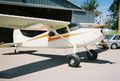
53 C-170-B+
It is better to be late in this world, than early in the next.
It is better to be late in this world, than early in the next.
Fri Apr 21, 2017 2:43 am
Re: Energy maneuverability
Nothing like a big whipper on dodgy gear to build character.
Fri Apr 21, 2017 10:45 pm
Re: Energy maneuverability
Some of the new GPS stuff can be programed to show what runways you can reach when you fly high. What everyone has to think about is what happens when I can't reach a runway. Roads, fields, water, brush, tundra, sandbars, trees, and swamps. All of that depends on plane, speed and time of year!!! In a cub I would take a road but look out for signs and wires, field with the low stuff are great, take a lake/river in winter most anyday, sandbars go away every now and then, old Alaska saying is avoid the Green trees (time of year thing), you will go over in a swamp but at least ya did not hit the real green trees!!! We all fly parts of the world with no good landing spot!!! Understanding Energy maneuverability means the difference between walking away (ya maybe with help) and being on 6PM news as a fatal crash. Most people never fly on the edge of what the plane will do. Go high and figure out what the plane will do!!! I have saved my plane (pacer/cub) and myself more than once on trusting on Energy maneuverability. FLY TO THE CRASH SITE AND LAND SLOW!!
DENNY
DENNY
DENNY
Sat Apr 22, 2017 8:44 am
Re: Energy maneuverability
John Boyd's theory is much less useful in a general aviation airplane than it is when considering maneuver capability of one high performance aircraft compared to another when they are both working as designed. What we really care about is how LITTLE energy we have when things are not working as planned. The engine failures I have had almost all initially had (so far) an initial reduction in power produced before they quit all together. Generally speaking, we need to make two good decisions when the fan quits- the initial decison on where we are going (happens when the first sputter happens), and the last decision (very near the ground) which should result in us hitting the smallest object available with the slowest speed possible, with anything except the center of the airplane. In my mind, I need to know two things - the difference in my glide capability between cruising straight and level at cruise speed, and glide distance in straight and level flight at a speed equal to the speed I fly final. Instead of trying to come up with complex energy theory, I generally use my wingtips as my reference point. In a Stearman, I can glide to most things that are as far as where the flying wires connect on the wings (roughly as far as you can drop a brick). In a bonanza in cruise configuration I can glide just past the end of the wingtips. Once I know these rough distances, I figure out what the final approach speed distance is and my "energy maneuveribility" problem is visually represented with something that works at most altitudes and airspeeds. Contemplating excess energy, glide ratios, turn radiuses, etc is fun to do when the weather sucks, but I am certainly not smart enough to have an emergency and do math in public.
Sat Apr 22, 2017 11:13 am
Re: Energy maneuverability
Silflexer,
I agree it not a time for math. All but two of my forced landings were less than six second deals. The safe orientation, for those who fly low, is management of energy available to maneuver to the survivable landing. Proficiency and currency with both energy management turns and full flap, full slip to maintain a brisk walk apparent rate of closure to the desired touchdown spot is most useful. None of that can be mathed out, just practiced and sorted out.
Before John Boyd came up with the design evaluation he called energy maneuverability, he learned and taught what I call energy management to defeat pilots in superior energy maneuverability airplanes in forty seconds. Energy in various forms can be used in various ways. Having no money for extra engine horsepower can be a good teacher of this.
I agree it not a time for math. All but two of my forced landings were less than six second deals. The safe orientation, for those who fly low, is management of energy available to maneuver to the survivable landing. Proficiency and currency with both energy management turns and full flap, full slip to maintain a brisk walk apparent rate of closure to the desired touchdown spot is most useful. None of that can be mathed out, just practiced and sorted out.
Before John Boyd came up with the design evaluation he called energy maneuverability, he learned and taught what I call energy management to defeat pilots in superior energy maneuverability airplanes in forty seconds. Energy in various forms can be used in various ways. Having no money for extra engine horsepower can be a good teacher of this.
- contactflying offline
- Posts: 4972
- Joined: Wed Apr 03, 2013 7:36 pm
- Location: Aurora, Missouri 2H2
Download my free "https://tinyurl.com/Safe-Maneuvering" e-book.
Mon May 15, 2017 7:18 pm
Re: Energy maneuverability
TommyN wrote:Thanks for your post and helpful additions to terminology. I beg to differ however on gravity not producing thrust. Thrust is simply a force; there need not be an opposing reaction as in a jet engine. If gravity did not produce thrust, gliders could never go forward. If you look at the gravity vector, it can be resolved into a force along the flight path and one normal to it. The first of these is thrust and keeps the glider flying forward.
Blue skies,
Tom
I received a nice PM (which I unfortunately deleted) indicating that I am all wet on my statement above. Thanks to the PM sender. Thrust is an aviation term and gliders have no thrust involved unless they are motor gliders. I was thinking of the component of lift along the flight path. And gravity only points straight down; always. I must have had a few too many of something when I posted the above. Sorry.
Tom
Mon May 15, 2017 7:47 pm
Re: Energy maneuverability
I can go back to zoom reserve in the form of altitude rather than gravity thrust, but let's not lose sight of gaining the energy to maneuver by pitching down. Going slow is helpful in making tight turns if we replace the lost lift by pitching down (the airplane is designed to do this naturally. ) Going slow is helpful for soft landing. Otherwise zoom reserve in the form of airspeed is most helpful for safe maneuvering.
I am good with any terminology that can get the idea across.
I am good with any terminology that can get the idea across.
- contactflying offline
- Posts: 4972
- Joined: Wed Apr 03, 2013 7:36 pm
- Location: Aurora, Missouri 2H2
Download my free "https://tinyurl.com/Safe-Maneuvering" e-book.
Tue May 16, 2017 4:38 am
Re: Energy maneuverability
It's all just a balance of kinetic (airspeed) and potential (altitude) energy.
Trading them back and forth is good technique when you're power limited - just make sure you aren't wasting one or the other. The energy checkbook should balance at the end of each maneuver.
Trading them back and forth is good technique when you're power limited - just make sure you aren't wasting one or the other. The energy checkbook should balance at the end of each maneuver.
- CamTom12 offline

- Posts: 3705
- Joined: Sun Jul 08, 2012 1:08 pm
- Location: Huntsville
- FindMeSpot URL: https://share.delorme.com/camtom12
- Aircraft: Ruppe Racer
Experimental Pacer
home hand jam "wizard"
Sat May 20, 2017 9:48 pm
Re: Energy maneuverability
Two different but similar post tramatic stressors are responsible for my huge concern with being able to use all energy available to maneuver the aircraft successfully at all times: getting an overloaded 235 HP spray plane over fences and trees on my way to the field and getting home from a drill weekend over the Continental divide in summer.
The divide doesn't seem that impressive between Santa Fe and Gallup. Most would just go high. My problem was high DA, shallow valleys, small engines, and southwest winds that made getting onto the ridge running north from Mt Taylor difficult. Arroyo Chico is not in the bottom of a deep valley like rivers further north. Finding ridge lift was difficult and the vertical space available between it and ceiling was small. Full throttle and Vy to stay level didn't give much airspeed or altitude to work with. Managing thermals (slow in updrafts and fast through downdrafts) was helpful, but I had to stay out of really strong prevailing SW winds up high to get home before dark (no electricity.)
It made me aware of all forms of energy, even ground effect on the high mesa system north of I-40.
The divide doesn't seem that impressive between Santa Fe and Gallup. Most would just go high. My problem was high DA, shallow valleys, small engines, and southwest winds that made getting onto the ridge running north from Mt Taylor difficult. Arroyo Chico is not in the bottom of a deep valley like rivers further north. Finding ridge lift was difficult and the vertical space available between it and ceiling was small. Full throttle and Vy to stay level didn't give much airspeed or altitude to work with. Managing thermals (slow in updrafts and fast through downdrafts) was helpful, but I had to stay out of really strong prevailing SW winds up high to get home before dark (no electricity.)
It made me aware of all forms of energy, even ground effect on the high mesa system north of I-40.
- contactflying offline
- Posts: 4972
- Joined: Wed Apr 03, 2013 7:36 pm
- Location: Aurora, Missouri 2H2
Download my free "https://tinyurl.com/Safe-Maneuvering" e-book.
Thu Jun 01, 2017 12:02 pm
Re: Energy maneuverability
CamTom12 wrote:It's all just a balance of kinetic (airspeed) and potential (altitude) energy.
Trading them back and forth is good technique when you're power limited - just make sure you aren't wasting one or the other. The energy checkbook should balance at the end of each maneuver.
This is how I learned it in physics, using the roller coaster analogy. Sitting at the top of a giant peak that your roller coaster has just peaked with nearly zero speed it is sitting on a ton of Potential Energy (PE). If you're sitting in a piper cub at 5000' AGL but just above stall speed you are still in possession of a ton of PE.
As your roller coaster rushes down hill it trades PE for Kinetic Energy (KE). At the very bottom it has expended all of the PE for KE. If there were zero wind resistance and no losses from the wheels the coaster could now rush back upward to crest another peak of the same height, exchanging all of it's KE for PE again.
Rinse Repeat.
Low and slow: You have no KE or PE in reserve (Contacts "zoom energy" - you have nadda).
Low and fast: You have KE you can spend on getting altitude (PE) or burning it off in a maneuver.
High and slow: You have great PE but no KE. No shame in this condition most of the time. That is, unless you wish you had more of that PE stuff (i.e. there's a mountain pass ahead and you're climb performance is pathetic).
High and fast: King S***, welcome to the Air Force. The advantage in any dogfight is from above your opponent and with greater KE.
Thu Jun 01, 2017 8:49 pm
Re: Energy maneuverability
contactflying wrote:Energy in various forms can be used in various ways. Having no money for extra engine horsepower can be a good teacher of this.
The words I live by!
- ShadowAviator offline
- Posts: 191
- Joined: Thu Feb 20, 2014 3:30 pm
- Location: Waldo
- Aircraft: 1969 C-172K "Valor"
SERVICE CEILING -noun - The altitude at which the pilot starts smacking the dash, exclaiming, "CLIMB OL' GIRL CLIMB!"
DISPLAY OPTIONS
Who is online
Users browsing this forum: No registered users and 5 guests
Latest Features
-
-
Featured Bush Planes
As one of the undisputed legends of bush flying, the Cessna 180 hauls a…Read More -
Aircraft Ownership and Maintenance
9 modification mistakes aircraft owners make when trying to "bush out" their birds—why some…Read More -
Live to Tell
A Minnesota pilot is surprised to learn that the sudden asymmetric drag of an…Read More


Latest Knowledge Base
-
Destinations
Canada offers some of the most spectacular backcountry flying on the continent. Here's what you need to know before you go.Read More -
Safety and Survival
Hope that you never have to use your survival vest but knowing you have it and knowing how to use…Read More -
Destinations
A regional guide with ideas for winter camping destinations in California, Nevada, New Mexico, and Arizona.Read More -
Aircraft
Finding an affordable aircraft that can handle the backcountry for $80K or less? A challenge for sure, but with the…Read More