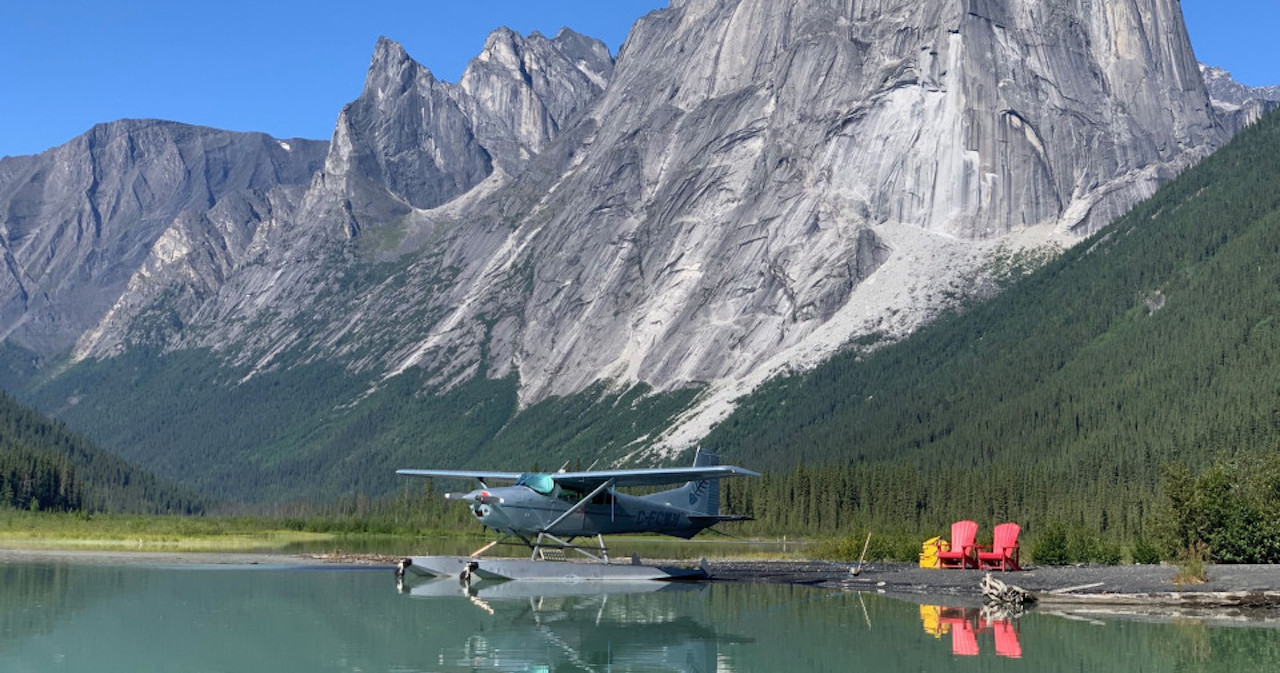
I watched a pilot come very close to crashing an bush plane on take off from a 3700 foot paved runway with virtually no wind. It was a collection of poor decisions, each of them easy enough to make on their own, that almost cost him his airplane, if not a lot more.
The runways are 25 and 07. There’s a dip in the runway towards the west end, so 25 is a predominantly downhill runway, and 07 is downhill for a short distance, then uphill. Take-offs from 25 go towards descending terrain. Takeoff’s from 07 go into a valley with ascending terrain on each side and a cannel in the bottom. Pictures of airplanes in the cannel are not unknown.
There was maybe a two-knot wind favoring 07 for departure, and while the field is only at 1,500 feet, DA was closer to 5,000 feet.
The pilot, probably thinking that a bush plane like his doesn’t need anything close to 3,700 feet of runway, decided to make a intersection departure on 07. Not only did that cut off more than 1,000 feet of usable runway, but he had to start his departure roll going UPHILL, where if he had gone to the end of 07 he would have started his departure roll going down hill.
As he (slowly) got towards the end of the usable pavement he was really trying to horse the airplane off the ground, further increasing his ground roll. He made it, but it was a hell of a lot tighter than it needed to be, or should have ever been. It was tight enough that people watching got that blank, disconnected look people get when they know what's coming but don't want to admit it until they have to. I think another hundred pounds in the airplane would have doomed him.
Obviously, the intersection departure was the spectacularly dumb decision. But there’s more…
“Always take off and land into the wind” is fantastically poor advice that far too many pilots don’t question. It takes a significant amount of wind to make up for a little bit gradient. If you want to prove it to yourself, try pushing your airplane up even a tiny incline, then turn it around and push it back down. Given the very light wind, high DA and runway layout, there was absolutely no reason for airplanes to be using 07 just because "winds favor it".
A few knots on the tail is negligible if you can take off downhill or land uphill. It's also negligible if you get to choose between taking off into descending terrain with no air current generators verses a valley with ascending terrain and a cold water sink at the bottom.
And obviously, the pilot had no concept of what the DA was, or what the impact on his ground roll was going to be. Sad, considering that they announce the DA on the AWOS when it gets that high. Usually when there's a special announcement on the AWOS, it's worth paying attention to, though how anyone could have walked from the restaurant to a parked airplane without realizing that it's almost 100 degrees is beyond me.
I think the really insidious part about all this is that it's likely the pilot knows all of this, but because he was flying a bush plane off a long, wide, paved runway at low altitude, he ignored it.
I realize how ridiculously idealistic and naive this is, but I just expected better out of a tailwheel pilot flying a classic bush plane. Glad it worked out for him, and I hope the lesson sunk in.
Flawed decisions, near crash.
Thu Aug 03, 2017 1:09 pm


Thu Aug 03, 2017 4:34 pm
Re: Flawed decisions, near crash.
Thanks for posting.
The Maule and I will commonly use intersection departures on longer paved runways when convienent, but I will still allow at least twice the runway I need. If I'm at the midpoint of a 4000' runway I may take off in the middle, all else being equal and conditions permitting.
This guy did not have my criteria of twice the necessary strip available met and nearly screwed the pooch.
Also, downhill takeoff roll and descending terrain trumps a mild headwind on the opposite runway.
The Maule and I will commonly use intersection departures on longer paved runways when convienent, but I will still allow at least twice the runway I need. If I'm at the midpoint of a 4000' runway I may take off in the middle, all else being equal and conditions permitting.
This guy did not have my criteria of twice the necessary strip available met and nearly screwed the pooch.
Also, downhill takeoff roll and descending terrain trumps a mild headwind on the opposite runway.
- Mountain Doctor offline
- Posts: 641
- Joined: Fri May 01, 2015 3:33 pm
- Location: Richland
- Aircraft: Maule MXT-7 180A
Thu Aug 03, 2017 4:36 pm
Re: Flawed decisions, near crash.
Also, DA will bite you in the ass and deserves more respect than this pilot gave it.
Location of little wheel not withstanding.
Location of little wheel not withstanding.
- Mountain Doctor offline
- Posts: 641
- Joined: Fri May 01, 2015 3:33 pm
- Location: Richland
- Aircraft: Maule MXT-7 180A
Thu Aug 03, 2017 5:08 pm
Re: Flawed decisions, near crash.
What kind of bush plane needs 2,700 to take off at 5,000 density? That's a *long* way. I wouldn't hesitate to bring my Maule into a strip like that if it was another thousand feet shorter. I wonder if his mixture wasn't set right.
- rw2 offline
- Posts: 1799
- Joined: Sat Dec 22, 2012 1:10 pm
- Location: San Miguel de Allende
- FindMeSpot URL: https://share.delorme.com/LaNaranjaDanzante
- Aircraft: Experimental Maule
Follow my Flying, Cooking and Camping adventures at RichWellner.com
Thu Aug 03, 2017 5:17 pm
Re: Flawed decisions, near crash.
rw2 wrote:What kind of bush plane needs 2,700 to take off at 5,000 density? That's a *long* way. I wouldn't hesitate to bring my Maule into a strip like that if it was another thousand feet shorter. I wonder if his mixture wasn't set right.
Can't speak to the mixture, but he had closer to 2,400 feet usable, and rolling uphill, even a little, makes a hell of a big difference.
Thu Aug 03, 2017 6:34 pm
Re: Flawed decisions, near crash.
Using techniques that glean every bit of available energy on every takeoff don't make so much difference on most takeoffs, just some.
- contactflying offline
- Posts: 4972
- Joined: Wed Apr 03, 2013 7:36 pm
- Location: Aurora, Missouri 2H2
Download my free "https://tinyurl.com/Safe-Maneuvering" e-book.
Thu Aug 03, 2017 6:36 pm
Re: Flawed decisions, near crash.
Scary learning experience. I had an "interesting" landing experience at KAUN by landing 7 when the wind was a couple of knots "favouring 7". I made such a pretty pirouette as I came to a stop where the downhill transitions to level.
100 degrees 4th of July at Bryant (O57) couple hundred pounds under gross was a wake up call to DA and 40 degrees at Truckee way under gross was another "Hey, this is way different than sea level" in my Maule MX-180.
Yeah, I am a tail wheel pilot with more than a 1000 hours in tail wheels and a glider rating but that doesn't mean common sense or a good stick: I try to not get into trouble by being paranoid and well-prepared.
My instructor never let me forget that runway ahead of me was a good thing.
So after all this prologue, I was at KPIH and tower offered me an intersection takeoff on a 9000' runway because it was a long taxi back and I declined. Unfortunately I did not ask for tower guidance and I wound up going too far encroaching on the 35 approach. Maybe because I turned on a dime when tower chastised me, nothing more happened (yeah tailwheel).
My two cents: there are innumerable ways to screw up. I hope to be lucky enough to survive and not repeat the mistake. I keep trying to be among those who learn from others.
100 degrees 4th of July at Bryant (O57) couple hundred pounds under gross was a wake up call to DA and 40 degrees at Truckee way under gross was another "Hey, this is way different than sea level" in my Maule MX-180.
Yeah, I am a tail wheel pilot with more than a 1000 hours in tail wheels and a glider rating but that doesn't mean common sense or a good stick: I try to not get into trouble by being paranoid and well-prepared.
My instructor never let me forget that runway ahead of me was a good thing.
So after all this prologue, I was at KPIH and tower offered me an intersection takeoff on a 9000' runway because it was a long taxi back and I declined. Unfortunately I did not ask for tower guidance and I wound up going too far encroaching on the 35 approach. Maybe because I turned on a dime when tower chastised me, nothing more happened (yeah tailwheel).
My two cents: there are innumerable ways to screw up. I hope to be lucky enough to survive and not repeat the mistake. I keep trying to be among those who learn from others.
Thu Aug 03, 2017 6:44 pm
Re: Flawed decisions, near crash.
What make / model aircraft?
For instance, maybe you wouldn't think twice about accepting the take-off option you describe in a Helio, but in a Skyhawk you never would.
For instance, maybe you wouldn't think twice about accepting the take-off option you describe in a Helio, but in a Skyhawk you never would.

Thu Aug 03, 2017 7:27 pm
Re: Flawed decisions, near crash.
I was off in about 1500 ft in my Maule MX-180C at KPIH. I never had a problem getting off any runway. Going anywhere afterwards...
Clearing the mountains that were well above the runway did take some time at Bryant and Sierraville with high DA.
I just screwed up the other way in asking for the entire length at Pocatella (KPIH) but wound up encroaching on the intersecting runway approach.
Clearing the mountains that were well above the runway did take some time at Bryant and Sierraville with high DA.
I just screwed up the other way in asking for the entire length at Pocatella (KPIH) but wound up encroaching on the intersecting runway approach.
Fri Aug 04, 2017 7:21 am
Re: Flawed decisions, near crash.
Hammer wrote:...rolling uphill, even a little, makes a hell of a big difference.
Yeah, and some of us flying "lower power" older airplanes find that an attempt at "uphill" takeoff affects our ground roll even more than it would in a more "normal power" airplane...
My little O-200 powered Citabria 7ECA has fairly anemic acceleration and climb rate, even on cool days at lower altitudes. At my home airport (paved, level runway) I routinely takeoff and land using < 1000 ft of runway, even in the summer (100-105º F, for a DA of ± 4000 feet).
But I was not mentally prepared for the impact on performance that a moderate uphill slope makes!
I recently took off from a towered field that has a "slight" upslope (first 1/3 of the runway in use). There was enough traffic in the pattern that I didn't even bother asking the tower for an "opposite direction" takeoff. The insidious factor here is that I've landed and taken off from this airport many times in the past, both with the 150-HP Grumman and with the 260-HP Commander 114. Never had any issue, and both of those airplanes had longer ground rolls than does the Citabria. (Though In hindsight, I'm not sure I ever had to takeoff in the "uphill" direction in either of those airplanes.) So I wasn't even vaguely thinking about the impact that initial uphill grade would have on my takeoff roll in the Citabria.
I started my takeoff roll from the end of the runway, at the bottom of the "hill"... Went to full power, confirmed static RPM was good, oil pressure in the green, no missing or hesitation from the engine. It took longer than normal for the airplane to start moving. Acceleration was leisurely at best. In this plane, I can normally count 5-6 seconds after going to full power before the elevator starts to lift the tail. Then there is another 5 seconds or so rolling on the mains before it achieves liftoff speed. But this time, I was well beyond 15 seconds, and the tailwheel was still glued to the ground... I don't believe the plane got any faster than a slow jogging pace until the runway began to level off at the crest of that up-slope - roughly 1000 feet from the starting point. When I was at 15 seconds, and moving barely faster than a brisk walk, I found myself racking my brain to remember the rule of thumb on aborting takeoffs: Thou shalt have 70% of liftoff speed by the runway mid-point, or though must abort thy takeoff. I was scrambling to mentally calculate that airspeed, instead of having it thought out ahead of time... That "70%" speed for my 7ECA is only 39 mph. So you can imagine the blistering acceleration – or lack thereof – I was experiencing. And that was with my tires inflated to the "book" recommended pressure, for minimal rolling resistance.
Fortunately, once I hit the crest of that hill, normal acceleration resumed, and I was off the ground well before the runway mid-point (1500 ft total). But it was an eye-opening experience for me, that reminded me that I still have much to learn...
So at this point, with this airplane, I would be far more likely to take off with a 10-knot tailwind versus trying to takeoff on an up-sloping runway.
I figure the 10 knot tailwind (20% of my landing speed) will add about twice that amount, or 40% to my takeoff distance. That's about a 400-foot additional ground roll for this plane, whereas the uphill slope will almost certainly add a LOT more than that based on my experience above.
Your airplane may have more "surplus" power, a better prop, and even a better pilot than mine, but the laws of physics still apply. It takes a LOT more power to accelerate an object uphill than it does on level or downhill slopes. I'm just glad I got the opportunity to learn this lesson in a fairly benign environment, instead of learning it "the hard way" as the guy almost did in Hammer's report...

Fri Aug 04, 2017 10:36 am
Re: Flawed decisions, near crash.
DA is really a silent killer. You can couple it with several factors to add up to "golly, that was dumb" scenario. Up here in Flagstaff, DA gets somebody nearly every month of the year (they depart the runway at other than the taxiways). In the summer we are frequently at DA's of 10,000'+. Folks tend to forget leaning, killed one Bonanza driver with that 3 years ago. Wind is a factor, your controls lose effectivity at altitude, just like the wing loses lift. Weight, your manual really does not give you a distance or compensation correction for weight at altitude. Slope, go to some of the more challenging runways in the world, like Narsarsuaq, Greenland. It is such the you can only take off and land in one direction (there is the giant fiord cliff to consider as well). It falls at 100' per thousand over 5,000'. You are literally standing on the brakes to stop before you dip into the chilly fiord, with appropriate icebergs floating about and have significant power to taxi back to the ramp (takeoff roll is quite short as well).
So what that person did was classic. Slight arrogance of what a "Bush" plane can do leads to a series of bad decisions. You can't get that runway you left behind. The takeoff might have looked sportier going downhill. 2 kts of wind, well within the measurement error of the instrument taking the measurement. So essentially no wind. Playing lifty tricks on takeoff, well some are as effective as some of those speed kits that make your aircraft all sorts of its faster. From my personal experience, taking off every day on a 105' runway in a 56,000 lbs aircraft, we did exactly the same thing every time, no variation. What works, works. The few that tried something different where excellent swimmers.
Accidents, without exception happen due to a series of poor decisions. It isn't just one that gets you, and to be fair sometimes other people get to participate as well in that series. So now, perhaps that person is a much wiser pilot. Dumb stuff you live through make you better, provided you realize it. Some of the things in the military make sense, for example, flathatting, showing off in your plane, is an offense that you immediately lose your wings, no exception. Why, it is chronic, the people that do it never learn from the bad decisions of others or themselves. Think B52 on a knife edge turn close to the ground at an airshow.
So what that person did was classic. Slight arrogance of what a "Bush" plane can do leads to a series of bad decisions. You can't get that runway you left behind. The takeoff might have looked sportier going downhill. 2 kts of wind, well within the measurement error of the instrument taking the measurement. So essentially no wind. Playing lifty tricks on takeoff, well some are as effective as some of those speed kits that make your aircraft all sorts of its faster. From my personal experience, taking off every day on a 105' runway in a 56,000 lbs aircraft, we did exactly the same thing every time, no variation. What works, works. The few that tried something different where excellent swimmers.
Accidents, without exception happen due to a series of poor decisions. It isn't just one that gets you, and to be fair sometimes other people get to participate as well in that series. So now, perhaps that person is a much wiser pilot. Dumb stuff you live through make you better, provided you realize it. Some of the things in the military make sense, for example, flathatting, showing off in your plane, is an offense that you immediately lose your wings, no exception. Why, it is chronic, the people that do it never learn from the bad decisions of others or themselves. Think B52 on a knife edge turn close to the ground at an airshow.
Fri Aug 04, 2017 10:48 am
Re: Flawed decisions, near crash.
I've taken off at some long paved California and NM mountian airports on 100 degree days with near 10,000' DA's and was dismayed to see ground rolls of about 1,500'+ in my semi low powered Maule.
- Mountain Doctor offline
- Posts: 641
- Joined: Fri May 01, 2015 3:33 pm
- Location: Richland
- Aircraft: Maule MXT-7 180A
Fri Aug 04, 2017 10:50 am
Re: Flawed decisions, near crash.
Years ago, I took off from Stehekin Washington in my O-300 powered Cessna 170 at about 150 lbs under gross weight.
The field elevation is 1230 ft and the temperature was about 90 degrees F. The density altitude was under 4000 feet, which was perfectly fine for my ship at this weight departing a 2600 foot strip with obstacles at 3000 feet from the departure end.
The grade of the 2600 foot strip is slight and the wind was strong and steady (10-15 knots) blowing downstream, clearly favoring an upstream departure.
I lifted off after about 800 ft of ground roll and accelerated in ground effect for another thousand feet, and all was normal. I then began to climb out of ground effect to clear the tall trees at the departure end by turning all of the kinetic energy that I had accumulated in to the potential energy of 150 feet of altitude. I found myself 20 feet higher than the trees and behind the power curve struggling to maintain altitude. We simply couldn't climb because we were in a steady downdraft. I rode it out and eventually gained altitude, but it was by far the most uncomfortable departure that I have ever made.
I was a 1200 hour pilot at the time with nearly all of my flying experience in the mountains dealing with high DA and the variability that wilderness airstrip environments can introduce. By the numbers, I had plenty of margin. Factors stacked against me and I almost ended up in the trees. A close call under the deceptive hand of high density altitude can offer a profound and lasting lesson.
The field elevation is 1230 ft and the temperature was about 90 degrees F. The density altitude was under 4000 feet, which was perfectly fine for my ship at this weight departing a 2600 foot strip with obstacles at 3000 feet from the departure end.
The grade of the 2600 foot strip is slight and the wind was strong and steady (10-15 knots) blowing downstream, clearly favoring an upstream departure.
I lifted off after about 800 ft of ground roll and accelerated in ground effect for another thousand feet, and all was normal. I then began to climb out of ground effect to clear the tall trees at the departure end by turning all of the kinetic energy that I had accumulated in to the potential energy of 150 feet of altitude. I found myself 20 feet higher than the trees and behind the power curve struggling to maintain altitude. We simply couldn't climb because we were in a steady downdraft. I rode it out and eventually gained altitude, but it was by far the most uncomfortable departure that I have ever made.
I was a 1200 hour pilot at the time with nearly all of my flying experience in the mountains dealing with high DA and the variability that wilderness airstrip environments can introduce. By the numbers, I had plenty of margin. Factors stacked against me and I almost ended up in the trees. A close call under the deceptive hand of high density altitude can offer a profound and lasting lesson.
- Scolopax offline

- Posts: 1717
- Joined: Tue Sep 27, 2005 5:02 pm
- Location: Nottingham
- FindMeSpot URL: http://share.findmespot.com/shared/face ... 4aYqSexnZC
Fri Aug 04, 2017 11:36 am
Re: Flawed decisions, near crash.
Thanks for sharing that...
It was scary just to read it, I can only imagine the stress of looking though the windscreen.
Were you alone?
It was scary just to read it, I can only imagine the stress of looking though the windscreen.
Were you alone?
- Mountain Doctor offline
- Posts: 641
- Joined: Fri May 01, 2015 3:33 pm
- Location: Richland
- Aircraft: Maule MXT-7 180A
Fri Aug 04, 2017 12:01 pm
Re: Flawed decisions, near crash.
I have nothing to contribute but as a rookie am particular grateful to anyone taking the time posting these types of experiences. I get more out of them than any other topics by a long shot. At the very least I'm surprised more of my own decisions don't bite me and reading these experiences drive it home that they can and will so keeps the brain thinking, changing and learning. Thanks again!
Fri Aug 04, 2017 12:13 pm
Re: Flawed decisions, near crash.
Mountain Doctor wrote:Were you alone?
I was with a passenger in the right seat, and a wingman who was flying solo in a Husky. He observed it from just behind me with the performance to climb out of the downdraft.
- Scolopax offline
- Posts: 1717
- Joined: Tue Sep 27, 2005 5:02 pm
- Location: Nottingham
- FindMeSpot URL: http://share.findmespot.com/shared/face ... 4aYqSexnZC
Fri Aug 04, 2017 12:30 pm
Re: Flawed decisions, near crash.
Scolopax wrote:Years ago, I took off from Stehekin Washington in my O-300 powered Cessna 170 at about 150 lbs under gross weight.
The field elevation is 1230 ft and the temperature was about 90 degrees F. The density altitude was under 4000 feet, which was perfectly fine for my ship at this weight departing a 2600 foot strip with obstacles at 3000 feet from the departure end.
The grade of the 2600 foot strip is slight and the wind was strong and steady (10-15 knots) blowing downstream, clearly favoring an upstream departure.
I lifted off after about 800 ft of ground roll and accelerated in ground effect for another thousand feet, and all was normal. I then began to climb out of ground effect to clear the tall trees at the departure end by turning all of the kinetic energy that I had accumulated in to the potential energy of 150 feet of altitude. I found myself 20 feet higher than the trees and behind the power curve struggling to maintain altitude. We simply couldn't climb because we were in a steady downdraft. I rode it out and eventually gained altitude, but it was by far the most uncomfortable departure that I have ever made.
I was a 1200 hour pilot at the time with nearly all of my flying experience in the mountains dealing with high DA and the variability that wilderness airstrip environments can introduce. By the numbers, I had plenty of margin. Factors stacked against me and I almost ended up in the trees. A close call under the deceptive hand of high density altitude can offer a profound and lasting lesson.
Great anecdote, and it brings up another common, and poorly understood trap.
Providing there's any wind at all, airfields, large or small, which are surrounded by timber always have a change in wind direction/speed/behavior at the top of the tree line, and the stronger the wind, the stronger the change. Think about it...if you're standing on the field with 10 knots of wind on your face while looking at a wall of trees at the other end of the field, do you think the wind you feel is coming through those trees, or is the wind coming over the tops of the trees and then spilling down onto the field?
Similarly, you can be taking off from a zero-wind environment at ground level and hit powerful air rotors at the tree line caused by a cross wind that doesn't reach the field floor.
Last year I saw the aftermath of two crashes at Schafer Meadows which were a direct result of this. Flying into the tree-line-transition with minimal energy or altitude (or both) is a super-easy way to end up in the trees. All the graphs and performance charts in the POH are based on a completely laminar wind, which means little in a mountain environment. It's like expecting a canoe to behave the same in rapids as it behaves in swift but featureless current.
Regardless of what the conditions on the ground are, get as much information about what the conditions aloft are before deciding it's ok to take off. I'll routinely glass the trees above the field with binoculars to look for movement, or question pilots who come in before I leave. I don't ask specific wind info...just whether their flight was bumpy or smooth.
Fri Aug 04, 2017 12:58 pm
Re: Flawed decisions, near crash.
My scariest take-off was on a weekend that I shouldn't have been flying at all. It was my first fly-in to Marble, CO, which I'd wanted to attend, but only a few days earlier, I'd been diagnosed with cancer. That diagnosis had really ripped me apart, emotionally. When you're struggling with a lot of emotions, flying shouldn't be part of your plans.
My landing on Friday had been just fine--I'd managed to keep my emotions under control, my thinking seemed to be on target, and it all went together well. The weekend was pleasant, those to whom I disclosed my diagnosis were compassionate, the camaraderie was great. And without a doubt, Marble is one of the nicest places to airplane camp.
By the time I'd packed up my camp on Sunday, it was warm, and the DA was hovering around 10,000'. With me, my Golden, and my camping equipment, but with a couple hours of fuel burned out, the airplane was moderately heavy. Taxiing uphill to the end of the runway, I properly leaned the engine and did the run-up on the roll. But what I did on take off clearly showed that my mind wasn't in the game, and in retrospect, it's a wonder I didn't do worse.
I was told that although the windsock showed I would have a headwind as I started to taxi, the sock changed direction, so I had a slight tailwind. The downhill run at Marble is steep enough that any slight tailwind can be ignored. But you still have to fly properly. Instead, as soon as the airplane lifted off, I tried to climb out--and at that high a DA, that simply cannot be done, with a well loaded 172 even with 180hp and a CS prop. As a result, as soon as it left ground effect, it just hung there, not gaining any altitude or airspeed.
There are trees just off the centerline soon after departure, and although I couldn't see them because of the deck angle, I knew that they were there. With the stall warner blaring, I went a bit to the left of centerline, and as the trees flashed by above me, I knew it was close. Once past the trees, I lowered the nose, the airplane descended some, airspeed increased, and when it reached about 90 mph indicated, the airplane started to climb.
The most bothersome thing about all of this, besides the adrenaline rush of nearly killing my dog and me, was and still is that I knew better. I've been flying out of high altitudes and high DAs all of my flying life, other than my first 75 hours in the Anchorage area. I've dealt with anemic climb rates, the need for shallow deck angles in order to have any climb rate, for many years--at that time, some 36 years--because of where I've lived, Laramie (elev. 7200'+) and Fort Collins (elev. 5000'). I've taught others high altitude operations. I'd owned my airplane long enough by then (5 years, more than 325 hours) that I was totally familiar with its performance vs. a stock 172, and I had many hundreds of hours in 172s with lesser capabilities.
But I'd set aside all that knowledge and experience, just doing things by rote, because I was so emotionally upset.
FWIW, I've been in and out of Marble several times since, same airplane, same load, same weather conditions, without the slightest hitch. But I've had my head in the game each of the other times. Lesson well learned.
Cary
My landing on Friday had been just fine--I'd managed to keep my emotions under control, my thinking seemed to be on target, and it all went together well. The weekend was pleasant, those to whom I disclosed my diagnosis were compassionate, the camaraderie was great. And without a doubt, Marble is one of the nicest places to airplane camp.
By the time I'd packed up my camp on Sunday, it was warm, and the DA was hovering around 10,000'. With me, my Golden, and my camping equipment, but with a couple hours of fuel burned out, the airplane was moderately heavy. Taxiing uphill to the end of the runway, I properly leaned the engine and did the run-up on the roll. But what I did on take off clearly showed that my mind wasn't in the game, and in retrospect, it's a wonder I didn't do worse.
I was told that although the windsock showed I would have a headwind as I started to taxi, the sock changed direction, so I had a slight tailwind. The downhill run at Marble is steep enough that any slight tailwind can be ignored. But you still have to fly properly. Instead, as soon as the airplane lifted off, I tried to climb out--and at that high a DA, that simply cannot be done, with a well loaded 172 even with 180hp and a CS prop. As a result, as soon as it left ground effect, it just hung there, not gaining any altitude or airspeed.
There are trees just off the centerline soon after departure, and although I couldn't see them because of the deck angle, I knew that they were there. With the stall warner blaring, I went a bit to the left of centerline, and as the trees flashed by above me, I knew it was close. Once past the trees, I lowered the nose, the airplane descended some, airspeed increased, and when it reached about 90 mph indicated, the airplane started to climb.
The most bothersome thing about all of this, besides the adrenaline rush of nearly killing my dog and me, was and still is that I knew better. I've been flying out of high altitudes and high DAs all of my flying life, other than my first 75 hours in the Anchorage area. I've dealt with anemic climb rates, the need for shallow deck angles in order to have any climb rate, for many years--at that time, some 36 years--because of where I've lived, Laramie (elev. 7200'+) and Fort Collins (elev. 5000'). I've taught others high altitude operations. I'd owned my airplane long enough by then (5 years, more than 325 hours) that I was totally familiar with its performance vs. a stock 172, and I had many hundreds of hours in 172s with lesser capabilities.
But I'd set aside all that knowledge and experience, just doing things by rote, because I was so emotionally upset.
FWIW, I've been in and out of Marble several times since, same airplane, same load, same weather conditions, without the slightest hitch. But I've had my head in the game each of the other times. Lesson well learned.
Cary
"I have slipped the surly bonds of earth..., put out my hand and touched the face of God." J.G. Magee
Fri Aug 04, 2017 1:04 pm
Re: Flawed decisions, near crash.
Rogue wrote:I have nothing to contribute but as a rookie am particular grateful to anyone taking the time posting these types of experiences. I get more out of them than any other topics by a long shot. At the very least I'm surprised more of my own decisions don't bite me and reading these experiences drive it home that they can and will so keeps the brain thinking, changing and learning. Thanks again!
I have a modest amout of experience, 1,700+ hours in a variety of aircraft and I agree 100%.
It's good to learn from other people's mistakes, you won't live long enough to make them all yourself.
- Mountain Doctor offline
- Posts: 641
- Joined: Fri May 01, 2015 3:33 pm
- Location: Richland
- Aircraft: Maule MXT-7 180A
Fri Aug 04, 2017 1:36 pm
Re: Flawed decisions, near crash.
Hammer wrote:The runways are 25 and 07. There’s a dip in the runway towards the west end, so 25 is a predominantly downhill runway.
I think 25 was the first downhill sloping runway I ever landed on. My instructor warned me that I may get some sink approaching the threshold, so I compensated by keeping a little extra power (and airspeed). This worked fine until I flared over the down-sloping runway and floated....all the way....down the runway....about 2 inches off the ground...in 3 point attitude. I finally touched down making the smoothest landing ever...clear down at the end of the runway about where it slopes back up. Needless to say I had to get on the brakes pretty aggressively. My instructor, who had kept his mouth shut for the whole episode, just looked over at me and grinned and gave me a knowing look, content that I had learned a valuable lesson without bending anything.
I still have a lot of respect for that airport. It presents some good challenges to the unsuspecting pilot. I come in there a lot steeper, and slower these days, and wouldn't hesitate to go around if I found myself in that predicament again!
DISPLAY OPTIONS
Who is online
Users browsing this forum: No registered users and 2 guests
Latest Features
-
-
Featured Bush Planes
As one of the undisputed legends of bush flying, the Cessna 180 hauls a…Read More -
Aircraft Ownership and Maintenance
9 modification mistakes aircraft owners make when trying to "bush out" their birds—why some…Read More -
Live to Tell
A Minnesota pilot is surprised to learn that the sudden asymmetric drag of an…Read More


Latest Knowledge Base
-
Destinations
Canada offers some of the most spectacular backcountry flying on the continent. Here's what you need to know before you go.Read More -
Safety and Survival
Hope that you never have to use your survival vest but knowing you have it and knowing how to use…Read More -
Destinations
A regional guide with ideas for winter camping destinations in California, Nevada, New Mexico, and Arizona.Read More -
Aircraft
Finding an affordable aircraft that can handle the backcountry for $80K or less? A challenge for sure, but with the…Read More