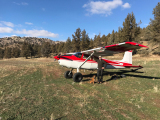
Geoffrey-I think I wrote an original post on the apparent brisk walk rate of closure approach, but here it goes briefly. This is the way Army aviators are taught to land in primary helicopter school. I had an airplane commercial when I when to Ft. Wolters in 1969 and saw the possibilities for very short field airplane work. If you look at an object 1/4 mile ahead while cruising at 500' AGL, it appears to be closing with you at a brisk walk, slow canter, steady gradual speed or whatever you want to call it. Your ground speed is probably near your airspeed, which is much higher. We are not concerned with ground speed, airspeed, or any indicator in the airplane. Ground speed is closer to the concept, but not the same. It is the "apparent rate."
When we practice slow flight and stalls at altitude, hopefully we learn the sounds, sights (not so good up this high), and kinetic feel of stalls and much more importantly the nearness of a stall. We apply that knowledge to the simple sight of the apparent rate of closure to come up with an approach that will completely or at least mostly remove the need for the more difficult to learn (initially) round out, flair, and hold off approach to landing.
At about 500' high and about 1/4 mile out on any approach, we will pick up this apparent brisk walk rate of closure with the numbers. It will very rapidly become a very fast run rate of closure unless we begin use the elevator to slow up. This will cause a climb unless we adjust power to stay on whatever glide angel we desire (steep or shallow makes no difference.) The closer we get while stabilized (no change in pitch or power,) the faster will become the apparent rate of closure. The lower we get while stabilized (no change in pitch or power,) the faster will become the apparent rate of closure. If we use pitch and power to maintain this apparent brisk walk, however, we will continue to decrease ground speed until the numbers disappear under the nose. We will continue to slow down requiring addition of power. At this point (very short final) we use that knowledge of the sights and sounds and feel of near stall speed to hold what we have, pull back just a bit to protect the nose gear, or close the throttle (power will be more that the normal stabilized approach at this point because we will be much slower than 1.3 Vso. We use our understanding of stalls to delay stall until almost down or down. We use our understanding of stalls to not be cruising in ground effect here. It will be weird but when done well you will touch down softly with power still on. Re-treads: those who have flown many normal stabilized or even faster approaches can expect to have to close the throttle and flair a bit. However, there will be no long hold off. Zero timers using the apparent rate of closure approach solo in less than seven hours regardless of nose or tail wheel airplane. Crop dusters and many bush pilots use this type approach even if they don't call it by the Army terminology.
Download my free "https://tinyurl.com/Safe-Maneuvering" e-book.

 I am very thankful that the examiner provided me with this lesson.