I hit them all the time low level in a 182 172 and a 210. Most of the time I don't see them as I'm over crops. If you "Core it" its kinda fun, the plane just yaws left and right. The higher up you go it seems the worse the turbulence, I usually hit them at less than 100'.
I would avoid any that are wider than the cockpit as they are quite strong, but the little ones are fun.
Fly Through a Dust Devil?
Sun Apr 18, 2010 6:09 am
Sun Apr 18, 2010 7:47 am
Re: Fly Through a Dust Devil?
Excellent picture! That's about the densest dust devil I've seen.
tom
tom
- Savannah-Tom offline
- Posts: 891
- Joined: Mon Mar 06, 2006 3:26 pm
- Location: Corvallis, OR
Sun Apr 18, 2010 8:20 am
Re: Fly Through a Dust Devil?
Lets see....hmmmmm.... You're 'low, slow, and in an unusual attitude close to the ground".
Nope. I'l pass on that recipe.
Nope. I'l pass on that recipe.
- MacombMaule offline
- Posts: 1
- Joined: Wed Apr 07, 2010 10:01 pm
- Location: MI
Sun Apr 18, 2010 8:28 pm
Re: Fly Through a Dust Devil?
58Skylane wrote:Crazy dust devil!!
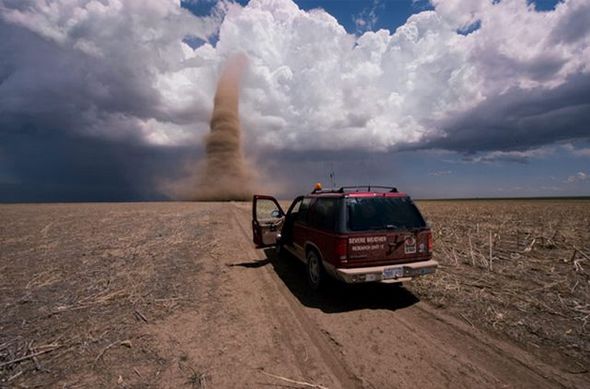
I would avoid that one.
Tim
- qmdv offline

- Posts: 3635
- Joined: Wed Feb 15, 2006 10:22 pm
- Location: Payette
- FindMeSpot URL: http://share.findmespot.com/shared/face ... I5tqEOk0rc
- Aircraft: Cessna 182
Thu Apr 22, 2010 8:50 am
Re: Fly Through a Dust Devil?
We flew through a fairly large dust devil with a Sikorsky T-58 loaded with smoke jumpers and gear outside of Winnemucca, NV. Helicopters and dust devils DO NOT mix, we lost all lift in the rotor head and dropped into a narrow canyon where the pilot barely (and I mean barely) put it into ground effect hover without hitting terra firma . Thought about a different line of work after we got back to the helibase...
. Thought about a different line of work after we got back to the helibase...- AirGuidesKid offline
- Posts: 31
- Joined: Tue Mar 16, 2010 8:17 am
- Location: Minnesota
Fri Apr 23, 2010 9:12 am
Re: Fly Through a Dust Devil?
Bill (EZ-Flap) is pretty much spot-on about dust devils; glider pilots actively seek them out and circle in very steep banks at very low speeds (stall + 5-10 kts)in them. Even 14 year old kids solo do this safely after proper training and some experience. They can be very rough - to the point of losing control - especially at low altitude and I tend to treat them very carefully below 1000 ft agl. In these instances, I tend to penetrate them wings level at 60-70 knots in order to evaluate the lift and turbulence. If not too rough, I slow down and circle. If rough, I fly through them wings-level, gaining a bit of altitude with every pass. In my experience, they tend to smooth out at altitude, where one can begin circling. I tend to avoid them altogether below 500 ft agl as they can be very rough and there is inadequate air below to enable recovery from upset.
Some of the comments in this (and other) threads indicate that many "back country" pilots have shockingly little understanding of the environment in which we fly and are incapable of taking advantage of the considerable energy that is available in the atmosphere. Most power pilots perceive convection and orographic phenomena as things to be avoided and commonly feared. Glider pilots view them as allies in getting where they want to go. The suggestion that pilots avoid crossing mountain ranges in the heat of the day is antithetic to the glider pilot. All of that ridge and thermal activity is "free" horsepower to safely traverse the range that is available to powered aircraft as well. You can achieve faster X-C speeds and save gas by developing some awareness and putting the energy to work for you.
Almost every weekend. sailplane pilots safely fly 300- 1000 miles nonstop deep in the mountains of the world in conditions and altitudes that most power folks might consider insane. They commonly fly a continuous 5-8+ hours per day and are faced with complex decision-making tasks including finding and utilizing lift sources, flying very precisely, possibly at very low altitudes, terrain avoidance, navigation, identifying potential landing sites, and oxygen management. They are not super-pilots, with a death wish; most are calm, analytical types who have learned to identify and utilize the available energy while minimizing risk. This is a skill set that all pilots could benefit from and would, I believe, improve accident statistics and would definitely increase pilot capabilities.
Some of the comments in this (and other) threads indicate that many "back country" pilots have shockingly little understanding of the environment in which we fly and are incapable of taking advantage of the considerable energy that is available in the atmosphere. Most power pilots perceive convection and orographic phenomena as things to be avoided and commonly feared. Glider pilots view them as allies in getting where they want to go. The suggestion that pilots avoid crossing mountain ranges in the heat of the day is antithetic to the glider pilot. All of that ridge and thermal activity is "free" horsepower to safely traverse the range that is available to powered aircraft as well. You can achieve faster X-C speeds and save gas by developing some awareness and putting the energy to work for you.
Almost every weekend. sailplane pilots safely fly 300- 1000 miles nonstop deep in the mountains of the world in conditions and altitudes that most power folks might consider insane. They commonly fly a continuous 5-8+ hours per day and are faced with complex decision-making tasks including finding and utilizing lift sources, flying very precisely, possibly at very low altitudes, terrain avoidance, navigation, identifying potential landing sites, and oxygen management. They are not super-pilots, with a death wish; most are calm, analytical types who have learned to identify and utilize the available energy while minimizing risk. This is a skill set that all pilots could benefit from and would, I believe, improve accident statistics and would definitely increase pilot capabilities.
Fri Apr 23, 2010 7:07 pm
Re: Fly Through a Dust Devil?
Mark, spot on as always.
Thanks. cubscout
Thanks. cubscout
Fri Apr 23, 2010 9:41 pm
Re: Fly Through a Dust Devil?
I fly both power and glider, and concur with Mark.
I tell folks new to gliding about one of the many differances between soaring and power flying. When I approach a raptor with a power plane, they'll usually fold their wings and dive away. But when I approach one with my sailplane (a Schleicher ASH26E), they'll sometimes do a little start if I come up from behind, but otherwise they are okay with being close. In fact, soaring birds are one of the clues glider pilots look for when trying to find the best lift, as they are much better at locating good lift in even marginal conditions (they do it for a living).
Once I joined an immature golden eagle under a 5000' cloud base over Lake Berryessa in CA. We circled together for maybe 5 minutes with him 5 feet off my wing tip holding position. The entire time his head was cranked over looking at me - mine was too. I think we were both impressed and probably went home and told our wives - - I know I did.
bumper
I tell folks new to gliding about one of the many differances between soaring and power flying. When I approach a raptor with a power plane, they'll usually fold their wings and dive away. But when I approach one with my sailplane (a Schleicher ASH26E), they'll sometimes do a little start if I come up from behind, but otherwise they are okay with being close. In fact, soaring birds are one of the clues glider pilots look for when trying to find the best lift, as they are much better at locating good lift in even marginal conditions (they do it for a living).
Once I joined an immature golden eagle under a 5000' cloud base over Lake Berryessa in CA. We circled together for maybe 5 minutes with him 5 feet off my wing tip holding position. The entire time his head was cranked over looking at me - mine was too. I think we were both impressed and probably went home and told our wives - - I know I did.
bumper

bumper
Minden, NV
Husky A1-B
Minden, NV
Husky A1-B
Fri Apr 23, 2010 9:59 pm
Re: Fly Through a Dust Devil?
I'd argue that the photo above is a fully qualified tornado. 

Sat Apr 24, 2010 5:55 am
Re: Fly Through a Dust Devil?
1SeventyZ wrote:I'd argue that the photo above is a fully qualified tornado.
I am not sure where the experts draw the line, but for me, it is well over that line.
Tim
- qmdv offline
- Posts: 3635
- Joined: Wed Feb 15, 2006 10:22 pm
- Location: Payette
- FindMeSpot URL: http://share.findmespot.com/shared/face ... I5tqEOk0rc
- Aircraft: Cessna 182
Sat Apr 24, 2010 7:43 am
Re: Fly Through a Dust Devil?
1SeventyZ wrote:I'd argue that the photo above is a fully qualified tornado.
Z..In reality the NWS guys around here consider it a tornado when the dust clound goes from the cloud to the ground..these dust devils can happen on an absolutley clear day..doesn't mean they are not dangerous. If the vortex never desends to the ground it's called a funnel cloud.
I am a weather observer for the NWS out of Cheyenne..from on the roof of the power plant I can see for miles. We had quite a number of tornados around here last summer..I reported three..hope I never see one again!
This is a tornado..the picture was shot by a friend of mine from a Bonanza.

'05 7GCBC High Country Explorer
The faster I go , the farther behind I get.
The faster I go , the farther behind I get.
Sat Apr 24, 2010 8:51 am
Sun Apr 25, 2010 9:49 am
Re: Fly Through a Dust Devil?
Big difference folks... tornadoes are made up of air accelerating DOWN out of a cloud. Dust Devils are air going UP towards the cloud. One of these phenomenae you can often use to improve your situation, the other one will always worsen it no matter what.
All those ten thousand hour back country experts growing on trees around here might want to take note of that minor factoid
All those ten thousand hour back country experts growing on trees around here might want to take note of that minor factoid

.
Sun Apr 25, 2010 9:56 am
Re: Fly Through a Dust Devil?
Do you really think some of us are that dumb? (damn, I was really trying to be good, too)
Sun Apr 25, 2010 10:04 am
Re: Fly Through a Dust Devil?
58Skylane wrote:Do you really think some of us are that dumb? (damn, I was really trying to be good, too)
Some yes, some no.
There are people on BCP that have at least "an order of magnitude" more hours and more varied experience than myself, and there are people who cause me to wonder if they actually fly at all.
.
Sun Apr 25, 2010 12:13 pm
Re: Fly Through a Dust Devil?
How long does it take to get a Glider Certification and where are some good schools. I have trouble finding updrafts and recognizing wind flow. It seems like glider training would be great info for any pilot.
- Jaerl offline

- Posts: 1423
- Joined: Mon Sep 01, 2008 4:59 am
- Location: Utah
- FindMeSpot URL: http://share.findmespot.com/shared/face ... Q0xkBgMvPi
Sun Apr 25, 2010 12:46 pm
Re: Fly Through a Dust Devil?
What about an F4 that's full of 2x4's and goats? Which direction is that flow going?
Generally dust devils are a clear sky/hot day phenomenon. That photo above (with red SUV) looks like a pretty puffy, unstable day. Also, it was poached from a National Geographic photo gallery on tornado stormchasers. While the difference in formation between a dust devil and a tornado might be distinguished in the apparent "point of extension," they are both a form of violent updraft. Eventually a tornado starts sucking earth upward.
I'm going to stick with tornado on this particular photo. Of course, I don't have much experience flying around tornados. I just read.
Generally dust devils are a clear sky/hot day phenomenon. That photo above (with red SUV) looks like a pretty puffy, unstable day. Also, it was poached from a National Geographic photo gallery on tornado stormchasers. While the difference in formation between a dust devil and a tornado might be distinguished in the apparent "point of extension," they are both a form of violent updraft. Eventually a tornado starts sucking earth upward.
I'm going to stick with tornado on this particular photo. Of course, I don't have much experience flying around tornados. I just read.
Mon Apr 26, 2010 12:57 am
Re: Fly Through a Dust Devil?
1SeventyZ wrote:What about an F4 that's full of 2x4's and goats? Which direction is that flow going?
Generally dust devils are a clear sky/hot day phenomenon. That photo above (with red SUV) looks like a pretty puffy, unstable day. Also, it was poached from a National Geographic photo gallery on tornado stormchasers. While the difference in formation between a dust devil and a tornado might be distinguished in the apparent "point of extension," they are both a form of violent updraft. Eventually a tornado starts sucking earth upward.
I'm going to stick with tornado on this particular photo. Of course, I don't have much experience flying around tornados. I just read.
The F-4 will always flow towards the gas pump and make a sound like heavy taxation. The 2x4's flow outward from Home Depot, making the sound of Mariachi music as they fly past the illegal day laborers hanging out in the parking lot. The goats flow inward towards the feeding trough.
Oops, I thought you meant an F-4 Phantom filled with wood and goats. An F4 tornado may be slightly different.
A tornado is a downward vortex, exactly like the vortex of water going down your bathtub drain. Although the bathtub drain may pick up bits of soap and debris and spin it around for a while, the flow is downward overall. A tornado will not suck earth upward. it will make a large cloud of debris flying around but there is no large upward component. If that photo was an actual tornado touching down, trust me that red SUV and the photographer would have been outta there long before the pict5ure was taken! That photo is a dust devil, which is on the leading edge of that storm cloud in the background. The dust devil is made up of air going up. It IS the violent updraft. The tornado is made of air coming down.It is a violent DOWNdraft.
The violent updrafts lift up air to a high altitude. After a while it cools off, and starts coming down, gathering momentum, water, etc.. You get rain and "gust fronts" and squall lines. If the air went up fast and hard enough before, and it cools off enough at altitude, then it can come down pretty hard. At some point, that cold air falls out of the sky (DOWNward) so much and so fast that it starts to spin like the drain water. That's the tornado.
.
Mon Apr 26, 2010 9:47 am
Re: Fly Through a Dust Devil?
EZFlap wrote:At some point, that cold air falls out of the sky (DOWNward) so much and so fast that it starts to spin like the drain water. That's the tornado.
That would seem an easy explanation based on the life cycle of a thunderstorm and our knowledge of drains, but I don't think it's accurate and/or complete regarding actual tornado formation.
Everything I have read about tornadoes indicates that they are indeed a concentrated vortex of rising air, whether or not the funnel appears to move downward or upward in extension. I concede that downdrafts are most certainly involved, as they are always present in the vicinity of a rising air, but are peripheral to the vortex. The severe shear between downdraft and updraft contributes to the formation of the vortex as well, but the vortex itself, the funnel, is a cyclonic updraft.
I'm not just pulling this from my anus, this thread has forced me to read about tornado formation, and this is what I've learned from several NWS pages. Here's an excerpt:
NWS Flagstaff wrote:A tornado is a vortex of air rising into a cloud. As mentioned, in their early and mature stages, all thunderstorms are characterized by the updraft, which supply the storm with warm, humid air for continued growth. But, in some cases, the column of rising air can give rise to a rapidly spinning vortex, which can become a funnel cloud, or a tornado. Winds in most tornadoes blow at 100 mph or less, but in a few cases, the vortex can become a strong tornado with winds of up to 300 mph.
Often, a tornado forms along the edge of the updraft, next to the downdraft that is formed from falling precipitation and rain cooled air. As mentioned above, in severe thunderstorms the updraft and downdraft remain separate allowing for more optimal tornado generation. To keep the updraft and downdraft separate, wind shear is required. Strong tornadoes tend to form in environments where winds at all levels are not only strong, but also turn in height in a clockwise, or veering, direction. As the downdraft hits the ground, the air is forced to spread outward away from the downdraft. This air acquires spin, which under optimal conditions, can be acted on by the updraft and stretched into the cloud, developing into a funnel cloud. If this funnel cloud reaches the ground, it becomes a tornado. This is one mechanism through which tornadoes can form.
Tornadoes can form in other ways as well. One of the key questions that scientists are trying to answer about tornadoes is why updrafts in some thunderstorms become these twisting whirlwinds, while those in apparently similar thunderstorms do not. Many field studies have occurred which try to increase our knowledge of how tornadoes form.
Mon Apr 26, 2010 3:06 pm
Re: Fly Through a Dust Devil?
I admit I do not have the scientific or field training to argue with the NWS. There are indeed some sharp folks who study this stuff all day. However, if I happened to be standing next to a NWS tornado researcher, I'd ask the following question:
1) We know that tornadoes develop because warm air and moisture rise up high, cool off, and sink back down violently. We know for sure that this phenomenon is the overall "engine" or energy source for the tornado. So the air must rise up first, essentially storing potential energy, "charging up" the storm.
2) Then a heat release or heat exchange occurs. This triggers the release of all that stored energy. I think we know that for sure too.
3) Then the energy is released, and this entire cold wet airmass comes down like an avalanche.
So the big question in my mind is... if the tornado is indeed an updraft (as the NWS quote indicates), then how could any significant updraft possibly form in the face of that enormous downward avalanche of air? The heat/rising cycle has already been completed by the time the cold wet air starts falling. This sounds like something along the lines of a surfer being able to surf against (and burst through) a pretty large tsunami to me.
If Mark Grubb is still reading this forum thread, I believe he is in a position to ask the opinion of two very qualified experts about this (Walt Rogers and Dan Gudgel). They are both highly qualified aviation weather types, and both have a large number of hours in small aircraft.
1) We know that tornadoes develop because warm air and moisture rise up high, cool off, and sink back down violently. We know for sure that this phenomenon is the overall "engine" or energy source for the tornado. So the air must rise up first, essentially storing potential energy, "charging up" the storm.
2) Then a heat release or heat exchange occurs. This triggers the release of all that stored energy. I think we know that for sure too.
3) Then the energy is released, and this entire cold wet airmass comes down like an avalanche.
So the big question in my mind is... if the tornado is indeed an updraft (as the NWS quote indicates), then how could any significant updraft possibly form in the face of that enormous downward avalanche of air? The heat/rising cycle has already been completed by the time the cold wet air starts falling. This sounds like something along the lines of a surfer being able to surf against (and burst through) a pretty large tsunami to me.
If Mark Grubb is still reading this forum thread, I believe he is in a position to ask the opinion of two very qualified experts about this (Walt Rogers and Dan Gudgel). They are both highly qualified aviation weather types, and both have a large number of hours in small aircraft.
.
DISPLAY OPTIONS
Who is online
Users browsing this forum: No registered users and 1 guest
Latest Features
-
-
Featured Bush Planes
As one of the undisputed legends of bush flying, the Cessna 180 hauls a…Read More -
Aircraft Ownership and Maintenance
9 modification mistakes aircraft owners make when trying to "bush out" their birds—why some…Read More -
Live to Tell
A Minnesota pilot is surprised to learn that the sudden asymmetric drag of an…Read More


Latest Knowledge Base
-
Destinations
Canada offers some of the most spectacular backcountry flying on the continent. Here's what you need to know before you go.Read More -
Safety and Survival
Hope that you never have to use your survival vest but knowing you have it and knowing how to use…Read More -
Destinations
A regional guide with ideas for winter camping destinations in California, Nevada, New Mexico, and Arizona.Read More -
Aircraft
Finding an affordable aircraft that can handle the backcountry for $80K or less? A challenge for sure, but with the…Read More