Flying to beaches
Thu May 07, 2020 6:30 am
Thu May 07, 2020 8:02 am
Re: Flying to beaches
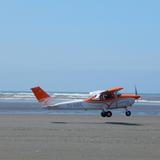
There are soooo many variables while landing on beaches, and people need to be aware before trying this.
Touch and go is a good idea but not a regular plop down, You want to barely touch the mains (not the nose) while carrying power and be able to feel the surface, if it starts to grab you you need to be able to fly out!
Every beach is different, some are hard as concrete, others are hard as concrete sometimes, some are always soft and the only way to land is with cub type airplane with Bushwheels.
The beach will also change with every tide. may be hard one day and soft the next.
You made me cringe with the relaxed elevator, its bad form and your nosewheel can dig in so fast it will make your head spin.
With a nosewheel plane you are also better off loaded aft, even if you need to add ballast to baggage compartment
a 182, or 206 with just a pilot and heavy on the fuel can be bad.
Steeper bank does not mean softer, sometimes lower where it flattens out is the softest place. Like I said every beach is different.
Also its best to land on an out going tide, that way when you get stuck you have more time to dig out before you loose your airplane.
Touch and go is a good idea but not a regular plop down, You want to barely touch the mains (not the nose) while carrying power and be able to feel the surface, if it starts to grab you you need to be able to fly out!
Every beach is different, some are hard as concrete, others are hard as concrete sometimes, some are always soft and the only way to land is with cub type airplane with Bushwheels.
The beach will also change with every tide. may be hard one day and soft the next.
You made me cringe with the relaxed elevator, its bad form and your nosewheel can dig in so fast it will make your head spin.
With a nosewheel plane you are also better off loaded aft, even if you need to add ballast to baggage compartment
a 182, or 206 with just a pilot and heavy on the fuel can be bad.
Steeper bank does not mean softer, sometimes lower where it flattens out is the softest place. Like I said every beach is different.
Also its best to land on an out going tide, that way when you get stuck you have more time to dig out before you loose your airplane.
Keep the Greasy side down!
Thu May 07, 2020 6:33 pm
Re: Flying to beaches
Great photography as usual. Thanks for sharing.
- On The Fly offline

- Posts: 199
- Joined: Wed Nov 01, 2017 4:56 pm
- Location: Hampton
- Aircraft: C`182K
Fri May 08, 2020 3:42 am
Re: Flying to beaches
On a soft field landing might a 20 degree flap setting allow for more elevator (less downwash, higher pitch attitude)? I would agree keeping the yoke full back after landing is correct soft field technique.
A couple of advantages for tail wheel (soft sand will cause a nose over as well) might be: less propeller erosion due to better clearance, and ability to use low psi tundra tyres.
A couple of advantages for tail wheel (soft sand will cause a nose over as well) might be: less propeller erosion due to better clearance, and ability to use low psi tundra tyres.
DISPLAY OPTIONS
Who is online
Users browsing this forum: No registered users and 1 guest
Latest Features
-
Live to Tell
A Minnesota pilot is surprised to learn that the sudden asymmetric drag of an out-of-rig ski can…Read More -
Creators
Working in some of the Yukon's most beautiful and remote environments, photographer Simon Blakesley captures aircraft in…Read More -
Aircraft Ownership and Maintenance
Upgrading to big tires can make a huge difference in backcountry performance, but with those gains come…Read More -
Tales from Yesteryear
In this tale from bush flying yesteryear, Don Cogger signs up to help Atlee Dodge Jr recovery…Read More


Latest Knowledge Base
-
Destinations
A regional guide with ideas for winter camping destinations in California, Nevada, New Mexico, and Arizona.Read More -
Aircraft
Finding an affordable aircraft that can handle the backcountry for $80K or less? A challenge for sure, but with the…Read More -
Aircraft
01.29.2018 - Zane - Updated tire diameter graphic to add 8.50x10 Guide to tires for use in the backcountry and off-airport landing…Read More -
Pilots
12.22.2013 - Initial article format Operating aircraft on skis and negotiating a snow-covered landscape is an entirely unique skillset and environment.…Read More


