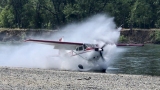
My friend taking off yesterday from the ranch, soft field a bit of mud and damp, 6,000ft density altitude, I told him to stay low in ground effect and turn left, dont know why he turned right, and wasnt pulling full elevator to get the nose wheel off the ground.
It was a bit scary.
High density soft field take off (a bit close)
Sun Jan 04, 2015 4:36 am
Sun Jan 04, 2015 7:31 am
Re: High density soft field take off (a bit close)
He did get off and that's the important thing. There are a couple of things he can change and do different that will help. Now he knows what the airplane acts like under those conditions and that is a huge reference. I will leave it to the professionals to comment on what he can do different. Great learning video and thanks for posting it!
Richard
Richard

Sun Jan 04, 2015 9:51 am
Re: High density soft field take off (a bit close)
I'm sure that was a learning experience about rising terrain... Glad it worked out. How long is your strip? Didn't look like there was a whole lot of time/distance to accelerate in ground effect.
- scottf offline
- Posts: 650
- Joined: Fri Mar 23, 2012 9:56 am
- Location: Meridian, ID
- FindMeSpot URL: http://share.findmespot.com/shared/face ... cbQCpIqefS
Sun Jan 04, 2015 10:10 am
Re: High density soft field take off (a bit close)
It's always easy to second guess; harder to be in the cockpit and do it exactly right.
It looked to me as if he had the nose up enough--the idea is to get the nose wheel just barely above the muck and not too much higher, and that's what he did. It appears that he was using 10 flaps; with a 182, I'd have used 20, which would have gotten him airborne sooner, and then stayed in ground effect to build speed before raising the flaps. The arguments have been going back and forth about richpiney's use of 20 flaps with the 150, but pretty unlikely the same arguments would be made regarding a 182, as both the POH and good practice call for 20.
It is hard to understand why he turned right--the terrain pretty clearly rises to the right, which I gather he figured out after he'd turned. Looks like his planning was a bit off, but maybe the closeness of his take off rattled him.
But the biggest issue, I think, is whether he accounted for the high DA. I couldn't tell from the video if he'd leaned for take-off (sometimes you can see darker exhaust when there's a failure to lean), but a mid-day take off is often possible but not desirable.
Cary
It looked to me as if he had the nose up enough--the idea is to get the nose wheel just barely above the muck and not too much higher, and that's what he did. It appears that he was using 10 flaps; with a 182, I'd have used 20, which would have gotten him airborne sooner, and then stayed in ground effect to build speed before raising the flaps. The arguments have been going back and forth about richpiney's use of 20 flaps with the 150, but pretty unlikely the same arguments would be made regarding a 182, as both the POH and good practice call for 20.
It is hard to understand why he turned right--the terrain pretty clearly rises to the right, which I gather he figured out after he'd turned. Looks like his planning was a bit off, but maybe the closeness of his take off rattled him.
But the biggest issue, I think, is whether he accounted for the high DA. I couldn't tell from the video if he'd leaned for take-off (sometimes you can see darker exhaust when there's a failure to lean), but a mid-day take off is often possible but not desirable.
Cary
"I have slipped the surly bonds of earth..., put out my hand and touched the face of God." J.G. Magee
Sun Jan 04, 2015 11:47 am
Re: High density soft field take off (a bit close)
Cary has covered most of what I saw. With practice, we can learn to horse it off into low ground effect with dynamic elevator, up and then down, a little earlier. This is similar to popping more than recommended flaps. I was never slick enough to do the pop with electric flaps, but did it that way with mechanical. At a predetermined point, we have to somehow get into low ground effect or quit. Staying on the ground until near Vx takes away this need to abort information.
It is obvious that he hasn't paid attention to us old guys saying, "always know which way is downhill and how to get there in ground effect, if possible." Most pilots I have worked with just don't plan on crashing. We need to plan to fly all the way to the crash, and downhill is the best bet. Oh! We need to plan on the engine failing as well. Even though this strip is long, the abort window is small.
When in a really bad place, after turning right, he made a good energy management turn back to the left through the very small treeless depression. He turned at whatever bank was necessary to get through there. Not pulling back on the stick, in that fairly steep turn, saved his life.
It is obvious that he hasn't paid attention to us old guys saying, "always know which way is downhill and how to get there in ground effect, if possible." Most pilots I have worked with just don't plan on crashing. We need to plan to fly all the way to the crash, and downhill is the best bet. Oh! We need to plan on the engine failing as well. Even though this strip is long, the abort window is small.
When in a really bad place, after turning right, he made a good energy management turn back to the left through the very small treeless depression. He turned at whatever bank was necessary to get through there. Not pulling back on the stick, in that fairly steep turn, saved his life.
- contactflying offline
- Posts: 4972
- Joined: Wed Apr 03, 2013 7:36 pm
- Location: Aurora, Missouri 2H2
Download my free "https://tinyurl.com/Safe-Maneuvering" e-book.
Sun Jan 04, 2015 11:58 am
Re: High density soft field take off (a bit close)
He may have turned right at first to gain all the area possible to turn to the left, nothing wrong with that at all. Watch people depart Johnson creek and you will see a lot of them turn to the right about 30 degrees to get to the far right hand side of the canyon. At this point they can make a much saver 180 degree turn to the south for a down wind departure.
Sun Jan 04, 2015 12:10 pm
Re: High density soft field take off (a bit close)
This was his first take off from this strip, strip is 900 meters long , but right now only 600 usable, and its soft, he waited 2 days for this take off, (which is good) because it has been raining and lots of mud, still was very soft on this take off.
He did use 20 degrees of flaps.
At being the ground soo soft maybe rising the nose wheel a bit more would help? Something Im interested to know from the Pros.
Turning right you have rising terrain, left lower terrain, he told me he felt a sinker so he went towards the wind (makes sense but terrain didnt help).
Here is his second take off (much better and to the left)
Great lesson for him, he is a better pilot now
He did use 20 degrees of flaps.
At being the ground soo soft maybe rising the nose wheel a bit more would help? Something Im interested to know from the Pros.
Turning right you have rising terrain, left lower terrain, he told me he felt a sinker so he went towards the wind (makes sense but terrain didnt help).
Here is his second take off (much better and to the left)
Great lesson for him, he is a better pilot now
Sun Jan 04, 2015 1:15 pm
Re: High density soft field take off (a bit close)
What makes energy management turns so helpful is that we do not need a lot of horizontal space to make them work. If we have zoom reserve in the form of airspeed, we can trade that wings level for altitude before turning now at a slower speed. If we do not have the extra airspeed, we simply make a descending turn to the lowest terrain available. Trying to maintain altitude in a turn or to climb is a very serious consideration. In maneuvering flight, it is almost always best to give up altitude in a turn, either the altitude gained in a zoom climb or the altitude we already have. By giving up altitude, by not pulling back on the stick, in the turn we guarantee enough gravity thrust to insure that no load factor or stall occurs. This safety characteristic was given us before we ever entered the airplane, by the designer.
In this situation the higher terrain to the right made the horizontal space required to do a 180 very limited. However, a 180 was not called for here. Simply following the drainage with whatever angle of bank necessary to do that was called for here, as in most cases. The energy management turn makes it possible to turn safely at whatever bank is necessary, as in most cases.
In this situation the higher terrain to the right made the horizontal space required to do a 180 very limited. However, a 180 was not called for here. Simply following the drainage with whatever angle of bank necessary to do that was called for here, as in most cases. The energy management turn makes it possible to turn safely at whatever bank is necessary, as in most cases.
- contactflying offline
- Posts: 4972
- Joined: Wed Apr 03, 2013 7:36 pm
- Location: Aurora, Missouri 2H2
Download my free "https://tinyurl.com/Safe-Maneuvering" e-book.
Sun Jan 04, 2015 2:09 pm
Re: High density soft field take off (a bit close)
Watching the second video, I think he could get the weight off the nose wheel sooner, with full back elevator, and then as the nose wheel clears the ground and the airspeed comes up, he can keep the nose wheel just above the terrain. Those huge elevators on a 182 will allow getting the nose up within the first 50-75 feet most of the time, unless there's a couple of huge guys in the front seats and nothing at all in the back, which can bring the CG right to the front of the envelope. The nose wheel adds a lot of drag in soft stuff, so getting it up ASAP is good.
The other mistake many people make with a trike is pulling the nose up too high for soft field take offs, which then adds a lot of aerodynamic drag and actually slows getting into the air. That's why you see a lot of trike trainers with dinged tail tie downs. I've never dragged a tail tie down yet in all these years, but I decided last year to add a skid to mine, just in case I was ever a klutz, because especially when I've been camping, I have a rearward CG. Not lifting the nose too high is especially important in high DA situations, because you need to minimize aerodynamic drag moreso than at lower altitudes, where you have more lift and power.
One of the issues that we've talked about is that our training is often unrealistic. Too many FBOs prohibit using their airplanes on anything but long and hard surfaced strips, so that often enough, students never get any real training in either short or soft strips--and as we know, often enough, those are combined in the real world. The Deakin method of holding the nose on the ground until Vx for a short field take off just isn't logical, when the strip is also soft. Using the first 1000' of a 10,000' x 150' hard surface runway as your short field gives you no idea what it's like to come off a short narrow, possibly soft, strip with trees at both ends and on both sides.
One of my buds is a low time private pilot who had to stop flying when an expensive divorce took all of his funding, but he's flown with me quite a bit, including to OSH once. He learned to fly with Aims Community College in Greeley. One Fall day a few years ago, we went up just to take leaf pictures. After we'd taken off, I asked him if he'd like to fly on over to Marble--I had told him about it, but in all of his training, he'd never been into the mountains. So we did that, and some of his reactions were emblematic of his unrealistic training.
As we dropped down into the canyon, his first reaction was that we were awfully close to the canyon walls. I was on the right side of the canyon but not hugging the wall, but several times he said, "aren't we awfully close to the wall?" Then when we turned up into the Crystal River canyon where the Marble strip is visible, I said, "there it is", and he said, "you've got to be kidding--down there?" Marble is not a difficult mountain strip, 3800' long nominally and plenty wide, but to someone who'd only flown out of GXY and FNL and a few other hard surfaced and long airports, I guess it looked pretty tiny. It was quite an eye-opener to him. Incidentally, our take off that day is the one in my Youtube video: https://www.youtube.com/watch?v=LPNaGwZ2fA8
Cary
The other mistake many people make with a trike is pulling the nose up too high for soft field take offs, which then adds a lot of aerodynamic drag and actually slows getting into the air. That's why you see a lot of trike trainers with dinged tail tie downs. I've never dragged a tail tie down yet in all these years, but I decided last year to add a skid to mine, just in case I was ever a klutz, because especially when I've been camping, I have a rearward CG. Not lifting the nose too high is especially important in high DA situations, because you need to minimize aerodynamic drag moreso than at lower altitudes, where you have more lift and power.
One of the issues that we've talked about is that our training is often unrealistic. Too many FBOs prohibit using their airplanes on anything but long and hard surfaced strips, so that often enough, students never get any real training in either short or soft strips--and as we know, often enough, those are combined in the real world. The Deakin method of holding the nose on the ground until Vx for a short field take off just isn't logical, when the strip is also soft. Using the first 1000' of a 10,000' x 150' hard surface runway as your short field gives you no idea what it's like to come off a short narrow, possibly soft, strip with trees at both ends and on both sides.
One of my buds is a low time private pilot who had to stop flying when an expensive divorce took all of his funding, but he's flown with me quite a bit, including to OSH once. He learned to fly with Aims Community College in Greeley. One Fall day a few years ago, we went up just to take leaf pictures. After we'd taken off, I asked him if he'd like to fly on over to Marble--I had told him about it, but in all of his training, he'd never been into the mountains. So we did that, and some of his reactions were emblematic of his unrealistic training.
As we dropped down into the canyon, his first reaction was that we were awfully close to the canyon walls. I was on the right side of the canyon but not hugging the wall, but several times he said, "aren't we awfully close to the wall?" Then when we turned up into the Crystal River canyon where the Marble strip is visible, I said, "there it is", and he said, "you've got to be kidding--down there?" Marble is not a difficult mountain strip, 3800' long nominally and plenty wide, but to someone who'd only flown out of GXY and FNL and a few other hard surfaced and long airports, I guess it looked pretty tiny. It was quite an eye-opener to him. Incidentally, our take off that day is the one in my Youtube video: https://www.youtube.com/watch?v=LPNaGwZ2fA8
Cary
"I have slipped the surly bonds of earth..., put out my hand and touched the face of God." J.G. Magee
Sun Jan 04, 2015 4:31 pm
Re: High density soft field take off (a bit close)
Very nice flight, Cary. When I was flying the New Mexico and Colorado mountains from 74 to 94, I was always able to use ridge lift on the downwind from the valley ridge. I never paid any attention to right or left side of the valley for traffic and I saw almost no traffic. Is the traffic significant now, or did I just not go to significant places?
- contactflying offline
- Posts: 4972
- Joined: Wed Apr 03, 2013 7:36 pm
- Location: Aurora, Missouri 2H2
Download my free "https://tinyurl.com/Safe-Maneuvering" e-book.
Sun Jan 04, 2015 5:16 pm
Re: High density soft field take off (a bit close)
It's not all that significant except during the annual fly in to Marble in September. But as long as the strip is open (mid-October is typical), there are campers especially on weekends, so it's good to stay to the right and announce position, to minimize conflicts.contactflying wrote:Very nice flight, Cary. When I was flying the New Mexico and Colorado mountains from 74 to 94, I was always able to use ridge lift on the downwind from the valley ridge. I never paid any attention to right or left side of the valley for traffic and I saw almost no traffic. Is the traffic significant now, or did I just not go to significant places?
The annual fly in brings in 50-60 airplanes, coming and going starting Friday morning through Sunday afternoon, typically. It's not unusual to have 2 or 3 airplanes in the pattern during part of that time, and if someone wants to get out (opposite direction traffic), it takes a little timing. 122.9 is the CTAF for the mountains, so it's not hard to accomplish as long as everyone talks to one another.
I don't like to go into the mountains when the wind exceeds about 20 knots over the tops, The older I get, the less I like the bumps!
So I don't have much occasion to do much ridge lift flying, other than getting back over the ridges on the way out on a warm afternoon.Cary
Cary
"I have slipped the surly bonds of earth..., put out my hand and touched the face of God." J.G. Magee
Sun Jan 04, 2015 7:17 pm
Re: High density soft field take off (a bit close)
That's one way to learn. There's also backcountry intructors that can teach high density stuff with a little more margin. Unlike Rich's video of testing some tips and instruction, this appears to be someone testing his luck. Not knowing how much flap to use, or which way the water flows before trying a takeoff like that is a good way to become a statistic. It's always better to be lucky than good though, the un-lucky type that could fall into a bucket of titties and come out sucking his thumb would have crashed.
- Nosedragger offline
- Posts: 975
- Joined: Fri Dec 31, 2010 6:40 am
- Location: SE Idaho
- FindMeSpot URL: http://share.findmespot.com/shared/face ... ACzcbTgqlT
DISPLAY OPTIONS
Who is online
Users browsing this forum: No registered users and 1 guest
Latest Features
-
Live to Tell
A Minnesota pilot is surprised to learn that the sudden asymmetric drag of an out-of-rig ski can…Read More -
Creators
Working in some of the Yukon's most beautiful and remote environments, photographer Simon Blakesley captures aircraft in…Read More -
Aircraft Ownership and Maintenance
Upgrading to big tires can make a huge difference in backcountry performance, but with those gains come…Read More -
Tales from Yesteryear
In this tale from bush flying yesteryear, Don Cogger signs up to help Atlee Dodge Jr recovery…Read More


Latest Knowledge Base
-
Destinations
A regional guide with ideas for winter camping destinations in California, Nevada, New Mexico, and Arizona.Read More -
Aircraft
Finding an affordable aircraft that can handle the backcountry for $80K or less? A challenge for sure, but with the…Read More -
Aircraft
01.29.2018 - Zane - Updated tire diameter graphic to add 8.50x10 Guide to tires for use in the backcountry and off-airport landing…Read More -
Pilots
12.22.2013 - Initial article format Operating aircraft on skis and negotiating a snow-covered landscape is an entirely unique skillset and environment.…Read More


