Inappropriate landing at Chicken Strip
Sat Jun 11, 2016 7:59 am


Sun Jun 12, 2016 6:29 am
Re: Inappropriate landing at Chicken Strip
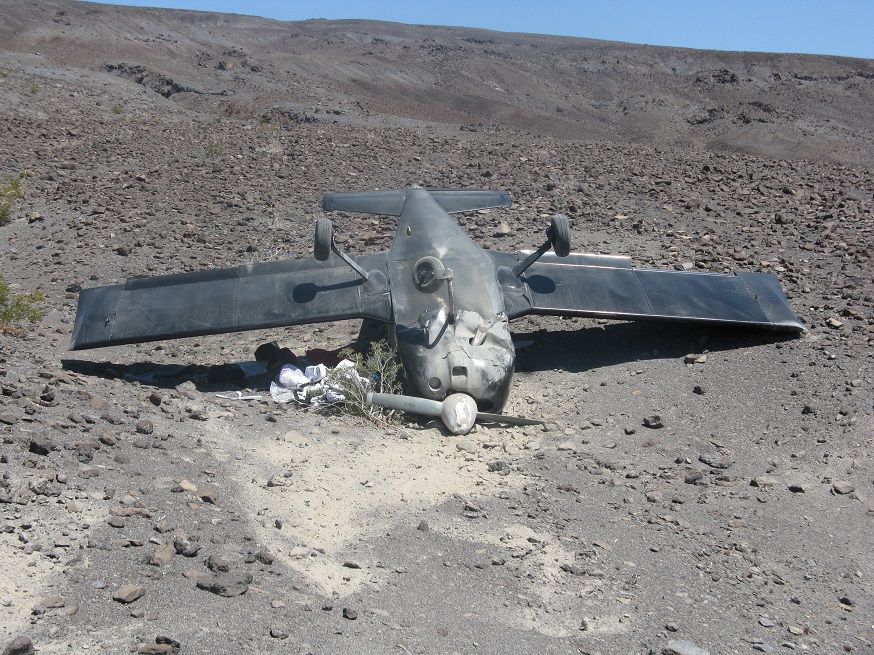
Talked to the caretaker...inexperienced pilot landing when it was 118 degrees. They're lucky they crashed on landing, otherwise they would have crashed on take off.


Sun Jun 12, 2016 5:19 pm
Re: Inappropriate landing at Chicken Strip
I believe I have met the pilot in question.
He has some amount of experience, having owned one or more Mooneys and a CASA ex-mil trainer jet. With the possible exception of Skip Holm, this pilot has shown the highest self-confidence level I've seen, combined with a very healthy and fully functional ego. He bought the Grumman AA-1 recently, and he parhaps had not had time to measure the wing area.
He has some amount of experience, having owned one or more Mooneys and a CASA ex-mil trainer jet. With the possible exception of Skip Holm, this pilot has shown the highest self-confidence level I've seen, combined with a very healthy and fully functional ego. He bought the Grumman AA-1 recently, and he parhaps had not had time to measure the wing area.

.
Sun Jun 12, 2016 5:24 pm
Re: Inappropriate landing at Chicken Strip
learned how to fly in a grumman T cat... wouldn't think of flying the stubby winged under powered thing in 118 degree heat...
Mon Jun 13, 2016 9:38 am
Re: Inappropriate landing at Chicken Strip
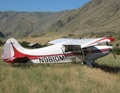
Inappropriate airplane for the mission. Look at the tire size. Personally I wouldn't attempt CS on less than 8.50. Why go there in super hot temps anyway? BTW it was a GOOD landing, they walked away.
Cheers...Rob
Cheers...Rob
- OregonMaule offline
- Posts: 6986
- Joined: Fri Sep 01, 2006 9:44 pm
- Location: Orygun
My SPOT page
"They who can give up essential liberty to obtain a little temporary safety, deserve neither liberty nor safety". Ben Franklin
http://en.wikiquote.org/wiki/Benjamin_Franklin
"They who can give up essential liberty to obtain a little temporary safety, deserve neither liberty nor safety". Ben Franklin
http://en.wikiquote.org/wiki/Benjamin_Franklin
Mon Jun 13, 2016 10:40 am
Re: Inappropriate landing at Chicken Strip
I wouldn't want to fly anything in 118 degree temps with a clear canopy and no a/c. Screw the tire size!
Kerosene and the thermostat set to "arctic winter.". [emoji41]
Gump
Sent from my iPhone using Tapatalk
Kerosene and the thermostat set to "arctic winter.". [emoji41]
Gump
Sent from my iPhone using Tapatalk
Mon Jun 13, 2016 12:44 pm
Re: Inappropriate landing at Chicken Strip
Tires are fine. I have a 5-5.00 on my nose and I was fine. HOWEVER I would NEVER go there in those temps.....nor would I land in there in that temp.
- piperpainter offline
- Posts: 970
- Joined: Sat Nov 29, 2008 10:57 pm
- Location: Auburn, WA
- Aircraft: C-205
Was Backcountry Mooney M20C
Mon Jun 13, 2016 12:58 pm
Re: Inappropriate landing at Chicken Strip
If the "Chicken Strip" being described is in fact this one:
https://www.youtube.com/watch?v=Wxu3BTR7J6U
then the tire size does not appear to be any significant concern. The surface appears to me to be suitable for a stock 150 or 172. There are videos of a 150 arriving and departing safely with no pucker factor.
I have not yet had the pleasure of being at this strip, but it sure looks like it is a simple balance between temperature, wing area, and available power.
https://www.youtube.com/watch?v=Wxu3BTR7J6U
then the tire size does not appear to be any significant concern. The surface appears to me to be suitable for a stock 150 or 172. There are videos of a 150 arriving and departing safely with no pucker factor.
I have not yet had the pleasure of being at this strip, but it sure looks like it is a simple balance between temperature, wing area, and available power.
.
Mon Jun 13, 2016 2:59 pm
Re: Inappropriate landing at Chicken Strip
Tire size doesn't matter. I've been there with six's and wheel pants on a Cessna 140 and been fine. He ran out of runway and went into the rocks at the end...not an easy thing to do...the vast majority of my landings require power to make it to the top of the strip.
Mon Jun 13, 2016 4:18 pm
Re: Inappropriate landing at Chicken Strip
Additional information, told to a friend of mine by the pilot of the aircraft in the photo, and that friend (also a pilot) told it to me (meaning only a mild case of hearsay):
Was landing, going too fast and too high, and attempted go-around into rising terrain.
Aircraft is a later (flat bottom wing) Grumman AA-1 series, with 150HP upgrade. Was based at my home airport KWHP until recently purchased and moved to Tehachapi.
Probably would not have been a problem (even with bad decision of being there at that temperature in the first place) if the pilot had been familiar enough with the aircraft to be at the correct altitude and airspeed. But the AA-1 has "decorative" flaps that don't do much in the STOL landing department.
Was landing, going too fast and too high, and attempted go-around into rising terrain.
Aircraft is a later (flat bottom wing) Grumman AA-1 series, with 150HP upgrade. Was based at my home airport KWHP until recently purchased and moved to Tehachapi.
Probably would not have been a problem (even with bad decision of being there at that temperature in the first place) if the pilot had been familiar enough with the aircraft to be at the correct altitude and airspeed. But the AA-1 has "decorative" flaps that don't do much in the STOL landing department.
.
Mon Jun 13, 2016 5:10 pm
Re: Inappropriate landing at Chicken Strip
that's the way I remember the T cat... flaps were virtually ineffective..
Mon Jun 13, 2016 8:48 pm
Re: Inappropriate landing at Chicken Strip
piperpainter wrote:Tires are fine. I have a 5-5.00 on my nose and I was fine. HOWEVER I would NEVER go there in those temps.....nor would I land in there in that temp.
Your special. You probably won't find any mud there.
Cheers...Rob
- OregonMaule offline
- Posts: 6986
- Joined: Fri Sep 01, 2006 9:44 pm
- Location: Orygun
My SPOT page
"They who can give up essential liberty to obtain a little temporary safety, deserve neither liberty nor safety". Ben Franklin
http://en.wikiquote.org/wiki/Benjamin_Franklin
"They who can give up essential liberty to obtain a little temporary safety, deserve neither liberty nor safety". Ben Franklin
http://en.wikiquote.org/wiki/Benjamin_Franklin
Tue Jun 14, 2016 5:52 pm
Re: Inappropriate landing at Chicken Strip
I taught in AA1-As in F lagstaff, AZ and Monte Vista, CO. I limited off field landing to smooth dry lakes roads because the nose gear seemed weak.
Sent from my SPH-L710 using Tapatalk
Sent from my SPH-L710 using Tapatalk
- contactflying offline
- Posts: 4972
- Joined: Wed Apr 03, 2013 7:36 pm
- Location: Aurora, Missouri 2H2
Download my free "https://tinyurl.com/Safe-Maneuvering" e-book.
Wed Jun 15, 2016 10:01 am
Re: Inappropriate landing at Chicken Strip
I've seen or heard of the nose gear folding up on several different AA1, AA5, RV, and GlasStars.
That twangy castoring-only design seems to be kinda delicate, but it's cheap and easy to build so is used on a lot of homebuilts or LSA's.
That twangy castoring-only design seems to be kinda delicate, but it's cheap and easy to build so is used on a lot of homebuilts or LSA's.

Cessna Skywagon -- accept no substitute!
Wed Jun 15, 2016 11:08 am
Re: Inappropriate landing at Chicken Strip
The RV guys have a bolt-on stiffener or reinforcement that seems to work. One of our EAA chapter guys built an RV-9A and showed me this reinforcement. Several RV's have indeed had failures of the little ski-pole nosegear.
One of the things you have to do when you STC convert an AA-1 to an AA-1-150 is to remove the AA-1 nosegear and install the AA-5 unit.... because the heavier engine will create a higher probability of wrecking the twangy nosegear.
New AD coming from the FAA... move all AA-1 and AA-5 nosegear to the rear of the fuselage
One of the things you have to do when you STC convert an AA-1 to an AA-1-150 is to remove the AA-1 nosegear and install the AA-5 unit.... because the heavier engine will create a higher probability of wrecking the twangy nosegear.
New AD coming from the FAA... move all AA-1 and AA-5 nosegear to the rear of the fuselage
.
Fri Jun 17, 2016 8:43 am
Re: Inappropriate landing at Chicken Strip
Two friends of mine each own a 150hp Yankee taildragger. Very sporty, pretty fast-- maybe not quite up to the RV6 (with which it is often confused) but close.
Cessna Skywagon -- accept no substitute!
Wed Jun 22, 2016 6:29 am
Re: Inappropriate landing at Chicken Strip
I trained in an AA1C (later model with different wing) and owned an AA5 Traveler. All of the Grummans are great planes, but people who aren't familiar with them actually believe the Old Wive's Tales about needing to land at 90 knots to "be safe"... The "straight wing" AA1 has a 60 knot stall speed, so approaches should be flown at 80 knots. The later AA1A/B/C models stall speeds are around 51-53 knots, so the approach should be flown at a bit less than 70 knots. Some pilots believe the OWTs (generally related to them by someone who has never flown the airplane), and attempt to fly the approach at 90 knots or more, with the result that they either: a) float a long way down the runway, ending up running off the end of an otherwise land-able runway, or b) they try to "force" the airplane to land at an excessive speed, and wind up doing the "pilot-induced oscillation" thing, often resulting in a nose-wheel first "wheelbarrow" landing, often wiping out the nose gear, causing a prop-strike, and/or ending up as a "runway loss of control" statistic...
Even pilots who know better will sometimes talk themselves into trouble, by adding a few knots for the high DA, a few more knots for gusty winds, and a few more "for the wife and kids"... The AYA (American Yankee Association) and GPA (Grumman Pilot's Association) both have a "Pilot Proficiency Program" that can be delivered by an experienced Grumman CFI. Graduates of this course have a markedly lower number of landing incidents, because they are taught the importance of airspeed control on final approach (among other things). It's enough of a difference that at least one insurance company offers a significant discount for taking the course.
But with all that said, I personally would not have wanted to land an AA1 (or an AA5, for that matter) on the Chicken Strip on a 118* day... I would be extremely concerned about the ability to depart safely, even later in the evening if it "cooled off" to 90* or so... On a standard day, the POH calls for roughly 1600 feet to take off and clear a 50' obstacle, and those planes (while quite fast) are NOT noted for their climb performance (around 700 fpm under ideal conditions). Under the conditions that day, I would expect it to take 2500 feet or more, if you did everything perfectly, and 3000 - 3500 feet might be more realistic for us 'mere mortal' pilots.
I was glad to hear that the occupants survived, which is an amazingly common occurrence with the Grumman aircraft (all models). They seem to provide extraordinary crash protection, with their bonded honeycomb construction and tubular spar wings.
Even pilots who know better will sometimes talk themselves into trouble, by adding a few knots for the high DA, a few more knots for gusty winds, and a few more "for the wife and kids"... The AYA (American Yankee Association) and GPA (Grumman Pilot's Association) both have a "Pilot Proficiency Program" that can be delivered by an experienced Grumman CFI. Graduates of this course have a markedly lower number of landing incidents, because they are taught the importance of airspeed control on final approach (among other things). It's enough of a difference that at least one insurance company offers a significant discount for taking the course.
But with all that said, I personally would not have wanted to land an AA1 (or an AA5, for that matter) on the Chicken Strip on a 118* day... I would be extremely concerned about the ability to depart safely, even later in the evening if it "cooled off" to 90* or so... On a standard day, the POH calls for roughly 1600 feet to take off and clear a 50' obstacle, and those planes (while quite fast) are NOT noted for their climb performance (around 700 fpm under ideal conditions). Under the conditions that day, I would expect it to take 2500 feet or more, if you did everything perfectly, and 3000 - 3500 feet might be more realistic for us 'mere mortal' pilots.
I was glad to hear that the occupants survived, which is an amazingly common occurrence with the Grumman aircraft (all models). They seem to provide extraordinary crash protection, with their bonded honeycomb construction and tubular spar wings.

Wed Jun 22, 2016 9:09 am
Re: Inappropriate landing at Chicken Strip
JP 256,
I agree very much with both your comments on this airplane and one the apparent brisk walk rate of closure approach. My first instructing was in the AA1-A at Flagstaff and later I instructed in Fred Shotenboer's AA5 (150 hp 4 place Traveler) at Monte Vista, CO. I used the apparent rate of closure with these as well as all other airplanes I flew. Yes, they make a decent power/pitch approach and yes short wing airplanes require more power to mitigate an excessive rate of descent at a proper slow speed.
We had the better loach in Vietnam, the OH6-A, but you OH58 guys had to be more skillful scout pilots to make the 58 work. Talk about a basic low ground effect takeoff. I know, colonels didn't like that transmission two inches from their right ear in the Hughes. You got to love the four star guys who buy stuff they have never used and then get great lobby jobs when they retire with a generals retirement pay.
Garyowen,
Jim
I agree very much with both your comments on this airplane and one the apparent brisk walk rate of closure approach. My first instructing was in the AA1-A at Flagstaff and later I instructed in Fred Shotenboer's AA5 (150 hp 4 place Traveler) at Monte Vista, CO. I used the apparent rate of closure with these as well as all other airplanes I flew. Yes, they make a decent power/pitch approach and yes short wing airplanes require more power to mitigate an excessive rate of descent at a proper slow speed.
We had the better loach in Vietnam, the OH6-A, but you OH58 guys had to be more skillful scout pilots to make the 58 work. Talk about a basic low ground effect takeoff. I know, colonels didn't like that transmission two inches from their right ear in the Hughes. You got to love the four star guys who buy stuff they have never used and then get great lobby jobs when they retire with a generals retirement pay.
Garyowen,
Jim
- contactflying offline
- Posts: 4972
- Joined: Wed Apr 03, 2013 7:36 pm
- Location: Aurora, Missouri 2H2
Download my free "https://tinyurl.com/Safe-Maneuvering" e-book.
Fri Jun 24, 2016 12:05 pm
Re: Inappropriate landing at Chicken Strip
We had the better loach in Vietnam, the OH6-A, but you OH58 guys had to be more skillful scout pilots to make the 58 work. Talk about a basic low ground effect takeoff. I know, colonels didn't like that transmission two inches from their right ear in the Hughes. You got to love the four star guys who buy stuff they have never used and then get great lobby jobs when they retire with a generals retirement pay.
Yeah, you sure did! While I was in flight school, we got a chance to see the last performance of the "Silver Eagles" Army demonstration team in their OH-6 LOACHes... I got to fly one of the Hughes 500-MD follow-on models during a Hughes factory tour, and it was a sweet-flying machine! I always thought it was great that the Israeli's took the 500-MD and made it their gun-ship, mounting 4 TOW missiles and a mini-gun. The reasoning was that they could put 4-5 of them in the field for the same cost as a single AH-1G Cobra, and they were far more maneuverable (and survivable in case of crashing). And with the single-pilot nature of the 500-MD, lower fuel usage, reduced maintenance (vs the Cobra), and MUCH higher mission readiness (simpler airframe, engine, and systems), I figured they could be a LOT more combat effective!
But getting back to your initial point about replacing the OH-6 with the OH-58... I wonder if there's any significance to the fact that Bell Helicopters was based in Ft Worth, TX, that Lyndon B Johnson was also from Ft. Worth, TX, and that LBJ was Speaker of the House / VP / President during the era when the LOACH contract was re-assigned to Bell instead of Hughes? Just find the "coincidence" a bit coincidental...

Sat Jun 25, 2016 8:21 am
Re: Inappropriate landing at Chicken Strip
Don't mess with Texas.
Cessna Skywagon -- accept no substitute!
DISPLAY OPTIONS
Who is online
Users browsing this forum: No registered users and 3 guests
Latest Features
-
-
Featured Bush Planes
As one of the undisputed legends of bush flying, the Cessna 180 hauls a…Read More -
Aircraft Ownership and Maintenance
9 modification mistakes aircraft owners make when trying to "bush out" their birds—why some…Read More -
Live to Tell
A Minnesota pilot is surprised to learn that the sudden asymmetric drag of an…Read More




Latest Knowledge Base
-
Destinations
Canada offers some of the most spectacular backcountry flying on the continent. Here's what you need to know before you go.Read More -
Safety and Survival
Hope that you never have to use your survival vest but knowing you have it and knowing how to use…Read More -
Destinations
A regional guide with ideas for winter camping destinations in California, Nevada, New Mexico, and Arizona.Read More -
Aircraft
Finding an affordable aircraft that can handle the backcountry for $80K or less? A challenge for sure, but with the…Read More



