hotrod180 wrote:I'm glad to hear that you're gonna actually experiment with it. It never fails to surprise me how many people will talk about what speed they should use for approach, but when you ask them what it stalls at their reply starts out with "the book says...". I always suggest that they should go out and do some ease-into-it power-off (aka approach) stalls, and see what their airspeed indicator says when it lets go to get a good baseline reference.
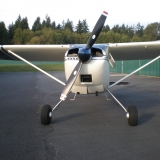
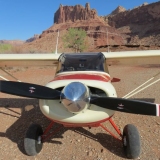
Yeah, I had little choice about that when I started flying my '65 Champion 7ECA... There literally is no pilot's manual available – no POH, no "Owner's Manual", only a 3"x4" Limitations page that lists CG limits, and a few other miscellaneous tidbits. Apparently back in those days, "real pilots" didn't need fancy manuals, only a placard or two...
I created an engine power vs fuel-flow chart by cribbing from an old C-150 manual (surprisingly accurate after I finally located an O-200 operator's manual and validated everything), and likewise cribbed from a later-model, higher powered (O-235 vs O-200) 7ECA manual to do some performance estimates, and created a couple of tables for takeoff "estimates" and cruise "estimates" that I'm still trying to verify. The book numbers are all with wheel pants installed, and I've got mine off for grass field operations, so that's not helping much...
The very first thing my tailwheel CFI and I did was to go out and do a bunch of power-on and power-off stalls, noting the attitude, feel, and (last and definitely least important) the actual ASI readings. My plane stalls almost 10 mph (indicated) slower than the later-model "book" figures (41 mph vs 51 mph in the later-model book). I suspect that the lighter, smaller engine and more 'draggy' landing gear (oleo struts vs flat spring) may result in "slower is better" performance, since I also seem to get a slightly higher rate of climb around 10 mph below the manual's Vy. I've done the 3-leg GPS ground-speed comparison, and the ASI seems to be reasonably accurate (maybe reading 1-2 mph lower than actual).
Anyway, after learning where my plane stalls, doing 3-point landings was a lot easier. If I had tried to do them at 51 mph (versus the 41 mph actual stall speed), the wing would still have been flying, and I would have been ballooning all over the place. Honestly, at 51 mph, the airplane just doesn't feel like it's anywhere near ready to land, so I'm glad I took the time to learn the actual "look and feel" of the stall before trying to land. Maintaining directional control was touch enough on that first landing, without having to deal with pilot-induced oscillation!
At this point I strongly prefer 3-point landings, and consistently do them bette. Learning to do a wheel landing well enough to get signed off was a lot harder for me, for some reason. I finally learned to do a "tail-low" wheel landing reasonably well. I know a lot of people (my CFI included) who prefer them in crosswinds, but thus far I'm still more comfortable 3-pointing it even with a good crosswind. So I keep practicing those wheel landings, hoping I'll eventually get better, or learn to dislike them a bit less – LOL.
Approaching 40 hours of TW time now, and she's still teaching me something on every flight!