I've read about lean-of-peak operations but never considered it much until late. After reading several articles on LOP including the one below, I gave it a whirl in the 180 (O-470S). The JPI engine analyzer gave me a good report with CHT's from 280 to 340 and EGT's between 1475 and 1550. I was surprised at the results since the carburetted O-470 has a reputation for poor fuel distribution. I was getting a burn rate of 8.9 gph on a power setting of 22/21 or about 60% hp. The following is probably the best article I've read on this subject. The topic seems to be gaining popularity. Has anyone out there explored this?
The AvWeb link below is worth reading.
http://www.avweb.com/news/savvyaviator/ ... 162-1.html
TJ
Lean of Peak Operations
Tue Nov 10, 2009 6:01 pm
Lean of Peak Operations
Last edited by TJ Carr on Tue Nov 10, 2009 7:17 pm, edited 1 time in total.
Tue Nov 10, 2009 6:06 pm
Re: Lean of Peak Operations
I've read a lot about it as well and the consensus seems to be..don't bother trying lean of peak ops with a carbureted motor. Many engines seem to fly happily with LOP ops though, most have gami's and fuel injection. I'd be interested to hear from others as well. I have zero hands -on experience with LOP.
- SixTwoLeemer offline

- Posts: 1285
- Joined: Thu Feb 07, 2008 10:53 am
- Location: Wasatch Front
Altitude is Time…. Airspeed is Life!
Tue Nov 10, 2009 8:19 pm
Re: Lean of Peak Operations
TJ Carr wrote:I've read about lean-of-peak operations but never considered it much until late. After reading several articles on LOP including the one below, I gave it a whirl in the 180 (O-470S). The JPI engine analyzer gave me a good report with CHT's from 280 to 340 and EGT's between 1475 and 1550. I was surprised at the results since the carburetted O-470 has a reputation for poor fuel distribution. I was getting a burn rate of 8.9 gph on a power setting of 22/21 or about 60% hp. The following is probably the best article I've read on this subject. The topic seems to be gaining popularity. Has anyone out there explored this?
The AvWeb link below is worth reading.
http://www.avweb.com/news/savvyaviator/ ... 162-1.html
TJ
I believe the S model has 7:1 compression. Remember when LOP fuel flow is the sole determiner of percent HP. For the low compression 470 engines 55% will be 9.1 GPH, 65% will be 10.7 GPH, 75% will be 12.4 GPH. Your EGT and CHT are quite a ways apart, showing the limitations of the carb'd setup. An injected 470 with GAMI's will have CHT's that are 5-10 degerees apart and CHT's only slightly farther apart than that. I run LOP all the time, but it's easier for me as my Bo is injected. For goofing off in the local area I'll usually use 19"/2100 RPM and burn 8.5 gph. That puts me slightly LOP, the book calls for 9.2 GPH at that setting, 45%, but that's ROP. I'll indicate about 140-150 MPH there depending on temperature. Nice gas mileage when I'm not going anywhere in particular. If you have a CHT of 340 then that cylinder more than likely is not LOP. Possibly a baffle problem but more likely your at peak or a little rich.
- Bonanza Man offline
- Posts: 909
- Joined: Fri Jul 07, 2006 3:42 pm
- Location: Seeley Lake
Tue Nov 10, 2009 8:38 pm
Re: Lean of Peak Operations
TJ Carr wrote:I've read about lean-of-peak operations but never considered it much until late. After reading several articles on LOP including the one below, I gave it a whirl in the 180 (O-470S). The JPI engine analyzer gave me a good report with CHT's from 280 to 340 and EGT's between 1475 and 1550. I was surprised at the results since the carburetted O-470 has a reputation for poor fuel distribution. I was getting a burn rate of 8.9 gph on a power setting of 22/21 or about 60% hp. The following is probably the best article I've read on this subject. The topic seems to be gaining popularity. Has anyone out there explored this?
The AvWeb link below is worth reading.
http://www.avweb.com/news/savvyaviator/ ... 162-1.html
TJ
TJ.
Whatever blows ones skirt up. LOP has been bantered around for generations. Opnions are about 70/30....against LOP, expecially with carbs. I fly two turbo/Senacas and a fuel injected C-206, as a volunteer pilot for a charity. None of our 20+ pilots operate them LOP, although the chief of maintence wants us to. I own a Maule with an IO 360 and do not operate LOP. Who knows. I just always figured the engine maker offered the best operating advise. Perhaps many of us who do not fly LOP.... operate as we do out of ignorance.

Have fun,
bob
Living the Dream
Tue Nov 10, 2009 8:50 pm
Re: Lean of Peak Operations
my o-540 doesn't like it much, unless u put it at about 50%...close the waste-gate on the turbo, and it is a good way to spend 30 large...! 50 deg rich works all the time, good cht's, about 12-18 hr depending on load and hurriedness...
these old boxer motors, air-cooled as they are, only put up with so much. flown within the right paramiters, they are almost bullet-proof! my old 182p had an R motor and worked awesome all the time...
these old boxer motors, air-cooled as they are, only put up with so much. flown within the right paramiters, they are almost bullet-proof! my old 182p had an R motor and worked awesome all the time...

jomac
Tue Nov 10, 2009 8:50 pm
Re: Lean of Peak Operations
my o-540 doesn't like it much, unless u put it at about 50%...close the waste-gate on the turbo, and it is a good way to spend 30 large...! 50 deg rich works all the time, good cht's, about 12-18 hr depending on load and hurriedness...
these old boxer motors, air-cooled as they are, only put up with so much. flown within the right paramiters, they are almost bullet-proof! my old 182p had an R motor and worked awesome all the time...
these old boxer motors, air-cooled as they are, only put up with so much. flown within the right paramiters, they are almost bullet-proof! my old 182p had an R motor and worked awesome all the time...
jomac
Tue Nov 10, 2009 9:07 pm
Re: Lean of Peak Operations
z3skybolt wrote:
I just always figured the engine maker offered the best operating advise.
bob
Lots of people did and they'd be wrong. Continental just came out and gave parameters for operating LOP after 50 years of saying don't dare ever go there. Lycoming, same thing. They finally realized that the science is out there and their position all these years is pure bullshit. The fact of the matter is they never bothered to instrument their engines and base the engine POH on actual science. They found something that was good enough and just made that their recommendation. Well some people have instrumented the engines and can tell you exactly what is happening inside there. Enter GAMI and API. The simple fact of the matter is for injected engines LOP is tremendously easier on the engine than book figures ROP. It would be for carb'd engines too if you get get equal amounts of fuel and air into each cylinder. But you can't so you're stuck operating the engine inefficiently. LOP means cooler CHT's and lower internal cylinder pressures.
- Bonanza Man offline
- Posts: 909
- Joined: Fri Jul 07, 2006 3:42 pm
- Location: Seeley Lake
Tue Nov 10, 2009 9:47 pm
Re: Lean of Peak Operations
This is always a fun topic.
I have always gotten a lot of advice from those poor bastards who own the aircraft they make their living with, right or wrong. I am not one of them.
Where I live, it is sea level. The outside air temperatures are cool. The normal cruising altitudes are from 1500 - 3500msl. Sometimes in the 4000's, but not very often. The typical leg is around .5, plus or minus a few minutes. There are A LOT of Cessna 206's, floats and wheels, and 207's. These are our pickup trucks. There are getting to be a few IO550's, but mostly still IO520's. For the 520, the typical power setting is 23/2400 leaned to 16 - 16.5 gph. On my airplane, that's roughly peak EGT. Guys bought the GAMI's when they came out, ran LOP and started burning out exhaust systems left and right. Now it's back to the old fuel settings. I guess we could all be wrong still, but it's working. These engines routinely see TBO, which takes 24 - 30 calendar months as a general rule.
Again, this is how it is where I live. Could be totally different for the guy who climbs up to 10K and cruises for a couple hours.
gb
I have always gotten a lot of advice from those poor bastards who own the aircraft they make their living with, right or wrong. I am not one of them.
Where I live, it is sea level. The outside air temperatures are cool. The normal cruising altitudes are from 1500 - 3500msl. Sometimes in the 4000's, but not very often. The typical leg is around .5, plus or minus a few minutes. There are A LOT of Cessna 206's, floats and wheels, and 207's. These are our pickup trucks. There are getting to be a few IO550's, but mostly still IO520's. For the 520, the typical power setting is 23/2400 leaned to 16 - 16.5 gph. On my airplane, that's roughly peak EGT. Guys bought the GAMI's when they came out, ran LOP and started burning out exhaust systems left and right. Now it's back to the old fuel settings. I guess we could all be wrong still, but it's working. These engines routinely see TBO, which takes 24 - 30 calendar months as a general rule.
Again, this is how it is where I live. Could be totally different for the guy who climbs up to 10K and cruises for a couple hours.
gb

Tue Nov 10, 2009 10:40 pm
Re: Lean of Peak Operations
At 10K, LOP/ROP is moot. You can run wherever you want to spend your gas.
ROP means excess gas. LOP means excess air. Both will cool your engine temps. Air is cheaper than gas and let's hope the gubment doesn't find out.
I have flown coast to coast and back again, mostly at 1000-2000 AGL and LOP. I was not in a hurry, but between 9.5 and 10 GPH was better than 12-14. I have run LOP just about all the time, cheap bastard that I am. The Lyc. IO-540 seems to love it. Big Lycomings don't seem to need the GAMI's. My factory injectors peak between .3 and .6 GPH between leanest and richest. The CHT difference between ROP and LOP has to be seen to be appreciated.
There's a jump school at one of the airports I frequent. They have a really tired C182 for when there are few customers. Poor thing is firewalled from the start of the takeoff roll to 12,000ft and then a few minutes cruise to position the jumpers. Once they are away, it dives for the runway to beat them back. So much for shock cooling. It routinely makes TBO. But, even if there is no right or wrong in the LOP/ROP debate, I can see economic and operational benefits. If you are an ROP pilot descending to an airport, you are constantly worrying about forgetting to adjust the mixture on the way down lest you get too lean and wreck something. As an LOP pilot, I just roll the RPM to the bottom of the green, trim nose down and don't touch anything until I'm on short final. Don't worry, at those low power settings, she won't quit. So, unless I have to make a 360 on downwind for some blankety blank dude, I just push prop and mixture forward on final and my temps have made a smooth, continuous taper from altitude until I hit the numbers. The engine loves it.
Last annual: These plugs are more than 400 hrs old and have been cleaned once in their life before this picture. And the inside of my tailpipe looks just right too.
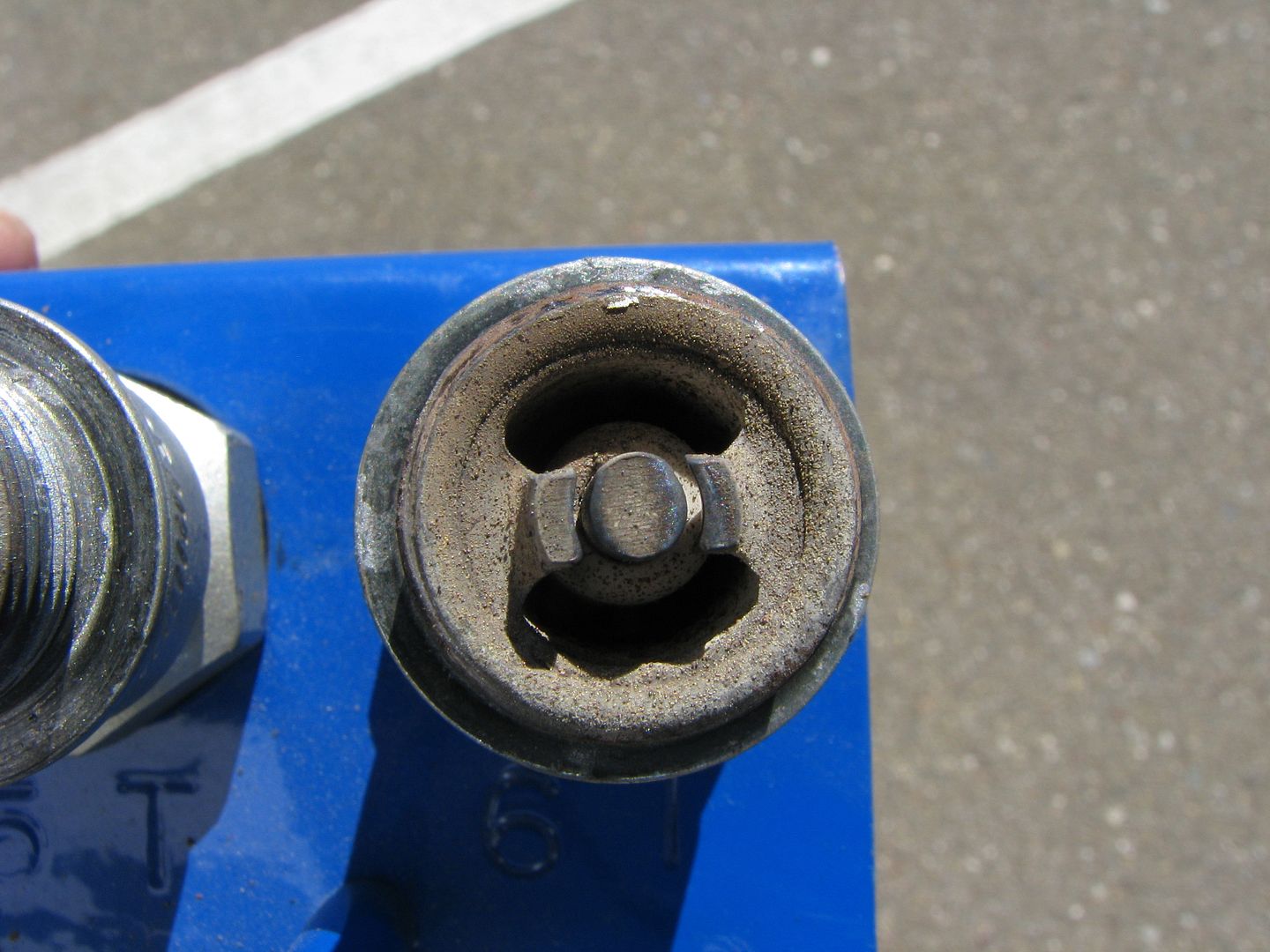
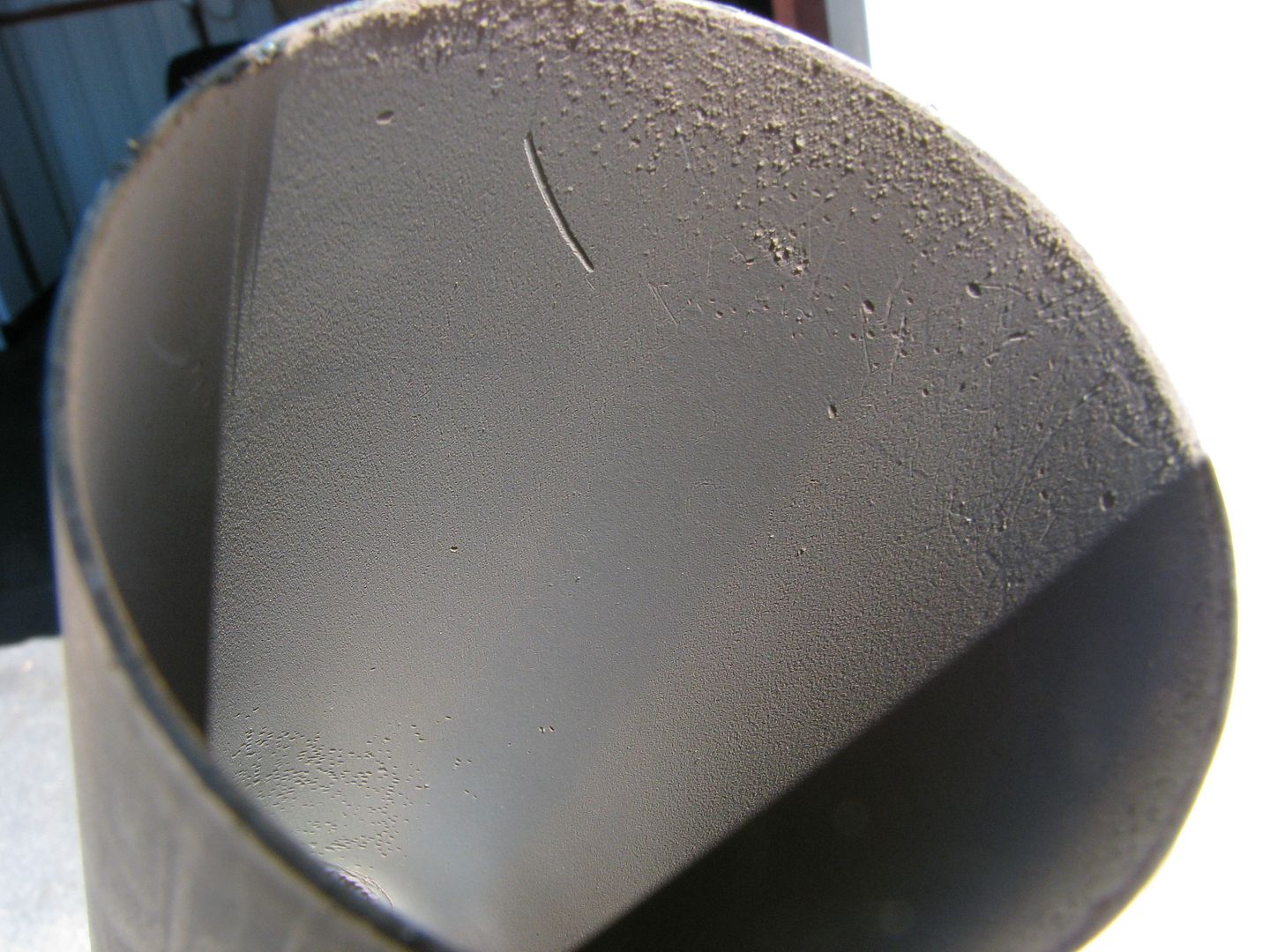
Now, for a REAL debate, let's talk carbon monoxide. There ain't any LOP (practically). CO is a product of incomplete combuustion. Excess air from LOP means there is no unburned fuel to create CO.
YB
ROP means excess gas. LOP means excess air. Both will cool your engine temps. Air is cheaper than gas and let's hope the gubment doesn't find out.
I have flown coast to coast and back again, mostly at 1000-2000 AGL and LOP. I was not in a hurry, but between 9.5 and 10 GPH was better than 12-14. I have run LOP just about all the time, cheap bastard that I am. The Lyc. IO-540 seems to love it. Big Lycomings don't seem to need the GAMI's. My factory injectors peak between .3 and .6 GPH between leanest and richest. The CHT difference between ROP and LOP has to be seen to be appreciated.
There's a jump school at one of the airports I frequent. They have a really tired C182 for when there are few customers. Poor thing is firewalled from the start of the takeoff roll to 12,000ft and then a few minutes cruise to position the jumpers. Once they are away, it dives for the runway to beat them back. So much for shock cooling. It routinely makes TBO. But, even if there is no right or wrong in the LOP/ROP debate, I can see economic and operational benefits. If you are an ROP pilot descending to an airport, you are constantly worrying about forgetting to adjust the mixture on the way down lest you get too lean and wreck something. As an LOP pilot, I just roll the RPM to the bottom of the green, trim nose down and don't touch anything until I'm on short final. Don't worry, at those low power settings, she won't quit. So, unless I have to make a 360 on downwind for some blankety blank dude, I just push prop and mixture forward on final and my temps have made a smooth, continuous taper from altitude until I hit the numbers. The engine loves it.
Last annual: These plugs are more than 400 hrs old and have been cleaned once in their life before this picture. And the inside of my tailpipe looks just right too.
Now, for a REAL debate, let's talk carbon monoxide. There ain't any LOP (practically). CO is a product of incomplete combuustion. Excess air from LOP means there is no unburned fuel to create CO.
YB
- Yellowbelly offline

- Posts: 355
- Joined: Wed Apr 27, 2005 9:03 pm
- Location: Beautiful southern Utah
Maule M-7-235C
I'm lost
but I'm not afraid
I'm lost
but I'm not afraid
Tue Nov 10, 2009 10:50 pm
Re: Lean of Peak Operations
AOPA has had two or three good articles this year about this topic. Since I have no experience with this, I'll defer it to them. They seemed to be well written aritcles based on some good info.
- Grassstrippilot offline


- Posts: 3536
- Joined: Wed May 31, 2006 6:17 am
- Location: Syracuse, UT
- FindMeSpot URL: https://share.garmin.com/WolfAdventures
- Aircraft: Cessna 205
Wed Nov 11, 2009 10:51 am
Re: Lean of Peak Operations
If you are still curious about this LOP/ROP take the time to read this article by John Deakin. http://www.avweb.com/news/pelican/182084-1.html
Jim Wheat
Wed Nov 11, 2009 11:16 am
Re: Lean of Peak Operations
All this back-n-forth about lean-of-peak versus rich-of-peak. Here's a (dumb) question-- why not just split the difference & run at peak? 
I have no EGT or CHT gauge, so cruising up high I lean to rough then twist it back in a bit. Zooming around down low I just lean it "out a ways". Seems to work OK. I'd hate to burn up an engine by running LOP, then forgetting to richen it up when I have to put it in a hard climb or something.
Not too technical a method but then I'm not too technical a person.
Eric
I have no EGT or CHT gauge, so cruising up high I lean to rough then twist it back in a bit. Zooming around down low I just lean it "out a ways". Seems to work OK. I'd hate to burn up an engine by running LOP, then forgetting to richen it up when I have to put it in a hard climb or something.
Not too technical a method but then I'm not too technical a person.
Eric


Cessna Skywagon -- accept no substitute!
Wed Nov 11, 2009 11:37 am
Re: Lean of Peak Operations
gbflyer wrote: For the 520, the typical power setting is 23/2400 leaned to 16 - 16.5 gph. On my airplane, that's roughly peak EGT. Guys bought the GAMI's when they came out, ran LOP and started burning out exhaust systems left and right. Now it's back to the old fuel settings. I guess we could all be wrong still, but it's working. These engines routinely see TBO, which takes 24 - 30 calendar months as a general rule.
gb
For my 520 at that power setting you are way rich. 75% power is 23"/2500 RPM and the book calls for 15.2 gph, assuming 285 HP version of 520. This however is in what's called the red box, seen here:
http://farm3.static.flickr.com/2573/409 ... 0f60_o.gif
And so is 16.5 gph at those power settings. You're going to need to be around 18 GPH to be on the safe side if you want to run ROP. If you are burning anything up when LOP then you simply are not lean like you think you are. 50 ROP is the same EGT as 50 LOP but the CHT will be higher at the rich setting. The CHT will always be higher on the rich side than the lean side when leaned to the same temp rich or lean of peak.
- Bonanza Man offline
- Posts: 909
- Joined: Fri Jul 07, 2006 3:42 pm
- Location: Seeley Lake
Wed Nov 11, 2009 12:11 pm
Re: Lean of Peak Operations
If you lean per manufacturer recommendations in most old planes you are already LOP in some cylinders anyway regardless if you are trying or not 
- onceAndFutr_alaskaflyer offline
- Posts: 1319
- Joined: Sun Apr 23, 2006 4:23 pm
- Location: Keweenaw Peninsula, Michigan and Carson Valley, Nevada
Wed Nov 11, 2009 4:45 pm
Re: Lean of Peak Operations
I agree it is difficult at best to run LOP on a carbureted engine due to the uneven flow to the cylinders. Would not recommend running any engine at greater than 75% power LOP.
- dawgdriver offline

- Posts: 107
- Joined: Mon Jun 22, 2009 8:52 am
- Location: Idaho
Wed Nov 11, 2009 5:50 pm
Re: Lean of Peak Operations
n6zt wrote:If you are still curious about this LOP/ROP take the time to read this article by John Deakin. http://www.avweb.com/news/pelican/182084-1.html
Thanks for the great pointer to an excellent article. I took several automotive engineering classes while going to school, and most of this was part of the engine analysis portions. It was a great refresher, and I liked the specific application to aviation engines.
tom

- Savannah-Tom offline

- Posts: 891
- Joined: Mon Mar 06, 2006 3:26 pm
- Location: Corvallis, OR
Wed Nov 11, 2009 6:23 pm
Re: Lean of Peak Operations
Bonanza Man wrote:gbflyer wrote: For the 520, the typical power setting is 23/2400 leaned to 16 - 16.5 gph. On my airplane, that's roughly peak EGT. Guys bought the GAMI's when they came out, ran LOP and started burning out exhaust systems left and right. Now it's back to the old fuel settings. I guess we could all be wrong still, but it's working. These engines routinely see TBO, which takes 24 - 30 calendar months as a general rule.
gb
For my 520 at that power setting you are way rich. 75% power is 23"/2500 RPM and the book calls for 15.2 gph, assuming 285 HP version of 520. This however is in what's called the red box, seen here:
http://farm3.static.flickr.com/2573/409 ... 0f60_o.gif
And so is 16.5 gph at those power settings. You're going to need to be around 18 GPH to be on the safe side if you want to run ROP. If you are burning anything up when LOP then you simply are not lean like you think you are. 50 ROP is the same EGT as 50 LOP but the CHT will be higher at the rich setting. The CHT will always be higher on the rich side than the lean side when leaned to the same temp rich or lean of peak.
Good information, thanks. I'll try it. If I screw up, I'll send that guy a bill for 6 new jugs.
gb
Wed Nov 11, 2009 9:05 pm
Re: Lean of Peak Operations
I read that article on Avweb about mixture settings before I ever flew my new XP O 360 and I have been following CHT limits instead of EGT ever since. I keep my highest cylinder CHT below 400 degrees, 380-390 preferably. Since I have carburetion, my CHT will vary more than if I had injection. What I took away from that article and put in combination with communications more than a year and a half ago with a Superior engineer, was that manufacturer's LOP and ROP recommendations were traditionally written based on steam gauge era accuracy. EGT variations were more readable on those type instruments than were CHT's variations. Modern digital readings are sensitive and responsive enough to let us actually watch CHT changes directly. It is at high CHT where the damage is done. There is not really anything detrimental to the engine about high temperatures of the exiting exhaust gasses directly, other than continued high EGT's will eventually result in an increase in CHT over safe limits and with those high temps backing into the cylinder itself causes softening of aluminum heads, pistons, etc. resulting in engine damage. (Aluminum over 400 degrees softens to approximately one half to what it was cold.) In other words we have been using high EGT as the early warning system to head off high CHT's, but high CHT is where the damage occurs. Since the purpose of managing EGT's with LOP and ROP goals was to manage CHT's why not manage CHT directly using digital technology. That's what I have been doing and it is much simpler.
Lynn Sanderson (Dirtstrip) passed away from natural causes in May 2013. He was a great contributor and will be missed dearly.
Wed Nov 11, 2009 9:13 pm
Re: Lean of Peak Operations
dirtstrip wrote:I read that article on Avweb about mixture settings before I ever flew my new XP O 360 and I have been following CHT limits instead of EGT ever since. I keep my highest cylinder CHT below 400 degrees, 380-390 preferably. Since I have carburetion, my CHT will vary more than if I had injection. What I took away from that article and put in combination with communications more than a year and a half ago with a Superior engineer, was that manufacturer's LOP and ROP recommendations were traditionally written based on steam gauge era accuracy. EGT variations were more readable on those type instruments than were CHT's variations. Modern digital readings are sensitive and responsive enough to let us actually watch CHT changes directly. It is at high CHT where the damage is done. There is not really anything detrimental to the engine about high temperatures of the exiting exhaust gasses directly, other than continued high EGT's will eventually result in an increase in CHT over safe limits and with those high temps backing into the cylinder itself causes softening of aluminum heads, pistons, etc. resulting in engine damage. (Aluminum over 400 degrees softens to approximately one half to what it was cold.) In other words we have been using high EGT as the early warning system to head off high CHT's, but high CHT is where the damage occurs. Since the purpose of managing EGT's with LOP and ROP goals was to manage CHT's why not manage CHT directly using digital technology. That's what I have been doing and it is much simpler.
The actual EGT is irrelevant. The actual temp of the combustion event is several thousand degrees, don't get too excited about the EGT value. Move the probe an inch either way and the temp will be higher or lower by quite a bit.
- Bonanza Man offline
- Posts: 909
- Joined: Fri Jul 07, 2006 3:42 pm
- Location: Seeley Lake
Sat Nov 14, 2009 7:13 am
Re: Lean of Peak Operations
I believe we are in agreement with the value (to the pilot) of the EGT reading being only an indicator of coming high CHT. While the actual EGT temp reported is subjective to placement of the probe, it is not that way where CHT's are concerned. The CHT probe is factory placed in the head and direct contact with the head provides better correlation to the actual engine parts that we are trying to protect.
Lynn Sanderson (Dirtstrip) passed away from natural causes in May 2013. He was a great contributor and will be missed dearly.
DISPLAY OPTIONS
Who is online
Users browsing this forum: No registered users and 0 guests
Latest Features
-
Live to Tell
A Minnesota pilot is surprised to learn that the sudden asymmetric drag of an out-of-rig ski can…Read More -
Creators
Working in some of the Yukon's most beautiful and remote environments, photographer Simon Blakesley captures aircraft in…Read More -
Aircraft Ownership and Maintenance
Upgrading to big tires can make a huge difference in backcountry performance, but with those gains come…Read More -
Tales from Yesteryear
In this tale from bush flying yesteryear, Don Cogger signs up to help Atlee Dodge Jr recovery…Read More


Latest Knowledge Base
-
Destinations
A regional guide with ideas for winter camping destinations in California, Nevada, New Mexico, and Arizona.Read More -
Aircraft
Finding an affordable aircraft that can handle the backcountry for $80K or less? A challenge for sure, but with the…Read More -
Aircraft
01.29.2018 - Zane - Updated tire diameter graphic to add 8.50x10 Guide to tires for use in the backcountry and off-airport landing…Read More -
Pilots
12.22.2013 - Initial article format Operating aircraft on skis and negotiating a snow-covered landscape is an entirely unique skillset and environment.…Read More


