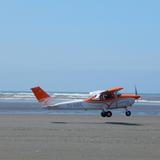
My uncle just finished his new strip at his farm.
Field elevation 3,700 ft
A bit humid and temp 26 centigrades.
Density altitude today when I took off was more than 6,000ft.
Ground is soft field.
This is the highest airfield in Costa Rica.
I went light to experiment the density altitude.
Full runway is going to be 990 meters, but today we have 600 meters available, and there is a small hill at the end of the runway.
Did a short field take off, accelerated as much as possible in ground effect and cleared the hill, but by a lot less than I would have imagined though!!
I leaned I bit but really didnt know how much to lean.
any tips on knowing how much to lean? I didnt want to make power runups in this field because of the rocks that could damage the prop.
Leaning for density altitude
Sat May 31, 2014 2:22 pm
Sat May 31, 2014 3:04 pm
Re: Leaning for density altitude
Probably one knuckle if you're still running your j model, then watch your egt's when you give it the onion. You'll know If you overdid it before takeoff, because it will fall on it's face during a rolling mag check running on one. Size up your setting on your finger next time you're at 6000 ft.
- Nosedragger offline
- Posts: 975
- Joined: Fri Dec 31, 2010 6:40 am
- Location: SE Idaho
- FindMeSpot URL: http://share.findmespot.com/shared/face ... ACzcbTgqlT
Sat May 31, 2014 3:13 pm
Re: Leaning for density altitude
I'd lean for max rpm until you are comfortable clear of everything, then richen the mixture for continued climbing for the additional cooling. usually about a knuckle's worth in my plane as well.
- scottf offline
- Posts: 650
- Joined: Fri Mar 23, 2012 9:56 am
- Location: Meridian, ID
- FindMeSpot URL: http://share.findmespot.com/shared/face ... cbQCpIqefS
Tue Jun 24, 2014 9:56 pm
Re: Leaning for density altitude
Flyers, I've got a '54 180 Skywagon and am planning a southwest trip.
My panel has fuel flow and a single channel CHT.
After scanning all of the "leaning" threads I am left still wondering: If I note my sea level fuel flow for a range of manifold pressures, would setting to those same flows, at those same indicated MP's be the best way to lean for high DA take off?
Thanks!
My panel has fuel flow and a single channel CHT.
After scanning all of the "leaning" threads I am left still wondering: If I note my sea level fuel flow for a range of manifold pressures, would setting to those same flows, at those same indicated MP's be the best way to lean for high DA take off?
Thanks!
- flyingzebra offline

- Posts: 479
- Joined: Sat Jan 24, 2009 4:53 am
- Location: Northwest Washington state
- Aircraft: Cessna Skylane 182 N3440S, Aviat Husky N2918L
Tue Jun 24, 2014 10:03 pm
Re: Leaning for density altitude
scottf wrote:I'd lean for max rpm until you are comfortable clear of everything, then richen the mixture for continued climbing for the additional cooling. usually about a knuckle's worth in my plane as well.
Leaning for max rpm doesn't work with a constant speed prop. Best bet is a full throttle run up, leaning for best MAP then slightly rich to account for a little more air flow on take off roll. YMMV

Tue Jun 24, 2014 10:05 pm
Re: Leaning for density altitude
flyingzebra wrote:Flyers, I've got a '54 180 Skywagon and am planning a southwest trip.
My panel has fuel flow and a single channel CHT.
After scanning all of the "leaning" threads I am left still wondering: If I note my sea level fuel flow for a range of manifold pressures, would setting to those same flows, at those same indicated MP's be the best way to lean for high DA take off?
Thanks!
Well, that works IF you can perform a full power runup prior to departure. If you're going to do that, you'd best do it over CLEAN pavement. Otherwise you're looking at prop damage......
If you're flying in there at the same temp, set the mixture in flight, land, then shut down with mags. Ready to leave, crank up, leave mix where it was, and go.
MTV


Wed Jun 25, 2014 2:55 am
Re: Leaning for density altitude
Halestorm wrote:scottf wrote:I'd lean for max rpm until you are comfortable clear of everything, then richen the mixture for continued climbing for the additional cooling. usually about a knuckle's worth in my plane as well.
Leaning for max rpm doesn't work with a constant speed prop. Best bet is a full throttle run up, leaning for best MAP then slightly rich to account for a little more air flow on take off roll. YMMV
Should MAP increase when you lean in that situation?
If the throttle butterfly is already wide open then the engine will be getting as much air pressure as possible, discounting any minor ram-air effects. The engine's like a compressor sucking harder on the manifold the more power it generates, so it seems to me the manifold pressure could actually reduce as power output increased, or have I missed something? Not sure.
If you are at like 7000ft DA with a non-turbo engine, you are able to simply lean to best power. You can just open the throttle and roll, pull the mixture until the engine fumbles or rpm drops, then push it in a half-inch or so, until the engine is roaring smoothly again.
Wed Jun 25, 2014 4:43 am
Re: Leaning for density altitude
MTV has a good suggestion. If you have a CHT/EGT gauge lean to set 1300 EGT as the best solution. As a matter of fact you can lean to 1300 EGT in any climb for the best power/FF/ICP setting.
My nickel,
gunny
My nickel,
gunny

Wed Jun 25, 2014 7:03 am
Re: Leaning for density altitude
A CS prop is at the max RPM stops until or almost until full throttle. It is essentially a fixed pitch prop until you pour the coals to it at fine pitch. Leaning for max RPM is effective both at and somewhat below he usual runup speed in any engine Ive sat behind.Halestorm wrote:Leaning for max rpm doesn't work with a constant speed prop.
Using MP is a bit harder to do...a 50 RPM gain from leaning to max RPM at typical runup speeds barely registers any MP drop at all from what I've seen.
To limit prop damage on rocky ground, lots of people use a reduced RPM during a brisk taxi back to the takeoff end of the airstrip to lean, cycle the prop, and check the mags (many times omitting the carb heat check, naturally, due to the dust). The higher taxi speed with the prop run up to 1400 or so allows back elevator to maximize prop clearance and reduce circulation which can suck rocks up.
Wed Jun 25, 2014 7:29 am
Re: Leaning for density altitude
I did it like lesuther when I had to fly a constant speed. When there was a choice, I flew a fixed pitch.
- contactflying offline
- Posts: 4972
- Joined: Wed Apr 03, 2013 7:36 pm
- Location: Aurora, Missouri 2H2
Download my free "https://tinyurl.com/Safe-Maneuvering" e-book.
Thu Jun 26, 2014 4:25 am
Re: Leaning for density altitude
I have been trying for take off a short field , soft field tehcnique , to be in the air as quickly as possible, and then continue to build speed in ground effect.
Will it be better to gain more speed in the take off run?
The way Im doing it is at 40mph add flaps to 30 degrees and start flying, at sea level works and happens easily, at this airport takes an effort to make it happen and the acceleration in ground effect is very slow.
Will it be better to gain more speed in the take off run?
The way Im doing it is at 40mph add flaps to 30 degrees and start flying, at sea level works and happens easily, at this airport takes an effort to make it happen and the acceleration in ground effect is very slow.
Thu Jun 26, 2014 9:41 am
Re: Leaning for density altitude
motoadve wrote:I have been trying for take off a short field , soft field tehcnique , to be in the air as quickly as possible, and then continue to build speed in ground effect.
Will it be better to gain more speed in the take off run?
The way Im doing it is at 40mph add flaps to 30 degrees and start flying, at sea level works and happens easily, at this airport takes an effort to make it happen and the acceleration in ground effect is very slow.
Higher DA changes the equation in more ways than I think you realize.
First, about leaning. My airplane has a constant speed prop, and I have flown her out of field elevations ranging from 4700' to over 9900'. I used to instruct and charter from Laramie, which has a field elevation of 7377'--we had 172s, 182s, a 206, and a T210. So high DAs are normal flying for me. Whether a fixed pitch or a CS prop, you can lean at normal run-up rpm until the rpm just barely drops, then enrichen the mixture about half an inch of mixture control movement. That works in just about every normally aspirated airplane. You don't need to do a full power run-up. On rougher strips, I do mine on the back taxi as a rolling run-up. (BTW, if you experiment on clean ground, you'll find that the leaning at full power rpm and the leaning at reduced run-up rpm is just about the same.)
Now about take off. At high DAs, 20 flaps is the most I would ever use in a Skylane, but I'd be more likely to use just 10. I would not ever use 30 in a high density altitude take off, because the airplane won't climb well at all. If the field is truly soft, keep the nose down so that it just barely clears the ground; if the field is hard enough, don't raise it except to just lighten it some. The higher you raise it, the more aerodynamic drag you have, and that inhibits gaining airspeed. Then when it lifts off, stay only in low ground effect (like 5' or so off the ground) until you build speed to well above your normal Vx, because Vx rises with higher DAs. I find it a lot easier to trim nose down somewhat and adjust my pitch by pulling rather than pushing the yoke (biceps are typically stronger than triceps), because as airspeed builds, the airplane wants to climb out of ground effect too quickly.
Cary

"I have slipped the surly bonds of earth..., put out my hand and touched the face of God." J.G. Magee
Thu Jun 26, 2014 12:49 pm
Re: Leaning for density altitude
My 182 has the Sportsman STOL this is why I use 10 degrees and at 40 MPH lower flaps to 30 .
This is the procedure for Sportsman STOL kit for shorter take offs.
Next time will try 10 and 20 degrees and maybe 50MPH instead of 40.
This is the procedure for Sportsman STOL kit for shorter take offs.
Next time will try 10 and 20 degrees and maybe 50MPH instead of 40.
Thu Jun 26, 2014 6:35 pm
Re: Leaning for density altitude
I honestly don't know what effect the Sportsman has at really high DAs--but I think I'd vote for starting with 10 and at most going to 20. Again, what you want is lift, not aerodynamic drag, and 30 provides a lot of drag, with or without the Sportsman. You may break ground sooner with 30, but you still have to fly after breaking ground. I think the only way you'll know for sure is to compare both ways, same temp, same load, etc. and see which is better.
Cary
Cary
"I have slipped the surly bonds of earth..., put out my hand and touched the face of God." J.G. Magee
Thu Jun 26, 2014 6:49 pm
Re: Leaning for density altitude
It would only make sense to lift-off sooner if you can accelerate faster in the air than on the ground. Probably not worthwhile using 30 degrees on a smooth runway. But on a rough airstrip it might be worthwhile. But honestly if it were really that close-cut, you probably should be staying at the ramp.
DISPLAY OPTIONS
Who is online
Users browsing this forum: No registered users and 3 guests
Latest Features
-
Live to Tell
A Minnesota pilot is surprised to learn that the sudden asymmetric drag of an out-of-rig ski can…Read More -
Creators
Working in some of the Yukon's most beautiful and remote environments, photographer Simon Blakesley captures aircraft in…Read More -
Aircraft Ownership and Maintenance
Upgrading to big tires can make a huge difference in backcountry performance, but with those gains come…Read More -
Tales from Yesteryear
In this tale from bush flying yesteryear, Don Cogger signs up to help Atlee Dodge Jr recovery…Read More


Latest Knowledge Base
-
Destinations
A regional guide with ideas for winter camping destinations in California, Nevada, New Mexico, and Arizona.Read More -
Aircraft
Finding an affordable aircraft that can handle the backcountry for $80K or less? A challenge for sure, but with the…Read More -
Aircraft
01.29.2018 - Zane - Updated tire diameter graphic to add 8.50x10 Guide to tires for use in the backcountry and off-airport landing…Read More -
Pilots
12.22.2013 - Initial article format Operating aircraft on skis and negotiating a snow-covered landscape is an entirely unique skillset and environment.…Read More


