Lightning inflight strike (another $#i+y day in Paradise)
Sat Feb 28, 2015 4:40 pm
Lightning inflight strike (another $#i+y day in Paradise)
Last edited by 8GCBC on Sun Mar 01, 2015 4:02 pm, edited 1 time in total.

CFII, MEI, CFISES, ATPME, IA/AP, RPPL, Ski&Amphib ops, RHC mechanic cert, RHC SC— 3000TT
Sat Feb 28, 2015 10:38 pm
Re: Lighting inflight strike (another $#i+y day in Paradise)
Believe it or not, lightning strikes in commercial aviation are very common. I've had three so far in 19 years. Some cause damage, some don't. Normally just an inspection, though one of mine did blow the static wicks off of the right aileron and elevator. Usually the damage, if any, is at the many (sometimes over a hundred) exit points.
Sat Feb 28, 2015 10:59 pm
Re: Lighting inflight strike (another $#i+y day in Paradise)
Cannon wrote:Believe it or not, lightning strikes in commercial aviation are very common. I've had three so far in 19 years. Some cause damage, some don't. Normally just an inspection, though one of mine did blow the static wicks off of the right aileron and elevator. Usually the damage, if any, is at the many (sometimes over a hundred) exit points.
Hi Cannon;
Glad you did not have any "bad" strikes. Luckily, never been hit flying my little ship.

Question(s), if I may:
#1 What type of aircraft were you flying?
# 2 Location, altitude, time of year ?
Thank you!
CFII, MEI, CFISES, ATPME, IA/AP, RPPL, Ski&Amphib ops, RHC mechanic cert, RHC SC— 3000TT
Sun Mar 01, 2015 10:00 am
Re: Lighting inflight strike (another $#i+y day in Paradise)
So far I had 4 lightning strikes in my career. Depending where you fly, lightning strikes are very common. I remember last year there were over 20 aircraft hit by lightning in one day going into Hong Kong. It's a non event. I once got hit on the nose, makes a really really loud bang and is very bright (thats why you switch the cockpit storm lights on at night when flying in bad weather) but that's it. Usually you have a small entry hole where the lightning hits and some blown rivets where it exits. My lighting strikes all exited on the wing tip.
Sun Mar 01, 2015 1:48 pm
Re: Lighting inflight strike (another $#i+y day in Paradise)
8GCBC wrote:
Hi Cannon;
Glad you did not have any "bad" strikes. Luckily, never been hit flying my little ship.
Question(s), if I may:
#1 What type of aircraft were you flying?
# 2 Location, altitude, time of year ?
Thank you!
The first one was in an RJ (EMB-145), springtime somewhere over Mississippi at FL370. Like an idiot I decided to fly between two cells that were ~15 miles apart rather than fly around them. It was daytime, clear between them, and I biased slightly toward the smaller of the two cells. Just as we got between them, the smaller cell (which was still 3-5 miles away) got us. I saw the bolt, and it was the first time I'd heard lightning from inside the cockpit. Sounded like someone hit the side of the airplane with a rubber mallet. We had a new flight attendant on her first training flight. She was looking out the window at the time, and the lightning hit literally inches from her face, right next to her window. She was not amused.
The second one was early winter leaving LAX of all places. I was deadheading on a 757 when we were hit somewhere on the right side. Big flash, same sound, and the passengers on the right side strangely responded by closing their window shades. Out of sight, out of mind, I guess.
The third one was at night, summertime, descending into Philly in a 737. It was a large area of moderate stratus-type rain, glass smooth, no forecast convection and none that could be seen sticking up out of the ~15,000' tops as we descended into the weather. The cockpit was very dark, and at about 7,000' - BAM! Right on the centerpost between the windshields. Bright is an understatement. The airplane was unaffected, A/P remained on, and after 5-10 seconds we could start to see the screens again, which fortunately were now bright (until this event, it never occurred to me that the photocells in the EFIS screens would also see the flash and immediately go full-bright - whether by accident or design, very beneficial). We landed uneventfully, though we did find a quarter-sized exit hole in the left winglet.
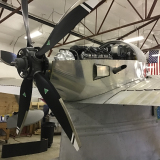
Now, getting hit in a prop airplane - whether piston or turboprop - can be more problematic. Lightning often likes to enter or exit through propellers, and when it does it wreaks havoc with the engine. It will arc across each bearing and gearset it comes across until it gets into the airframe, usually requiring an engine teardown because of the potential for pitting the various engine components. It rarely causes major problems in jets.
Sun Mar 01, 2015 1:54 pm
Re: Lighting inflight strike (another $#i+y day in Paradise)
I always wondered what would happen if lightning struck a prop plane. Why is it that the lightning like to enter or exit the prop? One would think that taking the path of least resistance would keep it from going through all the bearings. Unfortunately, lightning doesn't always follow the rules...

Sun Mar 01, 2015 4:01 pm
Re: Lightning inflight strike (another $#i+y day in Paradise
Cannon wrote:8GCBC wrote:
Hi Cannon;
Glad you did not have any "bad" strikes. Luckily, never been hit flying my little ship.
Question(s), if I may:
#1 What type of aircraft were you flying?
# 2 Location, altitude, time of year ?
Thank you!
The first one was in an RJ (EMB-145), springtime somewhere over Mississippi at FL370. Like an idiot I decided to fly between two cells that were ~15 miles apart rather than fly around them. It was daytime, clear between them, and I biased slightly toward the smaller of the two cells. Just as we got between them, the smaller cell (which was still 3-5 miles away) got us. I saw the bolt, and it was the first time I'd heard lightning from inside the cockpit. Sounded like someone hit the side of the airplane with a rubber mallet. We had a new flight attendant on her first training flight. She was looking out the window at the time, and the lightning hit literally inches from her face, right next to her window. She was not amused.
The second one was early winter leaving LAX of all places. I was deadheading on a 757 when we were hit somewhere on the right side. Big flash, same sound, and the passengers on the right side strangely responded by closing their window shades. Out of sight, out of mind, I guess.
The third one was at night, summertime, descending into Philly in a 737. It was a large area of moderate stratus-type rain, glass smooth, no forecast convection and none that could be seen sticking up out of the ~15,000' tops as we descended into the weather. The cockpit was very dark, and at about 7,000' - BAM! Right on the centerpost between the windshields. Bright is an understatement. The airplane was unaffected, A/P remained on, and after 5-10 seconds we could start to see the screens again, which fortunately were now bright (until this event, it never occurred to me that the photocells in the EFIS screens would also see the flash and immediately go full-bright - whether by accident or design, very beneficial). We landed uneventfully, though we did find a quarter-sized exit hole in the left winglet.
Now, getting hit in a prop airplane - whether piston or turboprop - can be more problematic. Lightning often likes to enter or exit through propellers, and when it does it wreaks havoc with the engine. It will arc across each bearing and gearset it comes across until it gets into the airframe, usually requiring an engine teardown because of the potential for pitting the various engine components. It rarely causes major problems in jets.
Hi Cannon;
Thank you for your detailed discussion. Some points that I was unaware of:
* Photocells (may) relay the intensity, of the lightning flash, to a screen making it very bright
* Props are natural lightning rods that seem to attract a path into the engine
* Jets tend to "Fly away" with minor issues and lightning is more common in the air carrier business
Mahalo

CFII, MEI, CFISES, ATPME, IA/AP, RPPL, Ski&Amphib ops, RHC mechanic cert, RHC SC— 3000TT
Sun Mar 01, 2015 4:16 pm
Re: Lighting inflight strike (another $#i+y day in Paradise)
A1Skinner wrote:I always wondered what would happen if lightning struck a prop plane. Why is it that the lightning like to enter or exit the prop? One would think that taking the path of least resistance would keep it from going through all the bearings. Unfortunately, lightning doesn't always follow the rules...
Good point. Maybe the aircraft had electrical potential (after all it was on the surface at takeoff). A flying "ground". The electricity entering the propeller then saturates the entire airframe via the engine. Obviously there is a huge amount of potential ground on the earth surface to keep the arch alive, during and after the strike. Yet another random thought sitting around with an iPAD.
CFII, MEI, CFISES, ATPME, IA/AP, RPPL, Ski&Amphib ops, RHC mechanic cert, RHC SC— 3000TT
DISPLAY OPTIONS
Who is online
Users browsing this forum: No registered users and 7 guests
Latest Features
-
Live to Tell
A Minnesota pilot is surprised to learn that the sudden asymmetric drag of an out-of-rig ski can…Read More -
Creators
Working in some of the Yukon's most beautiful and remote environments, photographer Simon Blakesley captures aircraft in…Read More -
Aircraft Ownership and Maintenance
Upgrading to big tires can make a huge difference in backcountry performance, but with those gains come…Read More -
Tales from Yesteryear
In this tale from bush flying yesteryear, Don Cogger signs up to help Atlee Dodge Jr recovery…Read More


Latest Knowledge Base
-
Destinations
A regional guide with ideas for winter camping destinations in California, Nevada, New Mexico, and Arizona.Read More -
Aircraft
Finding an affordable aircraft that can handle the backcountry for $80K or less? A challenge for sure, but with the…Read More -
Aircraft
01.29.2018 - Zane - Updated tire diameter graphic to add 8.50x10 Guide to tires for use in the backcountry and off-airport landing…Read More -
Pilots
12.22.2013 - Initial article format Operating aircraft on skis and negotiating a snow-covered landscape is an entirely unique skillset and environment.…Read More


