Before I get into the flying part of this tale I'm gonna talk a bit about the install. I ended up buying the Micro AeroDynamics VG's because they were the factory approved STC'd installation for the Maule. Maule is putting these VG's on most of the planes coming out of their factory now and I think that says a lot as to how useful Maule feels they are. I had a couple of questions for the factory about the install and the folks at Micro AeroDynamics were very helpful and had clear and concise answers. I did the install myself with the watchful supervision of my IA while we did an owner assisted annual inspection.
I was thinking of installing the VG's on the wing and then using the templates as paint masks to paint them after the install. But, after consulting with the factory I decided to go ahead and paint them first before gluing them to the wing and under the horizontal stab. If I had painted them in place on the wing I would have had to change angles with the spray gun repeatedly and it would have greatly increased the time to paint them. By using the method that Micro AeroDynamics recommends (taping them in a row to a long piece of plastic painters striping tape) it reduced the paint time to just a few minutes after the VG's were secured to the tape. I just had to run the spray gun down the side of the row. Painting these little goodies isn't required, but it sure makes for a better looking finished product.
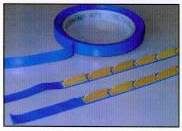
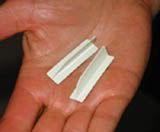
It was recommended to me that I start the install on the horizontal stabilizer to get a feel for the process and I think this is a good idea except that a lot of care should be taken when measuring and installing them because if you screw it up it would be very hard to remove them without damaging the fabric on the tail feathers. The most important thing to remember is to do your cord measurements two or three times and make sure you have them dead on because it's very difficult to remove a template and reposition it without tearing it. The templates are cut from the same material as plastic drawer liners and they come off about as easy as drawer liners do, meaning they stretch and tear very easily. Installing the templates is in my opinion the most time consuming part of the process. I really took my time with it to make sure I got it right. One word of warning that needs to be repeated just as it's written in the install instructions - CAUTION: TAIL VG's ARE INSTALLED ON THE UNDERSIDE OF THE HORIZONTAL STABILIZER!! Apparently in spite of this very graphic warning they have been installed on the top side on several occasions, and a couple of times by certified mechanics.
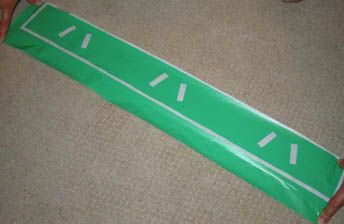
A template cut and ready to apply.
One other thing I noticed about installing the VG's on the wing is worthy of note. A string line is used to set the cord measurement the right distance from the leading edge lap seam on top of the wing. The instructions say to secure the string at several places along the string, but when you do this make sure you check the measurement to the seam each time you secure the string with a piece of tape. The string is going to sag a little no matter how tight you get it, so check the measurements at each spot that you secure it to make sure you have a straight line. Also, if there is a second lap seam at the extreme outer portion of the wing don't use this seam as a measurement reference point because it is sometimes crooked (it was on my wings). Instead use the outer edge of the main lap seam to make your mark and extend it out to the wing tip with the string.
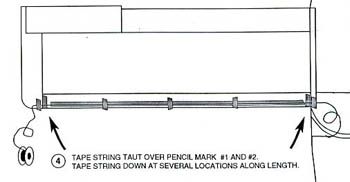
Make sure you check your measurements from several
locations along the string line before you tape it down.
The actual gluing of the VG's to the wing is very simple process. I won't get very involved in this step except to say that you only have about a minute to get them positioned square in the hole on the template; after that they are stuck on real good. Charles White at Micro AeroDynamics had a very good suggestion that speeds up and simplifies the gluing process. He suggested using the plastic end caps from the tube that the templates come in to hold activator and glue. Then using a Q-tip to apply the activator to the wing and glue to the VG, don't get the Q-tips mixed up though, or you'll contaminate the activator or the glue. I didn't use this method because I talked to Charles after I had completed the install, but it sounds like it would work pretty well and afford more control when applying the glue and activator.

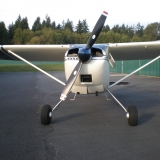
The finished installation in the field.
Next, let's talk about how VG's change the way the plane flies. I can't resist the temptation to play test pilot when I make a change like this to the airframe. So I did a complete stall series and a lot of slow flight and short field work before and after the VG install so I could get a real idea just what changed with them in place. My first reaction was WOW! The positive changes in handling were striking, and the stall break seemed more predictable and well behaved with the VG's even though the Maule has a pretty well behaved stall anyway. The plane didn't seem to get that abrupt increase in sink rate below sixty-five mph that it did before the install, at least not nearly as bad. This is no doubt due to the fact that the VG's are keeping the whole wing flying by keeping the boundary layer attached on the back half of the wing. Aileron authority was a hell of lot better at 1.2 VSO and below. Actually, I noticed a more stable and positive control feel from the top of the green arc on down. I flew the plane for a while with the airspeed indicator near the bottom of the dial and was simply amazed at the way the plane handled. Normal coordinated control inputs were very easy and the control harmony and authority felt like it did when flying between 70 and 80 before I installed them.
The plane felt a whole lot more comfortable at 1.1 VSO and below during the landing phase and hitting the mark when spot landing is a lot easier. Just making a good landing seems to be a little easier to me but I couldn't really say how much since making a roll-on landing has always been a difficult thing for me to master anyway. Trim seems to have changed slightly after the install requiring a little bit more forward trim to neutralize the control pressures for a given speed. I've heard it said that VG's change the center of lift of the wing slightly and this would logically alter the trim settings a bit.
As far as takeoff performance is concerned VG's seem to help there too. Takeoff roll seems to be reduced a bit and control at lift off and transitioning out of ground effect is more positive. These improvements are probably because of improved boundary layer characteristics causing an approximately eight percent lower stall speed with the flaps in the take off position. I suspect that Vg's also lower induced drag by reducing the amount of low pressure airflow migrating down the top of the wing and spilling into the tip vortices by creating a virtual stall fence of sorts. It would be interesting to see some comparative test data of the wing tip vortices before and after the install.
The first time I flew the plane cross country I thought I might have lost a couple of knots cruise speed but after flying to CA and back a couple of weeks ago I'm not sure if there's any loss of cruise speed at all. I'm going to make some GPS referenced speed tests in the next couple of weeks to explore this. Everyone I've talked to says there is no cruise speed penalty, and if there is, it is difficult to quantify. You'd think that all those little things on the wing would create a lot of drag, but when the wing is at the cruise speed angle of attack the VG's fall below the top line of the wing making them just another part of the leading edge barrier. I also think there may be a reduction in induced drag even though the angle of attack is much lower than it is in the landing configuration.
In conclusion, I'm sold on these little goodies. I think the Maule airfoil sees huge benefits from VG's at medium to high angles of attack and I would recommend them to anyone who flies a Maule even if they aren't looking for an edge in the planes STOL characteristics; especially if you're flying one of the shorter wing Maules. I consider them a safety accessory because they can help keep the boundary layer attached near VSO when the wind is doing strange things around the wing like it frequently does here in Arizona. To top it all off these things are easy to install, it just takes a long day to do it.
If you don't have them, get them; you'll be glad you did.
Visit MicroAeroDynamics on the web for more information.

 ). I’m just out here to have the most fun I can with my pants on, and flying is one of those things that does it for me.


