Another bit-o-scribbles from Trim
Sure hope I ain't startin' no damned pig fight!
My Introduction to the Canyon Turn
01-02-11
By Trimtab
Authors note:
This dialogue format is done in homage to Mark Twain’s book: What Is Man?
This book is often referred to as his philosophical Old Man, Young Man arguments.
It is somewhat about the ancient adage that, Old Age and lechery, (experience), wins out over youth and exuberance, almost, every time.
Disclaimer:
Please do not jump to the concussion that this lesson was as easy as doing each step once as generally described below. If I were to list all the fumbled attempts this story would become boringly endless. The plane was a 63 C-180-F.
My introduction to the emergency “Canyon Turn” started out something like this. We first flew all sorts of speeds, flaps, prop, and power settings. These numbers were all recorded on a small reference chart. This was done so we would know ahead of time just how to set the plane up for any maneuver that was planned or needed.
Then there was the protracted session of slow flight. The instructor kept telling me, “Slow it down, slower, I don’t hear the stall horn yet! Ok, so ya got a horn. Now!, SLOW it down.”
I had a lot to learn about minimum controllable airspeed. The Old Man beat me up so bad about my lack of precise airspeed control that I was just glad the flap handle was bolted to the floor. Then I had to learn to be comfortable making turns with the airspeed below the slow end of the white arc. They felt more like ‘Float Arounds’ than turns.
Then…
O.M. Ok, now I want you to fly up along the side of this canyon up to that rock outcrop there on the right. It will be used as a reference point to start your turns.
Y.M. I don’t see any rock outcrop.
O.M. You could if you were on the SIDE of the canyon, which would put it in profile.
Y.M. Okay.
I made what I considered to be a bold move to the right side of the canyon.
O.M. Well, when you goin to get over to the SIDE of the canyon?
Y.M. Isn’t that where we are? Feels pretty close to me!
O.M. Here, let me show you. My plane.
Y.M. Your plane.
O.M. I have it.
Y.M. Okay.
The instructor flew us over, from my perception of a safe distance, to around five hundred feet from the canyon wall. It looked like we were going to fly straight into the trees before he turned back parallel to the wall.
O.M. Now do you see the profile of a rock wall sticking out?
Y.M. Yeah, I mean yes, I see it. I also see the wall at the back end of the canyon.
O.M. I want you to use that rock face as your reference to start your turn each time.
Y.M. Okay.
The back of the canyon was coming up at a rate of closure that was far from comforting. I noticed I was beginning to tense up with a slight flush feeling creeping up the back of my neck, my ears were getting warm, and I was developing a case of lockjaw. I was wandering how to put an end to this onward rush, to my perception, of an apparent date with death. I pensively said…
Y.M. I would never get this deep into a dead end canyon to begin with.
O.M. Yeah, that’s what we all said.
O.M. This first pass is just to set a visual reference against which to judge how well this technique works as I sequentially attempt improve your skill. Now, I want you to hold your normal cruise speed as we come up on that rock outcrop.
Y.M. Okay. 130 indicated, no flaps!
O.M. When we get up beside that rock outcrop I want you to do a regular, level, twenty to thirty degree banked turn at this speed.
Y.M. Okay, um, are you sure there is room enough between the rock outcrop and the back end of the canyon?
O.M. We’re Ok. Just relax.
Y.M. Okay. Yeah sure, just relax.
As I started the 180 degree turn I could not help keeping a nervous eye on the end of the canyon, you know, the dead end. The first turn took up most of the canyon width. It also took up more of the dead end than I was comfortable with. We ended up way over on the far side of the creek that ran down the center of the canyon. We probably used up eighty percent of the canyon width.
O.M. How does that feel?
Y.M. Okay. I guess. We came a lot closer to the dead end than I was comfortable with.
O.M. We will fix most of that pretty soon.
Y.M. Okay-. I hope so.
O.M. Now for the second pass I want you to just simply transition to your canyon cruise settings for ninety indicated. No other changes.
Y.M. Okay, 90 indicated, no flaps.
I pulled the throttle back to the predetermined manifold pressure, dialed in the prop, let the speed settle down, trimmed off the pressure, and plowed ahead at ninety indicated. Now that we were slowed down a bit I was not quite so concerned about the dead end of the canyon. I knew enough to know that slower speed would give me more time.
O.M. This time I want you to do the same turn but at this slower canyon cruise speed.
Y.M. Okay.
The second pass only took about half of the canyon as we rolled out just outside of the creek, instead of way over on the far side. The back end of the canyon was no sweat this time. Slowing down was a big help. Each time we circled back to line up for another pass the Old Man would have me move a little closer to the side of the canyon.
O.M. What is that big smile all about?
Y.M. That was a pretty good reduction in the amount of room needed.
O.M Good, now for the third pass I want you to transition to your runway check out or approach configuration. Just slow it down to seventy. Don’t forget to put in the correct power, prop, and flap settings for the slower indicated airspeed.
Y.M. Okay, Where’s my chart?
O.M. You do plan to memorize your chart, don’t you?
Y.M. Tonight!
O.M. lets see, 16 inches, at 2350 RPM, 80 MPH indicated, flaps 20, and level flight.
Y.M. Okay.
It was nice to be able to see more terrain over the nose with this configuration. It was like a balcony seat in an old theater. On The third pass we finished well before the creek in the bottom of the canyon.
O.M. How was that?
Y.M. Impressive!
O.M. It’s supposed to be. The reason we are doing this in increments is so you will actually see the effect of just slowing down. In this terrain, speed can kill.
O.M. Are you ready for the meat of it?
Y.M. I don’t see where I would ever need to do anything any tighter.
O.M. You will tomorrow. This isn’t much of a canyon. It is more of a valley. I use it to start with because it leaves me room to salvage things in case you screw up.
Y.M. Okay. - Huh?
O.M. You notice that we have reduced the turn diameter by over fifty percent.
Y.M. Okay, I mean yes, this is almost fun.
O.M. Now, with this fourth pass we will begin to get serious about learning to do the Canyon Turn.
Y.M. Okay. How serious?
O.M. It means that we will see if you can handle major control changes while rotating around all three axis of flight.
Y.M. Okay.
I begin to get a sense of impending failure oozing out of me. Just how much is he planning to wring out of me in one session?
O.M. This time we will use the same flaps as last time, only slower with enough power to hold altitude and a flat prop. I want to see a steady sixty indicated before you start the turn. Then, this time I want you to add full power as you roll into the turn, and increase the bank angle up to at least forty degrees and slightly relieve the backpressure. You can let the airspeed go up a little bit.
Y.M. Okay.
Y.M. Wait, no level turn?
O.M. Not required.
Y.M. Huh?
O.M. You will be turning towards lower terrain, so you should always have some expendable altitude, if not, it is probably already too late.
Y.M. Okay. Oh! That’s right, turn towards lower terrain. I read about that.
O.M. Also, it is more important to NOT load the wing. Remember, as the bank increases, your stall speed is sneaking up to bite your ass.
Y.M. Okay.
Well, the fourth step did not go so smooth as the first three. The canyon swapped ends on me real quick. Adding full power while turning and attempting to relieve the backpressure upset any semblance of control on my part, much less precise control.
O.M. Watch your airspeed!
Y.M. What happened? Where’d the horizon go? …
O.M. I got it. You basically have no horizon down in these canyons so it is Ok to take a glance at the artificial horizon just as you roll in. Also, the addition of full power upset all your trim parameters.
Y.M. Okay. Wow! Sorry.
Deep breath – long exhale.
Several more tries at it and I was able to approximate what was supposed to happen.
The world seemed to rotate of it’s own accord while I was trying to retain some sem-blance of being in charge of what was going on.
O.M. How you feeling?
Y.M. A bit wrung out.
O.M. Well, we are not finished, there is still more.
Y.M. We, may not be finished, but I am about done in.
O.M. Well, there is still the last step. This time we will be getting REAL serious.
Y.M. Okay. Huh? REAL Serious! What the hell is this last step?
O.M. This is the one where I see if you can fly and chew gum at the same time.
Y.M. Okay. What?
I made some smartass remark about how I have been chewing gum all day…
O.M. Well?
Y.M. Okay. You win. What is this last step?
O.M. Once again I want you to simply do the same as last time with one addition.
Y.M. Okay. What’s that?
O.M. This time, just after rolling into the turn, going to full throttle, and relaxing the backpressure, I want you to pull in full flaps. DO NOT let go of the flap handle. DO NOT let your airspeed drop. As you come around near the 180 degree point you will roll the wings level, flaps to 20, airspeed to Vy, recover your altitude, set your manifold pressure and prop numbers for a comfortable airspeed.
Y.M. Okay.
O.M. We’ll see.
Y.M. See what?
O.M. We will see if it turns out “OK” as you so fond of saying.
Well, I will not belabor you with my attempts at trying to put the whole thing together, gum chewing and all. I will only say that it took several attempts for me to even approach the quality of the demonstrated turns. The several steps were used to sequentially develop my competence, and confidence, with the potentially life saving Canyon Turn. It was amazing to end up being able to make a reversing turn within a few wing lengths. The claim is that it can be done in three wing lengths. That’s the claim.
After several attempts I began to get the idea of how this was supposed to work. I even began to relax and feel a bit of confidence, maybe a little too much confidence.
Y.M. While we are here, do you mind if I try one more unassisted?
O.M. Go ahead, just hope ya don’t mind if I stay close by. You know, just in case.
Y.M. Okay.
It is not easy to get most of these Idaho Backcountry instructors rattled, but I managed.
I started with all the confidence I could muster, and, apparently, too much muscle.
Y.M. Oh shit!
O.M. WHOA THERE!
Y.M. I got it!
Hard right! Throttle off! Level the wings! Airspeed! Flaps to 20! Airspeed! Recover. Airplane first! Then composure. Exhale-. Remember to breath.
O.M. Well, at least you did not pull up and stall it into the wall. If you had we’d be all covered in chlorophyll.
Y.M. Okay. I mean thanks-. Sorry.
Actually, it was more a case of “WE” had it. In my exuberance I had turned closer to 270 degrees and was headed back into the rock wall. The O.M.’s realization of what was happening was probably a mite quicker than mine. But, it did not take much for me to realize what I had done as I watched the roll out point flash by. We were now pointed slightly down and headed toward rising terrain, at an exciting rate of closure that made it look like I was flying straight down into the ground. Which, relatively speaking, I was. But, I had already recovered with that quick hard turn to the right.
O.M. That is enough for me! Lets’ go home. I’ve seen all of that rock I need to for one day. Tomorrow, instead of this “valley,” I will put you in a real canyon.
Y.M. Okay. Huh? How narrow?
O.M. Narrow enough to raise your responsibility levels.
The next day was back to a diet of humble pie.
It turns out that it was only a lack of training and exposure that caused any anxieties on my part. The training, which was done in a style of adding sequential steps in a controlled environment, caused me to come out of there a lot more confident if not yet competent to execute the canyon turn. Now to practice, practice, practice.
Now, keep in mind, this was all done in a relatively wide canyon, more like a valley so I was told, on a clear day, with no sun on the horizon, no smoke in the canyon, no heavy load, no density altitude problem to speak of, no ominous lowering clouds, no turbulence, no wind, no storm, no rain, no thunder, no snow, no rough engine, no smoke in the cockpit, no bad radio, no circuit breakers popping, no injured passenger, no panicked pets, no sick kids, no significant other screaming, “I new this would happen,” only a calm and excellent instructor on a beautiful, smooth Idaho morning. Even so…
I have had a few hours of Acro Instruction and it was nowhere as stressful as learning the canyon turn. In aerobatics you have lots of prescribed airspace, and the precision is more a matter of pride. The canyon turn can be a matter of life or death. Learn it right.
My Intro To The Canyon Turn
Tue Feb 15, 2011 11:02 pm
Trimtab
It can be true, even if it didn't happen - Ken Keasey - mostly*
Man invented language so he could hide the truth from others - Tallyrand - sort of
It can be true, even if it didn't happen - Ken Keasey - mostly*
Man invented language so he could hide the truth from others - Tallyrand - sort of
Tue Feb 15, 2011 11:47 pm
Re: My Intro To The Canyon Turn
So basically a chandell with flaps?
- NineThreeKilo offline
- Retired
- Posts: 1679
- Joined: Thu Dec 31, 2009 8:16 pm
- Location: _
Wed Feb 16, 2011 1:21 pm
Re: My Intro To The Canyon Turn
Good write up. Thanks for sharing that!
- GroundLooper offline
- Posts: 1168
- Joined: Wed Jun 13, 2007 6:52 pm
- Location: Vancouver, WA
BCP Poser.
Life is good. Life is better with wings.
Life is good. Life is better with wings.
Wed Feb 16, 2011 1:30 pm
Re: My Intro To The Canyon Turn
I think Mark Twain's OM/YM format uses too many words by a factor of about 300%, but I like the story.  Good stuff to chew on.
I was taught (by an instructor who didn't claim to be a mountain flying instructor) to do the canyon turn at a set altitude. Perhaps this is just because he hadn't considered the "reduction of wing loading by pitching down" technique, but it worked quite well with full flaps/full power/60 deg bank, mainly due to the fact that the scenario was an aborted approach @65mph and trimmed appropriately. Going full power and full flaps from this config requires a strong push to keep from pitching up. We turned on a dime though.
Epic thread here with some entertainment. Much of what we all think every time we read something about this topic has already been said:
Good stuff to chew on.I was taught (by an instructor who didn't claim to be a mountain flying instructor) to do the canyon turn at a set altitude. Perhaps this is just because he hadn't considered the "reduction of wing loading by pitching down" technique, but it worked quite well with full flaps/full power/60 deg bank, mainly due to the fact that the scenario was an aborted approach @65mph and trimmed appropriately. Going full power and full flaps from this config requires a strong push to keep from pitching up. We turned on a dime though.
Epic thread here with some entertainment. Much of what we all think every time we read something about this topic has already been said:
- Zzz offline

- Posts: 2855
- Joined: Fri Oct 08, 2004 11:09 pm
- Location: northern
- Aircraft: Swiveling desk chair
Half a century spent proving “it is better to be thought a fool than to open your mouth and remove all doubt.”
Wed Feb 16, 2011 3:28 pm
Re: My Intro To The Canyon Turn
Zane wrote:Epic thread here with some entertainment. Much of what we all think every time we read something about this topic has already been said:
As to the old thread, Coyote Ugly's canyon hammerhead video says it all.
Gump
Wed Feb 16, 2011 5:30 pm
Re: My Intro To The Canyon Turn
Pull the flaps when you start the turn, then(if you are banked 45* or more) it is pulling you around more than it is pulling you up. As mentioned, holding altitude not necessary because you are turnng to lowering turrain, safer and easier on pilot and plane.
Atleast that my .02
Gary
Atleast that my .02
Gary
- shortfielder offline
- Posts: 2350
- Joined: Sun Mar 05, 2006 7:14 pm
- Location: Durango, Colorado
- FindMeSpot URL: http://share.findmespot.com/shared/face ... D263l9HKFb
If you want to go up, pull back on the controls. If you want to go down, pull back farther.
My SPOT page
My SPOT page
Wed Feb 16, 2011 6:45 pm
Re: My Intro To The Canyon Turn
Zane wrote:I think Mark Twain's OM/YM format uses too many words by a factor of about 300%, but I like the story.
I was taught (by an instructor who didn't claim to be a mountain flying instructor) to do the canyon turn at a set altitude. Perhaps this is just because he hadn't considered the "reduction of wing loading by pitching down" technique, but it worked quite well with full flaps/full power/60 deg bank, mainly due to the fact that the scenario was an aborted approach @65mph and trimmed appropriately. Going full power and full flaps from this config requires a strong push to keep from pitching up. We turned on a dime though.
Epic thread here with some entertainment. Much of what we all think every time we read something about this topic has already been said:
Zane - I s'pose you've read the late Sparky Imeson's treatise on the canyon turn, as posted on his http://www.mountainflying.com website?
He went quite a bit further on the steep turn tactic, recommending bank angles up to and including a 90-degree wingover .... which he says, because of the lack of backpressure on the elevator, allows the turn to exert far less wingloading on the airframe.
Sounds kinda scary for someone like me without any aerobatic experience ... but on the other hand, it's less scary than flying into a canyon wall.
Sparky's bottom line advice on the canyon turn was, don't ever put yourself into the position of needing one, because if you ever do, you're down to one option. If knowing how to do the canyon turn makes a pilot overconfident, and thus more likely to fly past the "point of no return", it's probably better not to learn the technique in the first place.
"Sometimes the magic works, and sometimes it doesn't"
Chief Dan George, in "Little Big Man"
Chief Dan George, in "Little Big Man"
Wed Feb 16, 2011 9:20 pm
Re: My Intro To The Canyon Turn
What a great, entertaining write up, thank you.
I must check this site 10 times a day for new content, this was a nice surprise!
Vitz
I must check this site 10 times a day for new content, this was a nice surprise!
Vitz
- Papa Victor offline
- Posts: 125
- Joined: Wed Feb 17, 2010 6:16 pm
- Location: Spokane, WA
Thu Feb 17, 2011 1:43 pm
Re: My Intro To The Canyon Turn
Nine Three Kilo asked the question: “So basically a chandell with flaps?”
A 180* turn is about the only thing common between Chandelle and the Canyon Turn.
The Chandelle is a CLIMBING turn, initiated into the wind, at cruise speed, with a prescribed 30* bank angle, with an INCREASE is pitch attitude, (wing loading), the roll out starts at the 90* point of the turn and ends at just above stall speed.
Cruise speed is normally too fast for flaps.
The Canyon Turn usually starts with the plane crawling along on it’s hands and knees under a cloud layer, well below cruise speed, partial flaps, partial power, looking for a way out.
A climbing turn would put you well into the cloud layer. The rudder may already be there. Not appropriate. The roll out comes much later in the Canyon Turn than it does in the Chandelle, and you are looking for something greater than near stall speed. The canyon turn could be done mostly level but does not have to be. The important reason for NOT loading the wing while pulling on full flaps is that the wing structure gets weaker as you pull full flaps. If you are in turbulence you run the risk of over stressing the wing structure. Therefore instead of pitching up you just slightly relax any back pressure, no need to really PITCH down, just do not load the wing while you are partially disassembling it. One can roll as far as 60* for a couple of seconds without getting too disoriented, double the prescribed 30* for the Chandelle. For the most part, the greater majority of them can be done with no more than forty to forty five degrees bank.
Yes, you probably should not be there to begin with. But, we do not always have adequate Wx information in the backcountry. That can lead to the dangerous old killing phrase, “Lets just go take a look.”
Chris C
A 180* turn is about the only thing common between Chandelle and the Canyon Turn.
The Chandelle is a CLIMBING turn, initiated into the wind, at cruise speed, with a prescribed 30* bank angle, with an INCREASE is pitch attitude, (wing loading), the roll out starts at the 90* point of the turn and ends at just above stall speed.
Cruise speed is normally too fast for flaps.
The Canyon Turn usually starts with the plane crawling along on it’s hands and knees under a cloud layer, well below cruise speed, partial flaps, partial power, looking for a way out.
A climbing turn would put you well into the cloud layer. The rudder may already be there. Not appropriate. The roll out comes much later in the Canyon Turn than it does in the Chandelle, and you are looking for something greater than near stall speed. The canyon turn could be done mostly level but does not have to be. The important reason for NOT loading the wing while pulling on full flaps is that the wing structure gets weaker as you pull full flaps. If you are in turbulence you run the risk of over stressing the wing structure. Therefore instead of pitching up you just slightly relax any back pressure, no need to really PITCH down, just do not load the wing while you are partially disassembling it. One can roll as far as 60* for a couple of seconds without getting too disoriented, double the prescribed 30* for the Chandelle. For the most part, the greater majority of them can be done with no more than forty to forty five degrees bank.
Yes, you probably should not be there to begin with. But, we do not always have adequate Wx information in the backcountry. That can lead to the dangerous old killing phrase, “Lets just go take a look.”
Chris C
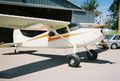
53 C-170-B+
It is better to be late in this world, than early in the next.
It is better to be late in this world, than early in the next.
Thu Feb 17, 2011 9:12 pm
Re: My Intro To The Canyon Turn
For most canyon turns, the real issue is to keep the speed down and be close enough to the downwind side of the canyon that you've given yourself the maximum amount of available room to make the turn. If you'll go out over the flats and pick a road to fly along, then execute a 180 at different airspeeds from cruise down to a comfortable minimum controllable airspeed, you'd be surprised at how much smaller diameter the reversing turn takes at slower speeds, which are still comfortably above stall speed. It's not necessary to make really steep banks, typically, and as Trim learned, steep turns too easily lead to loss of control, not because the airplane can't handle it, but because the pilot gets disoriented too easily without a horizon.
If a really steep turn is necessary, then unloading the wing is pretty easy, as you learned--just relax the back pressure during the turn and allow the nose to drop. But most canyon turns don't require a really steep turn and are therefore accomplished as a level turn.
My observation is that there are too many rumors about what a canyon turn really is. As you've learned, it's not a violent, semi-aerobatic maneuver, but rather a smooth, low speed, low to medium banked turn. Once in a blue moon, it requires extraordinary skill, but for the most part, anyone who can fly well at slow speeds can execute a good canyon turn. Those who choose to do violent wingovers are taking a greater risk, I think, than is necessary. The old/bold statement seems appropriate to remember.
Cary
If a really steep turn is necessary, then unloading the wing is pretty easy, as you learned--just relax the back pressure during the turn and allow the nose to drop. But most canyon turns don't require a really steep turn and are therefore accomplished as a level turn.
My observation is that there are too many rumors about what a canyon turn really is. As you've learned, it's not a violent, semi-aerobatic maneuver, but rather a smooth, low speed, low to medium banked turn. Once in a blue moon, it requires extraordinary skill, but for the most part, anyone who can fly well at slow speeds can execute a good canyon turn. Those who choose to do violent wingovers are taking a greater risk, I think, than is necessary. The old/bold statement seems appropriate to remember.
Cary
"I have slipped the surly bonds of earth..., put out my hand and touched the face of God." J.G. Magee
Fri Feb 18, 2011 3:59 pm
Re: My Intro To The Canyon Turn
nmflyguy wrote:
Zane - I s'pose you've read the late Sparky Imeson's treatise on the canyon turn, as posted on his http://www.mountainflying.com website?
No, I hadn't.
- Zzz offline
- Posts: 2855
- Joined: Fri Oct 08, 2004 11:09 pm
- Location: northern
- Aircraft: Swiveling desk chair
Half a century spent proving “it is better to be thought a fool than to open your mouth and remove all doubt.”
Fri Feb 18, 2011 4:03 pm
Re: My Intro To The Canyon Turn
Cary wrote:My observation is that there are too many rumors about what a canyon turn really is. As you've learned, it's not a violent, semi-aerobatic maneuver, but rather a smooth, low speed, low to medium banked turn. Once in a blue moon, it requires extraordinary skill, but for the most part, anyone who can fly well at slow speeds can execute a good canyon turn. Those who choose to do violent wingovers are taking a greater risk, I think, than is necessary. The old/bold statement seems appropriate to remember.
Cary
Cary,
Sparky's writings on the canyon turn amount to much more than a rumor, although I expect you weren't referring to him anyway.
But in any event, Sparky does recommend 60 degrees all the way up to 90 degree bank wingovers in Canyon Turns, as long as you release the backpressure to unload the wing. His essay is really about pilots who are very near the "point of no return", which Sparky describes as the point flying up a narrowing canyon with rising terrain in front where you're simply screwed, and cannot recover no matter what you do with the airplane .. i.e., you're going to fly into terrain. Being close to that point, a "violent" wingover may indeed be the last resort before hitting the canyon wall. Sparky didn't recommend this technique - he just wrote that if that's the only card you've got left before meeting your maker, you might as well play it.
For people not wishing to fly on the absolute edge of the aircraft performance envelope (and probably well past the performance envelope for most pilots!), staying the hell away from the "point of no return", and thus escaping harm with nothing more than a medium bank turn at slow but controllable airspeed is certainly the way to go.
But I think the way Sparky defined the term, that is not a "Canyon turn". It's just a turn.
"Sometimes the magic works, and sometimes it doesn't"
Chief Dan George, in "Little Big Man"
Chief Dan George, in "Little Big Man"
Fri Feb 18, 2011 6:19 pm
Re: My Intro To The Canyon Turn
Cary wrote:For most canyon turns, the real issue is to keep the speed down and be close enough to the downwind side of the canyon that you've given yourself the maximum amount of available room to make the turn. If you'll go out over the flats and pick a road to fly along, then execute a 180 at different airspeeds from cruise down to a comfortable minimum controllable airspeed, you'd be surprised at how much smaller diameter the reversing turn takes at slower speeds, which are still comfortably above stall speed. It's not necessary to make really steep banks, typically, and as Trim learned, steep turns too easily lead to loss of control, not because the airplane can't handle it, but because the pilot gets disoriented too easily without a horizon.
If a really steep turn is necessary, then unloading the wing is pretty easy, as you learned--just relax the back pressure during the turn and allow the nose to drop. But most canyon turns don't require a really steep turn and are therefore accomplished as a level turn.
My observation is that there are too many rumors about what a canyon turn really is. As you've learned, it's not a violent, semi-aerobatic maneuver, but rather a smooth, low speed, low to medium banked turn. Once in a blue moon, it requires extraordinary skill, but for the most part, anyone who can fly well at slow speeds can execute a good canyon turn. Those who choose to do violent wingovers are taking a greater risk, I think, than is necessary. The old/bold statement seems appropriate to remember.
Cary
Cary,
For those who've never gotten themselves into a situation that they really didn't want to be in, your assessment is probably fine.
Problem is, a lot of very experienced pilots have gotten themselves in a little too deep in the mountains, and decorated a rock face with an airplane and several pink bodies. I know a couple of them, by the way....all VERY experienced pilots, by the way.
A canyon turn needs to be practiced, and practiced regularly and practiced and tested in each airplane the pilot will fly in the mountains. Because there MAY come a time when you allow yourself to get a LITTLE too far up the wrong canyon, and your very life may depend on your ability to turn that airplane around in minimum radius.
And, that's not done with a nice gentle bank angle and a light puull We're talking about saving your life here, and those of your passengers. Likely because you did something dumb. I personally have never done anything dumb, of course, but I HAVE used the canyon turn, an aggressive one, one day when I got a little too far up a canyon that I knew well, but that had a little surprise in the way of weather. Fortunately for me, when I checked out in the Beaver, my mentor did a good job of instilling in me the importance of proper procedures to turn the airplane around in minimum radius, and I used each of those criteria that day. THat gentleman saved my life that day. And, this was in an airplane that has gained a reputation for killing people in canyons--a false reputation, in fact.
Also, a canyon turn should NOT permit a loss of altitude. Canyons tend to be somewhat symmetrical. If you're close to the bottom on the right side of the canyon when you start the turn, you sure don't want to lose altitude during the turn, or you'll hit the opposite side at a lower altitude.
THe canyon turn is a level, steep banked turn, with flaps, at a REASONABLY slow speed, depending on the airplane. ANd, configured for the turn.
MTV


Sat Feb 19, 2011 12:08 am
Re: My Intro To The Canyon Turn
Cary wrote:My observation is that there are too many rumors about what a canyon turn really is. As you've learned, it's not a violent, semi-aerobatic maneuver, but rather a smooth, low speed, low to medium banked turn. Once in a blue moon, it requires extraordinary skill, but for the most part, anyone who can fly well at slow speeds can execute a good canyon turn.
Have you ever been in a position to have to do one for real? Where the outcome is being dead in a few seconds if you screw it up?
MTV is exactly right on this.
Gump
Sat Feb 19, 2011 10:47 am
Re: My Intro To The Canyon Turn
I agree with Mike as well, one reason these conversations become debated to death is because things get lost in the differing semantics.
While one group says loss in alt. is fine, another says keep it level, and yet another says pitch it up... all along they are envisioning a different idea of what a canyon looks like, let alone turning in one. IMHO if you are in such a space as to allow for a descending turn, or a gentle bank, you have not yet reached a point, such that a 'life or death' as tight as you can turn is needed. Good for you! Much better planning than the camp discussing the 'oh shiv' maneuvers. Never the less, fly long enough in the sticks, and you too will say 'oh shiv' some day.
I think there is no one size fits all, given these convoluted parameters, but there most certainly are ways to turn in as tight a radius as possible, and that is where the rubber meets the road...
Also, what actually turns tight, and what 'feels' like a tight turns isn't always the same thing
Equally important is knowing what that sight picture is going to look like. It has been said 1-3 wing lengths.... I call BS, but, no point in arguing with a 'believer'... Do you really know what that turn takes, what kind of real estate you are using up? And what that 1-3 wing lengths looks like in bottom of a canyon?
I brought this up in the 'epic thread' but I wonder if anyone tried it. Simple way to learn what you are really doing. Set your GPS logging to it's finest scale. Find a road with a nice perpendicular wind. Fly down the road executing several course reversals. Back at the hangar zoom in and measure the distance required to make those course reversals, and the best part, compare the difference imparted by the wind component... Just that difference alone is going to be more than 3 wing spans, simple PPL PTS 'turns around a point' should have taught us that.. And bear in mind that this course reversal is going to be pre meditated, and in the comfort of a no- 'oh shiv' zone....
Take care, Rob
While one group says loss in alt. is fine, another says keep it level, and yet another says pitch it up... all along they are envisioning a different idea of what a canyon looks like, let alone turning in one. IMHO if you are in such a space as to allow for a descending turn, or a gentle bank, you have not yet reached a point, such that a 'life or death' as tight as you can turn is needed. Good for you! Much better planning than the camp discussing the 'oh shiv' maneuvers. Never the less, fly long enough in the sticks, and you too will say 'oh shiv' some day.
I think there is no one size fits all, given these convoluted parameters, but there most certainly are ways to turn in as tight a radius as possible, and that is where the rubber meets the road...
Also, what actually turns tight, and what 'feels' like a tight turns isn't always the same thing
Equally important is knowing what that sight picture is going to look like. It has been said 1-3 wing lengths.... I call BS, but, no point in arguing with a 'believer'... Do you really know what that turn takes, what kind of real estate you are using up? And what that 1-3 wing lengths looks like in bottom of a canyon?
I brought this up in the 'epic thread' but I wonder if anyone tried it. Simple way to learn what you are really doing. Set your GPS logging to it's finest scale. Find a road with a nice perpendicular wind. Fly down the road executing several course reversals. Back at the hangar zoom in and measure the distance required to make those course reversals, and the best part, compare the difference imparted by the wind component... Just that difference alone is going to be more than 3 wing spans, simple PPL PTS 'turns around a point' should have taught us that.. And bear in mind that this course reversal is going to be pre meditated, and in the comfort of a no- 'oh shiv' zone....
Take care, Rob

Sat Feb 19, 2011 11:45 am
Re: My Intro To The Canyon Turn
I liked the Twain riff...
If you actually truly really need this turn, you are probably already in a state of sin.
To paraphrase another old saw:
A good canyon turn is any you fly/walk/limp/crawl with your hair on fire away from.
If you actually truly really need this turn, you are probably already in a state of sin.
To paraphrase another old saw:
A good canyon turn is any you fly/walk/limp/crawl with your hair on fire away from.
Sat Feb 19, 2011 1:10 pm
Re: My Intro To The Canyon Turn
One concept that seems to get injected into the Canyon Turn debate that I'm having a little trouble believing is the following:
In it's purest (or depending upon your viewpoint, "most extreme") form, as per Sparky's essay on the Canyon Turn, you not only are flying at minimum controllable airspeed, and turning at a steep bank angle (60-90 degrees), but you also extend full flaps as you enter the turn, and then retract the flaps (at least partially) as the turn is completed and you level the wings. Some posters here and elsewhere have stated that extending full flaps "weakens your wing" and therefore shouldn't be deployed in a maximum bank turn.
Coupla things that don't add up:
1) you're also supposed to release elevator backpressure as you bank steeply so as to unload the wing, so a theoretically "weaker" wing should not matter a whit to this maneuver.
2) on most GA aircraft the strength of the wing comes from its spar which bears the entire structural load, and from the ribs which distribute the load from airfoil surfaces to the spar - neither of which structural element is affected by any settings of either flaps or ailerons. By deploying full flaps - and/or fully deflecting the ailerons - during the steep turn, the only thing you are changing is the aerodynamic behavior of the airfoil, and the degree, angle, and location of aerodynamic loading on the wing ribs and spar ... but you aren't doing anything to weaken the structure itself.
I dunno - this notion of a wing being weakened by extended flaps sounds like complete BS and old wives tale stuff to me.
Somebody show me the error of my way
In it's purest (or depending upon your viewpoint, "most extreme") form, as per Sparky's essay on the Canyon Turn, you not only are flying at minimum controllable airspeed, and turning at a steep bank angle (60-90 degrees), but you also extend full flaps as you enter the turn, and then retract the flaps (at least partially) as the turn is completed and you level the wings. Some posters here and elsewhere have stated that extending full flaps "weakens your wing" and therefore shouldn't be deployed in a maximum bank turn.
Coupla things that don't add up:
1) you're also supposed to release elevator backpressure as you bank steeply so as to unload the wing, so a theoretically "weaker" wing should not matter a whit to this maneuver.
2) on most GA aircraft the strength of the wing comes from its spar which bears the entire structural load, and from the ribs which distribute the load from airfoil surfaces to the spar - neither of which structural element is affected by any settings of either flaps or ailerons. By deploying full flaps - and/or fully deflecting the ailerons - during the steep turn, the only thing you are changing is the aerodynamic behavior of the airfoil, and the degree, angle, and location of aerodynamic loading on the wing ribs and spar ... but you aren't doing anything to weaken the structure itself.
I dunno - this notion of a wing being weakened by extended flaps sounds like complete BS and old wives tale stuff to me.
Somebody show me the error of my way
"Sometimes the magic works, and sometimes it doesn't"
Chief Dan George, in "Little Big Man"
Chief Dan George, in "Little Big Man"
Sat Feb 19, 2011 1:34 pm
Re: My Intro To The Canyon Turn
nmflyguy wrote:2) on most GA aircraft the strength of the wing comes from its spar which bears the entire structural load, and from the ribs which distribute the load from airfoil surfaces to the spar - neither of which structural element is affected by any settings of either flaps or ailerons. By deploying full flaps - and/or fully deflecting the ailerons - during the steep turn, the only thing you are changing is the aerodynamic behavior of the airfoil, and the degree, angle, and location of aerodynamic loading on the wing ribs and spar ... but you aren't doing anything to weaken the structure itself.
I dunno - this notion of a wing being weakened by extended flaps sounds like complete BS and old wives tale stuff to me.
Somebody show me the error of my way
I'll leave the canyon turn replies to those who at least have done it in real situations. The structural part of the wing with full flaps acts to put more stress on the wing by trying to twist it. Some aerobatic planes could not handle the stress if they had flaps. The 152 Cessna got an increase in gross weight when they limited flap travel to 30 degrees. I can't come up with any way that they beefed up the wing itself other than limit the flap travel. The stress to the wing is not all up and not at the same cg on the wing as flaps change. Full flaps creates a twisting effect from the extra drag behind the flaps. You know this by having to retrim when changing flaps. Not that the load itself in level flight is the problem but ability to withstand g force in the turn or the pull up is reduced or its limits exceeded quicker at the same weight with full flaps.
Late addition here, my Tundra at 15 degrees the maximum recommended airspeed is 90 mph. At 25 the max. drops to 70 mph. At 40 degrees the max is 50 mph.
(My disclaimer to using all the right terms is that I'm just a simple farm boy.)
Last edited by dirtstrip on Sat Feb 19, 2011 1:53 pm, edited 1 time in total.
Lynn Sanderson (Dirtstrip) passed away from natural causes in May 2013. He was a great contributor and will be missed dearly.
Sat Feb 19, 2011 1:46 pm
Re: My Intro To The Canyon Turn
I was sitting here visualizing practicing canyon turns when it hit me I always went left. Depending on the wind you may be on the other side of the canyon needing to turn right, and I know how much we all loved demonstrating steep turns to the right. Tandem airplanes won't be such a big deal but imagine making that turn into a wall you can't see. So, my suggestion is next weekend when you are out practicing do them both ways.

John
KSBP
KSBP
Sat Feb 19, 2011 2:13 pm
Re: My Intro To The Canyon Turn
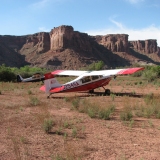
Back in Sept of '09 I did two canyon turns, the first right after takeoff from Mineral Canyon to the right, and then another right turn to photo Rob B as he departed the runway to the south. They were both >60deg banks..the first one while climbing out with two notches of flap, the second one with flaps retracted after leveling off at approximately 400ft AGL. Got a series of pictures while watching the clearance to the canyon walls as he was departing. Remember the canyon walls were about 1000ft above the river there. The Citabria that is rated +5G, I have no fear of this manuver....I've practiced this proceedure many times. Also, before you've gotten yourself into a situation, there is always an "UP" option before it's too late.


Just in case you were wondering....these two photos were shot about 50 ft apart..gives you some idea of the distance of the canyon walls.
Just in case you were wondering....these two photos were shot about 50 ft apart..gives you some idea of the distance of the canyon walls.
'05 7GCBC High Country Explorer
The faster I go , the farther behind I get.
The faster I go , the farther behind I get.
DISPLAY OPTIONS
Who is online
Users browsing this forum: No registered users and 2 guests
Latest Features
-
Live to Tell
A Minnesota pilot is surprised to learn that the sudden asymmetric drag of an out-of-rig ski can…Read More -
Creators
Working in some of the Yukon's most beautiful and remote environments, photographer Simon Blakesley captures aircraft in…Read More -
Aircraft Ownership and Maintenance
Upgrading to big tires can make a huge difference in backcountry performance, but with those gains come…Read More -
Tales from Yesteryear
In this tale from bush flying yesteryear, Don Cogger signs up to help Atlee Dodge Jr recovery…Read More


Latest Knowledge Base
-
Destinations
A regional guide with ideas for winter camping destinations in California, Nevada, New Mexico, and Arizona.Read More -
Aircraft
Finding an affordable aircraft that can handle the backcountry for $80K or less? A challenge for sure, but with the…Read More -
Aircraft
01.29.2018 - Zane - Updated tire diameter graphic to add 8.50x10 Guide to tires for use in the backcountry and off-airport landing…Read More -
Pilots
12.22.2013 - Initial article format Operating aircraft on skis and negotiating a snow-covered landscape is an entirely unique skillset and environment.…Read More


