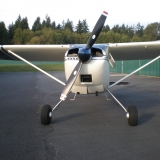
I have been flying a taylorcraft for nearly 15 years and was fortunate enough to have an instructor with nearly 30,000 hours in general aviation aircraft mostly taildraggers.
When he was teaching me to fly. He always said not to worry about nosing the airplane over due to pushing the controls full forward, because it will not happen. This of course, assuming you're not hitting the brakes or there is some other force involved.
I have found this to be true in my taylorcraft. I am just wondering, what everybody else's experience is??
Nosing over with full stick forward??
Thu Aug 10, 2006 4:25 pm

shawn coleman
2202T
tcraft f-22
2202T
tcraft f-22
Thu Aug 10, 2006 4:35 pm

Thu Aug 10, 2006 5:07 pm
shawn coleman
2202T
tcraft f-22
2202T
tcraft f-22
Thu Aug 10, 2006 8:10 pm
Thu Aug 17, 2006 8:17 am
Shawn:
Maybe you can ask your instructor if Zane can use his aircraft for the test. That's one way to determine how certain he is that it cannot be done.
I have a hunch that he'll decline the request.
My Champ will very likely have enough elevator, especially at take-off power, to drive the nose into the ground. The elevator and rudder are designed to be very powerful on most tailwheel aircraft. Well, on properly designed ones, that is; there are exceptions.
Jon B.
Maybe you can ask your instructor if Zane can use his aircraft for the test. That's one way to determine how certain he is that it cannot be done.
I have a hunch that he'll decline the request.
My Champ will very likely have enough elevator, especially at take-off power, to drive the nose into the ground. The elevator and rudder are designed to be very powerful on most tailwheel aircraft. Well, on properly designed ones, that is; there are exceptions.
Jon B.

Sorry. I don't have a clever sig yet.
Thu Aug 17, 2006 6:24 pm


Thu Aug 17, 2006 6:25 pm


Sun Aug 20, 2006 9:41 pm
I wish my instructor was still alive to explain his side of the argument. All I can seem to remember was that the thrust line would change so that consequently the elevator would lose lift and reach a happy medium. Like I said it all holds true for taylorcraft
shawn coleman
2202T
tcraft f-22
2202T
tcraft f-22
Fri Aug 25, 2006 10:07 am
tcraft wrote:I wish my instructor was still alive to explain his side of the argument. All I can seem to remember was that the thrust line would change so that consequently the elevator would lose lift and reach a happy medium. Like I said it all holds true for taylorcraft
The thrust line can't change! The prop is still bolted to the engine and the tail is still bolted/welded to the airframe. The aircraft's relative angle to the ground is irrelevant. Either the tail has enough leverage & influence to push the prop into the dirt or it doesn't.
Remember, the tail's function is to prevent the wing from tucking under. Its lift is down, not up. Increasing airspeed makes the wing want to tuck, and causes the tail to push down. Throwing in full down elevator (forward stick) will pretty likely cause the prop to eat the ground. I'm not going to try it with anyone's aircraft, especially my own.
If you travel along at cruise speed - or, since we're talking about take-off speed, use that - and shove the stick/yoke full forward, the airplane will nose down and (if it doesn't run out of gas) do an ugly outside loop. If it holds together in a fairly high negative-G situation, that is. Would it not do the same on the ground? I suspect it will, but again, I ain't gonna try it.
Jon B.
Sorry. I don't have a clever sig yet.
Fri Aug 25, 2006 10:29 am
tcraft wrote: All I can seem to remember was that the thrust line would change so that consequently the elevator would lose lift and reach a happy medium.
I think what you're looking for is that the pitch axis is slightly different than in flight because the main gear are in contact with the ground.
Jon B. wrote:The thrust line can't change! The prop is still bolted to the engine and the tail is still bolted/welded to the airframe.
This is true, thrustline is design configuration, a relationship of the axis of thrust in reference to the airframe.
Jon B. wrote:Throwing in full down elevator (forward stick) will pretty likely cause the prop to eat the ground. I'm not going to try it with anyone's aircraft, especially my own.
Nobody is going to try this is their aircraft, nor is anyone suggesting anybody try it. This is a purely theoretical discussion about the behavior of a tailwheel aircraft. Don't get hung up on the stupidity of trying it vs discussing it.
The main point of this whole thing is that in some aircraft the relative wind is strong enough flowing over the tail, that while the main gear are contacting the ground, the effective tail arm is longer (since the pitch axis is moved forward to the gear contact points), and therefore exerts more moment on the tail. The elevator surface area is fixed and can only exert so much up or down force, which according to this theory is not enough to push the pitch angle of the aircraft beyond a certain threshold, and the aircraft can maintain a rolling stinkbug attitude without nosing over. I had also heard from people (in person) who had this demonstrated to them by an instructor, in a Citabria. There are obviously some variable factors that may cause the above to not hold true, like prop length.
Sun Aug 27, 2006 6:25 pm
shawn coleman
2202T
tcraft f-22
2202T
tcraft f-22
Sun Aug 27, 2006 6:42 pm
Mon Aug 28, 2006 10:57 am
N18NV wrote:Zane
Bring this subject back up in January when the fog is 100"agl.
And it's 27 below zero in Minnesota...
I know the discussion has to do with theory. I happen to disagree with the theory that the elevators are incapable of driving the nose down at takeoff speed. I don't care to fully test the theory, though.
I think, instead, I'll go put a new cylinder on the Kick-Ass Champ tomorrow. I burned one up a week ago and the new one arrived today.
Jon B.
Sorry. I don't have a clever sig yet.

Tue Sep 05, 2006 10:26 am
zane wrote:Jon B. wrote:I don't care to fully test the theory, though.
Me neither
Get that Champ flyin again...the nice flying wx is about to hit. You guys gonna do the Fall Colors run again?
Good grief! Where have I been?
Sorry for the delay; it was a long weekend. Yes, the Champ is in the air again. I have about 4 hours on the new cylinder. It's amazing how much more power you get from 4 cylinders vs. three! Note: having 3 of 4 cylinders firing does *not* generate 75% power!
I've not heard any official plans for the fly-out. I sure hope it's on. If not, I'll have to organize one, I guess. The north shore of Superior is mighty nice in the fall; it would be a shame to miss it this year (again).
If/when a notice appears, I'll post it over here in case there are others in the upper midwest that care to join in - MTV; you there?
Jon B.
Sorry. I don't have a clever sig yet.
Wed Sep 06, 2006 6:35 am
Speaking of the northern Minnesota Fall COlors Tour...
http://www.supercub.org/phpbb2/viewtopic.php?t=11239
There's one (the 3rd annual) in the works!
Jon B.
http://www.supercub.org/phpbb2/viewtopic.php?t=11239
There's one (the 3rd annual) in the works!
Jon B.
Sorry. I don't have a clever sig yet.
Sun Oct 01, 2006 5:01 pm
I am a low timer so take heed- My experience is with Aeronca Champ 7ac 65 hp 75 hp and 7dc 85 hp. All of which will not nose over on hard surface runway take off with full stick forward- in fact this is the procedure taught to me by two seperate instructors.
Stick full up at throttle application- count to 3 - stick full forward (smoothly) hold on runway until 60- rotate- climb at 65-70mph.
Stick full up at throttle application- count to 3 - stick full forward (smoothly) hold on runway until 60- rotate- climb at 65-70mph.
- Steve Rains offline
- Posts: 1
- Joined: Wed Sep 20, 2006 6:47 pm
- Location: DFW Texas
DISPLAY OPTIONS
Who is online
Users browsing this forum: No registered users and 1 guest
Latest Features
-
-
Featured Bush Planes
As one of the undisputed legends of bush flying, the Cessna 180 hauls a…Read More -
Aircraft Ownership and Maintenance
9 modification mistakes aircraft owners make when trying to "bush out" their birds—why some…Read More -
Live to Tell
A Minnesota pilot is surprised to learn that the sudden asymmetric drag of an…Read More




Latest Knowledge Base
-
Destinations
Canada offers some of the most spectacular backcountry flying on the continent. Here's what you need to know before you go.Read More -
Safety and Survival
Hope that you never have to use your survival vest but knowing you have it and knowing how to use…Read More -
Destinations
A regional guide with ideas for winter camping destinations in California, Nevada, New Mexico, and Arizona.Read More -
Aircraft
Finding an affordable aircraft that can handle the backcountry for $80K or less? A challenge for sure, but with the…Read More



