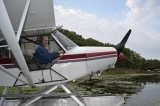
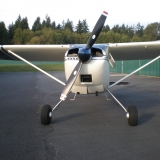
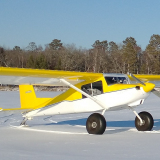
Frank found this O-290 powered PA-18S for about $28K on floats. Affectionally now known as the "Rat Cub".

contactflying wrote:.... Any place, including the wing, where the paint had chipped off the fabric, I could put my finger through the fabric. .... All I am saying is that most of the airplanes in my buy or lease market had ugly but safe fabric.....
contactflying wrote:About fabric: It gets changed for one of three reasons. Most popular reason; it doesn't look good. Second place; a mechanic, given other considerations, thinks he needs to get a closer look at some suspect tubing. A Maule fabric tester can be used on the tubing as well. The least likely reason for changing fabric: the fabric will not punch test high enough to suit the mechanic.
My crop duster mechanic/operator wasn't so fussy. I flew one of his CallAirs that was painted road department yellow. I don't know, but I think that is where the paint came from. Any place, including the wing, where the paint had chipped off the fabric, I could put my finger through the fabric. I asked him about this and he said, "Don't wine. The fabric just directs the relative wind around the wing. It is not structural."
I'm certainly not saying you should buy a plane with the fabric flapping in the wind. All I am saying is that most of the airplanes in my buy or lease market had ugly but safe fabric. Rotten tubing is a whole different story.
BRD wrote:Here's one that just sold for $10K. Narrow deck O-320. I flew it around the patch - hard to beat, even has the old hand brake. When it came up, our local IA got on the phone right away to a friend who was hoping to find an airplane someday (new pilot) and he scarfed it up. His wife gave her blessing for that price...
Frank found this O-290 powered PA-18S for about $28K on floats. Affectionally now known as the "Rat Cub".

JP256 wrote:....I asked if it would make a difference if I got my tailwheel endorsement (through a flight school / rental) before purchasing, and he thought it would make zero difference. The insurance companies apparently want to see that 100-hours of tailwheel time before they take you out of the "high risk" bracket. I got quotes from him two scenarios:
1) Tailwheel endorsement and 20 hours prior to purchasing
2) Purchase, then use my airplane for the tailwheel endorsement
Either way, the insurance company was going to require about 10 hours dual (after the TW endorsement) in my plane before "solo" operations. ....


daedaluscan wrote:In BC I bought my 170 with 0 tailwheel hours and about 60 hours total. $1400 a year and 10 hours dual required. Now about 500 hours in the 170 and no reduction in premium.
Interestingly they required 10 hours dual and I think 10! takeoffs and landing. More intelligent would be 30 mins dual and 500 takeoffs and landings IMHO.
A1Skinner wrote:.......When I went from my Citabria to my 180 I was sure they'd require a checkout, but they didn't. I was really surprised as they are two fairly different aircraft.
hotrod180 wrote:A1Skinner wrote:.......When I went from my Citabria to my 180 I was sure they'd require a checkout, but they didn't. I was really surprised as they are two fairly different aircraft.
My insurance agent (Bill White, skywagons a specialty) told me the underwriter required a "180 checkout" as well as (of course) a high performance endorsement. When I asked how many hours of checkout, he said no set number of hours required- just a sign-off. I was surprised because although I had plenty of C170 and C150/150TD time, I had zero 180 time and zero high-performance time. I went up with a CFI buddy of mine who owns a 180 and shot an hour's worth of landings,some landings, and that was that. But it's like getting your private ticket, that 180 signoff is just a license to learn-- it took a while longer for me to get comfortable in it. And a year and a half later, I'm still working on becoming competent.
.
Users browsing this forum: No registered users and 2 guests