I'm looking for information on how the experts handle their PA20/22s in regard to short fields.
Are the flaps effective?
What wingtips really work?
What speeds are you using?
Can you tell me your 3-point AOA? Maybe a photo?
Have you used VGs?
What else can you tell me?
I have flown a Vagabond and Clipper, but not much with the flap version of that wing. This is the detail I'm looking for.
PA20/22 Procedures
Thu Oct 31, 2013 6:04 am
Av8r3400
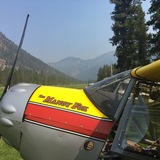
The Mangy Fox
Kitfox Classic IV-1200
912UL Zipper
I'd rather die trying to live,
Than live trying not to die.
-Leonard Perry
The Mangy Fox
Kitfox Classic IV-1200
912UL Zipper
I'd rather die trying to live,
Than live trying not to die.
-Leonard Perry
Thu Oct 31, 2013 7:34 am
Re: PA20/22 Procedures
I pop the flaps at 45 and she jumps off the ground. Establish climb at 55 then ease off the flaps as trees are cleared. Yes the flaps work on this plane. Stock wing and VG's makes for a nice honest flying plane! What engine and prop do you have? I loved my 0320 with an 82X41 prop. Climb was awesome but cruise is only around 90 MPH and you have to have 26" + tires or extended gear.
I fly the approach at 55 and 3 point is at less AOA than your KF. USE the trim!!! stock elevator runs out if you don't use the trim. Let us know what you think of the plane after you fly it Mr.!
I fly the approach at 55 and 3 point is at less AOA than your KF. USE the trim!!! stock elevator runs out if you don't use the trim. Let us know what you think of the plane after you fly it Mr.!
- akavidflyer offline
- Posts: 524
- Joined: Sat Nov 20, 2010 7:36 pm
- Location: Soldotna AK
Thu Oct 31, 2013 7:50 am
Re: PA20/22 Procedures
akavidflyer wrote:
I fly the approach at 55 and 3 point is at less AOA than your KF. USE the trim!!! stock elevator runs out if you don't use the trim. Let us know what you think of the plane after you fly it Mr.!
As a fairly new (~80 hour) PA22 pilot, I'd be interestest to know what exactly you do with the trim on approach. I am wanting to lower my approach speed at times when light but don't want to slam it in. I've got stock wings, no VGs.
- scottf offline
- Posts: 650
- Joined: Fri Mar 23, 2012 9:56 am
- Location: Meridian, ID
- FindMeSpot URL: http://share.findmespot.com/shared/face ... cbQCpIqefS
Thu Oct 31, 2013 1:58 pm
Re: PA20/22 Procedures
For full disclosure, this is research for a friend who is currently building a J5 clone (LSA) and wants to use short wings. The fuselage is set up for Pacer wings and I am lobbying for him to keep the flaps rather than deleting them to save a couple of pounds.
At this time he is considering a Lycoming O235 for power with an adjustable Sensenich prop.
At this time he is considering a Lycoming O235 for power with an adjustable Sensenich prop.
Av8r3400
The Mangy Fox
Kitfox Classic IV-1200
912UL Zipper
I'd rather die trying to live,
Than live trying not to die.
-Leonard Perry
The Mangy Fox
Kitfox Classic IV-1200
912UL Zipper
I'd rather die trying to live,
Than live trying not to die.
-Leonard Perry
Thu Oct 31, 2013 2:06 pm
Re: PA20/22 Procedures
I fly a '52 PA-20 and pretty much use full flap for all landings. The flaps are small, but there is a big difference between full flaps and zero flaps.
Typically I fly a pattern around 75-80MPH and then cross the numbers at about 65. Most my landings are with a touch of power and are wheelies.
Typically I fly a pattern around 75-80MPH and then cross the numbers at about 65. Most my landings are with a touch of power and are wheelies.
Thu Oct 31, 2013 3:48 pm
Re: PA20/22 Procedures
Experts?
Experts sit in their loungers sipping whisky giving out expert advise! I prefer a porch swing but the flight doc says not anytime soon!
I fly a pa22-160, booster wing tips, no VGs, on floats and skis with a 82-42 and on wheels a 74-56 incher, using 8:50s on the mains and an Airglass fork with a 8:00 on the nose. Western Alaska and no more then ten-twenty pavement landings a year.
Lets see, this is what I do (sign disclaimer at bottom of page please): standard pattern with runway halfway across struts on down wind
Abeam the numbers I pull carb heat, power back to 19-2100 depending on load, wait for the nose to start dropping and then crank in three turns, turn base, Pull one notch and she settles around 90 mph, turn finial, line her up nice, pull full flaps, and she shows 80 mph about 300-500 ft/min decent.
I guess I do about three distinct flair stages but seldom cross the numbers at less then 65. No reason to be any slower unless there is something smooth enough for the size of your tires underneath.
Take off is: trim same three turns as landing so I usually do not touch it (adjusted for load), full flap pull when in the white arc, slowly lower to first notch.
Climb out is ALWAYS: one notch, nose down for Vy and positive rate of climb, smoothly dump flaps and climb out at Vy. There is NO reason to climb out in a pacer/tri-pacer any slower-EVER. (see contact flying)
I soloed on floats and my instructor told me to get 300 hours before messing with pulling the flaps. At about 300 hours I was talking to a flying buddy who was about two years ahead of me in the flying curve, about getting a floatplane off the water. One hour of careful listening and I was able to shave half my water takeoff distance as well as get her off exactly when intended…almost every single time.
On wheels the only time pulling full flaps for takeoff is going to gain you anything is if you have wheel drag, mud, snow, water, slowing the takeoff or there is a need to be airborne in ground effect to keep from removing your wheel gear and reshaping the tips of your prop. That being said every one of my takeoffs is a practice for my next soft/short field that really is go or blow. My pre takeoff checklist has one notch of flaps only because reaching down for the floor during that critical stage of flight is not really the best idea.
When I truly need it all I leave the flap handle on the floor, I keep the nose wheel vary light but not off the ground, when at the vary end if the strip I pull full to the stop flap, yoke briskly to my chest, and grunt. Yoke forward about a third of its travel smoothly forward in less then a second. I then slowly push the yoke forward to get the nose down in probably less then a second and a half, its one of those whatever it takes kind of things, then slowly lower flaps to first notch all the while holding the nose as level as posable until Vy, then positive rate of climb, then slowly dump last notch of flaps. Except for the white arc check, which is mostly peripheral, the head is OUTSIDE the plane.
The reality is that the 375 foot strip is not a place we, as experienced or novice pilots, should have been in the first place and certainly not with friends or loved ones. On the other hand it sure is a kick in the ass getting her done! On the other hand…there is no other hand!
Soft field/short landings vary too much do to the nature of the beast except for this, I only pull full flaps when I have the strip MADE for certain and I push the carb heat in at the same time. I prefer about 500fpm and really plant her in there if it is indeed that short. The reality is that landing my tripacer short is never going to be the problem…she will always need more to get out.
The absolut best advice, expert for you arm chair pilots, is burn all the blue gas you can, because in the end all the horsepower, tires, and props in the world wont help for fuck all if you haven't done your time in the seat!
Rocket
Experts sit in their loungers sipping whisky giving out expert advise! I prefer a porch swing but the flight doc says not anytime soon!
I fly a pa22-160, booster wing tips, no VGs, on floats and skis with a 82-42 and on wheels a 74-56 incher, using 8:50s on the mains and an Airglass fork with a 8:00 on the nose. Western Alaska and no more then ten-twenty pavement landings a year.
Lets see, this is what I do (sign disclaimer at bottom of page please): standard pattern with runway halfway across struts on down wind
Abeam the numbers I pull carb heat, power back to 19-2100 depending on load, wait for the nose to start dropping and then crank in three turns, turn base, Pull one notch and she settles around 90 mph, turn finial, line her up nice, pull full flaps, and she shows 80 mph about 300-500 ft/min decent.
I guess I do about three distinct flair stages but seldom cross the numbers at less then 65. No reason to be any slower unless there is something smooth enough for the size of your tires underneath.
Take off is: trim same three turns as landing so I usually do not touch it (adjusted for load), full flap pull when in the white arc, slowly lower to first notch.
Climb out is ALWAYS: one notch, nose down for Vy and positive rate of climb, smoothly dump flaps and climb out at Vy. There is NO reason to climb out in a pacer/tri-pacer any slower-EVER. (see contact flying)
I soloed on floats and my instructor told me to get 300 hours before messing with pulling the flaps. At about 300 hours I was talking to a flying buddy who was about two years ahead of me in the flying curve, about getting a floatplane off the water. One hour of careful listening and I was able to shave half my water takeoff distance as well as get her off exactly when intended…almost every single time.
On wheels the only time pulling full flaps for takeoff is going to gain you anything is if you have wheel drag, mud, snow, water, slowing the takeoff or there is a need to be airborne in ground effect to keep from removing your wheel gear and reshaping the tips of your prop. That being said every one of my takeoffs is a practice for my next soft/short field that really is go or blow. My pre takeoff checklist has one notch of flaps only because reaching down for the floor during that critical stage of flight is not really the best idea.
When I truly need it all I leave the flap handle on the floor, I keep the nose wheel vary light but not off the ground, when at the vary end if the strip I pull full to the stop flap, yoke briskly to my chest, and grunt. Yoke forward about a third of its travel smoothly forward in less then a second. I then slowly push the yoke forward to get the nose down in probably less then a second and a half, its one of those whatever it takes kind of things, then slowly lower flaps to first notch all the while holding the nose as level as posable until Vy, then positive rate of climb, then slowly dump last notch of flaps. Except for the white arc check, which is mostly peripheral, the head is OUTSIDE the plane.
The reality is that the 375 foot strip is not a place we, as experienced or novice pilots, should have been in the first place and certainly not with friends or loved ones. On the other hand it sure is a kick in the ass getting her done! On the other hand…there is no other hand!
Soft field/short landings vary too much do to the nature of the beast except for this, I only pull full flaps when I have the strip MADE for certain and I push the carb heat in at the same time. I prefer about 500fpm and really plant her in there if it is indeed that short. The reality is that landing my tripacer short is never going to be the problem…she will always need more to get out.
The absolut best advice, expert for you arm chair pilots, is burn all the blue gas you can, because in the end all the horsepower, tires, and props in the world wont help for fuck all if you haven't done your time in the seat!
Rocket
- rocket offline
- Posts: 182
- Joined: Tue May 15, 2012 3:08 pm
- Location: Talkeetna
- FindMeSpot URL: http://share.findmespot.com/shared/face ... 9GZmP4hOO2
Thu Oct 31, 2013 6:02 pm
Re: PA20/22 Procedures
Av8r3400 wrote:I'm looking for information on how the experts handle their PA20/22s in regard to short fields.
Are the flaps effective?
What wingtips really work?
Have you used VGs?
My experience is limited, but I have learned a few things from a couple of highly experienced Alaska shortwing Piper pilots who use my product. The VG's work reasonably well. They improve the raw STOL performance a little, but they improve control response and flight safety down in that regime a lot.
Extended or re-shaped wingtips should work well, but this is a subjective opinion based on theory. I have never owned a PA-22. The people who have done those mods (Stewart Systems, Trimmer Aviation, etc.) have hands-on experience.
The flaps on the shortwings are good, but not nearly as good as the Cessna Fowler flaps. When you are doing real short field work, you need to use whatever the airplane has. So whether or not you have Cessna slotted Fowler flaps or plain Piper flaps does not matter, you use the plain flaps for everything you can get out of them. You just need to be able to get all of it out of the airplane safely and easily.
As part of a discussion on PA-22/20 STOL technique, one of the members of this forum was kind enough to quote directly from the Piper pilot's manual, and reported that starting the takeoff roll with no flaps, waiting until the last moment to deploy flaps on takeoff, then "popping" flaps right at the point of rotation, made a significant reduction in achieved takeoff roll. My research agreed with this finding, but I do have a significant financial stake in that discussion.
I would be very happy to discuss the flap issue in greater detail, either via PM or on this thread, but out of respect to the forum admin who tolerates limited and relevant "commercialized" postings, I'll wait until that subject is broached by someone else.

.
Thu Oct 31, 2013 6:20 pm
Re: PA20/22 Procedures
Flaps are most helpful. The manual does suggest starting the take off run with no flap and then "popping" them...it works fine...but I start with one notch of flap so I can reach the handle without burying my head behind the panel. I still pop the flap but the speed has to be right. If the airplane does not fly immediately when popping the flap; get rid of it...you applied flaps too early and leaving them down is not going to help until the speed increases. That speed is different for every Pacer I have flown. I know the speed in my plane and I apply full, assertive (not aggressive...there's a difference...flap and then bleed the flap off smoothly to one notch for the climb at just below Vy to give a bit of a buffer to my flap speed limitation. It's a nice smooth transition and if you set the trim properly before take off, the flap retraction schedule will do away with any trim as the aircraft gathers speed.
As mentioned, trim is important. Let the tail fly rather than introducing elevator into the mix to push the tail up.
I have VGs and they help the slow speed handling but good takeoff technique with trim, minimal control inputs, and straight tracking is important to get the best result.
The Pacer wing is a compromise but it's a respectable wing for back country flying. Just burn gas 'till ya get 'er right.
As mentioned, trim is important. Let the tail fly rather than introducing elevator into the mix to push the tail up.
I have VGs and they help the slow speed handling but good takeoff technique with trim, minimal control inputs, and straight tracking is important to get the best result.
The Pacer wing is a compromise but it's a respectable wing for back country flying. Just burn gas 'till ya get 'er right.
- northernguy offline


- Posts: 98
- Joined: Sat Oct 06, 2012 1:09 pm
- Location: Anahim Lake & Prince George
DISPLAY OPTIONS
Who is online
Users browsing this forum: No registered users and 8 guests
Latest Features
-
-
Featured Bush Planes
As one of the undisputed legends of bush flying, the Cessna 180 hauls a…Read More -
Aircraft Ownership and Maintenance
9 modification mistakes aircraft owners make when trying to "bush out" their birds—why some…Read More -
Live to Tell
A Minnesota pilot is surprised to learn that the sudden asymmetric drag of an…Read More




Latest Knowledge Base
-
Destinations
Canada offers some of the most spectacular backcountry flying on the continent. Here's what you need to know before you go.Read More -
Safety and Survival
Hope that you never have to use your survival vest but knowing you have it and knowing how to use…Read More -
Destinations
A regional guide with ideas for winter camping destinations in California, Nevada, New Mexico, and Arizona.Read More -
Aircraft
Finding an affordable aircraft that can handle the backcountry for $80K or less? A challenge for sure, but with the…Read More



