PACER MODS
Sat Nov 06, 2010 6:44 pm
PACER MODS
I saw info about stretching a pacer and changing the wing. This was licensed as an expermental. I have lost the contact info. Can anyone help.?
- cheechakotex offline
- Posts: 11
- Joined: Mon Feb 02, 2009 7:56 am
- Location: Abilene,TX
Sat Nov 06, 2010 6:54 pm
Re: PACER MODS
Yea it is the bushmaster. Some are experimental but other have STCs. The most common one is the BM 180. I did see a exp. Bushmaster that had a 300hp IO-540 once.
Reuben
Reuben
- cstolaircraft offline

- Posts: 523
- Joined: Wed Sep 29, 2010 12:50 pm
- Location: Blackwell, Mo
Mission Pilot in training. C-170B N8098A.
But they that wait upon the Lord shall renew their strength; they shall mount up on wings as eagles... Isaiah 40:31
But they that wait upon the Lord shall renew their strength; they shall mount up on wings as eagles... Isaiah 40:31
Sat Nov 06, 2010 7:00 pm
Re: PACER MODS
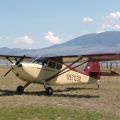
there is one for sale on barnstormers $80K nice pics
Sat Nov 06, 2010 7:26 pm
Re: PACER MODS
There's also the Dakota slotted wing in works. There are two flying with it, one stretched and one not. Another version besides the bushmaster is the producer.

Sat Nov 06, 2010 7:32 pm
Re: PACER MODS
Were you looking at this clipper?
http://www.barnstormers.com/classified_ ... DUCED.html
Looks pretty sweet to me.
http://www.barnstormers.com/classified_ ... DUCED.html
Looks pretty sweet to me.
Sat Nov 06, 2010 9:10 pm
Re: PACER MODS
Unusual choice of engines on that long-winged Clipper (O-300)-- musta been built by an old C170 guy.
A Pacer is a good-flying airplane. adding squared-off extended wingtips gives them more wing area which doesn't hurt. This would really be a nice mod if combined wth moving the ailerons outboard for better roll control. I think this is sorta what you end up with, with that Dakota wing, plus probably a slotted leading edge, that seems to be their thing.
A Pacer is a good-flying airplane. adding squared-off extended wingtips gives them more wing area which doesn't hurt. This would really be a nice mod if combined wth moving the ailerons outboard for better roll control. I think this is sorta what you end up with, with that Dakota wing, plus probably a slotted leading edge, that seems to be their thing.

Cessna Skywagon -- accept no substitute!
Sat Nov 06, 2010 10:43 pm
Re: PACER MODS
There is also a guy up here in AK building a stretched Pacer he calls a Producer. Don't have contact info, but you can find him over at www.shortwingpipers.org. He builds certified and experimental planes that seem to perform quite well.
Sat Nov 06, 2010 11:19 pm
Re: PACER MODS
Look up Eddie Trimmer in Willow, AK. He is the Pacer mod guy, he's got STC's for a lot of things from wing extensions, flap and aileron extensions, supercub gear, fuel system mods and really nice seaplane doors.
He has a website (Trimmeraviation.com) I think. Wonderful guy very helpful and very knowledgable.
He has a website (Trimmeraviation.com) I think. Wonderful guy very helpful and very knowledgable.

Sun Nov 07, 2010 8:03 am
Re: PACER MODS
Stickman wrote:Look up Eddie Trimmer in Willow, AK. He is the Pacer mod guy, he's got STC's for a lot of things from wing extensions, flap and aileron extensions, supercub gear, fuel system mods and really nice seaplane doors.
He has a website (Trimmeraviation.com) I think. Wonderful guy very helpful and very knowledgable.
The wing / aileron stuff isn't approved yet, paperwork was filed months ago but hasn't gotten any further.
Sun Nov 07, 2010 8:34 am
Re: PACER MODS
Rich Roberts out of Ft. Collins built up one based on Pacer components, but stretched wing and fuselage. He still has it, and it's a real good performer. Experimental, as he built WAY over 50%, including wings, from scratch.
Thanks. cubscout
Thanks. cubscout
Mon Nov 08, 2010 9:38 am
Re: PACER MODS
I think the Pacer is a pretty good airplane without streching it- that's a helluva lot of work. There are smaller less drastic ways to improve it--like fatter tires, Sutton exhaust, Odyssey battery, Borer prop, etc. Easy to add wing area with extended tips but then you have the aileron pretty far in from the end which doesn't help the roll rate any. Extending the wings one rib's worth, adding a short squared-off tip, moving the ailerons outboard, and extending the flaps outboard would make quite an improvement, but is pretty involved. I believe that's pretty much what Trimmer's got in the works for a possible STC. Might be a lot more bang for the buck to just add VG's & leave the round wingtips alone.
Cessna Skywagon -- accept no substitute!
Mon Nov 08, 2010 12:09 pm
Re: PACER MODS
Some things to consider when investing high $$$ into a tube and fabric plane:
The best Pacers are PA 22-20 conversions with the univaire wide gear kit. Since there was always a finite life to the older facbric and covering processes, an owner could justify making lots of great modifications to their planes to include the wingtips and taildragger conversions during the recovering process. At the time it was also real easy to get field approvals for modifications.
My 51 PA 22-20 had so many STC and modifications from HP upgrade STC to the tailwheel conversion, bagage door and plilot side pop out window. I baught it for $19,500 in 2006.
To take a TriPacer today and accomplish the same thing it would cost more money than the plane would ever be realistically valued at. The one on Barnstormers may have $80K into it, but I could by a C 180 for that. My good friend is neck deep into a Bushmaster and its gonna cost him twice what he could pay for a comperable turn key purchase (Maule or other) by his own admission. The wonderful thing about the Pacer is that you can buy on and mosdestl;y modify it to make it a great plane for like $25 K. I agree with the previous post. The Pacer is prett good by itself. For those who need a mission specific airplane, it may be more feasible to build one since anything they would buy may need modification.
The best Pacers are PA 22-20 conversions with the univaire wide gear kit. Since there was always a finite life to the older facbric and covering processes, an owner could justify making lots of great modifications to their planes to include the wingtips and taildragger conversions during the recovering process. At the time it was also real easy to get field approvals for modifications.
My 51 PA 22-20 had so many STC and modifications from HP upgrade STC to the tailwheel conversion, bagage door and plilot side pop out window. I baught it for $19,500 in 2006.
To take a TriPacer today and accomplish the same thing it would cost more money than the plane would ever be realistically valued at. The one on Barnstormers may have $80K into it, but I could by a C 180 for that. My good friend is neck deep into a Bushmaster and its gonna cost him twice what he could pay for a comperable turn key purchase (Maule or other) by his own admission. The wonderful thing about the Pacer is that you can buy on and mosdestl;y modify it to make it a great plane for like $25 K. I agree with the previous post. The Pacer is prett good by itself. For those who need a mission specific airplane, it may be more feasible to build one since anything they would buy may need modification.
- obxbushpilot offline
- Posts: 240
- Joined: Tue Feb 03, 2009 8:26 pm
- Location: Seward, AK
- Aircraft: C 172 Tailwheel
Mon Nov 08, 2010 12:44 pm
Re: PACER MODS
hotrod150 wrote:Might be a lot more bang for the buck to just add VG's & leave the round wingtips alone.
IMHO the wingtips are one of the places where a lot of improvement can be made without an awfully huge amount of work.
To make some improvement, you only have to change the back half. You can leave the large radius in the front "tip bow", that's actually helping. Making the trailing edge of the wing straight all the way to the very tip (instead of curving forward) is the trick. You could basically build the new improved section on top of the old curved bow, not even removing it. Just add the little bit of structure to the rear spar and trailing edge pieces and cover over it. This is the "quick and dirty" way of course. I would bet that you would see some small measurable improvement in low speed handling or performance.
To make a little more improvement, you could remove the existing wingtip bow and make a new trapezoidal "raked" wingtip with a few degrees of dihedral angle added. Make a new airfoiled wing rib about half as large (both chord and thickness) as the last original Piper rib. The trailing edge of this new rib should be at the same spanwise location as the end of the old tip bow (no dimensional increase in span, because that opens up a can of worms in Oklahoma City). The key is that the trailing edge of this new half-size tip rib is about 6 or 8 inches AFT of the trailing edge of the rest of the wing. If the stock Pacer wing has a smaller mini rib halfway out on the tip, then re-use this rib and place it where its trailing edge is in a straight line between the Piper end rib and the new tip rib.
Two or three simple bent aluminum supports (spar extensions technically) must be added on to the existing Piper spar so the loads are carried from this tip back into the Piper front/rear spar system. It would basically be a couple of .032" aluminum pieces with bent flanges, nothing mysterious at all. Plus a MUCH simpler swept back leading edge skin, which is now no longer a compound curve.
The end of the new wingtip should also be about 4 inches higher (tip dihedral angle). At the very least it should be straight with the top surface of the wing, with all the "taper" rising up on the bottom. Ideally it should be a bit more than that, with the new tip rib a few inches up higher. The added dihedral does something... it converts the pressure differential and the energy in the outward spanwise flow on the bottom of the wing into something useful. What it does is use that energy and momentum to "throw" the wingtip vortex a few inches outward away from the wing, instead of the vortex being right on top of the wingtip. This increases the effective wingspan of the wing, without increasing the physical span of the wing (One simple definition of the effective wingspan of an aircraft is the distance between the centers of the two wingtip vortices).
This "raked tip" planform (the top view) also measurably changes the pressure field distribution of the wing in the positive direction. Meaning it opposes the energy of the wingtip vortex. Meaning the wingtip makes more lift and waits longer to stall. Meaning it makes it ideal for better efficiency in climb, AND a STOL aircraft "hang in there" better down at the stall range. The Dornier light commuter and light seaplane aircraft are using this design with great results. Have a look at the wingtip shape of any modern efficient airliner to see what they think of this concept.
The aeronautical basis for this was quantified and explained something like 25 or 30 years ago by Wil Scherumann in an article in Soaring Magazine. Scheumann's new wingtip research was immediately put into production by the leading glider manufacturer Schempp-Hirth in the Discus sailplane, which proceeded to absolutely dominate its racing class for 20 years. Every new racing sailplane uses some form of the swept back "raked" wingtip.
But for the rest of ye olde unwashed masses who are not sailplane pilots or not interested in aerodynamics... just look at the wingtip of any high performance bird out there circling around in the mountains. Hawks, Eagles, etc. etc. Nature figured out the best low speed high lift wingtip shape a long long time ago


.
Tue Nov 09, 2010 7:34 pm
Re: PACER MODS
Fabricating & installing all that, plus getting it all approved, sounds more involved than most of us wanna get. Seems a lot easier to just buy someone's STC'd wingtips & install them: Stewart, Deemer, Crosswinds, ?? I've seen a simple short Hoerner-style tip for short-wing Pipers which looked like a good one, but don't know who made it.
A friend of mine had a nice light well-rigged Pacer with stock round tips which flew really well. If it was mine, I woulda added VG's & called it good.
A friend of mine had a nice light well-rigged Pacer with stock round tips which flew really well. If it was mine, I woulda added VG's & called it good.
Cessna Skywagon -- accept no substitute!
Wed Nov 10, 2010 2:03 pm
Re: PACER MODS
Isn't this what a Maule is?? I always thought the first Maules were stretched pacers with long wings???
- patrol guy offline

- Posts: 1749
- Joined: Wed Apr 11, 2007 2:52 pm
- Location: east of the river
...remember, life is uncertain, eat desert first!
... and, those that pound their guns into plows, will plow for those who don't.
... and, those that pound their guns into plows, will plow for those who don't.
Wed Nov 10, 2010 6:12 pm
Re: PACER MODS
I haven't heard that. But the bushmaster is a bushmaster. It is really called the Alaskan Bushmaster.
Reuben
Reuben
- cstolaircraft offline
- Posts: 523
- Joined: Wed Sep 29, 2010 12:50 pm
- Location: Blackwell, Mo
Mission Pilot in training. C-170B N8098A.
But they that wait upon the Lord shall renew their strength; they shall mount up on wings as eagles... Isaiah 40:31
But they that wait upon the Lord shall renew their strength; they shall mount up on wings as eagles... Isaiah 40:31
Wed Nov 10, 2010 8:49 pm
Re: PACER MODS
Actually, the first Maules were mostly Pacers with droop wing tips and big engines. The fuselage wasn't lengthened nor were the wings extended much.
You cannot just convert a Pacer to a Producer in the Exp category. Yes it's been done, but mostly by guys who FABRICATED the new fuselage from scratch. And, in any case, the FAA has now gotten pretty strict on what meets the 51% rule.
As the man said, you'd get upside down in one of these really fast, but if that's what'll wind your watch, the Producer type airplane is a heck of a machine.
MTV
You cannot just convert a Pacer to a Producer in the Exp category. Yes it's been done, but mostly by guys who FABRICATED the new fuselage from scratch. And, in any case, the FAA has now gotten pretty strict on what meets the 51% rule.
As the man said, you'd get upside down in one of these really fast, but if that's what'll wind your watch, the Producer type airplane is a heck of a machine.
MTV


Thu Nov 11, 2010 2:26 pm
Re: PACER MODS
What a minute! The maule M-1 was a low wing plane so it couldn't have been made from a pacer.
- cstolaircraft offline
- Posts: 523
- Joined: Wed Sep 29, 2010 12:50 pm
- Location: Blackwell, Mo
Mission Pilot in training. C-170B N8098A.
But they that wait upon the Lord shall renew their strength; they shall mount up on wings as eagles... Isaiah 40:31
But they that wait upon the Lord shall renew their strength; they shall mount up on wings as eagles... Isaiah 40:31
Thu Nov 11, 2010 6:53 pm
Re: PACER MODS
mtv wrote: Actually, the first Maules were mostly Pacers with droop wing tips and big engines. The fuselage wasn't lengthened nor were the wings extended much.
"Mostly Pacers".... it's kind of hard to build a smallish 4-place tube & fabric taildragger with a round tail & NOT have it look like a Pacer. The earliest M4 Maules used an O-300-- not that big, only 10 more horses than a PA-20-135. And yeah, the M4 has a round tail, but if you look closely it is different from the Pacer. I'm not sure about the airfoil used, but the M4 used a factory metal skinned wing. Lots of differences, in fact more differences than similarities other than profile.
Cessna Skywagon -- accept no substitute!
DISPLAY OPTIONS
Who is online
Users browsing this forum: No registered users and 3 guests
Latest Features
-
Live to Tell
A Minnesota pilot is surprised to learn that the sudden asymmetric drag of an out-of-rig ski can…Read More -
Creators
Working in some of the Yukon's most beautiful and remote environments, photographer Simon Blakesley captures aircraft in…Read More -
Aircraft Ownership and Maintenance
Upgrading to big tires can make a huge difference in backcountry performance, but with those gains come…Read More -
Tales from Yesteryear
In this tale from bush flying yesteryear, Don Cogger signs up to help Atlee Dodge Jr recovery…Read More


Latest Knowledge Base
-
Destinations
A regional guide with ideas for winter camping destinations in California, Nevada, New Mexico, and Arizona.Read More -
Aircraft
Finding an affordable aircraft that can handle the backcountry for $80K or less? A challenge for sure, but with the…Read More -
Aircraft
01.29.2018 - Zane - Updated tire diameter graphic to add 8.50x10 Guide to tires for use in the backcountry and off-airport landing…Read More -
Pilots
12.22.2013 - Initial article format Operating aircraft on skis and negotiating a snow-covered landscape is an entirely unique skillset and environment.…Read More


