Rob
I would expect it to be 7-$800.00 I think that is what they are running for the 180, and basically the same thing.
I know it is more than the v-brace, but it does more and a better job of the same.
Project: Cessna 170B BACK IN THE AIR!!!
Mon Dec 02, 2013 4:02 pm
- shortfielder offline

- Posts: 2352
- Joined: Sun Mar 05, 2006 7:14 pm
- Location: Durango, Colorado
- FindMeSpot URL: http://share.findmespot.com/shared/face ... D263l9HKFb
If you want to go up, pull back on the controls. If you want to go down, pull back farther.
My SPOT page
My SPOT page
Mon Dec 02, 2013 4:09 pm
Re: Project: Cessna 170B
http://www.aircraftspruce.com/pages/in/ ... -05345.php
This is an interesting tool. How long has it been out?
I have always been leary of having one piece of equipment that does it all. If anything in it goes wrong and ya have to send it, you are done flying until it comes back.
But I had the glass panel in the cub, and I sure liked that. great space/weight saver.
And, I just got my JPI stuff Still in the box if anyone wants it. FS450 and EDM 700-4C
Gary
This is an interesting tool. How long has it been out?
I have always been leary of having one piece of equipment that does it all. If anything in it goes wrong and ya have to send it, you are done flying until it comes back.
But I had the glass panel in the cub, and I sure liked that. great space/weight saver.
And, I just got my JPI stuff Still in the box if anyone wants it. FS450 and EDM 700-4C
Gary
- shortfielder offline
- Posts: 2352
- Joined: Sun Mar 05, 2006 7:14 pm
- Location: Durango, Colorado
- FindMeSpot URL: http://share.findmespot.com/shared/face ... D263l9HKFb
If you want to go up, pull back on the controls. If you want to go down, pull back farther.
My SPOT page
My SPOT page
Mon Dec 02, 2013 4:18 pm
Re: C-170B Project
bigrenna wrote:mtv wrote:Consider installing a 406 MHz ELT UNDER where that extended baggage floor would go.
Agreed. I noticed that also and forgot to mention. I would move the ELT from the side to under the baggage. I went with the Kannad. Great unit, and fits perfectly under the floor.
Not sure if I would bother with making a door. The Selkirk is a bit flimsy as it is and I cant imagine removing material for a door. Also, cutting a floor really isn't allowed in the STC. Moreover, it's really not needed. The floor is so easy to remove with just a couple of screws. With the remote switch, not sure why you need to get in there unless at annual, in which case the floor comes out anyway.

1). Switches have been known to fail
2). When your pride and joy completes the flight inverted, with the external antenna broken off, so you can remove the unit and deploy the handheld antenna.
3). So the ELT is easier to access in the event it activates and the remote switch won't turn it off. I've had that twice, though one was an older unit.
It's not that hard to make a door. And it's plenty strong, you just need to plan the location. I'll try to post a photo later.
I'm with Denali....got along for a long time without a baggage door on the 170, and never considered adding one worth the effort and expense.....contrary, I guess. And, yes, I've operated lots of Cessnas with baggage doors....my personal favorite is the one on the 206
 .....now, THATs a baggage door!
MTV


Mon Dec 02, 2013 6:34 pm
Re: Project: Cessna 170B
I guess we'll agree to disagree RE: an ELT door. But still foolish IMO. Having installed three now (two Selkirk and one Airglas) I would not compromise the already flimsy Seklirk floor with an access panel when it is just so easy to unscrew the floor. But the biggie is you can not legally just cut a hole in any extended baggage floor. Just call Joni and ask. For that matter, you cant even drill a hole to mount a tie down. But to each their own I guess.
- Bigrenna offline


- Posts: 2358
- Joined: Sun Sep 25, 2011 4:02 pm
- Location: New England
- Aircraft: C180H / C170B
www.bushwagoneast.com
Mon Dec 02, 2013 6:48 pm
Re: Project: Cessna 170B
shortfielder wrote:http://www.aircraftspruce.com/pages/in/enginemonitors_ei/eicgr30p10-05345.php
This is an interesting tool. How long has it been out?
I have always been leary of having one piece of equipment that does it all. If anything in it goes wrong and ya have to send it, you are done flying until it comes back.
But I had the glass panel in the cub, and I sure liked that. great space/weight saver.
And, I just got my JPI stuff Still in the box if anyone wants it. FS450 and EDM 700-4C
Gary
Gary, I may be interested in it. Email me, dsuter 7 gcbc at gmail dot com.
David

Mon Dec 02, 2013 7:03 pm
Re: Project: Cessna 170B
I've told Rob how much I love the FS450 Gary. That was the best investment I ever made. One thing that is important, that I learned a while back, was that you should call ACSpruce for big purchases. They sometimes have a different deal on the phone than online. For the FS450 I saved like $100!
- piperpainter offline

- Posts: 970
- Joined: Sat Nov 29, 2008 10:57 pm
- Location: Auburn, WA
- Aircraft: C-205
Was Backcountry Mooney M20C
Mon Dec 02, 2013 7:04 pm
Re: Project: Cessna 170B
piperpainter wrote:Screw the MVP.
Before you throw the baby out with the bath water, you might want to get up to speed on the details. Yes E.I. has a new unit, but it is not the same as the MVP. In order to get the full functionality that the MVP offers, you would need to install a second CGR head as there are not as many inputs to the unit. The CGR is also a tad deceiving as it is much bigger than they show as there is a large module that must be mounted behind the panel. There are also many other pressure modules that must be mounted for things like MP, static, pitot, fuel qty etc...
All that said, the CGR is a great unit. If you dont need the full bell and whistles of the MVP, than this is a great choice. The best part however is the customer service. Daniel at E.I. has been phenomenal during my install. Would not hesitate to do business with E.I. again.
For what its worth... installing the MVP in my Skywagon netted me a weight savings of aprox 20 lbs.
- Bigrenna offline
- Posts: 2358
- Joined: Sun Sep 25, 2011 4:02 pm
- Location: New England
- Aircraft: C180H / C170B
www.bushwagoneast.com
Mon Dec 02, 2013 7:32 pm
Re: Project: Cessna 170B
Man, all these rebuild threads. I may have to start a Citabria one... and then the wife would shoot me. Haha.
Good luck Rob. Looks great. Gonna look awesome when its done.
Good luck Rob. Looks great. Gonna look awesome when its done.
Mon Dec 02, 2013 8:35 pm
Re: Project: Cessna 170B
WoW! OK Rob let me know when you're doing the seats. I want to help.
- dudestickle offline

- Posts: 284
- Joined: Wed Sep 04, 2013 6:14 pm
- Location: Fallon
- FindMeSpot URL: https://login.findmespot.com/spot-main- ... /list.html
- Aircraft: 182heavy
Mon Dec 02, 2013 8:41 pm
Re: Project: Cessna 170B
bigrenna wrote:I guess we'll agree to disagree RE: an ELT door. But still foolish IMO. Having installed three now (two Selkirk and one Airglas) I would not compromise the already flimsy Seklirk floor with an access panel when it is just so easy to unscrew the floor. But the biggie is you can not legally just cut a hole in any extended baggage floor. Just call Joni and ask. For that matter, you cant even drill a hole to mount a tie down. But to each their own I guess.
It's called a "field approval".
In my opinion, a piece of safety equipment must be access able, otherwise it's useless and excess weight. Try FINDING a screwdriver when your airplane is upside down and gas is coming out of the wings....
But, to each his own. We put the door right next to the stiffening rib on the bottom of the floor....didn't affect strength at all.
MTV
Wed Dec 04, 2013 9:12 am
Re: Project: Cessna 170B
I owned a C170 for about 11 years, and with the big back seat out for camping never felt the need for a baggage door. I can see how one of those would be nice to access an extended baggage however.
I see the discussion rapidly extended to avionics. I'm not big on "gizmos", too many times installation of that stuff becomes a mission unto itself. I've seen discussions on aviation websites where the flying itself seemed secondary to use of gizmos. It'd be real easy to put a whole buncha money into gizmos-- great if you have it to spare, but if your funds are limited like mine are I'd save it for the necessities.
Com, txp, intercom, & handheld GPS are the extent of my avionics. I can see having a digital egt/cht but those engine/fuel flow monitors seem like overkill to me, esp on a C170 intended for backcountry use. I actually removed an EI fuel flow gizmo from my current plane and sold it. My "fuel totalizer" consists of sticking the tanks after fill-up, writing the fuel quantity & tach time down on a piece of tape, & sticking it on the panel. At any given moment, I can tell you within a gallon how much fuel I have on board by looking at the current tach time & doing a little math. Don't need any more than that.
I see the discussion rapidly extended to avionics. I'm not big on "gizmos", too many times installation of that stuff becomes a mission unto itself. I've seen discussions on aviation websites where the flying itself seemed secondary to use of gizmos. It'd be real easy to put a whole buncha money into gizmos-- great if you have it to spare, but if your funds are limited like mine are I'd save it for the necessities.
Com, txp, intercom, & handheld GPS are the extent of my avionics. I can see having a digital egt/cht but those engine/fuel flow monitors seem like overkill to me, esp on a C170 intended for backcountry use. I actually removed an EI fuel flow gizmo from my current plane and sold it. My "fuel totalizer" consists of sticking the tanks after fill-up, writing the fuel quantity & tach time down on a piece of tape, & sticking it on the panel. At any given moment, I can tell you within a gallon how much fuel I have on board by looking at the current tach time & doing a little math. Don't need any more than that.
Last edited by hotrod180 on Fri Dec 06, 2013 10:40 am, edited 1 time in total.
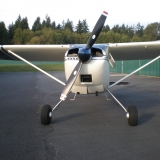
Cessna Skywagon -- accept no substitute!
Wed Dec 04, 2013 9:59 am
Re: Project: Cessna 170B
I tried getting the winshield wire brace kit to work today and was not able to do it.. The shaft the the yokes mount to is in the way.
I sure was hoping I could make that work. I guess it is on to the V-brace. Bettter that than nuthin.
I May start another thread for gizmos, Don't want to mess up the rebuild thread.I am not consumed by them, but I do like some of them and I like the weight savings.
Gary
I sure was hoping I could make that work. I guess it is on to the V-brace. Bettter that than nuthin.
I May start another thread for gizmos, Don't want to mess up the rebuild thread.I am not consumed by them, but I do like some of them and I like the weight savings.
Gary
- shortfielder offline
- Posts: 2352
- Joined: Sun Mar 05, 2006 7:14 pm
- Location: Durango, Colorado
- FindMeSpot URL: http://share.findmespot.com/shared/face ... D263l9HKFb
If you want to go up, pull back on the controls. If you want to go down, pull back farther.
My SPOT page
My SPOT page
Wed Dec 04, 2013 2:00 pm
Re: Project: Cessna 170B
On my last build, in 2006-'7, I was still leery of gizmo's. So, all steam gauges on my bird, big, heavy, steam gauges. I am contemplating yanking the panel, such as it is, and re-doing it , not for more bells and whistles or more capability, but purely for the weight savings. Hopefully at the same time I could make it all a bit tidier back there, with better access also. A side result would be more room left over in the panel, I always liked the glove box in my T-Craft panel and would like to have one again
Good luck on your project Rob, keep flying the hell out that thing and keep it LIGHT!
Good luck on your project Rob, keep flying the hell out that thing and keep it LIGHT!
- courierguy offline

- Posts: 4197
- Joined: Thu Mar 31, 2005 6:52 pm
- Location: Idaho
"Its easier to apologize then ask permission"
Tex McClatchy
Tex McClatchy
Wed Dec 04, 2013 2:07 pm
Re: Project: Cessna 170B
hotrod150 wrote:My "fuel totalizer" consists of sticking the tanks after fill-up, writing the fuel quantity & tach time down on a piece of tape, & sticking it on the panel. At any given moment, I can tell you within a gallon how much fuel I have on board by looking at the current tach time & doing a little math. Don't need any more than that.
I love that idea. I m going to copy.
- daedaluscan offline


- Posts: 1302
- Joined: Sat Jan 12, 2013 1:06 pm
- Location: Texada BC
Wed Dec 04, 2013 3:26 pm
Re: Project: Cessna 170B
hotrod150 wrote:I owned a C170 for about 11 years, and with the big back seat out for camping never felt the need for a baggage door. I can see how one of those would be nice to access an extended baggage however.
I see the discussion rapidly extended to avionics. I'm not big on "gizmos", too many times installation of that stuff becomes a mission unto itself. I've seen discussions on aviation websites where the flying itself seemed secondary to use of gizmos. It'd be real easy to put a whole buncha money into gizmos-- great if you have it to spare, but if your funds are limited like mine are I'd save it for the necessities.
Com, txp, intercom, handheld GPS are the extent of avionics. I can see having a digital egt/cht but those engine/fuel flow monitors seem like overkill to me, esp on a C170 intended for backcountry use. I actually removed an EI fuel flow gizmo from my current plane and sold it. My "fuel totalizer" consists of sticking the tanks after fill-up, writing the fuel quantity & tach time down on a piece of tape, & sticking it on the panel. At any given moment, I can tell you within a gallon how much fuel I have on board by looking at the current tach time & doing a little math. Don't need any more than that.
I'm with you on the gizmo's. More money and more weight. I only want the bare minimum in my panel. I already ripped out the AH, DG, suction guage, clock, and I'm thinking of replacing the electric turn coordinater with just a simple inclinometer ball that can't weigh more then a couple ounces. I've also thought of getting rid of the VSI since It's slightly off and I find myself using the VSI feature on my 496 a lot anyways. The transponder and com radio I have now work and are staying in the plane. I can't see spending thousands to replace them on a VFR plane. I am however contemplating selling my 496 and upgrading to a 796, it would look good in the center of the panel.

Wed Dec 04, 2013 3:33 pm
Re: Project: Cessna 170B
In my experience, a fuel totalizer is much more useful when backcountry flying then cross country flying. Cross country, most of the time you top the tanks and take off. You have climb fuel burns and cruise fuel burns and keeping track of the time that you are in those modes of flight is pretty straight forward.
When flying the backcountry, you may be out for days at a time between refueling, sometimes in cruise, but also doing a lot of take offs and landings etc. Also, try dipping your tanks at JC.......when not on flat ground, it is really tough to get an accurate measurement. I like to fly my airplane as light as possible, so knowing how much fuel I have down to 1 or two gallons makes a big difference in how much I enjoy flying. I still dip my tanks and keep track of time, but I also have a totalizer keeping track, and I always check it when I refuel. It is always within a gallon. So, with dipping my tanks and keeping track of time I have one picture, then the fuel totalizer helps fill in the rest of the story.
Engine monitors are also very important when flying over unfriendly terrain, and adding fuel flow to one is only adding a transducer interms of extra weight.
When flying the backcountry, you may be out for days at a time between refueling, sometimes in cruise, but also doing a lot of take offs and landings etc. Also, try dipping your tanks at JC.......when not on flat ground, it is really tough to get an accurate measurement. I like to fly my airplane as light as possible, so knowing how much fuel I have down to 1 or two gallons makes a big difference in how much I enjoy flying. I still dip my tanks and keep track of time, but I also have a totalizer keeping track, and I always check it when I refuel. It is always within a gallon. So, with dipping my tanks and keeping track of time I have one picture, then the fuel totalizer helps fill in the rest of the story.
Engine monitors are also very important when flying over unfriendly terrain, and adding fuel flow to one is only adding a transducer interms of extra weight.
- highroad offline

- Posts: 785
- Joined: Wed Feb 20, 2008 10:28 am
- Location: Southern Oregon Coast
- FindMeSpot URL: http://share.findmespot.com/shared/face ... SBWeUVDhQd
- Aircraft: A Maule we call X-ray
Wed Dec 04, 2013 3:48 pm
Re: Project: Cessna 170B
highroad wrote:In my experience, a fuel totalizer is much more useful when backcountry flying then cross country flying. Cross country, most of the time you top the tanks and take off. You have climb fuel burns and cruise fuel burns and keeping track of the time that you are in those modes of flight is pretty straight forward.
When flying the backcountry, you may be out for days at a time between refueling, sometimes in cruise, but also doing a lot of take offs and landings etc. Also, try dipping your tanks at JC.......when not on flat ground, it is really tough to get an accurate measurement. I like to fly my airplane as light as possible, so knowing how much fuel I have down to 1 or two gallons makes a big difference in how much I enjoy flying. I still dip my tanks and keep track of time, but I also have a totalizer keeping track, and I always check it when I refuel. It is always within a gallon. So, with dipping my tanks and keeping track of time I have one picture, then the fuel totalizer helps fill in the rest of the story.
Engine monitors are also very important when flying over unfriendly terrain, and adding fuel flow to one is only adding a transducer interms of extra weight.
X2
Also, connecting the fuel flow to your GPS is also a great feature to have, automatically totaling gallons per mile and fuel required to your destination.
Connects with just one wire, even to your portable (2-3-496).
Have fun with your project Rob.
- Terry offline

- Posts: 1365
- Joined: Sat Nov 10, 2007 9:11 pm
- Location: Willamette Valley
- FindMeSpot URL: http://share.findmespot.com/shared/face ... 4GzPHI6t1d
Wed Dec 04, 2013 3:55 pm
Re: Project: Cessna 170B
I definitely see the advantages of a fuel totalizer and I've thought of adding one before. I still might get one but theres money to be spent elsewhere first.
Wed Dec 04, 2013 5:16 pm
Re: Project: Cessna 170B
highroad wrote:In my experience, a fuel totalizer is much more useful when backcountry flying then cross country flying. Cross country, most of the time you top the tanks and take off. You have climb fuel burns and cruise fuel burns and keeping track of the time that you are in those modes of flight is pretty straight forward.
When flying the backcountry, you may be out for days at a time between refueling, sometimes in cruise, but also doing a lot of take offs and landings etc. Also, try dipping your tanks at JC.......when not on flat ground, it is really tough to get an accurate measurement. I like to fly my airplane as light as possible, so knowing how much fuel I have down to 1 or two gallons makes a big difference in how much I enjoy flying. I still dip my tanks and keep track of time, but I also have a totalizer keeping track, and I always check it when I refuel. It is always within a gallon. So, with dipping my tanks and keeping track of time I have one picture, then the fuel totalizer helps fill in the rest of the story.
Engine monitors are also very important when flying over unfriendly terrain, and adding fuel flow to one is only adding a transducer interms of extra weight.
Absolutely. In my opinion, a fuel flow computer is one of the best things ever created for airplanes. And, a FS 450 or similar weighs only ounces.... Gizmos??? Knowing EXACTLY how much gas you have left, how many minutes to dry tanks, and your current fuel flow is WONDERFUL information in any airplane. I've used them for years, and once calibrated, the ones I've used (JPI, EI and Shadin) were all within a tenth of a gallon or two after a few hundred gallons run through the plane since topping off. On floats, there are MANY times when you simply can't top off and carry any load, and these things make life a LOT less worrisome.
Unfortunately, my new ride has no electrical system, so a Fuel computer is not on the horizon. Sweated fuel all the way back from South Dakota with it, too.
To me, a fuel computer would be VERY high up on the list of "necessary" items, for a lot of reasons.
MTV
Wed Dec 04, 2013 5:29 pm
Re: Project: Cessna 170B
mtv wrote:highroad wrote:In my experience, a fuel totalizer is much more useful when backcountry flying then cross country flying. Cross country, most of the time you top the tanks and take off. You have climb fuel burns and cruise fuel burns and keeping track of the time that you are in those modes of flight is pretty straight forward.
When flying the backcountry, you may be out for days at a time between refueling, sometimes in cruise, but also doing a lot of take offs and landings etc. Also, try dipping your tanks at JC.......when not on flat ground, it is really tough to get an accurate measurement. I like to fly my airplane as light as possible, so knowing how much fuel I have down to 1 or two gallons makes a big difference in how much I enjoy flying. I still dip my tanks and keep track of time, but I also have a totalizer keeping track, and I always check it when I refuel. It is always within a gallon. So, with dipping my tanks and keeping track of time I have one picture, then the fuel totalizer helps fill in the rest of the story.
Engine monitors are also very important when flying over unfriendly terrain, and adding fuel flow to one is only adding a transducer interms of extra weight.
Absolutely. In my opinion, a fuel flow computer is one of the best things ever created for airplanes. And, a FS 450 or similar weighs only ounces.... Gizmos??? Knowing EXACTLY how much gas you have left, how many minutes to dry tanks, and your current fuel flow is WONDERFUL information in any airplane. I've used them for years, and once calibrated, the ones I've used (JPI, EI and Shadin) were all within a tenth of a gallon or two after a few hundred gallons run through the plane since topping off. On floats, there are MANY times when you simply can't top off and carry any load, and these things make life a LOT less worrisome.
Unfortunately, my new ride has no electrical system, so a Fuel computer is not on the horizon. Sweated fuel all the way back from South Dakota with it, too.
To me, a fuel computer would be VERY high up on the list of "necessary" items, for a lot of reasons.
MTV
Sorry for thread drift Rob, but I'm interested in the fuel totalizer for my 170B as well. Only thing is, I mainly fuel from 55 gal drums with a wobble pump, so I'm not sure how I'd go about calibrating it. I know I could buy one of those in-line, battery-powered flow meters and put it on the nozzle hose, but they're another $100, which has always been a little hard to swallow. Is there a better way?
- denalipilot offline

- Posts: 2793
- Joined: Mon Oct 15, 2007 4:53 pm
- Location: Denali
- Aircraft: C-170B+
DISPLAY OPTIONS
Who is online
Users browsing this forum: No registered users and 0 guests
Latest Features
-
-
Featured Bush Planes
As one of the undisputed legends of bush flying, the Cessna 180 hauls a…Read More -
Aircraft Ownership and Maintenance
9 modification mistakes aircraft owners make when trying to "bush out" their birds—why some…Read More -
Live to Tell
A Minnesota pilot is surprised to learn that the sudden asymmetric drag of an…Read More




Latest Knowledge Base
-
Destinations
Canada offers some of the most spectacular backcountry flying on the continent. Here's what you need to know before you go.Read More -
Safety and Survival
Hope that you never have to use your survival vest but knowing you have it and knowing how to use…Read More -
Destinations
A regional guide with ideas for winter camping destinations in California, Nevada, New Mexico, and Arizona.Read More -
Aircraft
Finding an affordable aircraft that can handle the backcountry for $80K or less? A challenge for sure, but with the…Read More



