http://www.adn.com/news/alaska/story/8556727p-8450293c.html
Dead at 96, Bradford Washburn was explorer of Alaska’s unclimbed peaks
Near-death experience in Wrangells didn’t keep him away
Published: January 12, 2007
Last Modified: January 12, 2007 at 12:31 PM
------------------------------------------------------------------------------------
Bradford Washburn, the founder of Boston's Museum of Science and an explorer who spent three-quarters of a century unlocking the secrets of the world's mountains in Alaska and elsewhere, died Wednesday of heart failure. He was 96.
A world-class mountaineer and a renowned cartographer, Washburn was a well-known Alaska climber who set the stage for the transformation of the sleepy railroad town of Talkeetna when he pioneered the West Buttress route to the summit of Mount McKinley in 1951.
In the years that followed, Talkeetna became the jumping-off point for nearly all climbers trying to reach the 20,320-foot-high point of North America and a focal point for a growing tourism business built around McKinley flightseeing.
McKinley, however, was not involved in Washburn’s greatest Alaska feat. That was his retreat from 17,150-foot Mount Lucania in the Wrangell Mountains in 1937.
Then a cocky, young member of the Harvard Mountaineering Club, Washburn set out with friend Bob Bates to climb what was at the time the highest unclimbed mountain in North America. Beset by bad weather, they ended up in a fight for their lives. They barely survived.
Their story was later chronicled by writer David Roberts in "Escape from Lucania: An Epic Story of Survival."
Washburn’s near death from starvation in the Wrangells might have forced other men to think twice about pursuing a career in the mountains, but the high peaks were at the heart of a passion Washburn could never let go.
He was a regular visitor to Alaska until shortly before his death. Friends would sometimes meet him wandering the hills around Talkeetna, simply looking for a better view of McKinley.
Still, late in life, he came to consider his climbing, his stunning mountain photography and his mapping of most of the great mountain ranges of the world as his life's secondary pursuits. He would be happy, he told The Boston Globe in 2000, to have a one-line obituary: “He built the Museum of Science."
"The top of Mount McKinley was thrilling," he said, "but there’s nothing on earth more exciting than the eyes of a youngster at the instant of discovery." In some ways, Washburn was that youngster his whole life. He spent eight decades traveling to the earth’s most remote regions, recording his observations and returning to share his discoveries.
Along the way, he was credited with being first to reach the summits of seven North American mountains. While researching and documenting his climbs, he created photographs that were both aesthetic gems and gateways for other explorers. He was considered a pioneer of aerial photography, but he was more than that.
"You recognize the explorer in Bradford Washburn at first sight," the late Ansel Adams, a longtime friend, said. "There is something about his eyes, the set of his chin … the consistent energy of mind and spirit."
Washburn had near-boundless enthusiasm, a granite determination and a meticulous attention to detail. Those qualities, colleagues said, brought success both in the jagged wilderness and in the thicket of Boston’s politics and academia.
He took the helm of the New England Museum of Natural History in the Back Bay in 1939 at the age of 29. Then largely a repository of deteriorating stuffed animals, the museum was described by one patron as "a grandmother’s attic, a hodgepodge of ill-cared and often repulsive exhibits which belong by rights in a medical school."
Washburn, though, had energy and ideas. All he needed was money. Thus began a series of fundraising drives that brought in millions. Within a decade, new plans were set for Museum of Science at the Charles River Basin.
"Everyone thought we were absolutely mad," Washburn once recalled.
But in 1951, the new museum opened. Subsequent additions added a planetarium and the 21u20442 million-volt Van de Graaff generator. By the time Washburn retired as director in 1980, he had built the first major museum anywhere to bring all science under a single roof — natural, physical, applied and planetary.
Washburn yearned to bring science to life for everyone.
"The great majority of our visitors," he once said, "probably never will be scientists, but they will be better lawyers, businessmen, clergymen, scoutmasters, parents, citizens because of this fascinating glimpse of the wonders which lie constantly hidden on all sides of every one of us."
A native of Cambridge, Mass., Henry Bradford Washburn Jr. attended the Buckingham School and the Groton School. His father was dean of an Episcopal theological school; his mother, Edith Buckingham Hall, was an amateur photographer who gave him his first camera, a Kodak Brownie, when he was 13.
In his boyhood, he was hampered by breathing difficulties. He found relief in the same mountains where he later found inspiration.
"I had perfectly terrible hay fever for the first 10 years of my life," he said in 2000. "I noticed that I didn’t get hay fever when I went into the mountains."
By age 11, he had climbed Mount Washington, the highest in New England; by 16, Mont Blanc, the highest in the Alps. Still in his teens, he wrote three guidebooks and gave lectures on the Alps in such august venues as Carnegie Hall in New York and Symphony Hall in Boston.
While an undergraduate at Harvard, he began his explorations of what he called "the incredibly savage beauty" of Alaska. Later, at the Natural History Museum, he recruited as his secretary Barbara Polk, a Smith College graduate working in Harvard’s biology department. "I didn't want to go work in that stuffy old place with a crazy mountain climber," she would say decades later, but Washburn eventually talked her into that and more. The two fell in love and married. On their honeymoon, they made the first recorded ascent of Mount Bertha in Alaska.
"She's the best thing that ever happened to me," he often said. In 1947, as Brad Washburn was becoming the first climber to twice reach the summit of McKinley, Barbara became the first woman to summit.
Brad, his wife said, was "the kind of guy who when he makes up his mind about something, you don’t have time to take a deep breath." That dogged approach served him well in completing his climbs and in creating his maps and models, renderings that became signposts to generations of scientists and adventurers. In addition to his Alaska research, he created with Barbara’s help what many believe are the definitive maps of the Grand Canyon and the Presidential Range in New Hampshire.
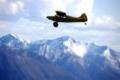
In photography, Brad married this profound sense of purpose with a sense of wonder. For his aerial images, he devised an elaborate process to capture the drama and sweep of what he experienced. He would yank the side door off a single-engine plane and strap himself and his 53-pound Fairchild K-6 camera into position at the opening. At 20,000 feet with buffeting winds, finger-freezing temperatures, a vibrating, yawing fuselage, and oxygen sucked through a bottle, conditions were brutal.
The results were striking. Shot from adjacent or diagonal angles rather than from straight above or from the base, the photographs of shrouded rocks and shifting clouds created visceral, almost animate images. Epic in scale yet intimate in detail and shading, they are more like portraits of individual mountains than landscapes. His photographs, critics say, don’t merely record, they reveal. In addition to his wife, Washburn leaves a son, Edward H.; two daughters, Dorothy Dundass of Newton and Elizabeth Cabot of Belmont; nine grandchildren and two great-grandchildren.
There will be no services.
“He didn’t want any fuss,” Barbara Washburn said.