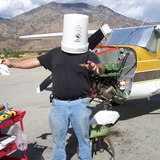
Any suggestions appreciated!


rocket wrote:The product you want to use is 1300L only it needs to be thinned with toluene to be applied to a smooth multi layer finish on both your leading edge and the inside of the rubber. Lets back up a little.
On the inside of your leading edge strip draw a neat line down the middle with a yellow grease/china pencil.
For the best adhesion the finish should be stripped down to metal, acid etched, and alodined. This is how I was trained to do it but I have also stuck them right on the paint.
Draw along the sheetmatel leading edge with a regular pencil a line that corresponds with the one you made on your rubber. Then lay the rubber on the leading edge and temporarily tape it in place. Draw the two corresponding lines of both rubber edges. I then mask off the part about 3/32 larger then the two lines so I am sure of complete coverage with out any of the rubber being unbounded.
Thin about 3/4 cup of 1300L until it is just a little thicker then whole milk. Using a natural fiber brush neatly lay on a drip free layer on both the sheet matal and the rubber. Don't brush it around like a kindergarden art project: use thin smooth passes. let this dry about twenty minutes and then re-coat gently so as not to disturb the first layer; it takes a little finesse to do this neatly but if you ball up or drip the 1300 it will show through the rubber and it will also affect the long term adhesion. Three coats on the metal and four on the rubber. Think contact cement, both need to dry about four-10 hours but do not wait any more then twelve.
Have a handy cup of the Toluene and a natural fiber brush ready; a heavy coffee mug works best as it will not tip over in the heat of battle. One also needs a Speedball ink roller for the next step. This is a four inch wide roller about one inch in diameter with a thin layer of rubber on the wood dowel: it looks like a little paint roller.
After the adhesive has dried roll up the rubber with the glue on the outside. Brush a thin coat of the toluene on the leading edge and carefully lay the rubber in the leading edge using the pencil line and the grease pencil line as your guide. Vary gently at first roll the leading edge but be weary of sliding the rubber around….gently.
You should only worry about wetting the radius as you work across the structure. Once the lenth of the leading edge has been applied and rolled I like to slide the brush under the flap wetting and rolling from the leading edge pushing any air toward the trailing edge. About the time you have figured all the top surfaces out doing the bottoms will not be the chore it first seemed they would.
If you face any stubborn edges or rivets to deal with it is best to be certain the 1300L is dry before trying to make them join. Some battles you win some you don't…best to just get over it, I have!
The last step is the most important: sealing the edges.
I like to use a B-1/2 chromated polysulfide (pro seal, chem seal, or whatever…) for its corrosion inhibiting properties and the fact that it really likes to stick to both the rubber and structure, it blends in well with the black, and flows nice if you get it on quickly after mixing. Just be sure to mask in a way that the masking can be removed smoothly and quickly without any booby-traps. Get the tape off right away after applying and the sealant will flow just enough to smooth out any imperfections in the structure or your tapping.
There are likely about thirty little micro steps I have forgotten that make this process work for me but I think you get the idea. Seems I do everything a little different each time…mostly for the better but then again.
Rocket
ps. any kind of rubber or tape on fabric leading edges is a bad idea!

Users browsing this forum: No registered users and 14 guests