Backcountry Pilot • Short field landing

Short field landing

Share tips, techniques, or anything else related to flying.
227 postsPage 3 of 121, 2, 3, 4, 5, 6 ... 12

Re: Short field landing

Zane wrote:Last year at JC I returned after a short midday outing and found myself high...on life of course. I went around. It's actually kind of fun just flying the pattern in that canyon at JC. Anyway, next time around, same thing. High as a kite. .


Image
58Skylane offline
User avatar
Posts: 5297
Joined: Thu Oct 11, 2007 12:36 pm
Location: Cody Wyoming

Re: Short field landing

[quote="]

Flying the plane to AK this winter...anyone want to go? February 1st.[/quote]


How about June 1st? :D

Sounds like a good time, safe trip to you.
WSH offline
Posts: 42
Joined: Sun Apr 04, 2010 3:09 pm
Location: Virginia Beach

Re: Short field landing

MarkGrubb wrote: Rob's analysis is correct ...


WTF,,,,, just when I get the hang of being the odd man out someone has to throw a curve ball... :?

Reading some of these posts, it occurs to me that there are far more people afraid of being 'cross controlled' than there are people who really realize what the wing is doing in a cross controlled state...

Slips 101)

the only difference *PERIOD* between a fwd slip and a side slip is the direction you are crossing the earth... aerodynamically speaking the airplane, doesn't know the difference, nor does it care...

Having said that, I will add that performing a SIDE slip is essentially worthless to this conversation... it gains you ZERO in aiding a short field landing, It's sole purpose in our lives is to maintain a centerline track on very short final while landing. If you are one of those 'kick out the crab at the last second" guys you have my condolences, we all have our faults...

.... A FORWARD Slip on the otherhand is a wonderful tool. Why? because your airplane is sideways to your direction of travel.... there is no more effective speed brake, than the whole damn airframe, THIS is the reason we do not let the nose fall through when we slip, we are trying to slow the show down... Coincidentally, since you are now flying 'sideways' your effective wingspan has now been shortened...

When you let the nose fall through in a slip, you drop like a stone, but your airspeed climbs. Conversely, when you hold the nose in a slip, you drop like a stone again, but your airspeed (and more importantly groundspeed) does too... in STOL, this is the name of the game...............


In the end.... I am in Gumps camp. Your engine will be much happier with you carrying power all the way to the touch down, than dead sticking it from altitude. I can, and do use slips, but, since everything I fly has flaps, 90% of the times I have to resort to slipping, are because I screwed the pooch somewhere else. The only common exceptions I can think of are a few strips up north I've frequented that are surrounded by 100'+ spruces, all while being short... now you need to get in short, but don't have the luxury of a drawn out, lean, drag it in approach. Here I am still power on till the end, but adding a slip to add to the elevator ride...

here we go again....
Rob offline
Supporter
User avatar
Posts: 1569
Joined: Sat Mar 11, 2006 10:34 am

Re: Short field landing

My two bits...
I use whatever techique seems good at the time since my flaps aren't all that effective in a dive to slow me down. On my video(http://vimeo.com/12935841) coming into JC, it is a long DW approach at 75 mph. When I turn base I am 60 mph. Just above idle, nose down, 3 notches of flap through the turn with carb heat turning final. I then judge my decent, airspeed, and clearnace as I approach the end of the runway with varying angles of slip with power. As landing is assured, add flapps 4&5, carb heat off, engine just above idle, hold slip until 100 ft above runway. At about 25 ft above runway, engine idle, slip gone, airspeed 45-50 mph and just let it settle in for a taildown, wheel landing. I find on the average coming into a new strip of any kind I tend to be high and fast (go around potential). Usually the third landing I understand what I'm doing and can nail it after that..remember I'm still getting used to this machine at 400 hrs in it. At home on my flat, wide open strip I practice landings of all types. Before I head to the backcountry I especially practice tight pattern work, steep appraoch, short soft field landings. At SNY runway 03 is grass, 1100ft from north end to taxiway, so that is my runway to practice my short field stuff..no matter WHAT direction the wind is. I wish I was closer to more backcountry flying as I could practice more of the real world stuff. I know my plane has the potential for something like Mile Hi, but I'm not ready for it.
HC
hicountry offline
User avatar
Posts: 1667
Joined: Wed Sep 05, 2007 3:40 pm
Location: SIDNEY NE
'05 7GCBC High Country Explorer
The faster I go , the farther behind I get.

Re: Short field landing

Rob wrote:If you are one of those 'kick out the crab at the last second" guys you have my condolences, we all have our faults...


Hey now.... [-X

Not always. Once in a while. When I feel like it. Most times I don't pay any attention to what technique I use, I'm just aimed in the general direction.... Etc, etc, etc....

But when it's really, really, really windy with a stout crosswind (30+ KTS) I'll hold the crab till the upwind wheel touches, and kick it out as the tire grabs the ground. And if on gravel/ice/snow, I may not even kick it out, but let it slide sideways.

Now on pavement. I get scared and go find dirt somewhere else. :roll:

Gump
GumpAir offline
User avatar
Posts: 4557
Joined: Wed Feb 14, 2007 9:14 am
Location: Lost somewhere in Nevada
Aircraft: Old Clunker

Re: Short field landing

GumpAir wrote:
Rob wrote:If you are one of those 'kick out the crab at the last second" guys you have my condolences, we all have our faults...


..... I'll hold the crab till the upwind wheel touches, and kick it out as the tire grabs the ground...

Gump


Hi Gump,

flying a 60' wide low wing, with all sorts of cr@p hanging down off the wing, I too, will occasionally fly the crab down till the upwind wheel barks... My comment was for the guys who fly the kicked out crab 24/7/365... Like many other facets of flying, it's strictly an opinion. And like most opinionated pilots, I am pretty certain of mine :lol:

Take care, Rob...
Rob offline
Supporter
User avatar
Posts: 1569
Joined: Sat Mar 11, 2006 10:34 am

Re: Short field landing

Rob wrote: Like many other facets of flying, it's strictly an opinion. And like most opinionated pilots, I am pretty certain of mine :lol:


Hey!!! I resemble that remark!!! :twisted:

That's the nice thing about being a curmudgeon. I can get away with it now.

Gump
GumpAir offline
User avatar
Posts: 4557
Joined: Wed Feb 14, 2007 9:14 am
Location: Lost somewhere in Nevada
Aircraft: Old Clunker

Re: Short field landing

I don't like the 'kicked out crab' because can present a bunch of bobbing and weaving at a time when you should be all but through with bobbing and weaving...

fwd slip vs. side slip and why we just don't care:

This brings us back to the guy who hasn't mastered a slip... you know... he's the guy that turns a left base to final, and stands on the right rudder to drop some excess altitude even with a right cross wind #-o . now down at terra firma, he has to roll out of the left wing low 'slip' and clear over into a right wing low 'slip' to maintain his centerline.... I can never figure out why 'this guy' didn't just finish the turn and roll the appropriate upwind wing down and ride the correct slip down to the ground, already in the appropriate config for landing?
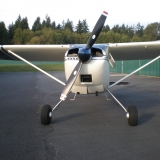
You see... once your going straight down final you're airplane doesn't recognize the difference between a slip from the right or slip from the left...it's all fwd err...a fwd going side slip :lol: ...

It is very cool looking to start a slip right out of the downwind to base turn and corkscrew your way to the ground. Just don't get stuck in the mindset that, that is the same side you have to ride all the way to the ground...
Rob offline
Supporter
User avatar
Posts: 1569
Joined: Sat Mar 11, 2006 10:34 am

Re: Short field landing

Reading through this thread, it seems like at least one person equates power-on & behind-the-power-curve only with a long flat drag-it-in approach. I've seen this done at STOL contests, to me it is applicable only to places with no obstructions like a sandbar on a straight river, etc.
I kinda like a steep approach, full flaps, slowed down to about halfway between the "normal" approach speed and stall speed. The low speed gives you a big sink rate, which you can moderate as required with the throttle. Pitch controls airspeed, throttle controls descent. The steep approach allows you to clear any obstacles, the low airspeed allows for a short landing. When you get low, you can push the nose over ( a little) to get enough airspeed & energy to arrest the sink rate when you flare, or use a blast of power to do the same thing. If the engine quits, you can push the nose over to a more normal approach speed which will flatten out your glideslope & allow you to still make it to the runway.Of course, the higher speed might make it tough to get stopped on a short landing site, but usually better to go off the far end at low speed than to crash short of the intended spot.
Last edited by hotrod180 on Thu Nov 18, 2010 6:34 pm, edited 1 time in total.
hotrod180 offline
Supporter
User avatar
Posts: 10534
Joined: Wed Jan 26, 2005 11:47 pm
Location: Port Townsend, WA
Cessna Skywagon -- accept no substitute!

Re: Short field landing

Rob wrote:
I can never figure out why 'this guy' didn't just finish the turn and roll the appropriate upwind wing down and ride the correct slip down to the ground, already in the appropriate config for landing?


I'm pleased to provide the answer to this for you. Much of the following is absolutely inconsequential in a Cessna 150, but many other airplanes have additional factors to consider. The answer (at least in the type of airplane I've done a whole lot of forward slips in)is in three parts:

1)Sitting on the left side of the airplane in a right rudder slip you can see where you are going by looking out the left side window or the left side of the windshield. If you were doing a left rudder slip flying from the left seat, your touchdown spot and anything in front of you would be partially obscured by the panel. This becomes more and more of an issue when you are doing slips with the nose high. If I were sitting on the right side of the airplane, the tendency might be reversed.

2) On the airplane in which I'm most familiar with slipping (the lovely old BC-12), believe it or not you are better off slipping with the nose into the crosswind even with the upwind wingtip higher. A little more or less pressure on the right pedal makes an instant, low stress adjustment to your track down the extended centerline. Using the side of the fuselage to displace one way or another is quick, easy, and does not require you to use much effort, no rolling, no adjustment in pitch to compensate for changing something else.

3) Most importantly, if you are doing a slip as you suggest with the upwind wing low, and the time comes to straighten the airplane out just at or after the flare, the inertia of the entire airplane is swinging (yawing) into the wind, with the pilot helping it. So in a T-craft, or a 180, or Maule, etc. you would be in a tailwheel airplane, landing with a crosswind from the right... you flare out just above the runway and purposely initiate a pro-groundloop yaw with the nose swinging right (into the wind) and all the inertia of the tail moving around to the left into the weathervane position, being helped by the wind and your right foot. You will have to work a lot harder to stop this pro-groundloop inertia when the nose finally aligns on the centerline. You would be doing a hard control reversal (right rudder just before touchdown then hard left rudder just after touchdown to stop the yaw and stay in centerline. Trust me, you would much rather have the airplane's rotational inertia fighting the weathervane/groundloop on touchdown than helping it.

Again, probably none of this makes a mouse turd of difference in a 150, 172, or 182.

Also, remember that if you are slipping with the nose away from the crosswind, you will have to hold a higher "deck angle" relative to level (for any given flight path) than you would have to hold if the nose were pointed into the crosswind. This is because the bank angle in the slip crates a lower relative angle of attach... the "relative wind" is "hitting" the top surface of the wing a little more than it would without the bank angle.
EZFlap offline
User avatar
Posts: 2226
Joined: Thu Aug 13, 2009 9:21 am
.

Re: Short field landing

EZ,

We have succesfully, and completely de railed this thread... hopefully something useful is coming of it!

thanks for the response, and for owning up to being one of 'those guys' :wink:

visibility! vis is great, being a shorty, and flying lots of bigwheeled tailwheelers, I am fairly familiar with vis issues... however in a slip we are still generally in the air, and not looking for ground bound obstacles. Your point is valid (and more so in a low wing) but not compelling enough in my apps / opps to be an issue YMMV...

groundlooping yaw.... yeee haw... again a very good thought to consider. Your solution is novel, and IMHO a band aid to mask a lack of flight skill, plain and simple... My suggestion for someone who can not control what yaw is left from relaxing what little slip is left at the flair is simple : more dual. Because 1)there should be no yaw into the wind at touchdown, your airplane should have been tracking straight down the runway, and heading that way too,and 2) sooner or later you will receive a gusty crosswind, that will give you a yawing moment into the wind... In this conversation you have succesfully illustrated why I do not prefer the crab kicking routine :wink:

Revisit the side vs fwd slip banter... by the time you are touching down your fwd slip should for all intents and purposes here be converted to a side slip... hence there will be no groundloop yaw, because you are maintaining the same wind correction you will be using in your ground handling ops of the airplane. Again all of this assuming you are slipping to the correct side... You do use wind correction on the ground don't you?

great mind exercise...

Take care, Rob
Rob offline
Supporter
User avatar
Posts: 1569
Joined: Sat Mar 11, 2006 10:34 am

Re: Short field landing

Rob wrote:EZ,

We have succesfully, and completely de railed this thread...


Oops, sorry, not my intent. Don't want to PO the natives here too much anymore. Been there, done that, got the patch.
EZFlap offline
User avatar
Posts: 2226
Joined: Thu Aug 13, 2009 9:21 am
.

Re: Short field landing

hotrod150 wrote: Pitch controls airspeed, throttle controls descent.


If that's the case then you're not flying a "behind-the-curve" approach, you're simply flying a narrower margin above stall speed. To the left of L/D Max power controls airspeed (as in, in order to slow down you have to add power) and pitch controls glide path. The approach you describe would certainly also be effective in shortening up your rollout since you have less energy to dissipate in the flare (what little flare there is) - the cost is less margin for error should you have to maneuver or encounter gusting wind.
Vick offline
User avatar
Posts: 823
Joined: Fri Jan 06, 2006 2:21 pm
Location: Grass Valley, CA
FindMeSpot URL: http://share.findmespot.com/shared/face ... WUk8CX06AP
Solum Volamus

Re: Short field landing

Work on slow flight and I don't carry a lot of extra altitude and airspeed for my landings on a short field. Here is a landing at Mackay Bar it isn't all that short. about 1900 Ft. You can run this ahead a little to catch the landing. : http://www.youtube.com/watch?v=8EPJkvyIt_E
skybobb offline
Posts: 634
Joined: Fri Dec 22, 2006 11:50 pm
Location: Vale, Oregon
1959 Cessna 182 Skylane N9054N

My back country videos are here: http://www.youtube.com/skybobb

"I don't belong to any organized Political party, I'm a Democrat."
Will Rogers 1879 - 1935

Re: Short field landing

If you think you are going long, I just suggest this technique, demonstrated by our own AvidFlyer

emflys offline
User avatar
Posts: 1039
Joined: Mon Nov 09, 2009 5:16 pm
Location: Folsom, CA

Re: Short field landing

Ok this thread is getting to painful, I just did 6 night landings at our strip over the trees with no lights. The slip works just as good right or left in the Commander. Once I cant see my neighbors garage lights I know I am too low, cant see them looking out the right or left window. Add power see lights again, chop power when abeam garage lights close eyes hold profile........thump yep safe on the ground again.

Tomorrow I will see if the Cub is any different.

If you cant slip right or left and see then you need way more practice. My leg doesn't like slips in the Commander because of the rudder interconnects.
Most Commander pilots use the crab kick, I don't unless I have to. I use lots of rudder trim to overcome the interconnects. I can land and stop in about 1/3 of what it takes to get back off.

What was this thread about any way......... :?: #-o
mr scout offline
User avatar
Posts: 774
Joined: Sun Jan 21, 2007 10:22 am
Location: Nevada

Re: Short field landing

Rob wrote:...I do not prefer the crab kicking routine :wink: ....


Lay off kicking them crabs, or you'll have the damn bunny huggers on our case for sure. :x
hotrod180 offline
Supporter
User avatar
Posts: 10534
Joined: Wed Jan 26, 2005 11:47 pm
Location: Port Townsend, WA
Cessna Skywagon -- accept no substitute!

Re: Short field landing

Vick wrote:
hotrod150 wrote: Pitch controls airspeed, throttle controls descent.


If that's the case then you're not flying a "behind-the-curve" approach, you're simply flying a narrower margin above stall speed. To the left of L/D Max power controls airspeed (as in, in order to slow down you have to add power) and pitch controls glide path.


I guess I'm not sure exactly what is meant by "behind the power curve". If lift/drag max is best glide speed, I'm definitely slower than (left of?) that in the scenario I described. "In order to slow down you have to add power" sounds to me like below power-off stall speed.
How about a (better) definition of "behind the power curve"?
hotrod180 offline
Supporter
User avatar
Posts: 10534
Joined: Wed Jan 26, 2005 11:47 pm
Location: Port Townsend, WA
Cessna Skywagon -- accept no substitute!

Re: Short field landing

yep, I am pulling out the red card on that. I usually don't like to directly contradict someone but will do it for safety reasons. Power does indeed equal glideslope and pitch is airspeed, that is how it works.

If you are adding power to slow down, what you are actually doing is adding power to stay in the air and your pitch attitude is still controlling your airspeed.

I will say that it is really dangerous to promote theories that could get a less experienced pilot in trouble, for example: if someone read your post and is landing long, but thinks he needs to add power to slow down because of his pitch attitude.
Headoutdaplane offline
User avatar
Posts: 526
Joined: Thu May 29, 2008 5:21 pm
Location: Homer, AK
The winner is the person with the most stories when he dies, not the most gold.
www.belugaair.com

Re: Short field landing

"I guess I'm not sure exactly what is meant by "behind the power curve". If lift/drag max is best glide speed, I'm definitely slower than (left of?) that in the scenario I described. "In order to slow down you have to add power" sounds to me like below power-off stall speed.
How about a (better) definition of "behind the power curve"?"


Here is a good little bit long explanation of Behind the Power Curve.

http://stoenworks.com/The%20Power%20Curve.html

GJ
Soup Campbell offline
Posts: 59
Joined: Sun Mar 21, 2010 2:59 pm
Location: BC

DISPLAY OPTIONS

PreviousNext
227 postsPage 3 of 121, 2, 3, 4, 5, 6 ... 12

Who is online

Users browsing this forum: No registered users and 3 guests

Latest Features

Latest Knowledge Base