I'll admit that I've never actually used Skyvector for flight planning purposes. But, I routinely play around on their site just to imagine different destinations I might visit, how long it would take to get there, and play around with routing stuff, etc. It's a neat tool for simple connect the dot purposes.
But, just today I realized that their calculations don't appear to be very accurate, at least based on what I can see. I did a simple point-to-point flight between KBJC (by me) and KOSU (where I first learned to fly). They calculate the distance at 1014NM, and I honestly couldn't tell you if that's right or not (don't have the sectionals available to plot it by hand). I input a TAS of 130 knots, and it spit out a computation of exactly 7 hours of flight time.
Using my trusty old Whiz Wheel I had an answer of 467 minutes, or 7.783 hours, which is 7 hours and 47 minutes. Precise calculations on a calculator gives the exact time as 7.8 hours, or 7 hours and 48 minutes. I did my calculations based on a no wind scenario, and assumed that Skyvector was doing the same.
So, how is it possible that I can eyeball the time within one minute of accuracy using nothing more than 1930's slide rule technology, but a modern flight planning site can miss the mark by 48 minutes? My gut tells me I must be missing something. Are there other inputs being factored into this plan that I can't see? For example, is a wind estimate automatically calculated when I use that site? My best guess is that wind is being interpolated, based on the fact that a reversal of those two points shows a longer time for a return flight (and headwinds are usually present for long westward journeys).
Anyway, I figured someone around here was probably an expert with modern flight planning techniques, so I thought I'd ask! I'm still a whiz-wheel and plotter guy… a long break between my initial training and now has left me behind the technology curve, I suppose!
Skyvector — is it accurate or not?
Thu Aug 20, 2015 1:32 pm
- coloradokevin offline
- Posts: 37
- Joined: Mon Apr 01, 2013 4:22 pm
- Location: Arvada, CO
Sat Aug 22, 2015 10:16 am
Re: Skyvector — is it accurate or not?
Could be a number of things, but I would guess among the possibles would be matching the math to the projection. Is the linear distance on the projection being calculated as a great circle route? Is the math being performed on the actual lat/long or on some transformation of the waypoint in the map display? Something could be getting prematurely rounded early in the calculation, skewing all downstream accuracy. Who knows?

Sat Aug 22, 2015 12:31 pm
Re: Skyvector — is it accurate or not?
skyvector takes winds into account, as well as climb/descents if you input an altitude. I don't know what the default aircraft profile is if you haven't signed in, nor do I know what the default time it is using prior to you entering a takeoff time (used to determine winds). Most online flight planing tools seem to default to 2ish hours from when you put the info in, but I'm not sure what skyvector does. You can see how the duration will change with changing winds if you change your departure time.

Mon Aug 24, 2015 9:34 am
Re: Skyvector — is it accurate or not?
right - winds aloft - so it's likely MORE accurate than your whizwheel - depending on if you took the time to calculate bearings correctly and got a winds forecast
- soyAnarchisto offline


- Posts: 1977
- Joined: Fri Aug 19, 2011 1:23 pm
- Location: Boulder, CO
- Aircraft: 1955 Cessna 180
Tue Aug 25, 2015 9:51 am
Re: Skyvector — is it accurate or not?
Simple math-- 1014 nm / 130 knots = 7.8 hours.
If Skyvector automatically adjusts for winds aloft, that's not good-- since the winds may be different when you fly the trip as opposed to when you plan it.
If Skyvector automatically adjusts for winds aloft, that's not good-- since the winds may be different when you fly the trip as opposed to when you plan it.
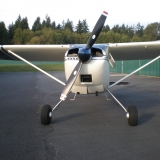
Cessna Skywagon -- accept no substitute!
Tue Aug 25, 2015 11:31 am
Re: Skyvector — is it accurate or not?
Foreflight does the same thing. You enter in the altitude and estimated time of departure and it uses the WA forecast for that time slot. It also includes climb and descent speeds with fuel burns you enter into the profile for your plane. I think if you want zero winds - enter in a ETD that is further out in the future than there is a forecast for. I'm not sure if there is another way.
I feel this is more realistic and therefore more accurate. It's how you should have been trained to create a flight plan on paper anyway. It's the best one I've seen so far.
https://skyvector.com/Flight-Planning-and-Filing-Pilots-Guide
I feel this is more realistic and therefore more accurate. It's how you should have been trained to create a flight plan on paper anyway. It's the best one I've seen so far.
https://skyvector.com/Flight-Planning-and-Filing-Pilots-Guide
- soyAnarchisto offline
- Posts: 1977
- Joined: Fri Aug 19, 2011 1:23 pm
- Location: Boulder, CO
- Aircraft: 1955 Cessna 180
Tue Aug 25, 2015 8:47 pm
Re: Skyvector — is it accurate or not?
Not sure about skyvector, but if you don't want Foreflight to calculate the winds aloft into your trip time along your route just enter 0000ft in the bar on top.

Wed Aug 26, 2015 2:15 am
Re: Skyvector — is it accurate or not?
Wow, times sure have changed. Seems like the new software takes a lot of the thinking out of flying these days! Whether that's a good or bad thing probably depends a lot on circumstances. But, looking at it again, it seems that you guys are exactly right… the program was calculating for winds (presumably obtained from the official winds aloft forecast?).
- coloradokevin offline
- Posts: 37
- Joined: Mon Apr 01, 2013 4:22 pm
- Location: Arvada, CO
Wed Aug 26, 2015 6:22 am
Re: Skyvector — is it accurate or not?
Yeah, it didn't used to do that. The rolled out a change recently that added a bunch of... features. Useful to some, but not to me. I just used it as a basic flight planning tool, to explore what-ifs.
Here's another site that may interest you.
http://www.iflightplanner.com/AviationCharts/
Here's another site that may interest you.
http://www.iflightplanner.com/AviationCharts/
DISPLAY OPTIONS
Who is online
Users browsing this forum: No registered users and 6 guests
Latest Features
-
-
Featured Bush Planes
As one of the undisputed legends of bush flying, the Cessna 180 hauls a…Read More -
Aircraft Ownership and Maintenance
9 modification mistakes aircraft owners make when trying to "bush out" their birds—why some…Read More -
Live to Tell
A Minnesota pilot is surprised to learn that the sudden asymmetric drag of an…Read More



Latest Knowledge Base
-
Destinations
Canada offers some of the most spectacular backcountry flying on the continent. Here's what you need to know before you go.Read More -
Safety and Survival
Hope that you never have to use your survival vest but knowing you have it and knowing how to use…Read More -
Destinations
A regional guide with ideas for winter camping destinations in California, Nevada, New Mexico, and Arizona.Read More -
Aircraft
Finding an affordable aircraft that can handle the backcountry for $80K or less? A challenge for sure, but with the…Read More