I did a search on the forum and found little bits here and there, but what's the prevailing opinion, if any, on the Stinson 108s?
I've seen them several times in Plane and Pilot as a real steal for what you get. I know the Franklin parts are hard to come by, but if it had a Lycoming conversion, it seems that it'd be a stellar plane that I wouldn't grow out of anytime soon. It can take floats, it will haul four people, good STOL capability.........I'm kindof reading it as a C-172 for the backcountry.
Stinson 108-3?
Thu Jan 29, 2009 6:36 pm
Thu Jan 29, 2009 6:43 pm
I have talked to the owner several times, seems like an honest airplane. I'd love to fly it. It is a -2 as Vick pointed out to me some time ago.
Seems that his ad expired, but I have the contact info if you're interested.
gb

Seems that his ad expired, but I have the contact info if you're interested.
gb
Last edited by gbflyer on Thu Jan 29, 2009 7:02 pm, edited 1 time in total.
Thu Jan 29, 2009 6:44 pm
Some of them have Continentals in them too.
I only have been in one, a 108-3 with the O-470...real performer and a nice plane. I'd consider one.
There is a Stinson owner and support group here if you want to check it out.
I only have been in one, a 108-3 with the O-470...real performer and a nice plane. I'd consider one.
There is a Stinson owner and support group here if you want to check it out.
- onceAndFutr_alaskaflyer offline
- Posts: 1319
- Joined: Sun Apr 23, 2006 4:23 pm
- Location: Keweenaw Peninsula, Michigan and Carson Valley, Nevada
Thu Jan 29, 2009 6:52 pm
Lots of engine conversions for the 108's-- Lycoming: O-435 (190hp), O-360 (180hp)& IO-360 (200hp); Continental: IO-360 (210hp) & O-470 (230hp); as well as Franklin (220hp). I would probably favor either an O- or IO-360 Lycoming. The hotrodded 108's I've seen advertised were priced very reasonably for what they should be able to do. Never flown in one so can't coment on that one way or the other.
Eric
Eric

Cessna Skywagon -- accept no substitute!
Thu Jan 29, 2009 7:03 pm
Ok honest opinion....I am a -3 owner, they rule, find one that someone has dumped money into like me, they really have a lot of them that are neglected. To be honest the 165 really pulls, and is a hell of an engine. But parts are a pain but there is a good community who will put them in your hand. I have a -3 w/ skis and floats. I can take 4 people on wheels and get off the ground in 1500 ft at gross, with 2 it's off the ground in 4-500 ft. For the money it really a beautiful plane, and it really flies amazingly nicer than almost anything i've flown. They are strong rugged planes, just pay more up front as it will cost a fortune to fix a beater up. It is alot cheaper to spend more up front. Mine is metal and most purists don't like that, but really I do. It costs some weight but really makes it so I don't care if I leave it outside and if it gets snowed on ect..... If you have any specific q's just pm me
Mike
Mike
- electricsnail offline

- Posts: 139
- Joined: Fri Sep 21, 2007 10:51 am
- Location: Potsdam, NY
48' Stinson 108-3
Thu Jan 29, 2009 7:18 pm
The Stinson is a fantastic bush plane. I just sold my 108-3 last week, after almost 4 great years of ownership. Flew mine 95% on floats, and 5% on wheel skis. Mine had the 220 Franklin. I needed more back seat room, since most of my travels are with a family of 4 and lots of stuff. But one of these planes damn sure won't let you down or disappoint you. With one of the big motors, make terrific float planes, very rugged, and silky smooth flyers. Definitely spend the money up front to get something nice, as Stinson owners are notoriously cheap. But for the price these planes can be had now days, they are a great buy. A properly set up Stinson will feed breakfast lunch and dinner to any 180 out there, at about half the price. Also they are a great handling tail dragger. The gear has super shock absorption and very tuff to bounce one. Landing speeds are slow too. Watch the weight - a good one with a IO 360, 220 Frank, or 0470 should be about 1400 pounds on wheels. This will give you 1000 pounds of useful load in the -3, and it can haul every bit of it without breaking a sweat. the -3 grosses at 2500 on floats. I miss mine just typing about it.
Thu Jan 29, 2009 7:19 pm
I have owned both a 165 -3 and an o-435 -2. Sold the -3 'cause it was a bit anemic here at 8V1 (8000 ft). I really liked the o-435 -2, you could land in way more xwind than the big tail-3. The o-435 made her perform like a C-180, although the cabin was much smaller. Ended up with a 180 cause the kids got too big!
- flynbeekeeper offline
- Posts: 372
- Joined: Fri Oct 19, 2007 8:01 pm
- Location: southern colorado
Tom

Thu Jan 29, 2009 7:37 pm
Looks like most of the Stinson owners here have already piped up - I'd expect another endorsement from Higgy as well if he happens across the thread. I'm enjoying mine with the O-470, though as Russ mentioned it's far more economical to find one that has already been duly modified than to undertake it yourself.
Lots of good info here to keep you busy if you want to learn more...
http://www.hangar9aeroworks.com/108main.html
The Yahoo group is another great (free) resource. There's also the Intl Stinson Club (ISC), but you have to pay to play there and I frankly never figured out what you get for your dues.
Lots of good info here to keep you busy if you want to learn more...
http://www.hangar9aeroworks.com/108main.html
The Yahoo group is another great (free) resource. There's also the Intl Stinson Club (ISC), but you have to pay to play there and I frankly never figured out what you get for your dues.
- Vick offline

- Posts: 823
- Joined: Fri Jan 06, 2006 2:21 pm
- Location: Grass Valley, CA
- FindMeSpot URL: http://share.findmespot.com/shared/face ... WUk8CX06AP
Solum Volamus
Thu Jan 29, 2009 8:35 pm
I have a Friend that has a -2 0-470 with -3 wings. I think the -3 wings are 50 gal. It is like climbing into a four place super cub.
I have a -2 165 franklin that preforms decent at sea level lightly loaded and has almost a 1000lb useful load.
To add a little to the other posts, they are very stable in slow flight with the slatted wings. Big horse power doesn't gain a lot of air speed. Another good website
http://www.stinsonflyer.com/ac-0.htm
I have a -2 165 franklin that preforms decent at sea level lightly loaded and has almost a 1000lb useful load.
To add a little to the other posts, they are very stable in slow flight with the slatted wings. Big horse power doesn't gain a lot of air speed. Another good website
http://www.stinsonflyer.com/ac-0.htm
- Terry offline

- Posts: 1365
- Joined: Sat Nov 10, 2007 9:11 pm
- Location: Willamette Valley
- FindMeSpot URL: http://share.findmespot.com/shared/face ... 4GzPHI6t1d
Thu Jan 29, 2009 9:23 pm
Love mine. Yes the -3 has 50 gal capacity. I love the looks of the 1 and -2's but the big tail has good authority.
I would buy one again.
The international stinson club, what you get for your money is a site that does not work. I don't bother anymore. The yahoo group is good.
Much more capable than a 172.
Get more info from Vic about hotrodded one's he is full bottle on them, luck guy.
I would buy one again.
The international stinson club, what you get for your money is a site that does not work. I don't bother anymore. The yahoo group is good.
Much more capable than a 172.
Get more info from Vic about hotrodded one's he is full bottle on them, luck guy.
- soaringhiggy offline
- Posts: 711
- Joined: Tue Dec 13, 2005 8:22 pm
- Location: Kimberly, ID
48 Stinson 108-3
Thu Jan 29, 2009 11:34 pm
Re: Stinson 108-3?
Tick wrote:I did a search on the forum and found little bits here and there, but what's the prevailing opinion, if any, on the Stinson 108s?
I've seen them several times in Plane and Pilot as a real steal for what you get. I know the Franklin parts are hard to come by, but if it had a Lycoming conversion, it seems that it'd be a stellar plane that I wouldn't grow out of anytime soon. It can take floats, it will haul four people, good STOL capability.........I'm kindof reading it as a C-172 for the backcountry.
There's a 108-2 on my website ( http://www.edmaircraft.com ) for sale.
Very low time engine and prop .Engine is a 0-470-R /-203 prop.
Great looking and preforming Stinson 108. Owner wants 35K - You can call owner Luther Tate at 702-327-7888 and discuss it with him.
Bill Reid
A&P /I.A.
EDM Aircraft LLC
- 182 STOL driver offline
- Posts: 1529
- Joined: Tue Apr 22, 2008 8:27 pm
Fri Jan 30, 2009 12:40 am
Wow!........I've never seen a single plane get such a hugely positive outlook. I'm still a ways out from buying and doing my homework but thanks for sending me all the links to ones for sale.
I've been putting together a spreadsheet, (geeky, I know) with all the different airframes I've been considering. Ultralights, Taylorcrafts, Luscombes, Cherokees, Aeroncas, Cessnas........... all with cost, gph, rate of climb, hp, yada, yada. I even made the girlfriend go with me on a drive to Lake Hood tonight to go look at one for sale. (On our 3 year anniversary no less, she's a keeper.)
I finally was gathering all the info today on the Stinson and was a little blown away. It just seems like a real good all around airplane, even before you consider that it's super cheap for what you're getting. Part of me is leaning towards a low cost T-Craft or ultralight, but another part of me says to buy an airplane I can keep building on for a while. I don't see myself needing to upgrade from a Stinson anytime soon.
I've been putting together a spreadsheet, (geeky, I know) with all the different airframes I've been considering. Ultralights, Taylorcrafts, Luscombes, Cherokees, Aeroncas, Cessnas........... all with cost, gph, rate of climb, hp, yada, yada. I even made the girlfriend go with me on a drive to Lake Hood tonight to go look at one for sale. (On our 3 year anniversary no less, she's a keeper.)
I finally was gathering all the info today on the Stinson and was a little blown away. It just seems like a real good all around airplane, even before you consider that it's super cheap for what you're getting. Part of me is leaning towards a low cost T-Craft or ultralight, but another part of me says to buy an airplane I can keep building on for a while. I don't see myself needing to upgrade from a Stinson anytime soon.
Fri Jan 30, 2009 5:34 am
The one 182 STOL shows for sale looks like a great deal, low time, 0470, $35,000? WOW. You can hardly buy a decent performing 2 place bush plane for that price, and that one would be a good 4 seater, and an incredible 2 seater with more room to haul stuff than you would ever need. I've hauled 3- 100 pound propane tanks in mine by removing rear seats (takes 1 minute to remove them). If you're gonna fly floats, you need the 470, 220 Frank, or IO360. Also, the only certified float is the EDO 2425, great floats, but near impossible to find a good set - expect to pay $12-$14,000 for a good set with Stinson rigging. Just sold a really nice set I had for $13,000. Stinsons also are approved on bush wheels and look extremely cool on them. Don't compare the big motored Stinson to a 172, not even in the same league. Compare to a 180, but better slow flight, easier landing (slower), cheaper insurance, and IMHO much tougher. Not busting on the time proven 180's, I just think that highly of the Stinson. A drawback compared to 180 is fewer available mods, and tougher loading people stuff in to back seat area because of smaller doors.
Fri Jan 30, 2009 9:54 am
To All:
Contact Brain Thompson
I think he's a sponsor of this site.
http://www.exploreaviationllc.com/Contact_Us.html
He has a 108-2 w/O-360 for $160 an hour, includes instruction.
Contact Brain Thompson
I think he's a sponsor of this site.
http://www.exploreaviationllc.com/Contact_Us.html
He has a 108-2 w/O-360 for $160 an hour, includes instruction.
Fri Jan 30, 2009 3:41 pm
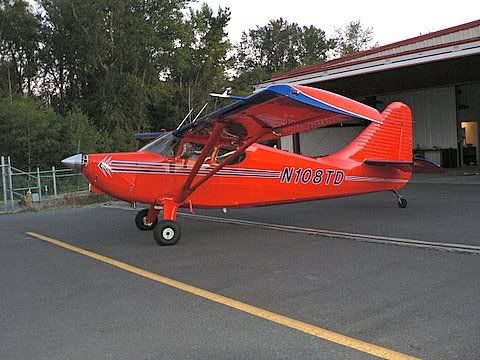
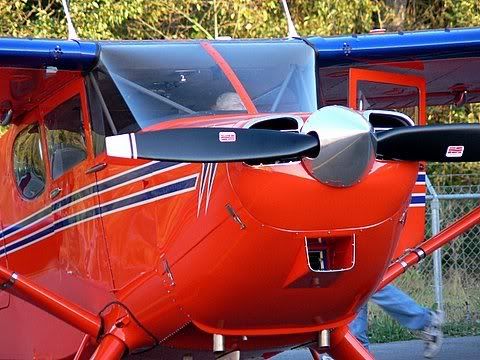
Stinson's are awesome! They're by far the best "bang for the buck" 4 place out there! I'm intimately aquainted with them...having rebuilt some as well as holding an STC for aux fuel for them.
The -3's wing tanks do hold 25 gallons of fuel each. This is the main outward difference. However, the spars are of a different alloy, to obtain the higher gross weight of the -3, and are a bit succeptable to some corrosion, so look them over carefully.
Edo 2425 floats are the only ones shown on the type certificate, however if you want it to really be nice, go with the STC'd 2440's...much better performing float. There was (is?) an STC for 2870's out there... I've seen one, and the guy swore it was great.
Never shy away from a properly done fabric job. The metal Stinsons are ncie, but a bit heavier, and a properly done fabric job will easily last 20 years or much more, so that's really not a concern. (unless it's cotton)
The O-435 Lyc is getting very tough to get parts for and when you do find them, they're expensive (it's also heavy and the prop is pretty expensive) ...if it's got a big engine mod, try to find one with the O-470 or one of the other engines that parts are so very readily available for...you wont be sorry! The original 165 Franklin is a wonderful engine, and the smoothest thing you'll fly behind...nothing at all wrong with them, other than parts availability at times. It's not that there aren't parts out there, it's just tougher and tougher to find them. I certainly wouldn't shy away from one with a good Franklin in it, and the 220 Franklin is a very good engine as well.
Like was said, the performance with the O-470 will make the 180 guys be pretty quiet around you. That, in itself is almost worth the money.
A good friend of mine, and one who had thousands of hours of backcountry time always said he'd rather have that Stinson around him if he ever had to go into the trees or rocks, than any other airplane. After rebuilding them, I'd have to agree!!
You've hit on my other favorite with the Taylorcraft, and I've got lots of good to say about them as well (I own one)... but a totally different plane, so I'm not going to pollute this thread with that.
I'd be glad to answer any questions you have about them, just shoot me a PM.
John
The -3's wing tanks do hold 25 gallons of fuel each. This is the main outward difference. However, the spars are of a different alloy, to obtain the higher gross weight of the -3, and are a bit succeptable to some corrosion, so look them over carefully.
Edo 2425 floats are the only ones shown on the type certificate, however if you want it to really be nice, go with the STC'd 2440's...much better performing float. There was (is?) an STC for 2870's out there... I've seen one, and the guy swore it was great.
Never shy away from a properly done fabric job. The metal Stinsons are ncie, but a bit heavier, and a properly done fabric job will easily last 20 years or much more, so that's really not a concern. (unless it's cotton)
The O-435 Lyc is getting very tough to get parts for and when you do find them, they're expensive (it's also heavy and the prop is pretty expensive) ...if it's got a big engine mod, try to find one with the O-470 or one of the other engines that parts are so very readily available for...you wont be sorry! The original 165 Franklin is a wonderful engine, and the smoothest thing you'll fly behind...nothing at all wrong with them, other than parts availability at times. It's not that there aren't parts out there, it's just tougher and tougher to find them. I certainly wouldn't shy away from one with a good Franklin in it, and the 220 Franklin is a very good engine as well.
Like was said, the performance with the O-470 will make the 180 guys be pretty quiet around you.
That, in itself is almost worth the money.
A good friend of mine, and one who had thousands of hours of backcountry time always said he'd rather have that Stinson around him if he ever had to go into the trees or rocks, than any other airplane. After rebuilding them, I'd have to agree!!
You've hit on my other favorite with the Taylorcraft, and I've got lots of good to say about them as well (I own one)... but a totally different plane, so I'm not going to pollute this thread with that.
I'd be glad to answer any questions you have about them, just shoot me a PM.
John
- hardtailjohn offline
- Posts: 924
- Joined: Thu Mar 16, 2006 7:06 pm
- Location: Marion, Montana
God put me here to accomplish a certain amount of things...right now I'm so far behind, I'll never die!!
Fri Jan 30, 2009 6:22 pm
Now thats a nice looking Stinson. However, I think you might be slightly off on the 2440 comment. If I'm not mistaken, the bottoms of the 2440 are exactly identical to the 2425. the only difference is the sides of the float are rounded out, and the tops are rounded up, giving it 15 pounds more displacement. As far as the water is concerned, it is the same bottom that is getting up on step. As a matter of fact, the 2425, 2440, and 2870 all use the same forward bottoms, the 2425 and 2440 just cut the 2870 forward bottom to length, at least that is what Eddie Peck told me. I prefer the 2425, because of the flat tops, and make it much nice to get a larger hatch in them. I had 250 hours in the last 4 summers on my Stinson on 2425's, and you are not underfloated on them at 3000 pounds. The 2440's require field approval, as do the 2870's. Good luck with that. I would say the 2870's are too long, and tails would drag on rotation. the 0470 will add 115 pounds right on the nose of the plane as compared to the 220 franklin, a lot of weight for 10 more horses, and the fuel burn is higher. The up side is parts availability and auto fuel STC, and every mechanic in the world knows 470's. Downside is they know 470s cause they love to eat jugs. I think the ideal motor would be the IO360 - weight is good for the power and good fuel burn. But I believe it needs 100LL. Remember the bush country of Canada was opened up with DeHavilands and Stinsons, and the Cessna's came along a little latter.
Fri Jan 30, 2009 7:43 pm
Well, I guess I needed to do a bit of searching anyway.... but here's some numbers for you.....
STC Number: SA1-48
Description: Edo 249-2870 floats.
Status: Amended 01/01/1960
ACO: ANE-170 New York Aircraft Certification Office Tel: (516) 228-7300
STC Holder: Blakely James R
Address: P.O. Box 53 Westchester Station, Bronx, NY, US, 10461
Make -- Model (TC): Stinson Div. Consolidated -- 108-3 (A-767),
STC Number: SA74NW
Description: Installation of Edo 248-2440 floats.
Status: Reissued and Amended 08/01/2001
ACO: ANM-100S Seattle Aircraft Certification Office Tel: (425) 917-6400
STC Holder: Super Stinson Modifications, LLC
Address: 13173 S. Spangler Rd., Oregon City, OR, US, 97045
Make -- Model (TC): Stinson Div. Consolidated -- 108-2 (A-767), Stinson Div. Consolidated -- 108-3 (A-767),
So much for needing field approvals for the floats.
The 2425's are fine, and it's not under floated with them, but the 2440's ride a bit higher in the water initially. I do know for a fact that the bottom front skins are not the same.
An O470-R is 76 pounds heavier than a 6A-350-C1 Franklin....not quite 115 pounds, and the McCauley 2A34C is 4# heavier than the Hartzell HC-C2YF that's called out for in the Franklin STC, however the McCauley isn't plagued by the repetative inspections that the Hartzell is. Don't get me wrong...the 220 Franklin, as I stated earlier, is a great engine....until you need parts. As far as the O-470 eating jugs, that's 90% operator, and about 9% baffel seals and cooling system maintenance, we've found.
Most of the 0-470 conversions are moving their battery further back than specified in the STC and getting a field approved deviation for this. This seems to bring the CG in without having to add any permanent balast to the tail, and hasn't been tough to get approved so far. No matter what you do to an airplane, there's a "give and take" to it. Everyone that I know that has the bigger engines has been well satisfied with them.
John
STC Number: SA1-48
Description: Edo 249-2870 floats.
Status: Amended 01/01/1960
ACO: ANE-170 New York Aircraft Certification Office Tel: (516) 228-7300
STC Holder: Blakely James R
Address: P.O. Box 53 Westchester Station, Bronx, NY, US, 10461
Make -- Model (TC): Stinson Div. Consolidated -- 108-3 (A-767),
STC Number: SA74NW
Description: Installation of Edo 248-2440 floats.
Status: Reissued and Amended 08/01/2001
ACO: ANM-100S Seattle Aircraft Certification Office Tel: (425) 917-6400
STC Holder: Super Stinson Modifications, LLC
Address: 13173 S. Spangler Rd., Oregon City, OR, US, 97045
Make -- Model (TC): Stinson Div. Consolidated -- 108-2 (A-767), Stinson Div. Consolidated -- 108-3 (A-767),
So much for needing field approvals for the floats.
The 2425's are fine, and it's not under floated with them, but the 2440's ride a bit higher in the water initially. I do know for a fact that the bottom front skins are not the same.
An O470-R is 76 pounds heavier than a 6A-350-C1 Franklin....not quite 115 pounds, and the McCauley 2A34C is 4# heavier than the Hartzell HC-C2YF that's called out for in the Franklin STC, however the McCauley isn't plagued by the repetative inspections that the Hartzell is. Don't get me wrong...the 220 Franklin, as I stated earlier, is a great engine....until you need parts. As far as the O-470 eating jugs, that's 90% operator, and about 9% baffel seals and cooling system maintenance, we've found.
Most of the 0-470 conversions are moving their battery further back than specified in the STC and getting a field approved deviation for this. This seems to bring the CG in without having to add any permanent balast to the tail, and hasn't been tough to get approved so far. No matter what you do to an airplane, there's a "give and take" to it. Everyone that I know that has the bigger engines has been well satisfied with them.
John
- hardtailjohn offline
- Posts: 924
- Joined: Thu Mar 16, 2006 7:06 pm
- Location: Marion, Montana
God put me here to accomplish a certain amount of things...right now I'm so far behind, I'll never die!!
Fri Jan 30, 2009 8:04 pm
As was explained to me by Peck Aero the supposed EDO guru, the 2440 forward bottoms are the same as 2425 forward bottoms, but maybe he is wrong. I do know that when you replace 2425 or 2440 forwards, it is the same skin as the 2870 from Peck, and you cut to length. Anyway irrelevant, as the 2440 and 2425 would both be good, flat tops are nice. Was also told that the STC (i thought it was 337) on the 2440 only applies to the 0470, and can't be used with 220 or 210.. I guess the people on the Stinson yahoo group have got some numbers wrong on weight. Possible accessories, oil coolers etc all add up. The 115 pounds I guess includes the 15 pounds on the tail post. Big thing is you directly give up the 80 or so pounds in useful. That beings said, the 470 with parts availability would have me sleeping better at night. 80 pounds on the nose will definitely affect short field landings on wheels. The jist of it is, the Stinson is probably the best buy out there. Buy one with the motor you want already in it. There is no way you get your money out of the conversion if you pay to have it done. That probably goes for almost any plane though, best to buy what you want up front. Throwing $10,000 and $20,000 parts at them to upgrade later just doesn't pay. Some of the older 180's are also coming way down in price.
Fri Jan 30, 2009 9:15 pm
DISPLAY OPTIONS
Who is online
Users browsing this forum: No registered users and 14 guests
Latest Features
-
Live to Tell
A Minnesota pilot is surprised to learn that the sudden asymmetric drag of an out-of-rig ski can…Read More -
Creators
Working in some of the Yukon's most beautiful and remote environments, photographer Simon Blakesley captures aircraft in…Read More -
Aircraft Ownership and Maintenance
Upgrading to big tires can make a huge difference in backcountry performance, but with those gains come…Read More -
Tales from Yesteryear
In this tale from bush flying yesteryear, Don Cogger signs up to help Atlee Dodge Jr recovery…Read More


Latest Knowledge Base
-
Destinations
A regional guide with ideas for winter camping destinations in California, Nevada, New Mexico, and Arizona.Read More -
Aircraft
Finding an affordable aircraft that can handle the backcountry for $80K or less? A challenge for sure, but with the…Read More -
Aircraft
01.29.2018 - Zane - Updated tire diameter graphic to add 8.50x10 Guide to tires for use in the backcountry and off-airport landing…Read More -
Pilots
12.22.2013 - Initial article format Operating aircraft on skis and negotiating a snow-covered landscape is an entirely unique skillset and environment.…Read More


