Here is the second part of my tailwheel training. I remembered the in cockpit audio cable for this one so it's a little better than the last. All practice was on the runway for this day. Decent crosswind from the right for most of the day. Hope you enjoy....
Tailwheel Endorsement in C170
Sun May 28, 2017 4:24 am
- Airplaneflyer offline
- Posts: 106
- Joined: Mon Mar 27, 2017 6:48 pm
- Location: Lexington
- Aircraft: Cessna 170
Sun May 28, 2017 7:51 am
Re: Tailwheel Endorsement in C170
I teach tail low wheel landings. I think you'd find that your wheel landings would be much less bouncy if you got the tail low for them.
I also nearly always make full stop landings. For one thing, the FAA requires full stops for currency in tailwheel airplanes. But more importantly, many ground loops develop when the plane is almost stopped. Finally, a full stop allows a quick analysis of the landing without the "student" being distracted trying to keep the thing straight on a takeoff, with the instructor yammering in his ear. I guarantee the only way you process any of that chat is watching the video, cause you're not hearing it while trying to take off.
FWIW.
MTV
I also nearly always make full stop landings. For one thing, the FAA requires full stops for currency in tailwheel airplanes. But more importantly, many ground loops develop when the plane is almost stopped. Finally, a full stop allows a quick analysis of the landing without the "student" being distracted trying to keep the thing straight on a takeoff, with the instructor yammering in his ear. I guarantee the only way you process any of that chat is watching the video, cause you're not hearing it while trying to take off.
FWIW.
MTV


Sun May 28, 2017 8:02 am
Re: Tailwheel Endorsement in C170
For my complex and tail wheel endorsements I remember saying "well at least there's no way I'm going to die in a crash - the plane is several minutes ahead of me"
Sun May 28, 2017 12:08 pm
Re: Tailwheel Endorsement in C170
mtv wrote:I teach tail low wheel landings. I think you'd find that your wheel landings would be much less bouncy if you got the tail low for them.
I also nearly always make full stop landings. For one thing, the FAA requires full stops for currency in tailwheel airplanes. But more importantly, many ground loops develop when the plane is almost stopped. Finally, a full stop allows a quick analysis of the landing without the "student" being distracted trying to keep the thing straight on a takeoff, with the instructor yammering in his ear. I guarantee the only way you process any of that chat is watching the video, cause you're not hearing it while trying to take off.
FWIW.
MTV
Awesome info. Thanks for taking the time to comment, I do appreciate it. My goal with these videos is to learn, from myself and from others.
So on a tail low wheeler... are you just approaching/leveling off a little slower and thereby have a slightly higher angle of attack? The plane does seam awfully "bouncy" on wheelers but I figured that's just due to be being low time...?
Sent from my iPhone using Tapatalk
- Airplaneflyer offline
- Posts: 106
- Joined: Mon Mar 27, 2017 6:48 pm
- Location: Lexington
- Aircraft: Cessna 170
Sun May 28, 2017 12:26 pm
Re: Tailwheel Endorsement in C170
Airplaneflyer wrote:mtv wrote:I teach tail low wheel landings. I think you'd find that your wheel landings would be much less bouncy if you got the tail low for them.
I also nearly always make full stop landings. For one thing, the FAA requires full stops for currency in tailwheel airplanes. But more importantly, many ground loops develop when the plane is almost stopped. Finally, a full stop allows a quick analysis of the landing without the "student" being distracted trying to keep the thing straight on a takeoff, with the instructor yammering in his ear. I guarantee the only way you process any of that chat is watching the video, cause you're not hearing it while trying to take off.
FWIW.
MTV
Awesome info. Thanks for taking the time to comment, I do appreciate it. My goal with these videos is to learn, from myself and from others.
So on a tail low wheeler... are you just approaching/leveling off a little slower and thereby have a slightly higher angle of attack? The plane does seam awfully "bouncy" on wheelers but I figured that's just due to be being low time...?
Sent from my iPhone using Tapatalk
Yes, for a tail low wheel landing, I want the tailwheel just a few inches off the runway when the mains touch, then you roll the plane up onto the mains at the touch. So, the approach is very similar to a three point.....easy, just not quite so nose high in the flare.
This works well for a couple reasons, primarily because you're going slower at the touch, and the airplane is rapidly bleeding energy. When the mains touch, the plane tends to just settle. Whereas, with tail high wheel landings, the airplane still has lots of energy.....the mains touch, and as they touch, that forces the tail down just a tiny bit, which increases angle of attack of the wing, which causes the plane to fly again, then touch, tail lowers, increases AOA, bounces into air, etc. Until the thing is finally in a low energy state.
Now, it's possible to land tail high, it's just that your timing has to be nearly perfect to touch, and nail the landing with either such a gentle touch or by a bit of forward yoke, at precisely the right time....wrong timing on forward yoke and you're REALLY bounce.
Tail low wheel landings are in widespread use in Alaska, and also in the missionary flying community. They work well for off airport landings, again because the plane is touching down at nearly as slow a speed as with a three point landing, except you can protect your tailwheel with a wheel landing.
MTV
Sun May 28, 2017 12:33 pm
Re: Tailwheel Endorsement in C170
mtv wrote:Airplaneflyer wrote:mtv wrote:I teach tail low wheel landings. I think you'd find that your wheel landings would be much less bouncy if you got the tail low for them.
I also nearly always make full stop landings. For one thing, the FAA requires full stops for currency in tailwheel airplanes. But more importantly, many ground loops develop when the plane is almost stopped. Finally, a full stop allows a quick analysis of the landing without the "student" being distracted trying to keep the thing straight on a takeoff, with the instructor yammering in his ear. I guarantee the only way you process any of that chat is watching the video, cause you're not hearing it while trying to take off.
FWIW.
MTV
Awesome info. Thanks for taking the time to comment, I do appreciate it. My goal with these videos is to learn, from myself and from others.
So on a tail low wheeler... are you just approaching/leveling off a little slower and thereby have a slightly higher angle of attack? The plane does seam awfully "bouncy" on wheelers but I figured that's just due to be being low time...?
Sent from my iPhone using Tapatalk
Yes, for a tail low wheel landing, I want the tailwheel just a few inches off the runway when the mains touch, then you roll the plane up onto the mains at the touch. So, the approach is very similar to a three point.....easy, just not quite so nose high in the flare.
This works well for a couple reasons, primarily because you're going slower at the touch, and the airplane is rapidly bleeding energy. When the mains touch, the plane tends to just settle. Whereas, with tail high wheel landings, the airplane still has lots of energy.....the mains touch, and as they touch, that forces the tail down just a tiny bit, which increases angle of attack of the wing, which causes the plane to fly again, then touch, tail lowers, increases AOA, bounces into air, etc. Until the thing is finally in a low energy state.
Now, it's possible to land tail high, it's just that your timing has to be nearly perfect to touch, and nail the landing with either such a gentle touch or by a bit of forward yoke, at precisely the right time....wrong timing on forward yoke and you're REALLY bounce.
Tail low wheel landings are in widespread use in Alaska, and also in the missionary flying community. They work well for off airport landings, again because the plane is touching down at nearly as slow a speed as with a three point landing, except you can protect your tailwheel with a wheel landing.
MTV
Perfect! You're the man! Thanks for the explanation, it makes perfect sense. Now to go do 150 landings for practice.
Sent from my iPhone using Tapatalk
- Airplaneflyer offline
- Posts: 106
- Joined: Mon Mar 27, 2017 6:48 pm
- Location: Lexington
- Aircraft: Cessna 170
Sun May 28, 2017 1:26 pm
Re: Tailwheel Endorsement in C170
I don't mean to sound too critical with these comments, but I have some that I'd like to suggest. Keeping in mind that I'm not a very good tailwheel pilot, let alone a tailwheel instructor, but just from a basic instructional standpoint, I dislike touch and goes. The only benefit to a T&G is that more touchdowns are possible in a given period of time, but a touchdown is not a landing. The disadvantages far outweigh that benefit.
To me, a landing begins on the approach and ends when the airplane exits the runway or stops on the runway, fully under control. NTSB and FAA records reflect oodles of slow speed accidents, caused by LOC on the ground, because the pilot relaxes before the landing is finished, with all kinds of airplanes. I think this is especially true of tailwheel airplanes--and of course, there are those who'll argue that the landing really isn't over until the airplane is tied down, especially when it's a bit breezy.
Too often during touch and goes, the pilot has moved his/her focus from landing the airplane to taking off again--adjusting flaps, pushing in the carb heat, retrimming, all the while ignoring that the airplane is off centerline and barely under control from landing--and often all that's happening at airspeeds that are still dangerously below flying speed but above taxiing speed, when the airplane is at its hardest to control.
Several years ago, I was on a training forum and got in a bit of an argument with a newbie pilot who had had several runway excursions from crosswind landings in a PA28 (truly one of the more docile trikes), because, although he could do touch and goes well, he was mishandling the controls as the airplane slowed below flying speed but while it was still in the high speed taxi phase. He had learned from an instructor who had him do very few stop and goes, but a lot of touch and goes. Somehow he had gotten in his head that he needed to straighten the nosewheel before lowering it to the ground, and of course, that meant he relaxed the necessary rudder to stay on the runway. He simply had not learned proper rudder control during that transition period from flying to taxiing! That's even more critical with tailwheels.
So my suggestion mirrors Mike's, that it's better to do "fully" full stop landings, i.e., not even rolling a little--there's a really good reason why full stops are required for tailwheel currency. If there's room to take off again, great, but if not, then taxi back and do it all over again.
Finally, I would recommend a slower approach speed. Your 170's stall speed is about the same as a 172's, 50 knots (58 mph) vs. 49 knots (56 mph). 1.3 Vso is therefore 65 knots, or 75 mph. I can't read your airspeed indicator in your video, but your video does show GPS knots, and your instructor made some comments about your approach speed--and to me, it's a bit too high. I think many pilots use too high an approach speed, and most landings are better at slower approach speeds. The only exception is to add half the gust factor in gusty winds.
I really like your instructor's emphasis on trimming. There are 2 keys to adequately flying an airplane, airspeed control and proper trimming.
Cary
To me, a landing begins on the approach and ends when the airplane exits the runway or stops on the runway, fully under control. NTSB and FAA records reflect oodles of slow speed accidents, caused by LOC on the ground, because the pilot relaxes before the landing is finished, with all kinds of airplanes. I think this is especially true of tailwheel airplanes--and of course, there are those who'll argue that the landing really isn't over until the airplane is tied down, especially when it's a bit breezy.
Too often during touch and goes, the pilot has moved his/her focus from landing the airplane to taking off again--adjusting flaps, pushing in the carb heat, retrimming, all the while ignoring that the airplane is off centerline and barely under control from landing--and often all that's happening at airspeeds that are still dangerously below flying speed but above taxiing speed, when the airplane is at its hardest to control.
Several years ago, I was on a training forum and got in a bit of an argument with a newbie pilot who had had several runway excursions from crosswind landings in a PA28 (truly one of the more docile trikes), because, although he could do touch and goes well, he was mishandling the controls as the airplane slowed below flying speed but while it was still in the high speed taxi phase. He had learned from an instructor who had him do very few stop and goes, but a lot of touch and goes. Somehow he had gotten in his head that he needed to straighten the nosewheel before lowering it to the ground, and of course, that meant he relaxed the necessary rudder to stay on the runway. He simply had not learned proper rudder control during that transition period from flying to taxiing! That's even more critical with tailwheels.
So my suggestion mirrors Mike's, that it's better to do "fully" full stop landings, i.e., not even rolling a little--there's a really good reason why full stops are required for tailwheel currency. If there's room to take off again, great, but if not, then taxi back and do it all over again.
Finally, I would recommend a slower approach speed. Your 170's stall speed is about the same as a 172's, 50 knots (58 mph) vs. 49 knots (56 mph). 1.3 Vso is therefore 65 knots, or 75 mph. I can't read your airspeed indicator in your video, but your video does show GPS knots, and your instructor made some comments about your approach speed--and to me, it's a bit too high. I think many pilots use too high an approach speed, and most landings are better at slower approach speeds. The only exception is to add half the gust factor in gusty winds.
I really like your instructor's emphasis on trimming. There are 2 keys to adequately flying an airplane, airspeed control and proper trimming.
Cary
"I have slipped the surly bonds of earth..., put out my hand and touched the face of God." J.G. Magee
Sun May 28, 2017 1:35 pm
Re: Tailwheel Endorsement in C170
Good input above. I like to think of tailwheel low landings as just coming in for a 3 point, then right before touchdown I nudge the yoke (or stick) forward to roll the mains on. But you have to have a very good sense of when you are just...right...there...to do it that way.
- Troy Hamon offline
- Posts: 913
- Joined: Tue Apr 06, 2010 8:27 am
- Location: King Salmon
- FindMeSpot URL: http://share.findmespot.com/shared/face ... 04iX0FXjV2
- Aircraft: Piper PA-22
Mon May 29, 2017 8:52 am
Re: Tailwheel Endorsement in C170
Years ago, Bill White (of Bill White Insurance fame) wrote a very good article about wheel landing the Skywagon. When I as trying to get wheel landings figured out in my old ragwing 170, it came in very handy. This article used to be online at the old Stancil Aviation / Skywagons-R-Us site, now a different version is available on a blog on the bwifly.com website but it's been elaborated on and is somewhat long-winded. Here's the key part from the earlier article:
"The Technique
Get established on final. At 1 mile out you should be at 60 knots IAS (depending on
wind conditions), 500 feet above the runway and descending at 500 FPM carrying
about 13"-14" MP with full flaps. Trimmed to hands off. The aircraft should come
over the threshold almost level. When the aircraft is on short final and about 20 feet
agl, you should apply slight back pressure on the yoke (don't touch the power), but
only for 3 to 4 seconds then released back to neutral until wheel contact. This
will slow the decent down to around 200 fpm until contact. The aircraft will contact
the runway in a perfect decent rate eliminating bounce. Remember, do not flair and
do not pull your power until you 'feel' the wheels touch (resist the temptation). This
has to be learned because your natural instinct is always to pull power. Almost
simultaneously when you cut power at wheel contact, come on with as much brakes
as you need and hold neutral yoke, The torque from braking will help keep the tail
up. Then as the speed is reduced and the tail settles come back with the yoke."
The 1 mile final / 500 AGL / 500 fpm / 13-14" MP / full flaps scenario doesn't seem quite right to me,
for me it's more like 1/2 mile final at 500 AGL and sink rate is whatever it is.
just fly your normal pattern and airspeed and using whatever power setting is required.
This technique isn't written in stone but it's sure a good place to start.
"The Technique
Get established on final. At 1 mile out you should be at 60 knots IAS (depending on
wind conditions), 500 feet above the runway and descending at 500 FPM carrying
about 13"-14" MP with full flaps. Trimmed to hands off. The aircraft should come
over the threshold almost level. When the aircraft is on short final and about 20 feet
agl, you should apply slight back pressure on the yoke (don't touch the power), but
only for 3 to 4 seconds then released back to neutral until wheel contact. This
will slow the decent down to around 200 fpm until contact. The aircraft will contact
the runway in a perfect decent rate eliminating bounce. Remember, do not flair and
do not pull your power until you 'feel' the wheels touch (resist the temptation). This
has to be learned because your natural instinct is always to pull power. Almost
simultaneously when you cut power at wheel contact, come on with as much brakes
as you need and hold neutral yoke, The torque from braking will help keep the tail
up. Then as the speed is reduced and the tail settles come back with the yoke."
The 1 mile final / 500 AGL / 500 fpm / 13-14" MP / full flaps scenario doesn't seem quite right to me,
for me it's more like 1/2 mile final at 500 AGL and sink rate is whatever it is.
just fly your normal pattern and airspeed and using whatever power setting is required.
This technique isn't written in stone but it's sure a good place to start.

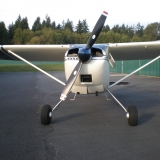
Cessna Skywagon -- accept no substitute!
Tue May 30, 2017 4:37 pm
Re: Tailwheel Endorsement in C170
hotrod180 wrote:Years ago, Bill White (of Bill White Insurance fame) wrote a very good article about wheel landing the Skywagon. When I as trying to get wheel landings figured out in my old ragwing 170, it came in very handy. This article used to be online at the old Stancil Aviation / Skywagons-R-Us site, now a different version is available on a blog on the bwifly.com website but it's been elaborated on and is somewhat long-winded. Here's the key part from the earlier article:
"The Technique
Get established on final. At 1 mile out you should be at 60 knots IAS (depending on
wind conditions), 500 feet above the runway and descending at 500 FPM carrying
about 13"-14" MP with full flaps. Trimmed to hands off. The aircraft should come
over the threshold almost level. When the aircraft is on short final and about 20 feet
agl, you should apply slight back pressure on the yoke (don't touch the power), but
only for 3 to 4 seconds then released back to neutral until wheel contact. This
will slow the decent down to around 200 fpm until contact. The aircraft will contact
the runway in a perfect decent rate eliminating bounce. Remember, do not flair and
do not pull your power until you 'feel' the wheels touch (resist the temptation). This
has to be learned because your natural instinct is always to pull power. Almost
simultaneously when you cut power at wheel contact, come on with as much brakes
as you need and hold neutral yoke, The torque from braking will help keep the tail
up. Then as the speed is reduced and the tail settles come back with the yoke."
The 1 mile final / 500 AGL / 500 fpm / 13-14" MP / full flaps scenario doesn't seem quite right to me,
for me it's more like 1/2 mile final at 500 AGL and sink rate is whatever it is.
just fly your normal pattern and airspeed and using whatever power setting is required.
This technique isn't written in stone but it's sure a good place to start.
Great post. The technique makes perfect sense! I need to get my own timing down. Right now I'm flying on "feel" more than anything.
Sent from my iPhone using Tapatalk
- Airplaneflyer offline
- Posts: 106
- Joined: Mon Mar 27, 2017 6:48 pm
- Location: Lexington
- Aircraft: Cessna 170
Wed May 31, 2017 10:36 am
Re: Tailwheel Endorsement in C170
It'll still be all about feel, this article just gives you something to start with.
IMHO this article is just like most if not all flight instruction--
it's how someone else does it but is not the final word.
It's up to the pilot to experiment and/or otherwise do what feels right for him and for that particular landing.
For example, the bit about "do not flair" is a bit too written-in-stone for me,
many times I've added some back stick and kinda felt for the runway with my mains.
And the earth didn't stop turning or anything.
IMHO this article is just like most if not all flight instruction--
it's how someone else does it but is not the final word.
It's up to the pilot to experiment and/or otherwise do what feels right for him and for that particular landing.
For example, the bit about "do not flair" is a bit too written-in-stone for me,
many times I've added some back stick and kinda felt for the runway with my mains.
And the earth didn't stop turning or anything.
Cessna Skywagon -- accept no substitute!
Wed May 31, 2017 12:31 pm
Re: Tailwheel Endorsement in C170
I recall an article I read somewhere, in which an old Viet Nam L19 veteran was asked how he handled the L19 on landing. His response, "I just land." Sometimes we worry a bit too much about this or that technique. That's good when first learning, but later on, we "just land".
But the one piece of advice that I think most experienced instructors will agree with is this: land slowly. The faster you land, the more things that can go wrong quickly. Whether it's a wheel landing or a 3 pointer, or whether it's a tricycle gear, landing slowly has multiple benefits. And of course, land straight in any airplane, but especially in any tailwheel airplane.
Cary
But the one piece of advice that I think most experienced instructors will agree with is this: land slowly. The faster you land, the more things that can go wrong quickly. Whether it's a wheel landing or a 3 pointer, or whether it's a tricycle gear, landing slowly has multiple benefits. And of course, land straight in any airplane, but especially in any tailwheel airplane.
Cary
"I have slipped the surly bonds of earth..., put out my hand and touched the face of God." J.G. Magee
DISPLAY OPTIONS
Who is online
Users browsing this forum: No registered users and 1 guest
Latest Features
-
Live to Tell
A Minnesota pilot is surprised to learn that the sudden asymmetric drag of an out-of-rig ski can…Read More -
Creators
Working in some of the Yukon's most beautiful and remote environments, photographer Simon Blakesley captures aircraft in…Read More -
Aircraft Ownership and Maintenance
Upgrading to big tires can make a huge difference in backcountry performance, but with those gains come…Read More -
Tales from Yesteryear
In this tale from bush flying yesteryear, Don Cogger signs up to help Atlee Dodge Jr recovery…Read More


Latest Knowledge Base
-
Destinations
A regional guide with ideas for winter camping destinations in California, Nevada, New Mexico, and Arizona.Read More -
Aircraft
Finding an affordable aircraft that can handle the backcountry for $80K or less? A challenge for sure, but with the…Read More -
Aircraft
01.29.2018 - Zane - Updated tire diameter graphic to add 8.50x10 Guide to tires for use in the backcountry and off-airport landing…Read More -
Pilots
12.22.2013 - Initial article format Operating aircraft on skis and negotiating a snow-covered landscape is an entirely unique skillset and environment.…Read More


