Some of the airfields Im landing in WA are one way in and out, specially the airport Im based at.
So landing with a tailwind is common, Im doing my regular slow approach full flaps , and just when doing the flare , plane just drops and landing is not smooth.
Kind of the wind pushes the airplane down.
What is a good technique for smooth tailwind landings?
Tailwind landings
Thu Apr 07, 2016 12:29 pm
Thu Apr 07, 2016 1:20 pm
Re: Tailwind landings
It's easy to get a little slow because all your attention is outside and you have a preconceived notion of what your landing speed (forward motion)should look like using visual cues.
I try to ignore the forward motion and try to focus on the rate of descent, attitude, and mushiness of the controls and bring some power in until touchdown if needed.
I try to ignore the forward motion and try to focus on the rate of descent, attitude, and mushiness of the controls and bring some power in until touchdown if needed.
Thu Apr 07, 2016 1:42 pm
Re: Tailwind landings
What CFOT said. Using the apparent rate of closure approach, the groundspeed will be the same but the airspeed will be slower than no wind and much lower than into a headwind. However, if slowing as you get closer as in apparent rate, the power will already be pretty high to control sink rate by the time you get really close. Behind the power curve, power does not increase speed as much as with a flatter approach into a wind. This is because the nose is already higher and power already higher. Just use power as needed to control the sink rate and don't worry about the extra noise.
If there are no obstructions, getting into low ground effect and slowing way down in low (one to three feet) ground effect works very well on short downwind strips. Practice hover taxi on long runways first. With the power necessary to stay up and very slow, the 182 will fly slower than out of ground effect stall speed in low ground effect. Simply reduce power to touch down when you get to the end of the runway.
If there are no obstructions, getting into low ground effect and slowing way down in low (one to three feet) ground effect works very well on short downwind strips. Practice hover taxi on long runways first. With the power necessary to stay up and very slow, the 182 will fly slower than out of ground effect stall speed in low ground effect. Simply reduce power to touch down when you get to the end of the runway.
- contactflying offline
- Posts: 4972
- Joined: Wed Apr 03, 2013 7:36 pm
- Location: Aurora, Missouri 2H2
Download my free "https://tinyurl.com/Safe-Maneuvering" e-book.
Thu Apr 07, 2016 5:53 pm
Re: Tailwind landings
The thing is, when you goose it to arrest the sink the 182 really yanks you over to the left. This is where i add some right rudder to straighten out, but now I'm straight and too far left and the trap is set because then I throw in right aileron to get back on line and now I'm sideways with too much power pointed where I don't want to go.
The trick with the 182 is to throw in all the throttle you need, but then use more right rudder than you think you need and drop the left wing a bit. Then just keep the nose up and concentrate on setting that left wheel down smoothly and the rest will follow.
When landing over trees with a tail wind that wind will follow you down over the trees. Be ready to throw in power, or land longer if you have the room.
This is all just my thought process I'm sharing, not any proven method.
The trick with the 182 is to throw in all the throttle you need, but then use more right rudder than you think you need and drop the left wing a bit. Then just keep the nose up and concentrate on setting that left wheel down smoothly and the rest will follow.
When landing over trees with a tail wind that wind will follow you down over the trees. Be ready to throw in power, or land longer if you have the room.
This is all just my thought process I'm sharing, not any proven method.
Thu Apr 07, 2016 7:20 pm
Re: Tailwind landings
A couple of the strips I've frequented in the last few years are also pretty much one way in, the other way out. They're both sloped pretty steeply, though, so up to a 10-12 knot tailwind is no big deal. I just land like normal, at the same airspeeds and AOA as if I had a headwind or no wind. But also, I'm very accustomed to the trees going by pretty quickly, because we're talking about a DA of 8500' to 10,500'. I just don't pay attention to the trees.
I'm not much of a videographer, but take a look at this one, which I took landing with a full load minus the fuel to get there, at Marble, CO, in my P172D.
This isn't nearly as hairy as some of the strips you've videoed going into, and except for the elevation and density altitude, it's not overly challenging. But what I want you to see is how fast the approach speed appears to be, by looking at the trees. The final approach to landing appears at about 5.00 minutes. The indicated airspeed is only 70 mph (61 knots), yet the calculated TAS is closer to 82 mph (71+ knots). On that day, there was very little wind, just a slight tailwind--see the windsock at 6:35 or so.
That's what I think your issue is, that you're slowing down because of the visual perception of excessive speed when you have a tailwind. If you'll just land like normal, trimmed for your normal final approach speed, that last second plop won't happen. It's not the wind pushing the airplane down; it's the loss of lift as you approach the stall quicker than you're accustomed to.
Obviously one of the things you must do to counter the tailwind is to adjust your approach by moving your aiming point back commensurate with the strength of the wind. Putting it simply, your flare will eat up more distance. If your approach obstacles aren't too high, that's not a problem, but if they are, you'll eat up more airstrip than you're accustomed to, and with a strong enough tailwind, there probably will be some air spilling over the obstacles that will tend to push the airplane down.
The strongest tailwind I've ever landed in was only about 25 knots or so, at Las Vegas McCarren back in about 1975 or so. But for me at that point in my flying life, that was a heckuva lot of wind. We were the last airplane in before tower reversed the pattern. Today, I wouldn't do it--"unable" works pretty well. Since that time, I think the strongest tailwind I've had was barely a little more than 15 knots, and that was doable reasonably comfortably. The extra risk of losing control with too strong a tailwind is just not worth it.
Cary
I'm not much of a videographer, but take a look at this one, which I took landing with a full load minus the fuel to get there, at Marble, CO, in my P172D.
This isn't nearly as hairy as some of the strips you've videoed going into, and except for the elevation and density altitude, it's not overly challenging. But what I want you to see is how fast the approach speed appears to be, by looking at the trees. The final approach to landing appears at about 5.00 minutes. The indicated airspeed is only 70 mph (61 knots), yet the calculated TAS is closer to 82 mph (71+ knots). On that day, there was very little wind, just a slight tailwind--see the windsock at 6:35 or so.
That's what I think your issue is, that you're slowing down because of the visual perception of excessive speed when you have a tailwind. If you'll just land like normal, trimmed for your normal final approach speed, that last second plop won't happen. It's not the wind pushing the airplane down; it's the loss of lift as you approach the stall quicker than you're accustomed to.
Obviously one of the things you must do to counter the tailwind is to adjust your approach by moving your aiming point back commensurate with the strength of the wind. Putting it simply, your flare will eat up more distance. If your approach obstacles aren't too high, that's not a problem, but if they are, you'll eat up more airstrip than you're accustomed to, and with a strong enough tailwind, there probably will be some air spilling over the obstacles that will tend to push the airplane down.
The strongest tailwind I've ever landed in was only about 25 knots or so, at Las Vegas McCarren back in about 1975 or so. But for me at that point in my flying life, that was a heckuva lot of wind. We were the last airplane in before tower reversed the pattern. Today, I wouldn't do it--"unable" works pretty well. Since that time, I think the strongest tailwind I've had was barely a little more than 15 knots, and that was doable reasonably comfortably. The extra risk of losing control with too strong a tailwind is just not worth it.
Cary
"I have slipped the surly bonds of earth..., put out my hand and touched the face of God." J.G. Magee
Thu Apr 07, 2016 7:40 pm
Re: Tailwind landings
One gotcha is if you are landing downwind and the strip is below a tree line there often is an unexpected "float". Your speed over the ground is Airspeed plus tailwind for example: approach airspeed 50 mph and tailwind 10 mph = 60 mph over the ground.
When you drop below the treeline, now you are traveling through calm air at 60mph.
Real tricky downwind is in gusting wind. Too slow and a gust might create a stall.
Part of the "Fun" of one way strips.
When you drop below the treeline, now you are traveling through calm air at 60mph.
Real tricky downwind is in gusting wind. Too slow and a gust might create a stall.
Part of the "Fun" of one way strips.
Thu Apr 07, 2016 8:55 pm
Re: Tailwind landings
My point in that last post was be ready to throw some power in, and know what to expect so you aren't bashful about it. It's hard to give up a good approach esp on a one way strip, but not such a big deal if you are expecting it...and if the bottom doesn't drop out, then you will probably get the float as was mentioned.
Thu Apr 07, 2016 9:44 pm
Re: Tailwind landings
I’m no expert, but here are my thoughts…
Tailwinds promote a drop-in because of burbles and gusts…wind is seldom laminar. Tailwinds tend to have more burbles than head winds because, unlike headwinds which flow down a nice long flat runway, tailwinds are coming through the terrain and vegetation directly behind the landing zone.
When you land into a headwind and hit a burble or a gust it generally increases lift, which is countered with yoke movement. When coming from behind burbles and gusts generally reduce lift, and if you’re close to a stall the only countermeasure is applying throttle…something generally not as fast or as intuitive as moving the yoke. If you pull back on the yoke that only makes it worse...no energy left to tap into with the angle of attack.
The bump when you hit the surface has more energy because you’re moving faster across the ground.
So the air doesn’t push you down, it just robs your wing of lift when low and slow, and you drop. That's compounded if your instinct to pull back on the yoke kicks in, deepening the stall.
Or not…just my intuition.
Tailwinds promote a drop-in because of burbles and gusts…wind is seldom laminar. Tailwinds tend to have more burbles than head winds because, unlike headwinds which flow down a nice long flat runway, tailwinds are coming through the terrain and vegetation directly behind the landing zone.
When you land into a headwind and hit a burble or a gust it generally increases lift, which is countered with yoke movement. When coming from behind burbles and gusts generally reduce lift, and if you’re close to a stall the only countermeasure is applying throttle…something generally not as fast or as intuitive as moving the yoke. If you pull back on the yoke that only makes it worse...no energy left to tap into with the angle of attack.
The bump when you hit the surface has more energy because you’re moving faster across the ground.
So the air doesn’t push you down, it just robs your wing of lift when low and slow, and you drop. That's compounded if your instinct to pull back on the yoke kicks in, deepening the stall.
Or not…just my intuition.


Fri Apr 08, 2016 7:01 am
Re: Tailwind landings
Except with the drag it in type approach, going behind the power curve happens most often on tailwind landings. Since the present school solution is that elevator controls glide angle and rate of descent and power controls airspeed, a strong word of caution is necessary in tailwind approaches. This orientation, or mind set, does not work behind the power curve. Like Hammer has so well pointed out, pulling back on the elevator to control the sink cause worse sinking. Throttle controls the sink rate ahead of or behind the power curve. In gusty conditions, aggressive throttle movement may be required to control widely variable sink and balloon rates.
Like Cary says, we can just use the same airspeed as we use into the wind and accept the faster groundspeed, if we have a comfortably long runway. If we are going to get into a short runway with a significant tailwind, however, we need a different orientation.
Like Cary says, we can just use the same airspeed as we use into the wind and accept the faster groundspeed, if we have a comfortably long runway. If we are going to get into a short runway with a significant tailwind, however, we need a different orientation.
- contactflying offline
- Posts: 4972
- Joined: Wed Apr 03, 2013 7:36 pm
- Location: Aurora, Missouri 2H2
Download my free "https://tinyurl.com/Safe-Maneuvering" e-book.
Sun Apr 10, 2016 6:28 am
Re: Tailwind landings
Cary's advice is spot on. For any steep mountain airfield, we fly a normal approach with aiming point displaced to allow for the tailwind. Pitch for glide slope and power for airspeed - but of course changing either one will entail adjusting the other.
The flare will be some way short of the threshold, but not below it. If terrain slopes steeply below the threshold, the flare may be 100 ft or more agl. It's usual to maintain or add power in the flare.
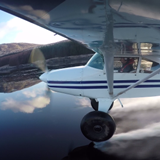
Dragging it in won't work if the trees are a hundred feet below the threshold as at this altiport:

Mushing down with the stall warner blaring (as shown in this site's excellent STOL tips videos) is an easier way to hit a landing spot with minimum kinetic energy in relatively benign conditions, but I'm not keen on such Valdez-style heroics in the mountains. An airplane executing a competition-winning stall-down approach way back of the power curve is in no shape to react to a 5 knot (500 fpm) up or down draught which can come out of nowhere.
For the European mountain rating, a student must learn to fly the approach at 1.2 to 1.3 Vso, and to aim off correctly so as to hit the selected touchdown zone. It's not the easiest way, but it's the only way to get the rating.
The flare will be some way short of the threshold, but not below it. If terrain slopes steeply below the threshold, the flare may be 100 ft or more agl. It's usual to maintain or add power in the flare.
Dragging it in won't work if the trees are a hundred feet below the threshold as at this altiport:
Mushing down with the stall warner blaring (as shown in this site's excellent STOL tips videos) is an easier way to hit a landing spot with minimum kinetic energy in relatively benign conditions, but I'm not keen on such Valdez-style heroics in the mountains. An airplane executing a competition-winning stall-down approach way back of the power curve is in no shape to react to a 5 knot (500 fpm) up or down draught which can come out of nowhere.
For the European mountain rating, a student must learn to fly the approach at 1.2 to 1.3 Vso, and to aim off correctly so as to hit the selected touchdown zone. It's not the easiest way, but it's the only way to get the rating.
Sun Apr 10, 2016 7:32 am
Re: Tailwind landings
All I do different when I land my 400' 12% grade strip in a tailwind is aim for about 100' short of the "threshold" (where I stop mowing), that seems to work out fine. The air is the same as any other air and the airplane flies the same, it's just moving me along the ground faster. Coming in over trees is a separate issue. My biggest concern when landing my place down wind, is that it means it's later in the day, and the thermals are popping, I've had times when I see the wind turbine at the top dead still, and the wind sock at the bottom of my property 1/4 mile away stick straight out, or vice versa. When that happens I circle for a bit and try and get a sense of the timing of them and come in between them, but I carry some extra speed, so extra speed while landing uphill in a tailwind, then I aim about 200' short, so far so good. Still, they are my least favorite wind direction, I'll take a strong cross wind anytime 
- courierguy offline

- Posts: 4197
- Joined: Thu Mar 31, 2005 6:52 pm
- Location: Idaho
"Its easier to apologize then ask permission"
Tex McClatchy
Tex McClatchy
Sun Apr 10, 2016 1:54 pm
Re: Tailwind landings
N-Jacko,
Your European and our latest school solution orientation, power controls airspeed and elevator controls rate of descent or glide angle, works with some serious limitations:
1. The out of ground effect airspeed must always be fast. You lose the advantage of prop blasting enough pressure air over the wing, when behind the power curve, to fly quite a bit slower safely
3. Gusts will cause a lot of difficulty if you attempt to mitigate the sinks and balloons with elevator. Serious gust spreads could easily cause a very hard landing unless power is applied to cushion the airplane onto the surface. Up elevator slows the airspeed, causing even greater descent.
2. The trees or other obstructions need be well below or well before the desired touchdown spot. You lose the advantage of using a very steep approach to put the airplane over the trees but still touchdown on the desired spot. We cannot depend on a self displaced threshold. Very short fields do not have room for self displaced thresholds. Using Patrick's stall down or my apparent brisk walk rate of closure makes over trees and/or downwind approach to a very short field safer.
3. With the European or our latest school solution orientation on power/pitch, going behind the power curve becomes as dangerous as stalling. What happens is that extra speed is added for obstructions, tailwind, gusts, density altitude, bad feeling in the pilots gut, the wife, the kids, and grandma. It is little wonder so many airplanes run off the far end of runways that should not cause so much trouble.
4. I understand the need for compliance in a testing situation. The same is true here. I just won't demand the school solution when it might hurt the student in the long run. The school solution requires a lot of taboos and other mental controls to be safe in only sanctioned situations. Many instructors teach only for the test. Others teach what they believe to be most safe in various situations the student may face after getting the license.
Best regards,
contact
Your European and our latest school solution orientation, power controls airspeed and elevator controls rate of descent or glide angle, works with some serious limitations:
1. The out of ground effect airspeed must always be fast. You lose the advantage of prop blasting enough pressure air over the wing, when behind the power curve, to fly quite a bit slower safely
3. Gusts will cause a lot of difficulty if you attempt to mitigate the sinks and balloons with elevator. Serious gust spreads could easily cause a very hard landing unless power is applied to cushion the airplane onto the surface. Up elevator slows the airspeed, causing even greater descent.
2. The trees or other obstructions need be well below or well before the desired touchdown spot. You lose the advantage of using a very steep approach to put the airplane over the trees but still touchdown on the desired spot. We cannot depend on a self displaced threshold. Very short fields do not have room for self displaced thresholds. Using Patrick's stall down or my apparent brisk walk rate of closure makes over trees and/or downwind approach to a very short field safer.
3. With the European or our latest school solution orientation on power/pitch, going behind the power curve becomes as dangerous as stalling. What happens is that extra speed is added for obstructions, tailwind, gusts, density altitude, bad feeling in the pilots gut, the wife, the kids, and grandma. It is little wonder so many airplanes run off the far end of runways that should not cause so much trouble.
4. I understand the need for compliance in a testing situation. The same is true here. I just won't demand the school solution when it might hurt the student in the long run. The school solution requires a lot of taboos and other mental controls to be safe in only sanctioned situations. Many instructors teach only for the test. Others teach what they believe to be most safe in various situations the student may face after getting the license.
Best regards,
contact
- contactflying offline
- Posts: 4972
- Joined: Wed Apr 03, 2013 7:36 pm
- Location: Aurora, Missouri 2H2
Download my free "https://tinyurl.com/Safe-Maneuvering" e-book.
DISPLAY OPTIONS
Who is online
Users browsing this forum: No registered users and 3 guests
Latest Features
-
-
Featured Bush Planes
As one of the undisputed legends of bush flying, the Cessna 180 hauls a…Read More -
Aircraft Ownership and Maintenance
9 modification mistakes aircraft owners make when trying to "bush out" their birds—why some…Read More -
Live to Tell
A Minnesota pilot is surprised to learn that the sudden asymmetric drag of an…Read More




Latest Knowledge Base
-
Destinations
Canada offers some of the most spectacular backcountry flying on the continent. Here's what you need to know before you go.Read More -
Safety and Survival
Hope that you never have to use your survival vest but knowing you have it and knowing how to use…Read More -
Destinations
A regional guide with ideas for winter camping destinations in California, Nevada, New Mexico, and Arizona.Read More -
Aircraft
Finding an affordable aircraft that can handle the backcountry for $80K or less? A challenge for sure, but with the…Read More



