I just completed an Airplains' 180hp conversion on my 172M. Wow!!! does it have power compaired to the tired O-320. My question is what is the best flap setting for short and soft field takeoffs? The POH say's 0-10 degrees, but per Sparky, max lift is when the flaps are set inline with max down deflection on the ailerons (I believe this is around 20 degrees.) I always used 20 degrees when I had a 182 and it worked well, therfore I'm assuming that it should work the same in a higher horsepower Skyhawk. Any recomendations?
Thanks,
Nick
Takeoff flap settings? 180hp Skyhawk
Mon Apr 20, 2009 10:32 am
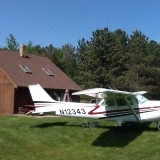
1974 Cessna 172M
Rotorway Exec 90
Rotorway Exec 90
Mon Apr 20, 2009 6:24 pm
Re: Takeoff flap settings? 180hp Skyhawk
Twenty flaps for shortest takeoff, and/or best climb angle.
MTV
MTV


Mon Apr 20, 2009 8:49 pm
Re: Takeoff flap settings? 180hp Skyhawk
On soft or rough, I like to takeoff with 20 degrees in my 170B to break ground as quickly as possible, then I milk them off to 10 degrees and climb out with that until obstacles are cleared.

Mon Apr 20, 2009 9:50 pm
Re: Takeoff flap settings? 180hp Skyhawk
Mine is a 172N w/ 180 hp Air Plains STC, been working to see how short I can get her off, she will fly at 40-41 kts indicated in ground effect just short of 400 feet from brake release w/ just me (230 lbs), light gear in back and full fuel at 10 deg. flap setting on a cool, calm day at sea level plus a few dozen feet or so.
Not sure I can get her off significantly shorter at 20 deg, 20 seems to give a little better initial Vx from seat of pants feel but crappier Vy overall. I am also not sure that the Vx improvement "feel" is repeatable or not, just 5 kts difference in headwind, thermals, etc seem to have a bigger impact on climb angle/performance than flap setting. Vy in terms of fpm improves all the way down to zero flap.....You don't need to get too far off the ground before the climb rate begins to suffer with the barn doors hanging out.
I'd be interested to try the same work at higher density altitudes, where the 20 vs 10 might provide a more noticeable difference, but I don't get much opportunity to make circuit after circuit when I am someplace fun...... Anyone else at higher elevations have any input as to whether 20 makes a bigger difference up high?
Flynengr
Not sure I can get her off significantly shorter at 20 deg, 20 seems to give a little better initial Vx from seat of pants feel but crappier Vy overall. I am also not sure that the Vx improvement "feel" is repeatable or not, just 5 kts difference in headwind, thermals, etc seem to have a bigger impact on climb angle/performance than flap setting. Vy in terms of fpm improves all the way down to zero flap.....You don't need to get too far off the ground before the climb rate begins to suffer with the barn doors hanging out.
I'd be interested to try the same work at higher density altitudes, where the 20 vs 10 might provide a more noticeable difference, but I don't get much opportunity to make circuit after circuit when I am someplace fun......
Anyone else at higher elevations have any input as to whether 20 makes a bigger difference up high?Flynengr
Mon Apr 20, 2009 9:54 pm
Re: Takeoff flap settings? 180hp Skyhawk
You did not mention if you happen to have a constant speed prop or fixed pitch.
If it is a fixed pitch, is it a cruise prop, climb prop, or compromise cruise / climb?
If it is a fixed pitch, is it a cruise prop, climb prop, or compromise cruise / climb?
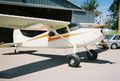
53 C-170-B+
It is better to be late in this world, than early in the next.
It is better to be late in this world, than early in the next.
Mon Apr 20, 2009 10:20 pm
Re: Takeoff flap settings? 180hp Skyhawk
Wannabe:
The Air Plains STC is for the O360A4M, w/ fixed pitch propeller. You have got me curious, though, because I thought the STC only lists one prop model/pitch. Unfortunately I don't have the POH supplement at home nor the STC. I will take a look next time I am in the hangar.
Best I can describe it, it's a "tweener" prop. Not full climb, not full cruise. Full power best climb configuration yields about 2450 rpm - Definitely not as good as a true climb prop. It will, however, run right past redline at 2700 if you level off without pulling the power back. Gives you a few knots over stock in cruise, and a hell of alot more ups - Consistently see 300 - 400 fpm more than the stock 160 hp skychickens I have flown.
Flynengr
The Air Plains STC is for the O360A4M, w/ fixed pitch propeller. You have got me curious, though, because I thought the STC only lists one prop model/pitch. Unfortunately I don't have the POH supplement at home nor the STC. I will take a look next time I am in the hangar.
Best I can describe it, it's a "tweener" prop. Not full climb, not full cruise. Full power best climb configuration yields about 2450 rpm - Definitely not as good as a true climb prop. It will, however, run right past redline at 2700 if you level off without pulling the power back. Gives you a few knots over stock in cruise, and a hell of alot more ups - Consistently see 300 - 400 fpm more than the stock 160 hp skychickens I have flown.
Flynengr
Mon Apr 20, 2009 11:34 pm
Re: Takeoff flap settings? 180hp Skyhawk
I use 20 degrees in my 150/150TD, immediately sucking them back up to 10 degrees after takeoff. Then to 0 when climb is well established. Try starting off with 10 (to make it easy to grab the handle), then jerk on about 30 degrees when it feels almost ready to fly, then immediately after it levitates back to 10-- that's a "jump take-off". A bit busy, but kinda fun and useful in some situations.
Eric
Eric


Cessna Skywagon -- accept no substitute!
Tue Apr 21, 2009 4:46 am
Re: Takeoff flap settings? 180hp Skyhawk
For most Cessna singles with "para lift" flaps, the 20 degree setting provides the best L/D configuration for the airplane, or closest to it. It's interesting to note that the early Cessnas with big flaps didn't even HAVE a 10 degree flap detent. I put one in my airplane, used it a bit to get a feel for it, and haven't used it in the last five years.
Twenty degrees of flap works just about right for short field or best angle climbs. Look at the later Cessna airplanes, such as the later 180/185, which have the big flaps, and they recommend 20 flaps for short field takeoff. The 172/170 is basically the same airframe aerodynamically. While power is lower on the stock 17X series, with the added power of the 0-360 and a light airplane, you're not that far from a heavy 180/185 in power to weight.
Use twenty flaps, practice with them, cause if it ever hits the fan, that's what will do the best job for you, not the 10 degree detent.
MTV
Twenty degrees of flap works just about right for short field or best angle climbs. Look at the later Cessna airplanes, such as the later 180/185, which have the big flaps, and they recommend 20 flaps for short field takeoff. The 172/170 is basically the same airframe aerodynamically. While power is lower on the stock 17X series, with the added power of the 0-360 and a light airplane, you're not that far from a heavy 180/185 in power to weight.
Use twenty flaps, practice with them, cause if it ever hits the fan, that's what will do the best job for you, not the 10 degree detent.
MTV
Tue Apr 21, 2009 5:44 am
Re: Takeoff flap settings? 180hp Skyhawk
Thank you for all the great information! I can wait to go play. I'm going to run it hard down the coast this weekend to break in the engine.
MTV, Thanks for confirming that 20 degrees gives the best L/D configuration. I always asumed that Cessna's recomended 10 degrees to lessen the chance of getting behind the power curve in a 172. When I had a 182 20 degrees worked the best for short field.
Nick
MTV, Thanks for confirming that 20 degrees gives the best L/D configuration. I always asumed that Cessna's recomended 10 degrees to lessen the chance of getting behind the power curve in a 172. When I had a 182 20 degrees worked the best for short field.
Nick
1974 Cessna 172M
Rotorway Exec 90
Rotorway Exec 90
Tue Apr 21, 2009 9:49 pm
Re: Takeoff flap settings? 180hp Skyhawk
Swingwing wrote:Thank you for all the great information! I can wait to go play. I'm going to run it hard down the coast this weekend to break in the engine.
MTV, Thanks for confirming that 20 degrees gives the best L/D configuration. I always asumed that Cessna's recomended 10 degrees to lessen the chance of getting behind the power curve in a 172. When I had a 182 20 degrees worked the best for short field.
Nick
Here's what I wrote in Cessna Pilots Assoc .
Hmmmm -I've got drawings of the flap stop bracket thinking of eliminating 10 degrees or changing it to and 14 degrees for 172, 15 degrees for 175,15 degrees for 180, and 14 degrees for 182's degrees (instead of 20 ).First notch 2nd would be half way between 1st. and 40 degrees and final would be at 40 . 152's and later model 172's only go to 30degrees,bring aileron down and measure -or see TCDS .
A 3 step flap -first notch for take off and others to land. BTW we are working on getting rid of the electric motor flap system and going for STC on all Cessnas from
150 to 206's . We have 2 airplanes already converted and flying .
--------------------
Bill Reid CPA>AOPA>PAMA>VHPA>N5502B
A&P /I.A. CPA Rigger,Pilot Boulder City,NV
- 182 STOL driver offline
- Posts: 1529
- Joined: Tue Apr 22, 2008 8:27 pm
Tue Apr 21, 2009 11:10 pm
Re: Takeoff flap settings? 180hp Skyhawk
Well, after all these years of appreciating MTV's obvious knowledge and expertise,
I have a small reservation on his 'strong' advise for 20 degrees flaps on take off for a 180hp 172.
I to have been told to use the ailerons down method to approximate best lift to drag setting for short field flap
settings. I agree with the 20 degrees for all 180 through 206 series Cessna planes with LOTS of "extra" horse power.
On 17x series with 180 hp and a constant speed prop it still seems to work up to about seven thousand feet of density altitude or 70 degrees F. I currently fly a 53 170B with a 180hp, and the 80 inch seaplane prop. I have found, as JR Cubbuilder stated above that often the ten degrees works a bit better at hotter temps and higher backcountry strips in Idaho.
The reason I asked earlier which prop you have is that I have flown a fixed pitch 180 hp 172 with a cruise prop into a lot of the Idaho strips while my 170 was getting upgrades. That plane obviously did NOT turn up the max. HP rpm of 2700 during the take off roll. My concern is that, without the max rpm of 2700, you may not have the "extra" hp required to overcome the drag of 20 degree flaps on hot high days with the compounding of debilitating effects that brings on.
Even the Cessna Cutlass which comes with the 180 hp and fixed pitch prop states,"Flap deflections greater than 10 degrees are not approved for takeoff." (1984 Cutlass 172Q information manual pg. 4-18)
My 172M ans 172N books both state to use zero to ten degrees. That in planes up to 160 HP fixed pitch.
Granted, they do seem to be inconsistent in flap settings between take off and go around procedures.
I used to argue that if 20 degrees is OK for a go around, then it should be OK for a short field take off.
As to MTV's statement about the similarities in Cessna airframes I can only back up to my original 170 manual.
In the stock 170 manual, section five, it has a chart with the 20 degree flap settings blacked out for certain altitudes and temperatures.
These start at 4,000 feet and 80 degrees F. At 6,000 feet the temperature drops to 40 degrees F. and the last entry of 7,000 feet drops all the way down to 20 degrees F.
It has been stated to me that at these altitudes and temperature combination there just simply is not enough "extra" horse power available to overcome the drag of 20 degree flap setting.
The 170 book has a NOTE: Take off performance figures for 10 degree flaps are approximately the same as for 20 degrees.
So, my concern is that with a fixed pitch prop, and a slightly heavier plane than the 170, you might want to do some testing to determine the best results at relevant altitudes and temperatures.
I have a small reservation on his 'strong' advise for 20 degrees flaps on take off for a 180hp 172.
I to have been told to use the ailerons down method to approximate best lift to drag setting for short field flap
settings. I agree with the 20 degrees for all 180 through 206 series Cessna planes with LOTS of "extra" horse power.
On 17x series with 180 hp and a constant speed prop it still seems to work up to about seven thousand feet of density altitude or 70 degrees F. I currently fly a 53 170B with a 180hp, and the 80 inch seaplane prop. I have found, as JR Cubbuilder stated above that often the ten degrees works a bit better at hotter temps and higher backcountry strips in Idaho.
The reason I asked earlier which prop you have is that I have flown a fixed pitch 180 hp 172 with a cruise prop into a lot of the Idaho strips while my 170 was getting upgrades. That plane obviously did NOT turn up the max. HP rpm of 2700 during the take off roll. My concern is that, without the max rpm of 2700, you may not have the "extra" hp required to overcome the drag of 20 degree flaps on hot high days with the compounding of debilitating effects that brings on.
Even the Cessna Cutlass which comes with the 180 hp and fixed pitch prop states,"Flap deflections greater than 10 degrees are not approved for takeoff." (1984 Cutlass 172Q information manual pg. 4-18)
My 172M ans 172N books both state to use zero to ten degrees. That in planes up to 160 HP fixed pitch.
Granted, they do seem to be inconsistent in flap settings between take off and go around procedures.
I used to argue that if 20 degrees is OK for a go around, then it should be OK for a short field take off.
As to MTV's statement about the similarities in Cessna airframes I can only back up to my original 170 manual.
In the stock 170 manual, section five, it has a chart with the 20 degree flap settings blacked out for certain altitudes and temperatures.
These start at 4,000 feet and 80 degrees F. At 6,000 feet the temperature drops to 40 degrees F. and the last entry of 7,000 feet drops all the way down to 20 degrees F.
It has been stated to me that at these altitudes and temperature combination there just simply is not enough "extra" horse power available to overcome the drag of 20 degree flap setting.
The 170 book has a NOTE: Take off performance figures for 10 degree flaps are approximately the same as for 20 degrees.
So, my concern is that with a fixed pitch prop, and a slightly heavier plane than the 170, you might want to do some testing to determine the best results at relevant altitudes and temperatures.
53 C-170-B+
It is better to be late in this world, than early in the next.
It is better to be late in this world, than early in the next.
Wed Apr 22, 2009 4:46 am
Re: Takeoff flap settings? 180hp Skyhawk
First, we have to start SOMEwhere. If you are taking off at 11,000 feet density altitude, there are a COUPLE of things you need to be thinking about, in addition to flap setting for takeoff. I'd still use 20 degrees there, however, my self.
Remember that a large part of what manufacturers recommend in their POH is somewhat modified by considerations for their own liability, while much of it is actually based on demonstrated aircraft performance. The problem comes with trying to sort one from the other.
Cessna limited flap travel to ~30 degrees in all their aircraft, recently, I believe, though I haven't flown a new 182. They did that for LIABILITY reasons on balked landings. ANY of those airplanes will not only fly level with full flaps and full power, but will actually climb. At sea Level, where all manufacturers reference performance numbers.
I've flown a number of Cessna 150s where the student almost wrecked the airplane trying to get those flaps from 40 to 30 on a go around. Take the controls and fly a go around AT 40 degrees. Granted, that would not work at 11,000 feet DA, though.
So, the point is, you have to start somewhere, and the somewhere that Cessna and every manufacturer starts is sea level. Things do change as the Density Altitude increases, no doubt, and the pilot would be wise to consider those changes. Mostly, however, the pilot needs to FLY the airplane, especially at high DA.
As to matching the aileron deflection to the flap deflection for T/O, that's a good rule of thumb, but it's certainly not sacrosanct.
Again, the early C-170's didn't even HAVE a 10 degree flap setting. So, would you suggest a high DA takeoff with NO flaps??? I wouldn't go there, myself.
As to drag at High DA: While horsepower decreases in normally aspirated engines, so does airframe drag. What we're really concerned with is the Lift/Drag relationship of the flaps, not just the additional drag. If they produce enough additional LIFT, then we can live with the additional drag.
I have very little time in C-17X airplanes with stock engines. I have a fair bit of time in ones with 180 hp or more. With a small engine, I'd still use 20 degrees for takeoff at high DA, because I want to lower the stall speed to the lowest possible, with the lowest resultant drag. If you check the stall speeds of the plane, with each notch of flaps, you'll find that 20 degrees gives you almost as low a stall speed as the 40 degree detent, but a LOT less drag. The 10 degree notch sorta slows the stall speed a bit.
At SL or high DA, I want the slowest stall speed for takeoff performance.
MTV
Remember that a large part of what manufacturers recommend in their POH is somewhat modified by considerations for their own liability, while much of it is actually based on demonstrated aircraft performance. The problem comes with trying to sort one from the other.
Cessna limited flap travel to ~30 degrees in all their aircraft, recently, I believe, though I haven't flown a new 182. They did that for LIABILITY reasons on balked landings. ANY of those airplanes will not only fly level with full flaps and full power, but will actually climb. At sea Level, where all manufacturers reference performance numbers.
I've flown a number of Cessna 150s where the student almost wrecked the airplane trying to get those flaps from 40 to 30 on a go around. Take the controls and fly a go around AT 40 degrees. Granted, that would not work at 11,000 feet DA, though.
So, the point is, you have to start somewhere, and the somewhere that Cessna and every manufacturer starts is sea level. Things do change as the Density Altitude increases, no doubt, and the pilot would be wise to consider those changes. Mostly, however, the pilot needs to FLY the airplane, especially at high DA.
As to matching the aileron deflection to the flap deflection for T/O, that's a good rule of thumb, but it's certainly not sacrosanct.
Again, the early C-170's didn't even HAVE a 10 degree flap setting. So, would you suggest a high DA takeoff with NO flaps??? I wouldn't go there, myself.
As to drag at High DA: While horsepower decreases in normally aspirated engines, so does airframe drag. What we're really concerned with is the Lift/Drag relationship of the flaps, not just the additional drag. If they produce enough additional LIFT, then we can live with the additional drag.
I have very little time in C-17X airplanes with stock engines. I have a fair bit of time in ones with 180 hp or more. With a small engine, I'd still use 20 degrees for takeoff at high DA, because I want to lower the stall speed to the lowest possible, with the lowest resultant drag. If you check the stall speeds of the plane, with each notch of flaps, you'll find that 20 degrees gives you almost as low a stall speed as the 40 degree detent, but a LOT less drag. The 10 degree notch sorta slows the stall speed a bit.
At SL or high DA, I want the slowest stall speed for takeoff performance.
MTV
Wed Apr 22, 2009 7:41 am
Re: Takeoff flap settings? 180hp Skyhawk
When talking about the takeoff with xx degrees of flaps you have to first ask the question :"Where's the obstacle?" In all of our types of airplanes the plane will get in the air sooner with takeoff flaps and climb at a greater angle but have less climb rate. In my Bo at 500 under gross at 5000 MSL the plane will liftoff in about 875 feet with flaps and 945 feet with no flaps. The plane with flaps will be higher than the no flap takeoff until 3400 feet from the beginning of the runway because of its greater angle. At that point the no flap takeoff crosses thru the flap airplanes altitude and then far outclimbs it because of its far better rate of climb. So for my typical backcountry camping missions in Schafer, Meadow Creek, etc, takeoffs are better with no flaps. You'll find most peoples mindset to be however, they'd rather be in the air, even if it's only in ground effect than still be accelerating down the runway.
- Bonanza Man offline
- Posts: 912
- Joined: Fri Jul 07, 2006 3:42 pm
- Location: Seeley Lake
Wed Apr 22, 2009 8:59 am
Re: Takeoff flap settings? 180hp Skyhawk
I am going to have to duck for cover on this one, but at sea level, ALL the flaps will get you off the ground faster when it is soft, least ways on any Cessna I've ever flown. I always had an airport under me at the higher altitudes, so I can't comment on that.
gb
gb
Wed Apr 22, 2009 9:06 am
Re: Takeoff flap settings? 180hp Skyhawk
Full flaps will get you off the ground sooner at any altitude simply because there's more lift with full flaps than partial flaps. Your rate of climb won't be very good.
- Bonanza Man offline
- Posts: 912
- Joined: Fri Jul 07, 2006 3:42 pm
- Location: Seeley Lake
Wed Apr 22, 2009 9:17 am
Re: Takeoff flap settings? 180hp Skyhawk
Bonanza Man wrote:Full flaps will get you off the ground sooner at any altitude simply because there's more lift with full flaps than partial flaps. Your rate of climb won't be very good.
I concur. Better start milking them off early if you need to climb. Really handy to have manual flaps for this, not sure what ever possessed Cessna to go with electric. But, if you have to do this, you probably shouldn't be there to start with, just something to practice in a controlled environment so you know how to do it. Don't ask me how I know...

gb
Wed Apr 22, 2009 11:40 am
Re: Takeoff flap settings? 180hp Skyhawk
I guess I wouldn't choose to leave the flaps deployed during a climb, generally speaking. Just cause you takeoff with half flaps doesn't imply that you need to climb with half flaps.
Generally, I'm back to zero flaps by the time I'm at 200 feet, after a takeoff with flaps. I can't imagine why anyone would keep the flaps down in a climb, except to overheat their engine.
You can have it both ways.
So, BM, if you DO takeoff with flaps, do you fly to your destination with the flaps deployed??
MTV
Generally, I'm back to zero flaps by the time I'm at 200 feet, after a takeoff with flaps. I can't imagine why anyone would keep the flaps down in a climb, except to overheat their engine.
You can have it both ways.
So, BM, if you DO takeoff with flaps, do you fly to your destination with the flaps deployed??
MTV
Wed Apr 22, 2009 3:28 pm
Re: Takeoff flap settings? 180hp Skyhawk
mtv wrote:I guess I wouldn't choose to leave the flaps deployed during a climb, generally speaking. Just cause you takeoff with half flaps doesn't imply that you need to climb with half flaps.
Generally, I'm back to zero flaps by the time I'm at 200 feet, after a takeoff with flaps. I can't imagine why anyone would keep the flaps down in a climb, except to overheat their engine.
You can have it both ways.
So, BM, if you DO takeoff with flaps, do you fly to your destination with the flaps deployed??
MTV
I forgot to mention in my above post that the no flap takeoff meets the flap takeoff at 320 AGL and the difference in rate of climb is 750 fpm vs 1150 fpm. No I don't fly all the way home with the flaps down but if the obstacle I'm trying to miss is, say, a mile away I'll be a lot higher over that obstacle with a no flap takeoff vs a flap takeoff. Might come in handy if the engine pukes.
- Bonanza Man offline
- Posts: 912
- Joined: Fri Jul 07, 2006 3:42 pm
- Location: Seeley Lake
Thu Apr 23, 2009 4:59 am
Re: Takeoff flap settings? 180hp Skyhawk
I still don't get your logic. I'm no Bonanza pilot, but in most any airplane, if you takeoff with flaps deployed, you will get airborne somewhat sooner, as in shorter.
Now, as soon as you are airborne and accelerating, which takes only a few moments, you raise the flaps to best CLIMB configuration.
By doing so, you shorten the takeoff, therefore you start the climb SOONER, both in time and distance from the "obstacle", and are climbing at best angle or rate, whichever is most appropriate for the situation.
As I said, the best of both worlds.....
MTV
Now, as soon as you are airborne and accelerating, which takes only a few moments, you raise the flaps to best CLIMB configuration.
By doing so, you shorten the takeoff, therefore you start the climb SOONER, both in time and distance from the "obstacle", and are climbing at best angle or rate, whichever is most appropriate for the situation.
As I said, the best of both worlds.....
MTV
Thu Apr 23, 2009 7:07 am
Re: Takeoff flap settings? 180hp Skyhawk
Look at the numbers I posted. There's a 70 foot difference in takeoff distance between flaps and no flaps. At those speeds that's less than a one second difference, less than your "few moments". The book numbers I gave also assume that you lift off right into the climb. If you start flying and then level out to accelerate in ground effect(for a few moments?) then that just makes it worse. You are now just chewing up real estate.
- Bonanza Man offline
- Posts: 912
- Joined: Fri Jul 07, 2006 3:42 pm
- Location: Seeley Lake
DISPLAY OPTIONS
Who is online
Users browsing this forum: No registered users and 2 guests
Latest Features
-
-
Featured Bush Planes
As one of the undisputed legends of bush flying, the Cessna 180 hauls a…Read More -
Aircraft Ownership and Maintenance
9 modification mistakes aircraft owners make when trying to "bush out" their birds—why some…Read More -
Live to Tell
A Minnesota pilot is surprised to learn that the sudden asymmetric drag of an…Read More




Latest Knowledge Base
-
Destinations
Canada offers some of the most spectacular backcountry flying on the continent. Here's what you need to know before you go.Read More -
Safety and Survival
Hope that you never have to use your survival vest but knowing you have it and knowing how to use…Read More -
Destinations
A regional guide with ideas for winter camping destinations in California, Nevada, New Mexico, and Arizona.Read More -
Aircraft
Finding an affordable aircraft that can handle the backcountry for $80K or less? A challenge for sure, but with the…Read More



