http://apod.nasa.gov/apod/image/1211/rainierclouds_thompson_3008.jpg
You will have to go look as not sure how to make this any smaller on the iPad and get it uploaded!!
Still a great photo, my friend Don sent me the link.
Looks like a good day to stay away from there.
GT
There are times to stay on the ground!
Sun Nov 25, 2012 1:03 pm
- M6RV6 offline
- Posts: 2313
- Joined: Mon Feb 25, 2008 5:52 pm
- Location: Rice Wa. 82WN Magee Creek AERODROME
- FindMeSpot URL: http://share.findmespot.com/shared/face ... sWKXuhKlg2
Have as much Fun as is Safe, and Keep SMILIN! GT,
Sun Nov 25, 2012 2:32 pm
Re: There are times to stay on the ground!
OUTSTANDING pic... 

Ben Haas
www.haaspowerair.com
www.haaspowerair.com
Sun Nov 25, 2012 2:57 pm
- Zzz offline


- Posts: 2855
- Joined: Fri Oct 08, 2004 11:09 pm
- Location: northern
- Aircraft: Swiveling desk chair
Half a century spent proving “it is better to be thought a fool than to open your mouth and remove all doubt.”
Sun Nov 25, 2012 3:10 pm
Re: There are times to stay on the ground!
Wow that is beautiful, but looks deadly.
- BigNickMontana offline

- Posts: 114
- Joined: Tue Nov 13, 2012 4:28 am
- Location: Livingston
Sun Nov 25, 2012 3:22 pm
Re: There are times to stay on the ground!
No, no!  Those would standing lenticular clouds and mark mountain wave. Glider pilots love them, and have climbed as high as 51,000 feet using the associated lift.
While it's true you often have to climb through turbulent rotor to get to the smooth laminar lift, once in the smooth stuff the air is as glass while you are climbing typically at 1,000 to 2,000 feet per minute with no sense of movement save the muffled hiss of the frigid air outside.
Winds near 18K will typically be 40 to 80 knots, so you can go nose into the wind and stay stationary over the ground or even move backwards - - though it is mildly disconcerting to have the moving map (track up) flip around backwards. Unless you have an ATC approved "wave window" open, you have to plan ahead when nearing 18K. You most likely can't just nose over to avoid busting Class A, as you'll reach VNE and still be going up!
Great fun. However, if you climb too fast you can get surface cracks in the glider finish, as the outer skin cools very rapidly causing it to shrink while the spar and inner structure are still relatively warm.
bumper
Those would standing lenticular clouds and mark mountain wave. Glider pilots love them, and have climbed as high as 51,000 feet using the associated lift. While it's true you often have to climb through turbulent rotor to get to the smooth laminar lift, once in the smooth stuff the air is as glass while you are climbing typically at 1,000 to 2,000 feet per minute with no sense of movement save the muffled hiss of the frigid air outside.
Winds near 18K will typically be 40 to 80 knots, so you can go nose into the wind and stay stationary over the ground or even move backwards - - though it is mildly disconcerting to have the moving map (track up) flip around backwards. Unless you have an ATC approved "wave window" open, you have to plan ahead when nearing 18K. You most likely can't just nose over to avoid busting Class A, as you'll reach VNE and still be going up!
Great fun. However, if you climb too fast you can get surface cracks in the glider finish, as the outer skin cools very rapidly causing it to shrink while the spar and inner structure are still relatively warm.
bumper
bumper
Minden, NV
Husky A1-B
Minden, NV
Husky A1-B
Sun Nov 25, 2012 3:30 pm
Re: There are times to stay on the ground!
Glider time baby!!!!!!!!!! dress warm!
Sun Nov 25, 2012 8:30 pm
Re: There are times to stay on the ground!
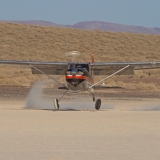
My Schleicher ASH26E (self-launch) glider over Minden in mountain wave.

As much as I love soaring, the Husky and back country flying is just a bit more fun (but it's close).
As much as I love soaring, the Husky and back country flying is just a bit more fun (but it's close).
bumper
Minden, NV
Husky A1-B
Minden, NV
Husky A1-B
Sun Nov 25, 2012 9:09 pm
Re: There are times to stay on the ground!
Can you get ATC approval in a glider to go higher than 18K?
Sun Nov 25, 2012 9:48 pm
Re: There are times to stay on the ground!
58Skylane wrote:Can you get ATC approval in a glider to go higher than 18K?
Certain operations have LOA's with the local TRACONS or Centers for a "Wave Window". California City had one with Joshua Approach. The FBO (Caracole Soaring in my case) would call Joshua prior to an anticipated high altitude flight and get authorization into the window. I was told to contact approach prior to entering into class A airspace, They would approve "Higher as needed in about 2000'+ increments. I topped out at 25,400' and hung out for about 10 mins, -36*F doesn't take long to get cold feet.
Now Minden Nv does it a bit different, You talk to the people on the ground, they call Oakland Ctr they gave the guy at the FBO (Soar Minden) the clearance then Soar Minden would radio the approved clearance up. It was warmer there -17*F at 27,000'
There are a couple guys (Gordon Boettger Fed Ex pilot and Jim Payne Retired Edwards AFB commander) that regularly make long and high wave flights and they get special clearances they will fly mostly Owens Valley.
- Glidergeek offline

- Posts: 1937
- Joined: Sat Sep 06, 2008 8:02 pm
- Location: Hesperia
- Aircraft: 1968 P206C
DG 400
Sun Nov 25, 2012 9:51 pm
Re: There are times to stay on the ground!
Glidergeek wrote:58Skylane wrote:Can you get ATC approval in a glider to go higher than 18K?
Certain operations have LOA's with the local TRACONS or Centers for a "Wave Window". California City had one with Joshua Approach. The FBO (Caracole Soaring in my case) would call Joshua prior to an anticipated high altitude flight and get authorization into the window. I was told to contact approach prior to entering into class A airspace, They would approve "Higher as needed in about 2000'+ increments. I topped out at 25,400' and hung out for about 10 mins, -36*F doesn't take long to get cold feet.
Now Minden Nv does it a bit different, You talk to the people on the ground, they call Oakland Ctr they gave the guy at the FBO (Soar Minden) the clearance then Soar Minden would radio the approved clearance up. It was warmer there -17*F at 27,000'
There are a couple guys (Gordon Boettger Fed Ex pilot and Jim Payne Retired Edwards AFB commander) that regularly make long and high wave flights and they get special clearances they will fly mostly Owens Valley.
Interesting. Thanks Ggeek.
Mon Nov 26, 2012 9:45 pm
Re: There are times to stay on the ground!
The best up elevator you will ever ride. We used to fly waves in Western Australia, a lot of fun, can make for wow I can't believe it moments.
- soaringhiggy offline
- Posts: 711
- Joined: Tue Dec 13, 2005 8:22 pm
- Location: Kimberly, ID
48 Stinson 108-3
Mon Nov 26, 2012 10:38 pm

- OregonMaule offline

- Posts: 6977
- Joined: Fri Sep 01, 2006 9:44 pm
- Location: Orygun
My SPOT page
"They who can give up essential liberty to obtain a little temporary safety, deserve neither liberty nor safety". Ben Franklin
http://en.wikiquote.org/wiki/Benjamin_Franklin
"They who can give up essential liberty to obtain a little temporary safety, deserve neither liberty nor safety". Ben Franklin
http://en.wikiquote.org/wiki/Benjamin_Franklin
Mon Nov 26, 2012 10:57 pm
Re: There are times to stay on the ground!
OregonMaule wrote:
Your such a prick!!


Mon Nov 26, 2012 11:08 pm

- Terry offline
- Posts: 1365
- Joined: Sat Nov 10, 2007 9:11 pm
- Location: Willamette Valley
- FindMeSpot URL: http://share.findmespot.com/shared/face ... 4GzPHI6t1d
Mon Nov 26, 2012 11:23 pm
Re: There are times to stay on the ground!
58Skylane wrote:OregonMaule wrote:
Your such a prick!!
That's Mr. Prick to you.
- OregonMaule offline
- Posts: 6977
- Joined: Fri Sep 01, 2006 9:44 pm
- Location: Orygun
My SPOT page
"They who can give up essential liberty to obtain a little temporary safety, deserve neither liberty nor safety". Ben Franklin
http://en.wikiquote.org/wiki/Benjamin_Franklin
"They who can give up essential liberty to obtain a little temporary safety, deserve neither liberty nor safety". Ben Franklin
http://en.wikiquote.org/wiki/Benjamin_Franklin
Mon Nov 26, 2012 11:44 pm
Re: There are times to stay on the ground!
58Skylane wrote:Can you get ATC approval in a glider to go higher than 18K?
Sure. At Minden you radio "SoaringNV" on 123.3 and they'll call Oakland landline ("Soar Minden" ceased ops last year). Wave window is typically to 28,000 and they'll almost always open it for you. I've been to 28,800 and while it was fun and interesting, it's not something I'll be doing often - - need to protect the few active brain cells I've got left.
bumper
Minden, NV
Husky A1-B
Minden, NV
Husky A1-B
Tue Nov 27, 2012 8:10 am
Re: There are times to stay on the ground!
OregonMaule wrote:That's Mr. Prick to you.

I get that straight next time
Tue Nov 27, 2012 8:20 am
Re: There are times to stay on the ground!
bumper wrote:No, no!
....Great fun. However, if you climb too fast you can get surface cracks in the glider finish, as the outer skin cools very rapidly causing it to shrink while the spar and inner structure are still relatively warm.
bumper
First.. Great post... I learned alot....
On a recent flight to FLA in my buddies CJ-4 we were at FL450 and the OAT was right at ISA = -74*f.. Brrrrrrr.
How many pairs of Carharts do you guys wear when going up that high.
Ben Haas
www.haaspowerair.com
www.haaspowerair.com
Tue Nov 27, 2012 9:56 pm
Re: There are times to stay on the ground!
battery powered undies are the bees knees for this.
- soaringhiggy offline
- Posts: 711
- Joined: Tue Dec 13, 2005 8:22 pm
- Location: Kimberly, ID
48 Stinson 108-3
DISPLAY OPTIONS
Who is online
Users browsing this forum: No registered users and 1 guest
Latest Features
-
Live to Tell
A Minnesota pilot is surprised to learn that the sudden asymmetric drag of an out-of-rig ski can…Read More -
Creators
Working in some of the Yukon's most beautiful and remote environments, photographer Simon Blakesley captures aircraft in…Read More -
Aircraft Ownership and Maintenance
Upgrading to big tires can make a huge difference in backcountry performance, but with those gains come…Read More -
Tales from Yesteryear
In this tale from bush flying yesteryear, Don Cogger signs up to help Atlee Dodge Jr recovery…Read More


Latest Knowledge Base
-
Destinations
A regional guide with ideas for winter camping destinations in California, Nevada, New Mexico, and Arizona.Read More -
Aircraft
Finding an affordable aircraft that can handle the backcountry for $80K or less? A challenge for sure, but with the…Read More -
Aircraft
01.29.2018 - Zane - Updated tire diameter graphic to add 8.50x10 Guide to tires for use in the backcountry and off-airport landing…Read More -
Pilots
12.22.2013 - Initial article format Operating aircraft on skis and negotiating a snow-covered landscape is an entirely unique skillset and environment.…Read More


