This happened to me in 2007, IIRC. There are a few lessons here to be learned - please do. I've thought long and hard about the whyfors and whethertos but I still haven't found out exactly what the initial problem was. At least not the technical aspects of it.
I was flying a charter flight from an island in the archipelago. It's a vast archipelago, some 30000 islands, and the destination was first a lake about 40 miles south west of the island and then an airport. I had four passengers on board and I was supposed to drop two of them off at a mansion by the lake.
The airplane was (is) a Cessna U206F from 1973 with a 300 hp IO520 on amphibious floats, EDO 3500. McCauley prop and Robertson STOL (flaperons) and Flint wing tip tanks giving it a max t/o mass at 3800 pounds and six hours fuel at 65 percent (or thereabouts). All in all a great plane for charter ops.
The passengers were a younger couple in their fourties and an elderly couple in the mid seventies. The younger ones were to disembark and the lake.
The flight to the lake was uneventful, the weather was good and all was golden. When I arrived at the lake I found the water to be very murky so I opted to land in the wake of a motor boat.
As I taxied to the jetty, or pier is a better word, I ran aground. Being barefoot I immediately got in the water (after shutting the engine down) and pulled the plane afloat again. I examined what I had struck and it seemed to be a flat and rather smooth rock formation covered with brownish slime/mud/grit. I also felt along the keel of the float but it felt ok.
I taxied to the pier, a large wood construction where the wings just barely cleared the railing in the pier. I got out and held the plane as my passengers got off, being cautious not to let the stab too close to the structure. I also looked on how the plane sat in the water and the cg looked normal, indicating that all compartments of the floats were sound. To let go of the plane and check the floats with the pump wasn't an option due to the risk of damaging plane on the pier.
I cast off and the plane still sat fine in the water and it taxied normally. I taxied back to where I landed, avoiding the rock this time, and set up for take off. Te first part of the take off run was normal but as I was about the get up on the step the plane started to feel nose heavy and veered to the left. I aborted the take off, shut the engine down and stepped out on the float, now sitting noticeably low in the water.
I popped the float hatch to get the pump and found the compartment to be full of water. Pumping turned out to be futile as the water was rising faster that I could get it out.
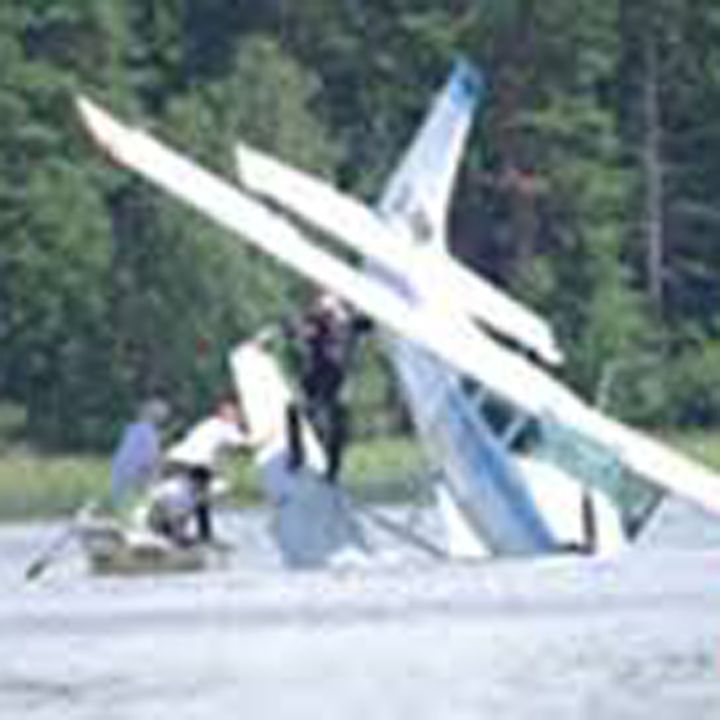
I determined the plane to being rapidly becoming unstable and ordered my passengers to leave the aircraft as I didn't want two senior citizens being caught upside down in a sinking plane in dark water. Eventually, as the plane nosed over to the left after a few minutes, the lady passenger and I got an involuntary bath, the gentleman was fortunate enough to step in directly into a passing boat.
Hindsight is always 20/20 and while I think I could have fired the engine and made it to shore, perhaps 200 feet or so (at least that was what by boss told me I should have done), I'm glad I didn't. As soon as I concluded that the plane was gone, the only thing I focused on was the passengers. At least I did that much right.
The plane sat upside down for 36 hours until we salvaged it by turning it very slowly around and then hauling it up on a nearby beach. The engine was started within one hour and the only real damage was to the GPS.
Upon inspection we found an about 5 inches long crack in the bottom skin, about halfway between the keel and the side of the float, in the third compartment (ahead of the step). The were lots of picking marks, like if someone had been at the float with a pointy object (like a dull icepick or ice axe). We checked the rock but couldn't find something that mathed the marks but we did find metal objects protruding from the wooden pier beneath the surface that may (or may not) have caused the marks.
The correct way to in this case have dealt with running aground would have been to leave the pier, taxi out on the lake and then having performed a check. That way I would have caught the leak, despite it being caused by the running aground or by the metal objects by the pier. Now, why didn't I?
As I said, I've thought alot about this. Firstly, I thought I was certain that the float was ok, having not found anything but smooth slimy rock and no damage to the keel upon a hands on inspection. Secondly, the balance of the plane supported that notion.
Also, I was going to an airport nearby with a maintenance facility that could repair any damage. While I didn't "think this out loud" at the time, I think it may have contributed to my decision that all was ok.
There's also one more thing, and this is where it get's even more interesting. I had poor knowledge of float design. The only float drawing I had ever seen was of straight floats and the main difference, in case of the EDO 3500's at least, is that the compartments are open about two inches or so at the top in the first three compartments to allow for the landing gear mechanism. So what happened was that when I set t/o power and raised the nose I also applied maximum water pressure to the crack, causing it to widen. Then the compartment pressure filled with water, above the sea level, and water started to spill over to the next compartent. And next. Remember Titanic?
IIRC the 3500's have eleven compartments of which three are ahead of the step. These the are responsible for carrying the most of the weight of plane and they are all connected. If the are filled with water above sea level above a certain point they'll pass point of no return and the airplane will flip over.
I'm not saying that I would have acted differently had I known about the design. But, had I thought about it, and especially had I understood the potential dangers of such a design, I may have acted differently and done the float check by the book as I should have. And this could have been avoided.
So what have I learned from this? Well, the NTSB equivalent stated pilot error to be the cause and while they are essentially correct it's a shame they chose to summarize it so briefly.
But what I have done is that I've added a WHY to my mental mental check list. Every time I say to my self "we are good to go" or whatever, I also ask myself why I think it's ok. Do I because it is so, or do I because I want it to be so?
I'm also thinking alot more about technical aspects, about potential pitfalls and what to do when things go south. As an example I was flying the Citation Sovereign and I noticed during the initial training that the parking brake lever was situated in a poor spot, likely to be stepped on by a non careful pilot. It's not a guarded lever and if released you need to get the hydraulic pressure up (ie aux pump or engines running) to re-engage it – that takes a while. I concluded that the only way to address a situation was to pull the emergency brake, blowing nitrogen in the system (read: costly reset) if in a tight spot. And what happens? My big foot colleague steps on the lever, with everything off - even batteries - sitting on a snowy and sloping ramp. So I'm sitting there in the dark, in the right seat, and I know immediately what do do. I reach over to where the left pilot right knee would be and grab the emer brake lever. The ramp is at about a three degree slope and we had moved about five feet before we stopped. Another ten and we would have hit the fence. In the end it cost only a few hours of maintenance, had I not thought about it, and identified the potential hazard in a poorly designed parking brake, it would have costed us dearly.
Learn something from this if it makes any sense and feel free to comment and ask.
About to flip over. Naturally I made headlines in the tabloids...