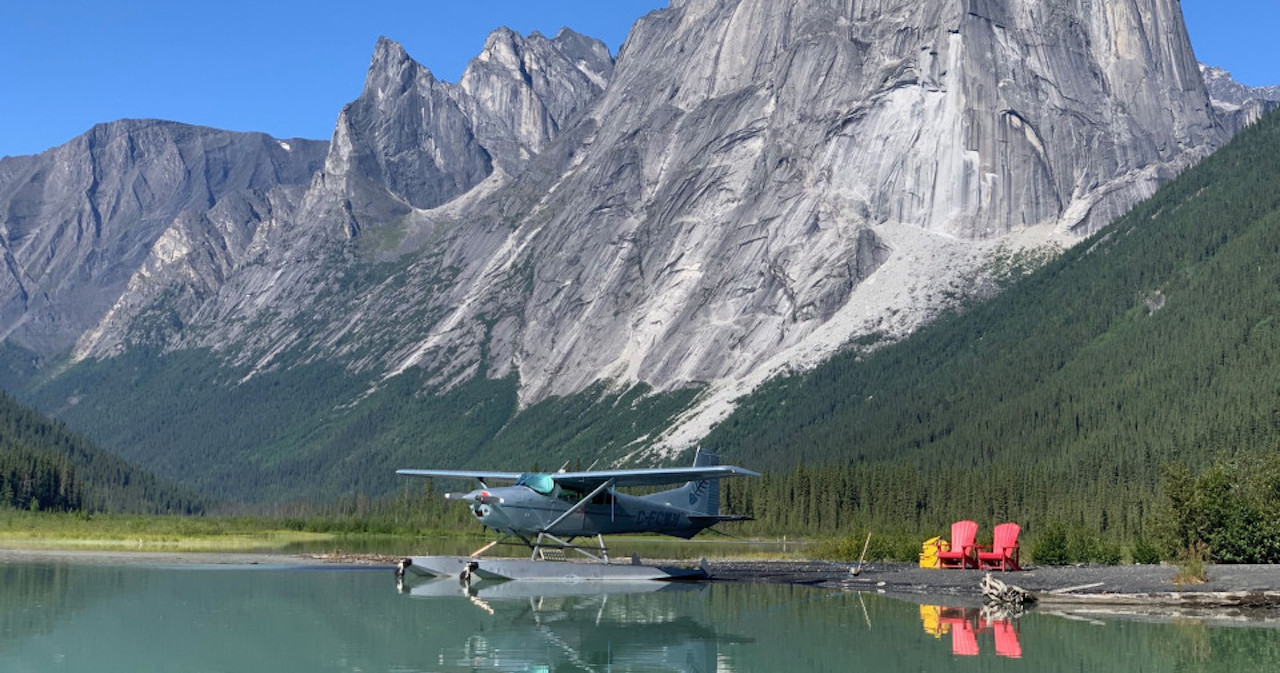
The landing maybe isn't backcountry, but there sure is some beauty in this!
This is why we fly...
Sat Nov 16, 2013 10:27 am
- Floatsnskis offline
- Posts: 65
- Joined: Wed Aug 28, 2013 5:33 am
- Location: Stockholm
Sun Nov 17, 2013 9:58 pm
Re: This is why we fly...
This is my home airport!
You can actually see my house on short final.
Nice, thanks for posting!
You can actually see my house on short final.
Nice, thanks for posting!
- dontlookdown offline
- Posts: 71
- Joined: Sun Jun 25, 2006 3:52 pm
- Location: New Zealand
Sun Nov 17, 2013 10:11 pm
Re: This is why we fly...
Excellent Video!
- Scolopax offline

- Posts: 1717
- Joined: Tue Sep 27, 2005 5:02 pm
- Location: Nottingham
- FindMeSpot URL: http://share.findmespot.com/shared/face ... 4aYqSexnZC
Sun Nov 17, 2013 10:21 pm
Re: This is why we fly...
Was that a published approach or home made? Beautiful scenery.

CFII, MEI, CFISES, ATPME, IA/AP, RPPL, Ski&Amphib ops, RHC mechanic cert, RHC SC— 3000TT
Sun Nov 17, 2013 11:31 pm
Re: This is why we fly...
Beautiful...really cool transition through the clouds
Mon Nov 18, 2013 1:00 am
Re: This is why we fly...
I think I saw Frodo and Samwise on top of one of those peaks...
Beautiful.
Beautiful.

Mon Nov 18, 2013 7:19 am
Re: This is why we fly...
Queenstown?
Mon Nov 18, 2013 11:59 am
Re: This is why we fly...
8GCBC wrote:Was that a published approach or home made? Beautiful scenery.
That looks like one of those curved RNP approaches, they work great in terrain like that. Sketchy when you are descending through a layer knowing that the mountains are right there.

Mon Nov 18, 2013 12:06 pm
Re: This is why we fly...
Nice video! Looks like a fun approach, definitely more fun with terrain avoidance equipment.
Last edited by Waterboy on Mon Nov 18, 2013 12:21 pm, edited 1 time in total.
- Waterboy offline
- Posts: 288
- Joined: Mon Jan 21, 2013 8:28 pm
- Location: Hood River, OR
- FindMeSpot URL: http://share.findmespot.com/shared/face ... sosgK4n7cI
Mon Nov 18, 2013 12:17 pm
Re: This is why we fly...
Rezrider wrote:8GCBC wrote:Was that a published approach or home made? Beautiful scenery.
That looks like one of those curved RNP approaches, they work great in terrain like that. Sketchy when you are descending through a layer knowing that the mountains are right there.
While watching, the descent through the cloud layer looked pretty serious. But, beautiful too. Local knowledge for sure.
CFII, MEI, CFISES, ATPME, IA/AP, RPPL, Ski&Amphib ops, RHC mechanic cert, RHC SC— 3000TT
Mon Nov 18, 2013 12:54 pm
Re: This is why we fly...
It's a lot similar to the RNP approach into Jackson, WY: http://155.178.201.160/d-tpp/1312/00504RRY19.PDF All of my approaches into Jackon IFR were pre-GPS, so they were on this ILS approach: http://155.178.201.160/d-tpp/1312/00504IYL19.PDF. Either way, lots of rocks on both sides.
This video was sure cool, though. To me, there's nothing much neater than flying above the clouds, then descending through them on an approach to break out just right to land. It's doubly so when there are beautiful mountains along the way. Nice video!
Cary
This video was sure cool, though. To me, there's nothing much neater than flying above the clouds, then descending through them on an approach to break out just right to land. It's doubly so when there are beautiful mountains along the way. Nice video!
Cary
"I have slipped the surly bonds of earth..., put out my hand and touched the face of God." J.G. Magee
Mon Nov 18, 2013 1:11 pm
Re: This is why we fly...
A few years ago I was flying out of SLC to Jackcon Hole for work. Since almost all the pilots I was flying with were flatlanders and never flown out here before, the company required them to have a line check. So, one morning we launched into a blinding snow storm taking place in Jackson with a check airman on the jumpseat. ILS down to minimums, turned, and back to SLC. Check airman got off and we headed back to Jackson. By this time, it had cleared out. The guy I was flying with about crapped his drawers when he saw the terrain around the airport. With fresh snow, sun, and bright blue skies, the Tetons were especially impressive that day.
Very cool video. RNP approaches are very cool. I understand there are a couple of cool ones into Juneau.
Very cool video. RNP approaches are very cool. I understand there are a couple of cool ones into Juneau.
- Grassstrippilot offline

- Posts: 3536
- Joined: Wed May 31, 2006 6:17 am
- Location: Syracuse, UT
- FindMeSpot URL: https://share.garmin.com/WolfAdventures
- Aircraft: Cessna 205
Mon Nov 18, 2013 1:20 pm
Re: This is why we fly...
I've had dreams like that. No airplane though, just me flying!
CW
CW
- clippwagon offline
- Posts: 737
- Joined: Sun Nov 13, 2011 9:49 pm
- Location: Oregon
Tue Nov 19, 2013 1:31 am
Re: This is why we fly...
Yes, Queenstown.
RNAV, RNP approach.
Only recently introduced, but it makes a difference to the reliability of service into the basin.
With the addition of the Multilateration system, it's all going on!:
http://www.airways.co.nz/about_airways/ ... llance.asp
RNAV, RNP approach.
Only recently introduced, but it makes a difference to the reliability of service into the basin.
With the addition of the Multilateration system, it's all going on!:
http://www.airways.co.nz/about_airways/ ... llance.asp
- dontlookdown offline
- Posts: 71
- Joined: Sun Jun 25, 2006 3:52 pm
- Location: New Zealand
Tue Nov 19, 2013 9:56 am
Re: This is why we fly...
Here are the actual approaches. Pretty cool! He landed runway 5. But if you look at the runway 23 approach that looks pretty crazy! Just think of the places we could eventually see approaches down the road as we get more advanced. The thing I think is stupid is that this has to be flown on the autopilot with a FD. Although we can easily maintain the required nav without an autopilot & FD. Notice there is no allows for Category A & B.
http://www.aip.net.nz/pdf/NZQN_45.1_45.2.pdf
http://www.aip.net.nz/pdf/NZQN_45.1_45.2.pdf
- piperpainter offline
- Posts: 970
- Joined: Sat Nov 29, 2008 10:57 pm
- Location: Auburn, WA
- Aircraft: C-205
Was Backcountry Mooney M20C
Thu Nov 28, 2013 6:09 pm
Re: This is why we fly...
Awesome video. A must why all of us should have our instrument licenses 

- csstricker offline
- Posts: 67
- Joined: Mon Jan 28, 2013 4:18 pm
- Location: Ogden, UT
- FindMeSpot URL: http://share.findmespot.com/shared/face ... HSiQDWEYn1
Thu Nov 28, 2013 7:09 pm
Re: This is why we fly...
In olden times, we didn't video much--the technology wasn't available, beyond 8 mm movie cameras or big clunky video cameras which took 2 men and a boy to lift. But memories can be indelible. Here's a night approach I made into old Denver Stapleton, probably in 1983 or so. I'll try to describe it so that you can "see" it with your mind--much like the old "theater of the mind" radio shows like Dragnet, The Green Hornet, and The Shadow (man, does all that date me!).
I was flying a friend's over-equipped Mooney 231 from Laramie to Denver to pick him up. It had been raining off and on most of the day--a warmish rain for winter time. The cloud deck at Laramie started at about 800' AGL. Before I climbed into the soup, since it was winter, I turned on the pitot heat and hot prop, and periodically I turned on the ice-light to look at the leading edges. But no ice was forming. The temp was just warm enough that the airplane was getting wet, but not iced.
The flight down to the Denver area was uneventful, except that I couldn't see the lights of Fort Collins, Longmont, or even Denver--the clouds were so full of moisture. Denver Approach offered me vectors to final for the north-south runway (not sure of its numbers now), but I asked for the full approach, in order to have time to set up for it. Approach reminded me that it would take longer that way, but I said that's what I wanted to do.
Incidentally, this airplane was fully equipped and capable of coupled approaches. Not only did it have the latest King flight director/autopilot, but it had color radar, radar altimeter, everything you could imagine could be stuffed into a Mooney panel--even a "Flite Phone". But I was hand-flying it, not trusting the autopilot to do its thing.
The route of flight took me south directly over downtown Denver, but none of the city lights showed through the muck. It was truly like flying inside a black hole. As I crossed the IAF and started into the procedure turn, I slowed to 110 knots, which was my usual approach speed. As I came out of the procedure turn and lined up on the localizer, I kept thinking to myself, "get ready to go missed". At the IAF, just as the glideslope centered and the outer marker lit up, I dropped the gear and the first notch of flaps and started sliding down the ILS. At 110 knots, the Mooney was as solid as a rock. Halfway down the approach, I did a final GUMPS check, flattened the prop, and watched as I came closer to the MDA. The radar altimeter came alive and its pointer moved closer and closer to the 200' minimum. At 50' above the MDA, 250' AGL, I started to push in the throttle to go missed.
Suddenly I broke into the relative clear just below the cloud deck. It was a sight to behold. The rabbit leading up to the approach end, the VASIs showing their red and white that proved I was on target, the centerline lights going off into the distance, the edge lights on either side of the wide runway--it was like that climactic scene from The High and the Mighty! Sploosh, I touched down gently on the wet runway.
As I taxied in the light rain, I felt that elation that comes from doing something right--a truly good nearly textbook approach. I walked into the Combs-Gates terminal to find my friend on the phone, trying to arrange a rental car--he was sure I wouldn't be able to get in.
The flight home was totally anti-climactic. It remained low IFR until about halfway home, the clouds started lifting, and by the time we got to Laramie, I didn't even have to shoot an approach.
I don't think that "picture" of seeing the lights as I broke out will ever leave my mind, it was so spectacular. In all these years, I have a lot of memories like that. I wish the technology existed that I could put those memories on video so I could share them with everyone. Such memories are truly why we fly.
Cary
I was flying a friend's over-equipped Mooney 231 from Laramie to Denver to pick him up. It had been raining off and on most of the day--a warmish rain for winter time. The cloud deck at Laramie started at about 800' AGL. Before I climbed into the soup, since it was winter, I turned on the pitot heat and hot prop, and periodically I turned on the ice-light to look at the leading edges. But no ice was forming. The temp was just warm enough that the airplane was getting wet, but not iced.
The flight down to the Denver area was uneventful, except that I couldn't see the lights of Fort Collins, Longmont, or even Denver--the clouds were so full of moisture. Denver Approach offered me vectors to final for the north-south runway (not sure of its numbers now), but I asked for the full approach, in order to have time to set up for it. Approach reminded me that it would take longer that way, but I said that's what I wanted to do.
Incidentally, this airplane was fully equipped and capable of coupled approaches. Not only did it have the latest King flight director/autopilot, but it had color radar, radar altimeter, everything you could imagine could be stuffed into a Mooney panel--even a "Flite Phone". But I was hand-flying it, not trusting the autopilot to do its thing.
The route of flight took me south directly over downtown Denver, but none of the city lights showed through the muck. It was truly like flying inside a black hole. As I crossed the IAF and started into the procedure turn, I slowed to 110 knots, which was my usual approach speed. As I came out of the procedure turn and lined up on the localizer, I kept thinking to myself, "get ready to go missed". At the IAF, just as the glideslope centered and the outer marker lit up, I dropped the gear and the first notch of flaps and started sliding down the ILS. At 110 knots, the Mooney was as solid as a rock. Halfway down the approach, I did a final GUMPS check, flattened the prop, and watched as I came closer to the MDA. The radar altimeter came alive and its pointer moved closer and closer to the 200' minimum. At 50' above the MDA, 250' AGL, I started to push in the throttle to go missed.
Suddenly I broke into the relative clear just below the cloud deck. It was a sight to behold. The rabbit leading up to the approach end, the VASIs showing their red and white that proved I was on target, the centerline lights going off into the distance, the edge lights on either side of the wide runway--it was like that climactic scene from The High and the Mighty! Sploosh, I touched down gently on the wet runway.
As I taxied in the light rain, I felt that elation that comes from doing something right--a truly good nearly textbook approach. I walked into the Combs-Gates terminal to find my friend on the phone, trying to arrange a rental car--he was sure I wouldn't be able to get in.
The flight home was totally anti-climactic. It remained low IFR until about halfway home, the clouds started lifting, and by the time we got to Laramie, I didn't even have to shoot an approach.
I don't think that "picture" of seeing the lights as I broke out will ever leave my mind, it was so spectacular. In all these years, I have a lot of memories like that. I wish the technology existed that I could put those memories on video so I could share them with everyone. Such memories are truly why we fly.
Cary
"I have slipped the surly bonds of earth..., put out my hand and touched the face of God." J.G. Magee
DISPLAY OPTIONS
Who is online
Users browsing this forum: No registered users and 7 guests
Latest Features
-
-
Featured Bush Planes
As one of the undisputed legends of bush flying, the Cessna 180 hauls a…Read More -
Aircraft Ownership and Maintenance
9 modification mistakes aircraft owners make when trying to "bush out" their birds—why some…Read More -
Live to Tell
A Minnesota pilot is surprised to learn that the sudden asymmetric drag of an…Read More


Latest Knowledge Base
-
Destinations
Canada offers some of the most spectacular backcountry flying on the continent. Here's what you need to know before you go.Read More -
Safety and Survival
Hope that you never have to use your survival vest but knowing you have it and knowing how to use…Read More -
Destinations
A regional guide with ideas for winter camping destinations in California, Nevada, New Mexico, and Arizona.Read More -
Aircraft
Finding an affordable aircraft that can handle the backcountry for $80K or less? A challenge for sure, but with the…Read More