Hi all,
Looking through some specs and I see the 135hp Tri-Pacer listed as needing 1,120' to get off the ground and 1,600' to clear 50'. Does that sound right? Same source actually showed the Pacer slight worse at 1,210' & 1,725'. Is that what you all are seeing, or do these seem off? Seems to me it would perform a little better than that? Obviously, one would see better numbers with the 160hp models.
Thanks.
Tri-Pacer Take Off Performance
Tue May 21, 2019 6:32 pm
Tue May 21, 2019 9:13 pm
Re: Tri-Pacer Take Off Performance
Using the basic low ground effect takeoff, the 0-290 Tri-Pacer will do better than that. Like all light airplanes with small engines, low ground effect is more criticality important. Obstructions are more problematic as well. If 100' over the obstruction is your need, you're not going to like the 135 hp. It will zoom 10' over safely, however, if you stay in low ground effect until near the obstruction. The longer you stay in low ground effect, the more airspeed or kinetic energy or zoom reserve you gain before the obstruction
You want the nose gear just off quickly or abort. You want the mains off halfway or abort. Once level and accelerating quickly in low ground effect halfway down, you feel pretty good about the outcome.
Downhill helps on the runway and/or after we're off. Pay close attention to which way is down drainage and if you can get there in ground effect. You will not go up smartly, nor should you try. In low powered aircraft, the outcome of high pitched climbs are always in doubt. Level ten feet over the obstruction and look for lower terrain.
Once you get maneuvering speed, you can climb. Or better yet, find some rising air. In the mountains, either hydraulic or thermal lift far exceeds 135 hp from 10:00 til night most days. And you only get a percentage of that 135 hp leaned at full throttle.
You want the nose gear just off quickly or abort. You want the mains off halfway or abort. Once level and accelerating quickly in low ground effect halfway down, you feel pretty good about the outcome.
Downhill helps on the runway and/or after we're off. Pay close attention to which way is down drainage and if you can get there in ground effect. You will not go up smartly, nor should you try. In low powered aircraft, the outcome of high pitched climbs are always in doubt. Level ten feet over the obstruction and look for lower terrain.
Once you get maneuvering speed, you can climb. Or better yet, find some rising air. In the mountains, either hydraulic or thermal lift far exceeds 135 hp from 10:00 til night most days. And you only get a percentage of that 135 hp leaned at full throttle.
- contactflying offline
- Posts: 4972
- Joined: Wed Apr 03, 2013 7:36 pm
- Location: Aurora, Missouri 2H2
Download my free "https://tinyurl.com/Safe-Maneuvering" e-book.
Tue May 21, 2019 9:39 pm
Re: Tri-Pacer Take Off Performance
That might be right at sea level. Not at a density altitude of 5000-7000.
My Pacer 135 needed more than that on a good day with 2 up front, half tanks, and camping gear at a DA of around 5500'. I'd easily eat up over 2000' to 50' pretty easily in those conditions.
The extra 15-25 hp makes a rather striking difference.
My Pacer 135 needed more than that on a good day with 2 up front, half tanks, and camping gear at a DA of around 5500'. I'd easily eat up over 2000' to 50' pretty easily in those conditions.
The extra 15-25 hp makes a rather striking difference.
Sun May 26, 2019 3:56 pm
Re: Tri-Pacer Take Off Performance
lesuther wrote:The extra 15-25 hp makes a rather striking difference.
Amen to that! I had a Grumman Traveler (150 HP 4 seat speedster) that was kind of a dog for climbout. I'd rarely see more than 500 fpm on a hot day even when solo.
I applied Bill Scott's high compression STC to the engine, which basically swaps the pistons, rods, rings, and if necessary the cylinders, converting the engine to 160 HP equivalent. (Technically limited to 157.5 by reducing max RPM by 50 to make the FAA happy, but...) The change was pretty dramatic from just that 10 HP increase. I would see 750 fpm solo routinely after that. And oddly enough, my fuel burn went down, even flying the same speeds and engine RPM. Just more efficient combustion with the higher-compression pistons, I guess!


Wed May 29, 2019 9:59 am
Re: Tri-Pacer Take Off Performance
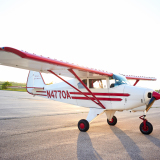
All depends on the mods as well. Extended tips, VGs, and 150hp on my Tri Pacer have gotten me off at gross weight, calm wind, in under 700' consistently. 2 up front, half fuel, we are usually taking off in 500' without being laser focused on the short ground roll, because we don't have huge tires, so we are usually in strips at least 1500' long anyway. Haven't flown the 135hp though, so perhaps the numbers really hold true for it - but my 150hp still has a book # of 1100ft book roll with stock wings, and we've lucky to have cut that substantially. As noted, high DA is a monster - have taken off from KMMH (highest in California) at gross with 9KDA before and the climbout over a nearly two mile long runway was far from 500-900fpm like we get at sea level even when heavy.

Wed May 29, 2019 7:58 pm
Re: Tri-Pacer Take Off Performance
Evan's Tri-Pacer flew much stronger than the mostly tired Tri-Pacers I flew out of Gallup and Tohatchi, both 6500 MSL. I had 2600 feet of abandoned paved road at Tohatchi. I carried four and fuel to tabs out of there but no obstacles to the south and down drainage all the way to Twin Lakes. 135 hp or Colt was two people and limited fuel to south out of Tohatchi in summer. Getting into low ground effect using most of the surface is not so dangerous when lower desert is available ahead. Climbing can be dangerous until cruise is developed safely in ground effect.
Heat without wind is very dangerous at high DA. Wind generally arrives with the heat of day up high with limited vegetation. Sticky, hot, still days in the Midwest can be more dangerous than expected.
Heat without wind is very dangerous at high DA. Wind generally arrives with the heat of day up high with limited vegetation. Sticky, hot, still days in the Midwest can be more dangerous than expected.
- contactflying offline
- Posts: 4972
- Joined: Wed Apr 03, 2013 7:36 pm
- Location: Aurora, Missouri 2H2
Download my free "https://tinyurl.com/Safe-Maneuvering" e-book.
Wed May 29, 2019 9:44 pm
Re: Tri-Pacer Take Off Performance
Lesuther is correct that 15 hp makes a lot of difference in the Tri-Pacer. 30 makes a lot of difference between the Traveler and Tiger. I taught in C-140, Traveler, and Tiger at Monte Vista, Colorado 7611 MSL summers while my wife attended Adams State. The extra hp, in either case, made far less difference than takeoff without obstructions down drainage.
The POH will tell us what we can't or shouldn't do. Unfortunately, it won't tell us how to find natural energy sufficient to do it safely. The over obstruction numbers are good, but the missing down drainage number has to do only with the distance necessary to get into low ground effect.
The POH will tell us what we can't or shouldn't do. Unfortunately, it won't tell us how to find natural energy sufficient to do it safely. The over obstruction numbers are good, but the missing down drainage number has to do only with the distance necessary to get into low ground effect.
- contactflying offline
- Posts: 4972
- Joined: Wed Apr 03, 2013 7:36 pm
- Location: Aurora, Missouri 2H2
Download my free "https://tinyurl.com/Safe-Maneuvering" e-book.
Thu May 30, 2019 8:55 am
Re: Tri-Pacer Take Off Performance
CT_Pilot, I know this isn't a TriPacer but I only manage to squeeze out of N41 with the O-300 powered C-172 (145 HP) with two bigger guys and half hanks. The runway is 2000' long but with the turf and high trees at both ends, if I took much more weight it's too close for comfort. The book performance numbers are very similar to the Pacer's. I can say I've often been limited by temps and lack of wind so we either have to re-position to OXC or MMK if we need to load up more fuel or weight. If you can swing it I would definitely look for something with more power.
Fri May 31, 2019 11:33 am
Re: Tri-Pacer Take Off Performance
...Or a climb prop. Going to a 56 twist instead of the cruise 61 on the Tri Pacer w/ 150hp gets much more climb and no sacrifice in cruise. 58 twist on the 160hp from the rumblings on the SWPC works well. Not sure about the 135hp though since those aren't used as often for STOL - but they certainly can be appropriately loaded and piloted. This guy does a lot with a little Pacer: https://www.youtube.com/watch?v=NxTnPIBFKdE
Thu Jun 06, 2019 1:38 pm
Re: Tri-Pacer Take Off Performance
I think that those of us who routinely live with high elevations have a much greater respect for the loss of performance that high DAs create. An extra 15-20 hp can make a big difference, because in reality, we already accept a whole lot less horsepower as "normal". So whether you're talking Tri-Pacer or 172 or 185, you can't accept "book" figures as remotely appropriate, unless you're at sea level on a standard day, the engine is brand new, the wings are clean, the pavement is hard, and the piloting is test pilot perfect.
For instance, the OP is at Norwalk, Connecticut. The Bridgeport airport is nearby, at 9' MSL. But as I write this, the DA there is 1915'. If we accept a loss of 3% of the power for each 1000' of altitude, that 135 hp Tri-Pacer is, at best, only a 126 hp Tri-Pacer. It's also lost significant lift and thrust, although that's harder to measure.
Now bring it out to my homedrome, Greeley, at 4700' MSL. DA right now is 7300', so that 135 hp engine is down to 105 hp, with a greater loss of lift and thrust. Or take it up to Marble, CO, where the elevation is 7800' and the DA right now is over 10,400', and the horsepower is down to 93 hp.
So no matter what the "book" figures are, they're not accurate for any kind of planning purposes, no matter what the airplane is. When power and lift and thrust are compromised by temperature and altitude, they're meaningless numbers, no matter what the airplane is.
Cary
For instance, the OP is at Norwalk, Connecticut. The Bridgeport airport is nearby, at 9' MSL. But as I write this, the DA there is 1915'. If we accept a loss of 3% of the power for each 1000' of altitude, that 135 hp Tri-Pacer is, at best, only a 126 hp Tri-Pacer. It's also lost significant lift and thrust, although that's harder to measure.
Now bring it out to my homedrome, Greeley, at 4700' MSL. DA right now is 7300', so that 135 hp engine is down to 105 hp, with a greater loss of lift and thrust. Or take it up to Marble, CO, where the elevation is 7800' and the DA right now is over 10,400', and the horsepower is down to 93 hp.
So no matter what the "book" figures are, they're not accurate for any kind of planning purposes, no matter what the airplane is. When power and lift and thrust are compromised by temperature and altitude, they're meaningless numbers, no matter what the airplane is.
Cary
"I have slipped the surly bonds of earth..., put out my hand and touched the face of God." J.G. Magee
Thu Jun 06, 2019 9:26 pm
Re: Tri-Pacer Take Off Performance
Three things happen as density altitude increases. 1) The engine produces less horsepower. 2) The plane has to be accelerated to a higher true airspeed to leave the ground, and 3) it takes more horsepower to maintain altitude.
The first two are obvious and learned by everyone. The third often engenders skepticism. But it is exactly the reason that the best angle of climb indicated airspeed rises so much with density altitude. It's interesting to see how this relates to those measly 15 hp or so.
The Tri/Pacer 135's peter out at a ceiling of around 15k (density altitude). The engine produces just over 50% of the sea level rating at that altitude, meaning it needs roughly 68 hp just to stay in the air at the 15k ceiling. This translates to 50 hp at sea level (standard atmosphere) due to the density differences (square root of the density ratio).
So at a density altitude of 5k', about as good as it gets on a mid-morning in summer in the lower Idaho strips, you end up needing to accelerate the plane to a TAS that is about 10% higher, using around 17% less horsepower (112 hp). Once in the air, you will need just shy of 10% more hp just to maintain level flight over the ground (around 55 hp). The horsepower remaining to actually gain altitude with is then a mere 57 hp compared with 80 hp at sea level.. This is why the rate of climb falls off a cliff.
If 15 sea level hp is added to the mix (12 hp at 5k), then you have 69 hp for climb with the 150 hp engine, or about 21% better climb performance. The published values for the -150 vs the -135 are....
drum rolls....
20.5% better with the -150 engine.
None of this is magic math. It's pretty straightforward.
The impact of that 20%+ climb rate to clear a 50 foot obstacle is pretty clear, and the distance to clear a 50 foot obstacle follows, rather boringly after accounting for the higher allowed gross weight, the same math. And if you fly light, the extra hp in the -150 model plays a rapidly more dramatic role in performance improvement compared to flying light in the -135 model.
The first two are obvious and learned by everyone. The third often engenders skepticism. But it is exactly the reason that the best angle of climb indicated airspeed rises so much with density altitude. It's interesting to see how this relates to those measly 15 hp or so.
The Tri/Pacer 135's peter out at a ceiling of around 15k (density altitude). The engine produces just over 50% of the sea level rating at that altitude, meaning it needs roughly 68 hp just to stay in the air at the 15k ceiling. This translates to 50 hp at sea level (standard atmosphere) due to the density differences (square root of the density ratio).
So at a density altitude of 5k', about as good as it gets on a mid-morning in summer in the lower Idaho strips, you end up needing to accelerate the plane to a TAS that is about 10% higher, using around 17% less horsepower (112 hp). Once in the air, you will need just shy of 10% more hp just to maintain level flight over the ground (around 55 hp). The horsepower remaining to actually gain altitude with is then a mere 57 hp compared with 80 hp at sea level.. This is why the rate of climb falls off a cliff.
If 15 sea level hp is added to the mix (12 hp at 5k), then you have 69 hp for climb with the 150 hp engine, or about 21% better climb performance. The published values for the -150 vs the -135 are....
drum rolls....
20.5% better with the -150 engine.
None of this is magic math. It's pretty straightforward.
The impact of that 20%+ climb rate to clear a 50 foot obstacle is pretty clear, and the distance to clear a 50 foot obstacle follows, rather boringly after accounting for the higher allowed gross weight, the same math. And if you fly light, the extra hp in the -150 model plays a rapidly more dramatic role in performance improvement compared to flying light in the -135 model.
Fri Jun 07, 2019 6:43 am
Re: Tri-Pacer Take Off Performance
Thanks for the very extensive mathematical explanation and comparison, lesuther.
In the mountains, well everywhere, I flew both, well everything, as if it had nothing. Considering how poor my math was, that worked.
In the mountains, well everywhere, I flew both, well everything, as if it had nothing. Considering how poor my math was, that worked.
- contactflying offline
- Posts: 4972
- Joined: Wed Apr 03, 2013 7:36 pm
- Location: Aurora, Missouri 2H2
Download my free "https://tinyurl.com/Safe-Maneuvering" e-book.
Fri Jun 07, 2019 5:14 pm
Re: Tri-Pacer Take Off Performance
LESUTHER said: "Three things happen as density altitude increases. 1) The engine produces less horsepower." 2) The plane has to be accelerated to a higher true airspeed to leave the ground, and 3) it takes more horsepower to maintain altitude."
Statement #2 is one I see a lot, and while it is 100% true, it can be very misleading, because most of us don't have "true airspeed indicators" in our airplanes. (OK - if you've got an EFIS, you might, but that's not the point...) Some pilots reading the blue statement above might think they need to fly their approaches at a higher indicated airspeed to achieve that higher true airspeed, and that's not the case (see AIM reference below). Using higher indicated airspeeds for approach / landing will unnecessarily increase the distance required to land – you're effectively creating your own tailwind. The same is true for taking off. If you try to accelerate to a higher "rotation speed", you'll be rolling on the ground for a lot longer, which will in turn add distance to your takeoff and obstacle clearance distances. Again, you're effectively creating your own tailwind.
Here's the relevant paragraph from the AIM (7-5-4, paragraph h.):
"When landing at a high altitude field, the same indicated airspeed should be used as at low elevation fields. Remember: that due to the less dense air at altitude, this same indicated airspeed actually results in higher true airspeed, a faster landing speed, and more important, a longer landing distance. During gusty wind conditions which often prevail at high altitude fields, a power approach and power landing is recommended. Additionally, due to the faster groundspeed, your takeoff distance will increase considerably over that required at low altitudes."
(Emphasis added by me...)
Statement #2 is one I see a lot, and while it is 100% true, it can be very misleading, because most of us don't have "true airspeed indicators" in our airplanes. (OK - if you've got an EFIS, you might, but that's not the point...) Some pilots reading the blue statement above might think they need to fly their approaches at a higher indicated airspeed to achieve that higher true airspeed, and that's not the case (see AIM reference below). Using higher indicated airspeeds for approach / landing will unnecessarily increase the distance required to land – you're effectively creating your own tailwind. The same is true for taking off. If you try to accelerate to a higher "rotation speed", you'll be rolling on the ground for a lot longer, which will in turn add distance to your takeoff and obstacle clearance distances. Again, you're effectively creating your own tailwind.
Here's the relevant paragraph from the AIM (7-5-4, paragraph h.):
"When landing at a high altitude field, the same indicated airspeed should be used as at low elevation fields. Remember: that due to the less dense air at altitude, this same indicated airspeed actually results in higher true airspeed, a faster landing speed, and more important, a longer landing distance. During gusty wind conditions which often prevail at high altitude fields, a power approach and power landing is recommended. Additionally, due to the faster groundspeed, your takeoff distance will increase considerably over that required at low altitudes."
(Emphasis added by me...)
Fri Jun 07, 2019 7:28 pm
Re: Tri-Pacer Take Off Performance
Good points, Jim. I was lucky enough to learn, fly, and teach not using the airspeed indicator for takeoff or landing. There are better visual, aural, and kinetic indications of when the airplane will lift into low ground effect, the quality of acceleration, when it will safely zoom over obstructions, when it will begin to sink on short final, the quality of deceleration without stall out of ground effect, and finally the quality of deceleration to stall in low ground effect just prior to touchdown slowly and softly.
- contactflying offline
- Posts: 4972
- Joined: Wed Apr 03, 2013 7:36 pm
- Location: Aurora, Missouri 2H2
Download my free "https://tinyurl.com/Safe-Maneuvering" e-book.
Fri Jun 07, 2019 9:19 pm
Re: Tri-Pacer Take Off Performance
The airspeed indicator measures the momentum change of an airflow as it changes from whatever it was doing before you ran into it with the pitot tube to being the same speed as the pitot tube. The momentum change is an indication of the lift potential of the wing. So it remains the same for things like approach and rotate speeds.
Things like Vx and Vy require an adjustment to IAS with a change to density altitude. The IAS for Vx and Vy converge at the absolute altitude for obvious reasons.
Things like Vx and Vy require an adjustment to IAS with a change to density altitude. The IAS for Vx and Vy converge at the absolute altitude for obvious reasons.
Mon Jun 10, 2019 3:22 pm
Re: Tri-Pacer Take Off Performance
I think that one of the best effects of flying mostly out of high elevation airports and airstrips is that very soon, the pilot learns not to rely on horsepower, i.e., not to fly the engine. He/she learns instead to fly the airplane--sorta like olden times, before most of us here (even me) learned to fly, when 60 hp was the norm and 85 hp was high powered.
When I was instructing out of Laramie (elev. about 7284' "officially") back in the 70s and 80s, we had a fleet of 172s that we used for instruction. As a 2-place trainer, it works pretty well, whether it has 145 hp, 150 hp, or 160 hp (we had all of them). Once in awhile, we'd load them with a back-seater, but that really compromised performance, even when within W&B.
A short story: back in about 1974, my step-bro and his wife were visiting from Detroit, so we decided to take them for a ride in a 172. He and I were about the same weight, around 165 lbs each, and both women were much lighter, less than 130 lbs. each, so even with full fuel, we were within W&B. It was a warmish day, so although I don't recall the DA, I'm sure it was in the 10,000'+ range. He's a pilot, although at the time a very inexperienced one. When I leaned for take-off, my step-bro asked "why are you doing that?", so I explained. Then we started down 21, and finally we lifted off at about the 3000' mark, roughly where 12/30 crosses 21/3. We climbed out at the princely rate of about 200 fpm, maybe a little more or less. He asked, "what's wrong with the airplane?" "Nothing--it's just the density altitude." He'd heard of that in his lessons back in Detroit, but he'd never experienced it, so we had quite a discussion about it.
I don't think he was an unusual low-land pilot. Until it's experienced, it's really hard to believe how much a high DA can impact airplane performance. I have a plethora of similar stories, always involving transient pilots at Laramie, who didn't understand the value of leaning for take off or the effects on airplane performance at high DAs. The instruction that most pilots get just doesn't prepare them for it.
Cary
When I was instructing out of Laramie (elev. about 7284' "officially") back in the 70s and 80s, we had a fleet of 172s that we used for instruction. As a 2-place trainer, it works pretty well, whether it has 145 hp, 150 hp, or 160 hp (we had all of them). Once in awhile, we'd load them with a back-seater, but that really compromised performance, even when within W&B.
A short story: back in about 1974, my step-bro and his wife were visiting from Detroit, so we decided to take them for a ride in a 172. He and I were about the same weight, around 165 lbs each, and both women were much lighter, less than 130 lbs. each, so even with full fuel, we were within W&B. It was a warmish day, so although I don't recall the DA, I'm sure it was in the 10,000'+ range. He's a pilot, although at the time a very inexperienced one. When I leaned for take-off, my step-bro asked "why are you doing that?", so I explained. Then we started down 21, and finally we lifted off at about the 3000' mark, roughly where 12/30 crosses 21/3. We climbed out at the princely rate of about 200 fpm, maybe a little more or less. He asked, "what's wrong with the airplane?" "Nothing--it's just the density altitude." He'd heard of that in his lessons back in Detroit, but he'd never experienced it, so we had quite a discussion about it.
I don't think he was an unusual low-land pilot. Until it's experienced, it's really hard to believe how much a high DA can impact airplane performance. I have a plethora of similar stories, always involving transient pilots at Laramie, who didn't understand the value of leaning for take off or the effects on airplane performance at high DAs. The instruction that most pilots get just doesn't prepare them for it.
Cary
"I have slipped the surly bonds of earth..., put out my hand and touched the face of God." J.G. Magee
Mon Jun 10, 2019 4:31 pm
Re: Tri-Pacer Take Off Performance
Cary,
We've had this discussion before, but I don't remember your coments. None of the Stromberg carburetor equipped little Continental engines I flew would lean to any extra rpm. Even the Lycoming O-320 would get about 300 extra compared to the Continental 0-300 200 or so, as I remember. All at around 10,000 DA.
I'm going from poor memory. Has that changed or were my Taylorcraft, Ercoupe, C-120,140, and Champ engines just tired? The O-300 was CAP 172 at Gallup. The C-140 was Fred Schotenboar's at Monte Vista in summer. Was it the Stromberg?
I pulled the mixture all the way back in those little engines because it made me feel better.
Contact
We've had this discussion before, but I don't remember your coments. None of the Stromberg carburetor equipped little Continental engines I flew would lean to any extra rpm. Even the Lycoming O-320 would get about 300 extra compared to the Continental 0-300 200 or so, as I remember. All at around 10,000 DA.
I'm going from poor memory. Has that changed or were my Taylorcraft, Ercoupe, C-120,140, and Champ engines just tired? The O-300 was CAP 172 at Gallup. The C-140 was Fred Schotenboar's at Monte Vista in summer. Was it the Stromberg?
I pulled the mixture all the way back in those little engines because it made me feel better.
Contact
- contactflying offline
- Posts: 4972
- Joined: Wed Apr 03, 2013 7:36 pm
- Location: Aurora, Missouri 2H2
Download my free "https://tinyurl.com/Safe-Maneuvering" e-book.
Tue Jun 11, 2019 11:39 am
Re: Tri-Pacer Take Off Performance
contactflying wrote:Cary,
We've had this discussion before, but I don't remember your coments. None of the Stromberg carburetor equipped little Continental engines I flew would lean to any extra rpm. Even the Lycoming O-320 would get about 300 extra compared to the Continental 0-300 200 or so, as I remember. All at around 10,000 DA.
I'm going from poor memory. Has that changed or were my Taylorcraft, Ercoupe, C-120,140, and Champ engines just tired? The O-300 was CAP 172 at Gallup. The C-140 was Fred Schotenboar's at Monte Vista in summer. Was it the Stromberg?
I pulled the mixture all the way back in those little engines because it made me feel better.
Contact
I rarely did the leaning at full power, so I don't recall the rpm difference. The method I was taught when I moved to Laramie from Anchorage was to lean at normal run-up rpm (less chance of picking up FOD in the prop), lean to peak rpm, then enrichen about half an inch of the mixture control movement. That seemed to work, whether Cessnas of varying normally aspirated engine sizes with push/pull mixture controls or Pipers with the "console" controls, and whether constant speed prop or fixed pitch. So naturally, I passed on what I was taught to my students. I honestly know next to nothing about their carburetors.
I lean my engine, which is a Lycoming 360 with a CS prop, the same way. Although I have an Insight monitor, it seems to be no more accurate to use it than to use the method I was taught.
The only airplane I flew in with a smaller engine than the O-300 145 hp Continental in one of the 172s was a single flight in my friend Jack's modified Piper Pacer, which had a somewhat tired 135hp engine, wing extensions, and droopy tips. He did a full power run-up, but I don't recall the rpm difference. I do recall that flight with him to Casper, and I don't think we ever got above 8,000', dodging hills and power poles and antelope all the way. When we landed at Casper, he slowed it so much and touched down so accurately that he was able to turn off at the first taxiway, only 200' past the approach end of the runway. His many years of Alaska bush pilot experience played a big part in that, I think.
Cary
"I have slipped the surly bonds of earth..., put out my hand and touched the face of God." J.G. Magee
Tue Jun 11, 2019 1:25 pm
Re: Tri-Pacer Take Off Performance
Thanks Cary. The Lycomings O-290 135hp engine had the Marvel Schebler carburetor like the O-320. It got extra RPM lean just like the bigger engines. I leaned the bigger engines at mag check RPM like you. Along with gravity, wind management, and ground effect, I also wanted as many engine turns I could get.. The Stromberg just didn't seem to lean at any throttle setting.
Back when I was still buying cheap airplanes, some little Continental engines were advertised with Marvel Schebler carburetor.
Back when I was still buying cheap airplanes, some little Continental engines were advertised with Marvel Schebler carburetor.
- contactflying offline
- Posts: 4972
- Joined: Wed Apr 03, 2013 7:36 pm
- Location: Aurora, Missouri 2H2
Download my free "https://tinyurl.com/Safe-Maneuvering" e-book.
Tue Jun 11, 2019 4:29 pm
Re: Tri-Pacer Take Off Performance
gdflys wrote:CT_Pilot, I know this isn't a TriPacer but I only manage to squeeze out of N41 with the O-300 powered C-172 (145 HP) with two bigger guys and half hanks. The runway is 2000' long but with the turf and high trees at both ends, if I took much more weight it's too close for comfort. The book performance numbers are very similar to the Pacer's. I can say I've often been limited by temps and lack of wind so we either have to re-position to OXC or MMK if we need to load up more fuel or weight. If you can swing it I would definitely look for something with more power.
Thanks Greg - this is Drew by the way (from RAF). Will look to head up to N41 sometime this summer in the 172 (ours is 160HP) - will shoot for early morning, though will need to fly a bit and burn some fuel off to be on the safe side - we keep it topped off on the line.
Need to meet up for lunch again soon. Actually looking to work on my tailwheel endorsement this summer I think. Starting up instrument training as well with one of the club members. Should be a fun summer. Will need to swing by OXC some time and get a ride in that Maule!
DISPLAY OPTIONS
Who is online
Users browsing this forum: No registered users and 0 guests
Latest Features
-
Live to Tell
A Minnesota pilot is surprised to learn that the sudden asymmetric drag of an out-of-rig ski can…Read More -
Creators
Working in some of the Yukon's most beautiful and remote environments, photographer Simon Blakesley captures aircraft in…Read More -
Aircraft Ownership and Maintenance
Upgrading to big tires can make a huge difference in backcountry performance, but with those gains come…Read More -
Tales from Yesteryear
In this tale from bush flying yesteryear, Don Cogger signs up to help Atlee Dodge Jr recovery…Read More


Latest Knowledge Base
-
Destinations
A regional guide with ideas for winter camping destinations in California, Nevada, New Mexico, and Arizona.Read More -
Aircraft
Finding an affordable aircraft that can handle the backcountry for $80K or less? A challenge for sure, but with the…Read More -
Aircraft
01.29.2018 - Zane - Updated tire diameter graphic to add 8.50x10 Guide to tires for use in the backcountry and off-airport landing…Read More -
Pilots
12.22.2013 - Initial article format Operating aircraft on skis and negotiating a snow-covered landscape is an entirely unique skillset and environment.…Read More


