Just curious if any of you out there have any experience flying into the Idaho strips in a somewhat under-powered aircraft. I am planning a trip to Idaho and wanted to hear your opinions about flying there in a 85HP Cessna 140. The strips I am considering are: Johnson Creek, Big Creek, and Garden Valley. Anyone been out there in a 140 or something of comparable performance? I know it's not the ideal airplane for the trip, but it's what I have available to me. Thanks for any input you may have.
Matt
Under-powered airplanes in the Idaho Backcountry.
Wed Feb 14, 2007 1:53 pm
- ShamuPilot offline

- Posts: 66
- Joined: Thu Dec 28, 2006 11:31 pm
- Location: Mission Viejo, CA
Wed Feb 14, 2007 6:19 pm
Hey Matt,
I started flying in the Idaho Backcountry in my Luscombe (C-85) last year. They are quite similar to the 140. I've been into Garden Valley, Smiley Creek, Copper Basin, Indian Creek. If you are cautious about your weight you shouldn't have any problem. I have never been in to Big Creek or Johnson Creek but they are on my list this year.
Jon
I started flying in the Idaho Backcountry in my Luscombe (C-85) last year. They are quite similar to the 140. I've been into Garden Valley, Smiley Creek, Copper Basin, Indian Creek. If you are cautious about your weight you shouldn't have any problem. I have never been in to Big Creek or Johnson Creek but they are on my list this year.
Jon

Thu Feb 15, 2007 6:37 am


Thu Feb 15, 2007 8:09 am
Thanks guy's,
I'm used to operating at high density altitudes with my 140 and know what kind of performance to expect, having had it when I lived in Prescott, AZ. The difference being, all of the dirt strips I operated out of were surrounded by flat land and no appreciable obstacles. Allen Macbean has also been in and out of there with his stock 140, so I'll plan on going there in mine versus riding with one of my friends. Hopefully I can get them carry all of my gear. Thanks again,
Matt Miller
I'm used to operating at high density altitudes with my 140 and know what kind of performance to expect, having had it when I lived in Prescott, AZ. The difference being, all of the dirt strips I operated out of were surrounded by flat land and no appreciable obstacles. Allen Macbean has also been in and out of there with his stock 140, so I'll plan on going there in mine versus riding with one of my friends. Hopefully I can get them carry all of my gear. Thanks again,
Matt Miller
- ShamuPilot offline
- Posts: 66
- Joined: Thu Dec 28, 2006 11:31 pm
- Location: Mission Viejo, CA
Thu Feb 15, 2007 8:16 am
The answer is...it depends.
How many hours do you have? Do you have any mountain experience? With low horse power, you will be limited to flying in absolute perfect conditions. Check out the mountain flying clinic by Lori McNicols out of McCall. They will not give instruction in mountain flying in airplanes with less than 200 hp (with a few exceptions such as cubs).
If you haven't already, buy Sparky Imeson's "Mountain Flying Bible", and read it religiously. Also buy Galen Hanselman's book "Fly Idaho". Galen's book has pictures about most of the major back country strips, and has a rating system that helps quantify the risks of each particular strip.
You could probably do Smiley Creek in a 140 if you are loaded light, and the temperature is cool. It is in a wide open valley with easy approach and departure. Go-around is do-able if started soon enough.
I have never landed at Garden Valley, but I have flown over it, and there are lots of tall trees at the east end of the runway.
I have never landed at Copper Basin, but it also is in a large flat valley. You could probably do that one.
I would not do Johnson Creek in anything less than 200hp. I admit that I am chicken. People do it all the time with less HP. I flew along side a guy in his 172 into and out of JC last summer. I was really impressed how he expertly worked the thermals to get amazing rate of climb out of his 172. He did really well, but he is a much better pilot than I. He also was the only person in the plane.
I have not been to Big Creek.
If you want to fly the backcountry, you can use Galen's book to pick out the airfields which give you the most options. Then, tip-toe around the edges of the more advanced strips until you get more comfortable. And of course, unles you already have gobs of mountain experience, get an instructor to take you into a couple of strips you are interested in.
DEGJR
If you haven't already, buy Sparky Imeson's "Mountain Flying Bible", and read it religiously. Also buy Galen Hanselman's book "Fly Idaho". Galen's book has pictures about most of the major back country strips, and has a rating system that helps quantify the risks of each particular strip.
You could probably do Smiley Creek in a 140 if you are loaded light, and the temperature is cool. It is in a wide open valley with easy approach and departure. Go-around is do-able if started soon enough.
I have never landed at Garden Valley, but I have flown over it, and there are lots of tall trees at the east end of the runway.
I have never landed at Copper Basin, but it also is in a large flat valley. You could probably do that one.
I would not do Johnson Creek in anything less than 200hp. I admit that I am chicken. People do it all the time with less HP. I flew along side a guy in his 172 into and out of JC last summer. I was really impressed how he expertly worked the thermals to get amazing rate of climb out of his 172. He did really well, but he is a much better pilot than I. He also was the only person in the plane.
I have not been to Big Creek.
If you want to fly the backcountry, you can use Galen's book to pick out the airfields which give you the most options. Then, tip-toe around the edges of the more advanced strips until you get more comfortable. And of course, unles you already have gobs of mountain experience, get an instructor to take you into a couple of strips you are interested in.
DEGJR
Thu Feb 15, 2007 8:36 am
I am not far from there. When pilots come into the fbo and ask about flying in the" Back strips' we say nothing. It is no place to just go find out or try. To many flat landers get killed trying it. You are better off going in with a pilot that has done it and been there to see just what you are in for. You should be asking for a ride in and where to learn about it.. Moutains can be like fingers trying to pull you down into hell. I have seen a few times flat landers come here to buy a plane and fly East and want to cry to mom because they are affraid to fly over them. Then someone will fly it to Bozeman or? while the buyer rents a car and drives it there. Then the pilot drives back. Even though he was scared he was smart. No one here knows you or your plane and you may or may not hear what you want. It will not matter it is all hear say anyway.
- squaretail offline
- Posts: 28
- Joined: Sun Nov 27, 2005 8:54 pm
- Location: NorthWest Montana
Thu Feb 15, 2007 9:16 am
Re: The answer is...it depends.
DEGJR wrote:Do you have any mountain experience? With low horse power, you will be limited to flying in absolute perfect conditions.
DEGJR
I do have a decent amount of mountain experience going in and out of places like Aspen, Telluride, Gunnison and Eagle, but that was in a Dash-8 and it doesn't really equate. As far as the weather is concerned, you are absolutely right, if it's not perfect it's a no go. The Mountain Flying Bible and the Fly Idaho!books are part of my library and I am impressed with all of the info they have. In fact, the strips I have chosen were based on his Galen's Relative Hazard Index. Nothing higher than a 15 this first time around.
-Matt
- ShamuPilot offline
- Posts: 66
- Joined: Thu Dec 28, 2006 11:31 pm
- Location: Mission Viejo, CA
Thu Feb 15, 2007 9:39 am
squaretail wrote: No one here knows you or your plane and you may or may not hear what you want.
I want to hear anything anybody here has to say, especially the nay sayers. I'm trying to make as informed a decision on this as possible. This trip is still over a year away and I might change my mind a few times between now and then. Given what I know about my plane and what other's experiences have been getting in and out of those strips, I'll plan on flying my own machine in there. For now anyway. Keep the input coming.
-Matt
- ShamuPilot offline
- Posts: 66
- Joined: Thu Dec 28, 2006 11:31 pm
- Location: Mission Viejo, CA
Thu Feb 15, 2007 11:00 am
140 into the Idaho backcountry.
Johnson Creek and Big Creek all both rated 14 in the Fly Idaho book. That means that they are not to difficult runways. They are high at 4933' and 5743' for Big Creek. They both have down country takeoff get a ways. That is if you don't turn up a side canyon. If you load light use early morning cool air You should be OK. Here again I know nothing of your flying experience or your airplanes' condition. So I am hesitant to say you will have no problems. I have been in to both with my 1953 170 with a 145 hp cont. and we had no trouble. Have you ever been in to either of these strips before? I have a video of my 182 going into Big Creek on youtube if you are interested. Bob
Thu Feb 15, 2007 11:07 am
I'm interested. Do you have a link?
Never mind I found it. Thanks. http://www.youtube.com/watch?v=OEF-lBrDweA
Never mind I found it. Thanks. http://www.youtube.com/watch?v=OEF-lBrDweA
- ShamuPilot offline
- Posts: 66
- Joined: Thu Dec 28, 2006 11:31 pm
- Location: Mission Viejo, CA
Thu Feb 15, 2007 11:36 am
Link for Big Creek Video
http://www.youtube.com/watch?v=OEF-lBrDweA
Try this I wasn't to proud of this landing. I didn't go far enough on my down wind. It is actually better to go down to a wide spot a few miles below the strip turn around and come back up so you can see the strip.
Because of a hog back ridge adjacent to the runway you can't see the strip until you come out of base to final on approach. Bob
Try this I wasn't to proud of this landing. I didn't go far enough on my down wind. It is actually better to go down to a wide spot a few miles below the strip turn around and come back up so you can see the strip.
Because of a hog back ridge adjacent to the runway you can't see the strip until you come out of base to final on approach. Bob
Thu Feb 15, 2007 11:44 am
Re: Link for Big Creek Video
skybobb wrote:http://www.youtube.com/watch?v=OEF-lBrDweA
Try this I wasn't to proud of this landing. I didn't go far enough on my down wind. It is actually better to go down to a wide spot a few miles below the strip turn around and come back up so you can see the strip.
Because of a hog back ridge adjacent to the runway you can't see the strip until you come out of base to final on approach. Bob
It was a bit long, but it didn't look too bad to me. You committed to it instead of deciding to change your mind when it was too late. Besides, now I know what to do (and not to do) when I go in there. Thanks.
- ShamuPilot offline
- Posts: 66
- Joined: Thu Dec 28, 2006 11:31 pm
- Location: Mission Viejo, CA
Thu Feb 15, 2007 11:50 am
I guess I'm confused on this. For one thing, there are ways to compute what your runway requirements should be, assuming you do a good job of developing that information to start with. I realize Cessna was a little vague with that information, and that was based on a new airplane, but.....
So, you have flown around mountains in a Dash 8. Uh, precisely what would be the differences? Air is air. Air in motion affects every airplane. Granted, having a boatload of power and climb capability is a bit of an advantage, for sure, but what specifically are you looking for, if you already know what your airplane's performance is in northern AZ?
It's not going to perform any different in Idaho, it's just that there are more rocks around to dodge.
Do you know what your airplane's climb capability is at say 9,000 DA? How about 12,000 DA? That should tell you whether you should even consider going there with that aircraft in the first place, I'd reckon.
Flying in mountains is not rocket science. I grant you that there are a lot of clueless pilots around who frankly never should have been certificated, but that's just my opinion.
Any pilot should be able to figure out his aircraft's performance capabilities. Then it is largely a matter of looking at maps, and looking at weather and understanding what that all means. The reading resources noted earlier are good references as well, and a good instructor is a great idea as well.
I'm stunned at how intimidated people are about flying in mountainous country. It has a very significant set of problems you MUST deal with, but so does everywhere else. Learn the problems, then take the conservative approach and don't screw up.
When I moved from Kodiak to Fairbanks, a lot of people thought I'd fly in any sort of weather there, since I'd flown hard in Kodiak for 8 years. I didn't push it in Fairbanks. It took me a good while to learn that area. Very different set of problems, very different set of solutions. Is one harder than the other? Not really--just different.
Learn all you can about your airplane. Learn everything you can about the country. Then, stick your toe in there a bit at a time.
Or hire someone to go with you and teach you.
I was at Smiley Creek last summer. I have to smile about the note above which says a go around is possible at Smiley Creek "if started early enough". If you think a go around at Smiley Creek might be a problem, you might need some further training or a bigger rubber band up front .
.
Challenges are everywhere. Get to the point where you can safely and consistently land your airplane in 300 feet, or 500 feet at sea level, EVERY time, NEVER miss, and you'll be better prepared for these kinds of places. You can do that at an airport anywhere. Then it becomes a matter of can you climb high enough, fast enough to work the country at the DA's involved. Only you and your airplane can figure that out.
If you've flown in the mountains, then you know what the air does there.
MTV
So, you have flown around mountains in a Dash 8. Uh, precisely what would be the differences? Air is air. Air in motion affects every airplane. Granted, having a boatload of power and climb capability is a bit of an advantage, for sure, but what specifically are you looking for, if you already know what your airplane's performance is in northern AZ?
It's not going to perform any different in Idaho, it's just that there are more rocks around to dodge.
Do you know what your airplane's climb capability is at say 9,000 DA? How about 12,000 DA? That should tell you whether you should even consider going there with that aircraft in the first place, I'd reckon.
Flying in mountains is not rocket science. I grant you that there are a lot of clueless pilots around who frankly never should have been certificated, but that's just my opinion.
Any pilot should be able to figure out his aircraft's performance capabilities. Then it is largely a matter of looking at maps, and looking at weather and understanding what that all means. The reading resources noted earlier are good references as well, and a good instructor is a great idea as well.
I'm stunned at how intimidated people are about flying in mountainous country. It has a very significant set of problems you MUST deal with, but so does everywhere else. Learn the problems, then take the conservative approach and don't screw up.
When I moved from Kodiak to Fairbanks, a lot of people thought I'd fly in any sort of weather there, since I'd flown hard in Kodiak for 8 years. I didn't push it in Fairbanks. It took me a good while to learn that area. Very different set of problems, very different set of solutions. Is one harder than the other? Not really--just different.
Learn all you can about your airplane. Learn everything you can about the country. Then, stick your toe in there a bit at a time.
Or hire someone to go with you and teach you.
I was at Smiley Creek last summer. I have to smile about the note above which says a go around is possible at Smiley Creek "if started early enough". If you think a go around at Smiley Creek might be a problem, you might need some further training or a bigger rubber band up front
.
Challenges are everywhere. Get to the point where you can safely and consistently land your airplane in 300 feet, or 500 feet at sea level, EVERY time, NEVER miss, and you'll be better prepared for these kinds of places. You can do that at an airport anywhere. Then it becomes a matter of can you climb high enough, fast enough to work the country at the DA's involved. Only you and your airplane can figure that out.
If you've flown in the mountains, then you know what the air does there.
MTV


Thu Feb 15, 2007 12:04 pm
Matt -
I've had my 90hp Luscombe into Johnson Cr and Garden Valley. I've landed at Big Cr many many times, but not in the Luscombe, it's similar to JC though. I wouldn't hesitate to take it there, just haven't had the occasion.
JCr and BCr both have down hill "escapes," and as long as you follow the rivers, you're going downhill to the Pacific.
Wind, weather and temps are all very important factors. I think that airmanship is probably more inportant than horsepower (although extra ponnies never hurt!).
I also can't stress enough obtaining good advice and insruction. Lori's school is pretty good, but as DEGJR pointed out, they want 200hp or more if you bring your own plane. You can rent a 180hp 172 in McCall in which they will do instruction.
I think Indian Cr and perhaps Mahoney on the Middle Fork would also be quite doable in a 140. After some practice, there are a couple more.
Backcountry flying is pretty serious, and simple mistakes get magnified. It's ultra important to consider yourself, your aircraft and the conditions every time you make a foray into it.
I'd be happy to answer anymore questions you might have. Happy flying, and maybe we'll see you in McCall this summer/fall.
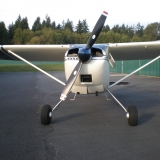
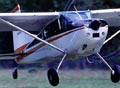
John Here's a small pic of my Luscombe at Johnson Cr last summer.

I've had my 90hp Luscombe into Johnson Cr and Garden Valley. I've landed at Big Cr many many times, but not in the Luscombe, it's similar to JC though. I wouldn't hesitate to take it there, just haven't had the occasion.
JCr and BCr both have down hill "escapes," and as long as you follow the rivers, you're going downhill to the Pacific.
Wind, weather and temps are all very important factors. I think that airmanship is probably more inportant than horsepower (although extra ponnies never hurt!).
I also can't stress enough obtaining good advice and insruction. Lori's school is pretty good, but as DEGJR pointed out, they want 200hp or more if you bring your own plane. You can rent a 180hp 172 in McCall in which they will do instruction.
I think Indian Cr and perhaps Mahoney on the Middle Fork would also be quite doable in a 140. After some practice, there are a couple more.
Backcountry flying is pretty serious, and simple mistakes get magnified. It's ultra important to consider yourself, your aircraft and the conditions every time you make a foray into it.
I'd be happy to answer anymore questions you might have. Happy flying, and maybe we'll see you in McCall this summer/fall.
John Here's a small pic of my Luscombe at Johnson Cr last summer.
- LowAndSlow offline
- Posts: 161
- Joined: Wed Feb 15, 2006 9:27 am
- Location: Medford, OR

Thu Feb 15, 2007 2:06 pm
Under-powered airplanes in the Idaho Backcountry
You might take a look at the AOPA web page, under airport directory. Put in the airport identifier:3U2 (Johnson Creek), check out ASF Accident Report. Johnson Creek is one of the easy backcountry strips, yet it has one of the highest accident rates. As far as these backcountry seminars, they are a good source of information, my personal opinion is they tend to create a false sense of confidence. These strips can be hazardous. Check with local FBOs, they have pilots who fly these airstrips everyday. They should be able to refer you to a good local instructor who can show you what you need.
Idaho Supercub
Idaho Supercub
- Idaho SuperCub offline
- Posts: 141
- Joined: Sun Nov 19, 2006 3:46 pm
- Location: McCall, Idaho
Thu Feb 15, 2007 2:35 pm
^^^^^^^ That's a good idea. Learn specifically what everyone else who wadded there did wrong. It seems like with mountain flying, knowing what NOT to do is just as critical.
I haven't flown my own bird into any idaho strips yet, but I did ride along with jmtgt in his M5, and tried to absorb as much as I could. In addition to everything you'll read in Sparky's or Fletcher's books, here's what I noticed:
- GPS is useless except for a bearing, which is useless in a canyon. Sectional and topo skills are critical.
- Become comfortable flying close to terrain and trees. This was disconcerting at first, but it's the only way to set the approaches up correctly, especially at strips like JC and BC where you pretty much fly a pattern.
- Become proficient in the lower end of the speed envelope in case you have to climb at or close to Vx, stay coordinated.
- Know your numbers, and the strip's numbers, and what it will take to clear terrain. Circling to climb can be impossible in some places, and if you can't find some ridge lift or a thermal that profiles a ridge, it might be puckering.
- If jmtgt offers to let you fly, even at a safe altitude, don't accept his offer. He'll just take the controls back if you don't maintain your heading within 1 degree.
- Make sure SuperDave is around to carry your gear back when jmtgt says you can't bring it home because his Weber BBQ is taking up too much space.
I haven't flown my own bird into any idaho strips yet, but I did ride along with jmtgt in his M5, and tried to absorb as much as I could. In addition to everything you'll read in Sparky's or Fletcher's books, here's what I noticed:
- GPS is useless except for a bearing, which is useless in a canyon. Sectional and topo skills are critical.
- Become comfortable flying close to terrain and trees. This was disconcerting at first, but it's the only way to set the approaches up correctly, especially at strips like JC and BC where you pretty much fly a pattern.
- Become proficient in the lower end of the speed envelope in case you have to climb at or close to Vx, stay coordinated.
- Know your numbers, and the strip's numbers, and what it will take to clear terrain. Circling to climb can be impossible in some places, and if you can't find some ridge lift or a thermal that profiles a ridge, it might be puckering.
- If jmtgt offers to let you fly, even at a safe altitude, don't accept his offer. He'll just take the controls back if you don't maintain your heading within 1 degree.
- Make sure SuperDave is around to carry your gear back when jmtgt says you can't bring it home because his Weber BBQ is taking up too much space.
- Zzz offline


- Posts: 2855
- Joined: Fri Oct 08, 2004 11:09 pm
- Location: northern
- Aircraft: Swiveling desk chair
Half a century spent proving “it is better to be thought a fool than to open your mouth and remove all doubt.”
Thu Feb 15, 2007 3:55 pm
I'm stunned at how intimidated people are about flying in mountainous country. It has a very significant set of problems you MUST deal with, but so does everywhere else. Learn the problems, then take the conservative approach and don't screw up.
The key being "don't screw up." Unfortunately, we're all human (going out on a limb, here
 ) and, as others have said, canyon flying has a way of magnifying the consequences of even a single error. (For that matter, the most dangerous moment I’ve ever experienced happened at a strip that was, by the numbers, one of the easy ones.)
Since 1998, three of the most experienced 135 pilots in the Idaho backcountry have died in their planes. Two of them had their own mountain flying clinics. These folks spent their lives flying the same country where they died. Add to this all of the other tragedies during that time, and I’m not aware of accident rates and profiles this grim anywhere else outside of Idaho other than in Alaska.
For my own part, the little bit of fear and intimidation I feel is part of the respect that is essential to survival in this kind of flying. The rewards are unique and incredible, but the risks are beyond ordinary if your frame of reference is the lower 48.
CAVU
Last edited by CAVU on Thu Feb 15, 2007 6:13 pm, edited 1 time in total.
Thu Feb 15, 2007 5:38 pm
I usually sit on the sidelines here, reading the posts and laughing or shaking my head as the occassion demands, but I have to wade in here. Matt, if you can fly, and it sounds like you can, you can fly your 140 safely in the backcountry. The horsepower thing is way overrated. I have both a Cessna 140 and a Skyhawk, and although it is the Skyhawk we take to the west for two weeks each summer, they have similar performance for a similar load. I've had my 150 hp Skyhawk into Johnson Creek, Big Creek, Cold Meadows, Moose Creek, Fish Creek, Dixie, Warren, Elk City, and others (and that is with my wife and two weeks of camping gear). The departures are notable only for the lack of excitement - more than enough performance. The most challenging aspect is dealing with the guys who swagger up to the airplane and ask in a loud voice "how many horsepower ya got in there?" You then got to put up with a lecture on how you really need 200hp to operate safely. Sigh. There are plenty of ways to hurt yourself in the mountains, but they are largely independent of engine displacement (I count taking off upvalley as a problem with cranial displacement, not engine displacement). The whole horsepower thing is much more about our cultural fixation with "bigger is better" than anything based on reality. Fire away guys. 
-Andy
-Andy
- Andy Turner offline
- Posts: 8
- Joined: Thu Feb 23, 2006 7:56 pm
- Location: Clarion, PA
Andy
N7332G
N2212V
N7332G
N2212V
Thu Feb 15, 2007 5:39 pm
Hi Matt,
I would add Chamberlain Basin (U79) to your list. It is higher (5700) but it is in a shallow basin without steep mountains all around like your other choices....more like Rifle than the other Colorado strips you mentioned. It is still a one way departure, though, just like all the rest you mentioned. Real Wilderness there, my favorite.
Nevertheless, in the 140 you are going to have to start operations by yourself with maybe 20 gallons of gas and 30 lbs of gear until you are more familiar with each strip. I would not depart any of these strips in your plane at above 70 degrees, 60 even better. That means departure before 8 am most days. Getting into the strips is not as critcal, assuming you are accurate on all your approaches and don't ever have to go around (;>). Still, our Idaho air is just as turbulent as Colorado on a summer afternoon, and at that light wing loading it won't be much fun. The old saw about no canyon operations between 10 am and 7 pm is still in force!
Big Creek is the most difficult of the strips you picked because it is a blind approach, is in a narrow canyon, and is shaped like a ski jump. It's long enough, though.
Each strip in Galen's book requires a different approach strategy, with no mistakes allowed on about a third of them (no go-around). Once you have eliminated some of them based on pure performance concerns, you still have to know each ones idiosyncrasies. Thus the requirement for local instruction, or at the very least a thorough briefing. In such an underpowered machine you MUST KNOW.
Of course that could also be said of a Dash-8's minimum balanced field length...the difference is that DeHavilland has given you all those numbers and formulas and Cessna hasn't...you are going to have to make them up yourself!
Start a careful program of logging every takeoff and landing in the 140 with all the environmental factors and distances, just as if you were trying to write a pilot's manual. Whatever numbers you come up with in Colorado will of course work here, with the difference that many of our strips have much tighter terrain constraints. Glenwood Springs would be a similar situation to try. (I lived there ten years)
There is no reason you can't have lot's of fun here in Idaho in the 140 IF you respect the aircraft's limited performance. BTW, I disagree with another member's mention of Copper Basin....it is as high as Aspen in a huge basin with 10,000 to 12,000ft peaks all around. It's also rough from cows. I would suggest Smiley Creek (U87) instead, slightly lower with 4900 feet of beautifully maincured grass and clear terrain to the north for 20 miles. Great camping facilities but not really in the backcountry.
When you get closer to your trip, send a private message to me and I'll be glad to give you more specific info. I've been flying into most of these strips for 25 years.
Good Luck!
The Flying Squirrel

I would add Chamberlain Basin (U79) to your list. It is higher (5700) but it is in a shallow basin without steep mountains all around like your other choices....more like Rifle than the other Colorado strips you mentioned. It is still a one way departure, though, just like all the rest you mentioned. Real Wilderness there, my favorite.
Nevertheless, in the 140 you are going to have to start operations by yourself with maybe 20 gallons of gas and 30 lbs of gear until you are more familiar with each strip. I would not depart any of these strips in your plane at above 70 degrees, 60 even better. That means departure before 8 am most days. Getting into the strips is not as critcal, assuming you are accurate on all your approaches and don't ever have to go around (;>). Still, our Idaho air is just as turbulent as Colorado on a summer afternoon, and at that light wing loading it won't be much fun. The old saw about no canyon operations between 10 am and 7 pm is still in force!
Big Creek is the most difficult of the strips you picked because it is a blind approach, is in a narrow canyon, and is shaped like a ski jump. It's long enough, though.
Each strip in Galen's book requires a different approach strategy, with no mistakes allowed on about a third of them (no go-around). Once you have eliminated some of them based on pure performance concerns, you still have to know each ones idiosyncrasies. Thus the requirement for local instruction, or at the very least a thorough briefing. In such an underpowered machine you MUST KNOW.
Of course that could also be said of a Dash-8's minimum balanced field length...the difference is that DeHavilland has given you all those numbers and formulas and Cessna hasn't...you are going to have to make them up yourself!
Start a careful program of logging every takeoff and landing in the 140 with all the environmental factors and distances, just as if you were trying to write a pilot's manual. Whatever numbers you come up with in Colorado will of course work here, with the difference that many of our strips have much tighter terrain constraints. Glenwood Springs would be a similar situation to try. (I lived there ten years)
There is no reason you can't have lot's of fun here in Idaho in the 140 IF you respect the aircraft's limited performance. BTW, I disagree with another member's mention of Copper Basin....it is as high as Aspen in a huge basin with 10,000 to 12,000ft peaks all around. It's also rough from cows. I would suggest Smiley Creek (U87) instead, slightly lower with 4900 feet of beautifully maincured grass and clear terrain to the north for 20 miles. Great camping facilities but not really in the backcountry.
When you get closer to your trip, send a private message to me and I'll be glad to give you more specific info. I've been flying into most of these strips for 25 years.
Good Luck!
The Flying Squirrel
DISPLAY OPTIONS
Who is online
Users browsing this forum: No registered users and 1 guest
Latest Features
-
Live to Tell
A Minnesota pilot is surprised to learn that the sudden asymmetric drag of an out-of-rig ski can…Read More -
Creators
Working in some of the Yukon's most beautiful and remote environments, photographer Simon Blakesley captures aircraft in…Read More -
Aircraft Ownership and Maintenance
Upgrading to big tires can make a huge difference in backcountry performance, but with those gains come…Read More -
Tales from Yesteryear
In this tale from bush flying yesteryear, Don Cogger signs up to help Atlee Dodge Jr recovery…Read More


Latest Knowledge Base
-
Destinations
A regional guide with ideas for winter camping destinations in California, Nevada, New Mexico, and Arizona.Read More -
Aircraft
Finding an affordable aircraft that can handle the backcountry for $80K or less? A challenge for sure, but with the…Read More -
Aircraft
01.29.2018 - Zane - Updated tire diameter graphic to add 8.50x10 Guide to tires for use in the backcountry and off-airport landing…Read More -
Pilots
12.22.2013 - Initial article format Operating aircraft on skis and negotiating a snow-covered landscape is an entirely unique skillset and environment.…Read More


