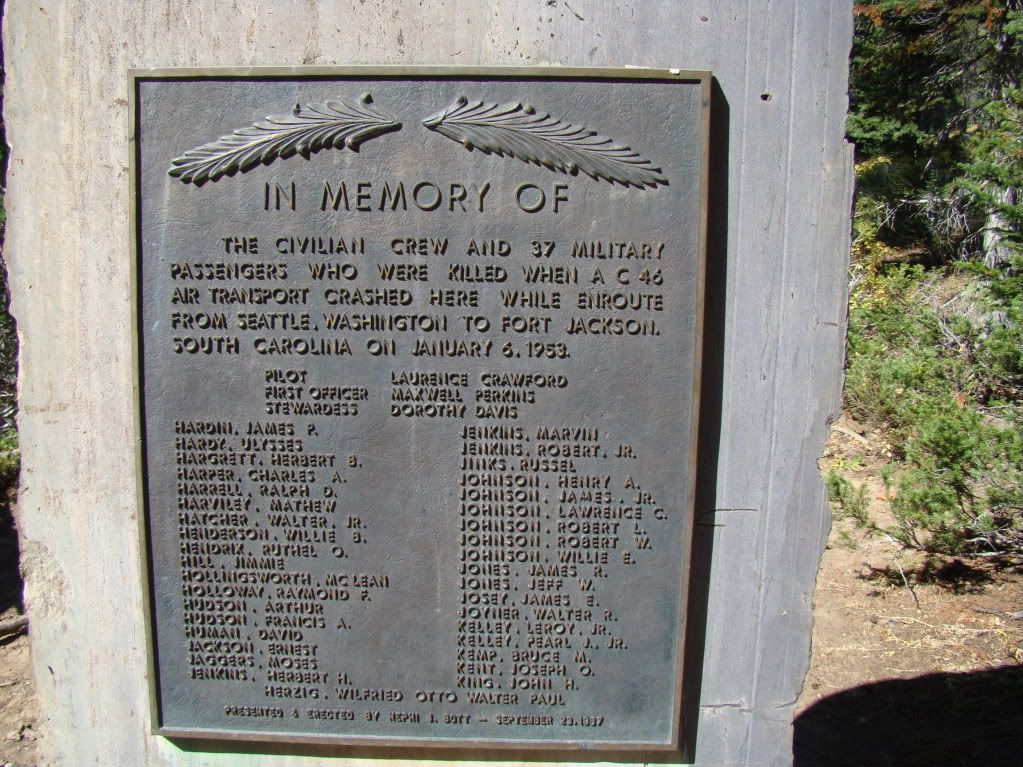
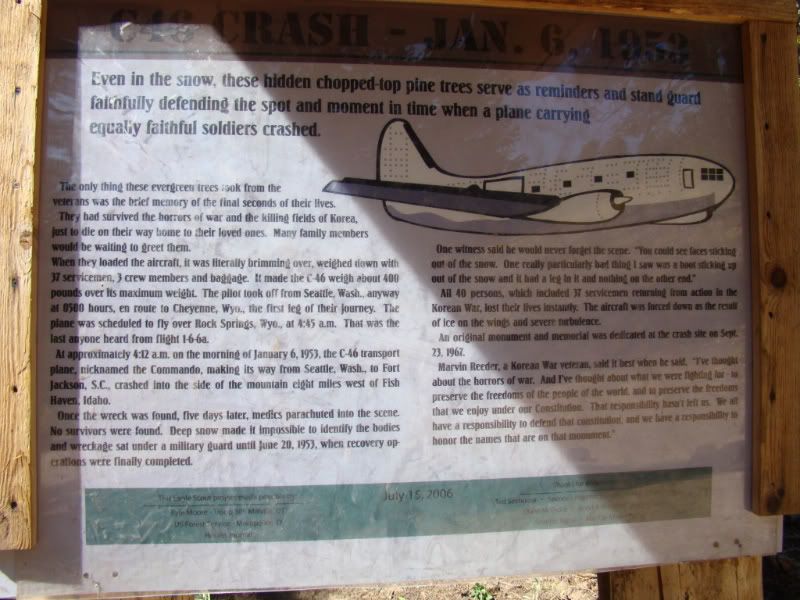
Being intrigued by this, I decided to fly up there in October and check it out for myself. I landed at Paris, Id, 1U7, and talked with O.B., the airport manager about the possibilities of finding the crash site. "You won't find it unless you're up there with someone who's been there.." he assured me. " I was up there 20 years ago and it was tough to find it then".
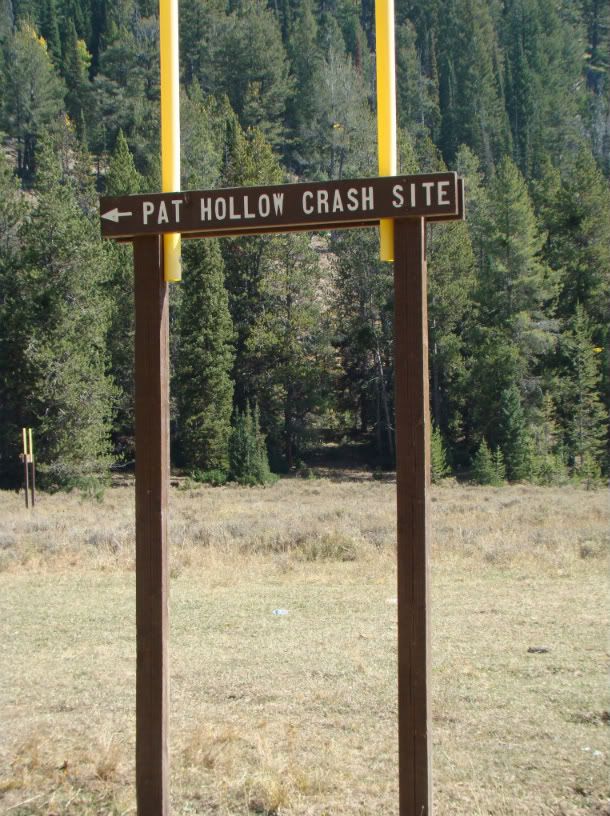
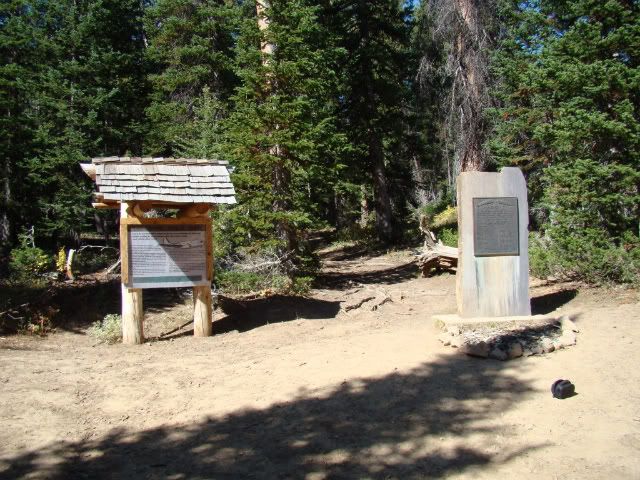
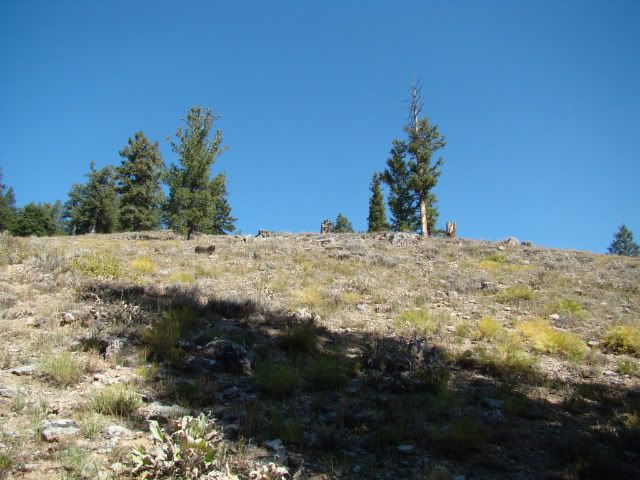
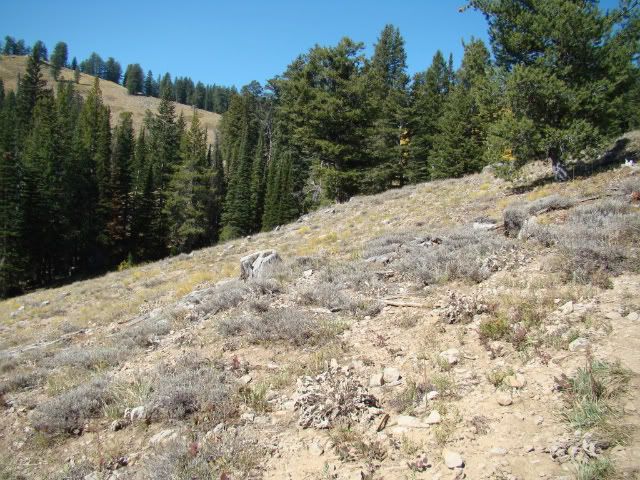
I asked around the town of Fish Haven if anyone could direct me to the site and no one had any idea what I was talking about. Long story short, I found a Forest Service map that showed a "point of interest" that matched a description I had seen on the internet. So a few of us headed up Fish Haven Canyon Rd. in search of the crash site, hoping to find something pointing us there. As it turns out, there was a Forest Service sign pointing us right to the crash site. We drove to within 50 yards of the Memorial that was erected by another Scout Troop, I believe.
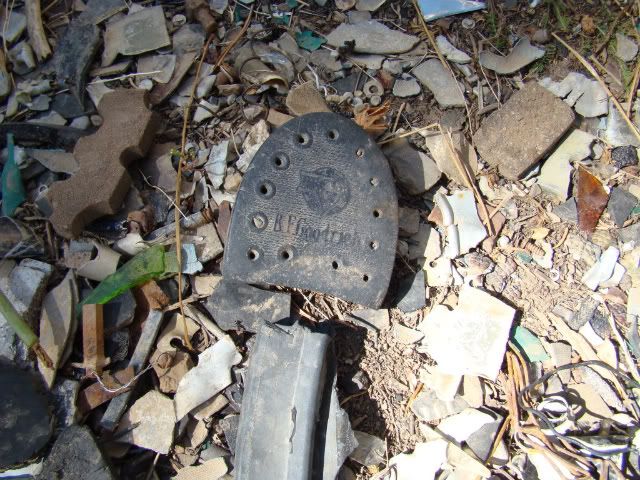
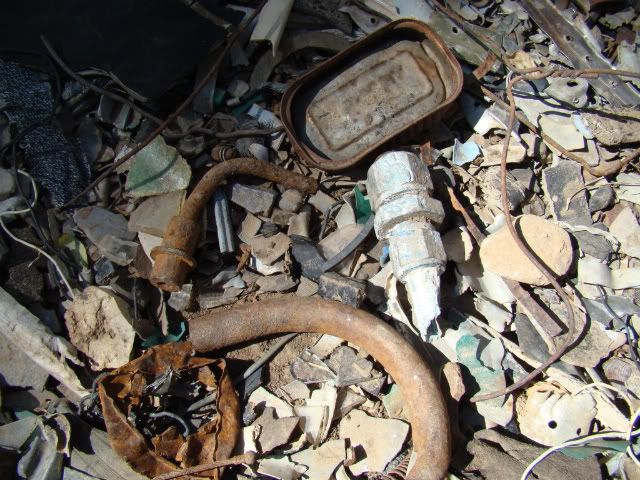
I had finally arrived at a place I had been thinking about for quite some time and the anxiety was building like I was going out on my first date. The anxiety soon changed to a sadness as we scoured around the crash site. Funny thing was, the other 2 guys with me didn't say a word and neither did I. It was a somber 40 minutes walking around an area where 39 men and 1 women lost their lives. They had served in the Korean War and were being transported home ot meet their families when the plane was lost. Suddenly, I'm aware of the huge sacrifices others make for our Country's freedom. Sober, I guess is the word.
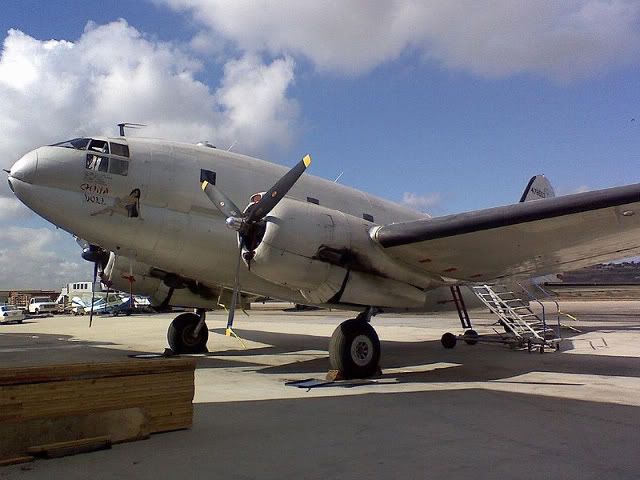
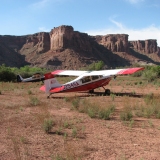
Below is a picture of a C-46 Commando transport like the one that crashed and I clipped some words from another's blog that tells of the story. I hope they forgive me.
Anyhows, thought I would share.
In January 1953, the Korean War had been blazing for two and a half years; a cease-fire would not be signed until the following July. Thousands of American soldiers had been fighting and freezing in Korea since 1950, and now some of them were coming home. In Seattle, returning soldiers were sorted into groups according to their final destinations, and with military efficiency they were marched aboard charter flights in alphabetical order. A C-46 transport plane designated as Trip 1-6-6A was headed to South Carolina; its 40 seats were assigned to men whose last names began with H, J, and K. A flight crew from San Antonio – a pilot, a first officer, and a young stewardess making her very first trip – were assigned to the flight, which left Seattle’s Boeing Field on January 6.
The C-46’s flight plan called for the plane to fly southeast across Idaho, over the Bear Lake Valley, then east over Rock Springs, Wyoming, to a refueling stop at Cheyenne. In an age before radar covered the vast reaches of the American West, pilots checked in by radio as they flew over landmarks, and the C-46 ’s pilot reported in regularly. Just before 4:00 a.m. on January 7, the pilot radioed that he was passing over Malad, Idaho; he would check in again over Rock Springs at 4:45 a.m.
But he didn’t.
As the hours passed with no word from the overdue plane, search planes were dispatched along the Utah-Idaho-Wyoming borders. The territory was rugged; the weather was brutal. A snowstorm from the northwest limited visibility, and flights were grounded on January 8. Ground crews struggled to investigate the flares a Paris, Idaho woman reported seeing in the mountains near her, with nothing located; a fire reported in the foothills above Kemmerer, Wyoming, turned out to be only a shepherd.
Finally, on January 12, Richard Burt, a search-and-rescue pilot based at Ogden, spotted something above Fish Haven, on the Idaho side of the Bear Lake Valley, that didn’t look quite natural. He flew lower, and spotted a wheel protruding from snow-covered wreckage. Burt flew to Hill AFB and picked up two paramedics. Returning to Fish Haven, the two paramedics parachuted to the site, then radioed to Burt that there were no survivors.
News of the search for the missing plane had been followed throughout the country, including, of course, in the southern hometowns of the missing men. Now the news of finding the wreckage was broadcast in grim detail: “Para-Medics Find Death on Hillside” blared one headline. A military inspector announced that “It was a miserable sight, seeing only small parts of the airplane and tiny segments of human bodies.” Hal Schindler, later to become author of Man of God, Son of Thunder, the biography of Orrin Porter Rockwell, but then a staff writer for the Salt Lake Tribune, hiked to the crash site, reported it as “grisly,” and wrote a chilling description of the loneliness of the site and the unbelievable destruction he had witnessed.