I was talking to Tangogawd who has a 135 Certificate and mail contract in Alaska on the phone recently. We both believe in some plan, even if only a few seconds, before entering IMC.
This made me think back to the FAA examiner who gave me my 135 check ride for a Single pilot, day VFR certificate while his secretary typed my hand printed application. I know! It's not done that way anymore. I asked him why I was taking an instrument check ride for a VFR certificate. He explained the pop up clearance and when asked if it would not be safer to plan and file IFR before leaving, he explained that was what you should do, jut not file until popped up. I have always been amazed at how the government, after regulating against the safer solution, can expect us to PIC the safer solution.
Scud running is sanctioned against rather than taught for in the system. We who have done it know that it is much safer at 200 feet than at 1,000 feet. At 1,000 the background goes away and you would be safer to just admit you are IMC and get on the gauges. The problem is that the transition is fuzzier up there. And it is the transition that will most likely kill you.
At 200' a tree line a mile away looks like a tree line a mile away.. At 1,000 feet, a tree line a mile away is not as apparent.
If a stationary front moves at 0 and a cold front at 40 and a warm front somewhere in between, our rate of closure, in a 130 mph airplane, is going to be 130 to 170 going toward or 90 to 130 overtaking fronts. We don't really know how bad until we get near, but the closure rate should cause us to plan a bit. Instrument ratings and equipment can be very helpful, but should not cause us to delay our decision to either turn around, pop up, or land. All are safer when planned for. And we should plan for the tactical situation being fluid.
VMC TO IMC
Wed Jan 18, 2017 9:47 am
- contactflying offline
- Posts: 4972
- Joined: Wed Apr 03, 2013 7:36 pm
- Location: Aurora, Missouri 2H2
Download my free "https://tinyurl.com/Safe-Maneuvering" e-book.
Wed Jan 18, 2017 5:31 pm
Re: VMC TO IMC
Good topic and observations. When the terrain disappears under the prop it's past time to rethink the flight.
Did download your e-book and am enjoying the contents. Thanks for the work.
Gary
Did download your e-book and am enjoying the contents. Thanks for the work.
Gary
Sun Jan 22, 2017 9:07 pm
Re: VMC TO IMC
I remember wondering why I not only had to have my IR but be current, to fly VFR 135 charters--not just the regulatory reason, but the logical reason. We did fly at night, mostly between Laramie and Denver. But it was made clear to us by the boss that we were not to file IFR except in a bonafide weather emergency. Of course, we used flight following pretty religiously instead, but with the distances involved in most of my flights, I would have preferred to be on an IFR flight plan--for the very same reasons that most of my long distance flights now are on an IFR flight plan. It also would have it easier to get into Denver, because it always seemed as if our VFR 135 flights were step-sisters to the 135 and 121 flights coming in IFR, especially during "bank" times.
Cary
Cary
"I have slipped the surly bonds of earth..., put out my hand and touched the face of God." J.G. Magee
Sun Jan 22, 2017 10:12 pm
Re: VMC TO IMC
It didn't make sense and yes there is a pecking order. When my "Dustoff" unit was using that call sign back hauling serious injured on to Las Angeles from our Combat Support Hospital near Ft. Irwin, we got in line. Very soon the controllers at March AFB advised us to use the "Evac" call sign. Then we were number one except when Air Force One was around. I made many IMC approaches to March, but never had any other clearance than vectors direct to the LOM for a straight in approach.
- contactflying offline
- Posts: 4972
- Joined: Wed Apr 03, 2013 7:36 pm
- Location: Aurora, Missouri 2H2
Download my free "https://tinyurl.com/Safe-Maneuvering" e-book.
Mon Jan 23, 2017 6:48 am
Re: VMC TO IMC
contactflying wrote:I was talking to Tangogawd who has a 135 Certificate and mail contract in Alaska on the phone recently. We both believe in some plan, even if only a few seconds, before entering IMC.
Scud running is sanctioned against rather than taught for in the system. [color=#FF0040]We who have done it know that it is much safer at 200 feet than at 1,000 feet. [/color] At 1,000 the background goes away and you would be safer to just admit you are IMC and get on the gauges. The problem is that the transition is fuzzier up there. And it is the transition that will most likely kill you.
At 200' a tree line a mile away looks like a tree line a mile away.. At 1,000 feet, a tree line a mile away is not as apparent.
If a stationary front moves at 0 and a cold front at 40 and a warm front somewhere in between, our rate of closure, in a 130 mph airplane, is going to be 130 to 170 going toward or 90 to 130 overtaking fronts. We don't really know how bad until we get near, but the closure rate should cause us to plan a bit. Instrument ratings and equipment can be very helpful, but should not cause us to delay our decision to either turn around, pop up, or land. All are safer when planned for. And we should plan for the tactical situation being fluid.
Contact,
Note the sentence I've highlighted......Staying low in scud is definitely NOT always the best plan. There are parts of the world and conditions where there are simply not enough distinct features on the surface to fly an airplane visually. One of those is water...think Kennedy Jr. Another is Northern and western Alaska, in winter. Dense smoke from forest fires can present real challenges as sun angle changes.
I call those conditions "PVFR" for Pretend VFR. You may actually have two miles visibility, but there's nothing within two mile to see. I wrote a magazine article on this some time back.
I agree that you should ALWAYS have an exit strategy, however. But that strategy MAY be better off to initiate a climb and get on instruments. As you noted, it's that transition that can bite you, but that's often because the pilot is trying too hard to remain visual.
MTV


Mon Jan 23, 2017 8:01 am
Re: VMC TO IMC
MTV,
You are right, as usual. My wife, too, gets frustrated with my generalizations and is not as diplomatic.
I have read your excellent article on PVFR.
Your comments, and hers, are invaluable to me.
Contact
You are right, as usual. My wife, too, gets frustrated with my generalizations and is not as diplomatic.
I have read your excellent article on PVFR.
Your comments, and hers, are invaluable to me.
Contact
- contactflying offline
- Posts: 4972
- Joined: Wed Apr 03, 2013 7:36 pm
- Location: Aurora, Missouri 2H2
Download my free "https://tinyurl.com/Safe-Maneuvering" e-book.
Mon Jan 23, 2017 10:55 am
Re: VMC TO IMC
contactflying wrote:.....Scud running is sanctioned against rather than taught for in the system. [color=#FF0040]We who have done it know that it is much safer at 200 feet than at 1,000 feet. [/color] At 1,000 the background goes away ...
There was a crash around here about 3 weeks ago, a C182 crashed & all 4 people aboard were killed.
All indications were that it was a VFR-into-IMC situation. Radar tracks later showed the airplane flying at 2500' shortly before a couple of descending 360's & disappearing off radar. Ceilings nearby were reported at 600', although who knows what they were in the actual crash area. It might be that the pilot was in the clouds at 2500', but might have been below them if he'd flown at a couple hundred feet over Hood Canal (part of Puget Sound) instead of higher & over land where he was. It's blacker than the ace of spades at night around there, so maybe even being out of the clouds wouldn't have helped, but it's something to wonder about.

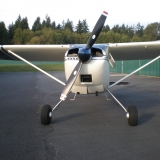
Cessna Skywagon -- accept no substitute!
Mon Jan 23, 2017 11:53 am
Re: VMC TO IMC
With whiteout conditions, and on blacker than the inside of a cow nights over water, sometimes you're safer in actual IMC than on the deck because it's way simpler for your brain to process. Especially if you are not experienced or proficient.
In both of the prior scenarios, it's the optical illusions that kill you. The creekbeds or vegetation that run at an angle to the windshield turn instantly into the horizon in a whiteout. At night over water, a row of lights from the shore will do the same, and if you try and fly visually you WILL whack the ground.
In lots and lots of thousands of hours in that crap, I would still get the leans to where I could not hold my head upright. You get used to scud running in nil visibility to the point where all you need is that tiny sliver of ground to function just fine. But, when that tiny sliver is lying to you, and if you believe it you will die, it is extremely hard to ignore.
Gump
In both of the prior scenarios, it's the optical illusions that kill you. The creekbeds or vegetation that run at an angle to the windshield turn instantly into the horizon in a whiteout. At night over water, a row of lights from the shore will do the same, and if you try and fly visually you WILL whack the ground.
In lots and lots of thousands of hours in that crap, I would still get the leans to where I could not hold my head upright. You get used to scud running in nil visibility to the point where all you need is that tiny sliver of ground to function just fine. But, when that tiny sliver is lying to you, and if you believe it you will die, it is extremely hard to ignore.
Gump
Mon Jan 23, 2017 12:32 pm
Re: VMC TO IMC
Who would have thought that all the stuff sticking up, in most of the lower 48, would be an advantage when scud running. The tactical situation is always fluid. Good information guys. Appreciated.
- contactflying offline
- Posts: 4972
- Joined: Wed Apr 03, 2013 7:36 pm
- Location: Aurora, Missouri 2H2
Download my free "https://tinyurl.com/Safe-Maneuvering" e-book.
Mon Jan 23, 2017 12:50 pm
Re: VMC TO IMC
Here's the link to the article I referenced in my earlier post: https://www.backcountrypilot.org/featur ... ngle-pilot
It was here all along....I just didn't know where to look. Thanks, Zane.
MTV
It was here all along....I just didn't know where to look. Thanks, Zane.
MTV
Mon Jan 23, 2017 1:47 pm
Re: VMC TO IMC
Excellent article we all can benefit from.
- contactflying offline
- Posts: 4972
- Joined: Wed Apr 03, 2013 7:36 pm
- Location: Aurora, Missouri 2H2
Download my free "https://tinyurl.com/Safe-Maneuvering" e-book.
DISPLAY OPTIONS
Who is online
Users browsing this forum: No registered users and 0 guests
Latest Features
-
Live to Tell
A Minnesota pilot is surprised to learn that the sudden asymmetric drag of an out-of-rig ski can…Read More -
Creators
Working in some of the Yukon's most beautiful and remote environments, photographer Simon Blakesley captures aircraft in…Read More -
Aircraft Ownership and Maintenance
Upgrading to big tires can make a huge difference in backcountry performance, but with those gains come…Read More -
Tales from Yesteryear
In this tale from bush flying yesteryear, Don Cogger signs up to help Atlee Dodge Jr recovery…Read More


Latest Knowledge Base
-
Destinations
A regional guide with ideas for winter camping destinations in California, Nevada, New Mexico, and Arizona.Read More -
Aircraft
Finding an affordable aircraft that can handle the backcountry for $80K or less? A challenge for sure, but with the…Read More -
Aircraft
01.29.2018 - Zane - Updated tire diameter graphic to add 8.50x10 Guide to tires for use in the backcountry and off-airport landing…Read More -
Pilots
12.22.2013 - Initial article format Operating aircraft on skis and negotiating a snow-covered landscape is an entirely unique skillset and environment.…Read More


