Can someone school me on the Franklin 220 engine:
> what makes them different from other mid-200 horsepower engines in terms of their design?
> are they any different, from an operational perspective?
> I understand they have been out of production (like many things for aircraft) for quite some time, why - did they fail as a company, lawsuits, ???
> what sets them apart, are they superior to Lycoming / TCM engines in some way(s), or are they deficient in some ways?
What sets the Franklin 220 apart?
Mon Aug 31, 2015 8:57 pm

Mon Aug 31, 2015 9:19 pm
Re: What sets the Franklin 220 apart?
I'm interested too in any info on the Franklin engines. There have many 170s and 175s for sale this summer with that power plant and most have low hours. It seems like a popular conversion but why so many for sale? The horse power and clean look of the conversion are intriguing but are there reasons not to have one?
Mon Aug 31, 2015 9:22 pm
Re: What sets the Franklin 220 apart?
They all have low hours because they recently blew up. High time franklins don't exist.

Mon Aug 31, 2015 9:25 pm
Re: What sets the Franklin 220 apart?
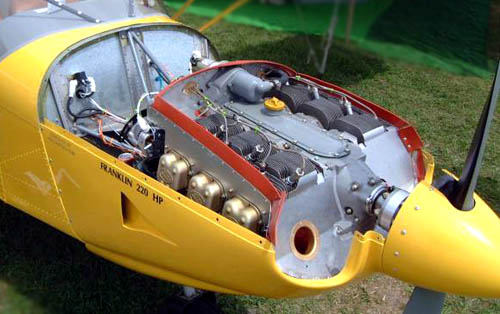
One thing I always thought was cool was the access panel on the top of the case that lets you inspect the camshaft without splitting the case.

Mon Aug 31, 2015 9:30 pm
Re: What sets the Franklin 220 apart?
I researched them a little when considering installing one in my Cessna 170 years ago. I talked to several owners/operators and they all raved about them. Apparently it is an extremely smooth engine. I flew behind a 165 Franklin in a Stinson for several hours and really liked the way it ran. Smooth like the O-300, but able to yank quite a bit harder. There are a few guys on this forum who run the 220 Frank.
This site has been up since I first started researching back-country aircraft in 1999: http://www.franklinengines.com/
Here is a Franklin thread for the reading from a few years back: https://www.backcountrypilot.org/forum/franklin-aircraft-engine-usa-born-again-9785
I am attracted to that feature as well ZZZ
This site has been up since I first started researching back-country aircraft in 1999: http://www.franklinengines.com/
Here is a Franklin thread for the reading from a few years back: https://www.backcountrypilot.org/forum/franklin-aircraft-engine-usa-born-again-9785
Zzz wrote:One thing I always thought was cool was the access panel on the top of the case that lets you inspect the camshaft without splitting the case.
I am attracted to that feature as well ZZZ
- Scolopax offline


- Posts: 1718
- Joined: Tue Sep 27, 2005 5:02 pm
- Location: Nottingham
- FindMeSpot URL: http://share.findmespot.com/shared/face ... 4aYqSexnZC
Mon Aug 31, 2015 9:50 pm
Re: What sets the Franklin 220 apart?
The Franklin engine is a great engine, Franklin engine company New York was bought out by PZL Poland in 1974 were they continued to use the engine over there for a few years. Parts availability is the biggest downside and there are people still trying to supply that nitche & the continued rumors on several new Franklin engines available in the US sometime in the future. Any updates to the rumors? I have had 2 M-4 s powered with the 220, I am flying 1 now.
vaughans
vaughans
Tue Sep 01, 2015 2:44 am
Re: What sets the Franklin 220 apart?
They were at Oshkosh with a booth. Said parts and engines avaiable. Working on a 4 cylinder that uses the same cylinders so the will have commonality.
- tailwind5sw offline

- Posts: 60
- Joined: Thu Feb 26, 2015 10:15 am
- Location: ICT
- Aircraft: WITTMAN W10
Tue Sep 01, 2015 7:31 am
Re: What sets the Franklin 220 apart?
I have zero time behind a Franklin but I was obsessed with them for a while. I wanted a Frank 220 powered Maule so bad it was silly. A few of the things that attracted me:
220hp from 350ci
Dry weight of ~330lbs. I don't know what that includes but that's still pretty light.
10.5:1 compression ratio
Max CHT of 390*F
Their reputation of being very smooth running and quite fuel efficient.
As Z mentioned, the case access cover would be really nice to have:
I don't know if it is true but I read somewhere that they were the most popular aircraft engine at one point but due to poor management they we bankrupt and never recovered. To me they seem like a better designed engine but haven't benefited from 50yrs of production like Lycoming and Continental.
220hp from 350ci
Dry weight of ~330lbs. I don't know what that includes but that's still pretty light.
10.5:1 compression ratio
Max CHT of 390*F
Their reputation of being very smooth running and quite fuel efficient.
As Z mentioned, the case access cover would be really nice to have:
I don't know if it is true but I read somewhere that they were the most popular aircraft engine at one point but due to poor management they we bankrupt and never recovered. To me they seem like a better designed engine but haven't benefited from 50yrs of production like Lycoming and Continental.

Tue Sep 01, 2015 10:09 am
Re: What sets the Franklin 220 apart?
h.
Last edited by mountainwagon on Fri Apr 15, 2016 9:50 am, edited 1 time in total.
- mountainwagon offline
Tue Sep 01, 2015 10:18 am
Re: What sets the Franklin 220 apart?
I've seen Franklin also spelled "Franklyn", seems like I've seen it stamped that way on some valve covers too? What's up with that?
Aspects of the 220 Frank that appeal to me:
lots of hp out of not-so-much displacement (350ci) = light weight
peekaboo inspection cover on crankcase
replaceable steel cylinder liners
Not so appealing aspects:
less common than Lyc or Cont, so harder finding parts & experts
no mogas
Aspects of the 220 Frank that appeal to me:
lots of hp out of not-so-much displacement (350ci) = light weight
peekaboo inspection cover on crankcase
replaceable steel cylinder liners
Not so appealing aspects:
less common than Lyc or Cont, so harder finding parts & experts
no mogas

Cessna Skywagon -- accept no substitute!
Tue Sep 01, 2015 10:19 am
Re: What sets the Franklin 220 apart?
What sets Franklin 220 apart? Simple: Not knowing if you'll be able to overhaul or replace parts in five years, or ten, or.....?
Too many owners, far too many promises that were proven to be BS.
Yes, you can find parts.....like an OX-5????? Holy shit, like anybody wants or needs that kind of hassle?
If someone ever bought the company, actually put the engines back in production (as opposed to just saying they would) and continued production for a year or two, maybe aircraft owners would start to have a little confidence in the engines.
Oh, and there isn't a single production airplane that uses those engines. So the pool of aircraft using those engines is getting smaller all the time, and that's not a very deep pool to begin with.
Yes, they perform, no doubt. I've flown a few and they are smooth and perform. But, consider the ramifications of having to remove that Franklin down the road and replace it with a Lycoming......
And, try to sell one of the things nowadays. Again, they've not done a good job of proving to the world that the engines will continue to be supported.
MTV
Too many owners, far too many promises that were proven to be BS.
Yes, you can find parts.....like an OX-5????? Holy shit, like anybody wants or needs that kind of hassle?
If someone ever bought the company, actually put the engines back in production (as opposed to just saying they would) and continued production for a year or two, maybe aircraft owners would start to have a little confidence in the engines.
Oh, and there isn't a single production airplane that uses those engines. So the pool of aircraft using those engines is getting smaller all the time, and that's not a very deep pool to begin with.
Yes, they perform, no doubt. I've flown a few and they are smooth and perform. But, consider the ramifications of having to remove that Franklin down the road and replace it with a Lycoming......
And, try to sell one of the things nowadays. Again, they've not done a good job of proving to the world that the engines will continue to be supported.
MTV

Tue Sep 01, 2015 11:31 am



Tue Sep 01, 2015 2:12 pm
Re: What sets the Franklin 220 apart?
Roman, the fellah that operates the PZL outfit (current certificate holder for Franklin engines) went to Oshkosh the year before last. He was briefed on the various parts shortages. He said he'd try to do something about it.
This past year, a few weeks prior to Oshkosh, he was asked about cam bearings. At Oshkosh, he pulled a new set out of his pocket. He'd refurbished a machine that hadn't produced parts in decades.
He's got a laundry list of the parts in greatest shortage and is supposed to be solving the problems one at a time. We'll just have to wait and see. I surely could use a set of pistons for my 165 about now. They're at or near the top of that list.
Any negative stories about reliability are likely the result of people re-using components that they shouldn't. I cracked a ring because the previous builder re-used pistons that had compression ring grooves that were too wide. One other one had skirt failure.
The 150 and 165's are low compression, so TCP or Mogas, or you're going to be dealing with lead deposits. The 220's don't have that issue. The 150's and 165's have the 14mm plugs. The 220 has 18mm. I love the inspection cover. I love sleeved cylinders. Smooth. P/W ratio.
-Glen

This past year, a few weeks prior to Oshkosh, he was asked about cam bearings. At Oshkosh, he pulled a new set out of his pocket. He'd refurbished a machine that hadn't produced parts in decades.
He's got a laundry list of the parts in greatest shortage and is supposed to be solving the problems one at a time. We'll just have to wait and see. I surely could use a set of pistons for my 165 about now. They're at or near the top of that list.
Any negative stories about reliability are likely the result of people re-using components that they shouldn't. I cracked a ring because the previous builder re-used pistons that had compression ring grooves that were too wide. One other one had skirt failure.
The 150 and 165's are low compression, so TCP or Mogas, or you're going to be dealing with lead deposits. The 220's don't have that issue. The 150's and 165's have the 14mm plugs. The 220 has 18mm. I love the inspection cover. I love sleeved cylinders. Smooth. P/W ratio.
-Glen

Tue Sep 01, 2015 3:40 pm
Re: What sets the Franklin 220 apart?
The sleeved cylinder is something I forgot about but I really like.
Tue Sep 01, 2015 6:39 pm
Re: What sets the Franklin 220 apart?
Watch the movie "Tucker". It's a great movie. But then I'm a sucker for any Jeff Bridges movie, and any entrepreneur-as-hero vs. big corporations movie.
Besides enjoyably passing two hours, you'll find out what happened to Franklin engine.
Pierre
Besides enjoyably passing two hours, you'll find out what happened to Franklin engine.
Pierre
- Pierre_R offline

- Posts: 313
- Joined: Mon Sep 30, 2013 3:17 am
- Location: Minden, Northern Nevada
- FindMeSpot URL: https://share.findmespot.com/shared/fac ... 5KFquxzBYq
- Aircraft: 1964 C182 IO550 on Aerocet 3400's.
Aerotrek A220.
TBM 850
Tue Sep 01, 2015 7:42 pm
Re: What sets the Franklin 220 apart?
I've never flown behind one, but I love the idea of the 220. Not being able to run mogas would suck though. Even high test e-0 mogas is no good with that engine?
- CamTom12 offline

- Posts: 3705
- Joined: Sun Jul 08, 2012 1:08 pm
- Location: Huntsville
- FindMeSpot URL: https://share.delorme.com/camtom12
- Aircraft: Ruppe Racer
Experimental Pacer
home hand jam "wizard"
Tue Sep 01, 2015 9:30 pm
Re: What sets the Franklin 220 apart?
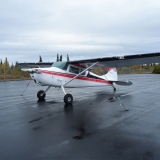
This is one of the 170s that has been for sale for quite sometime in Anchorage. I have not looked at it personally but it sure looks like a nice clean airframe. Low time Franklin but I would guess that is the reason it has not sold?
So far from this thread I have come to understand they are the best engine ever made that would be the only conversion to consider.......until they "blow up"!? Gives a guy something to chew on anyway.
http://anchorage.craigslist.org/fod/5148672051.html
So far from this thread I have come to understand they are the best engine ever made that would be the only conversion to consider.......until they "blow up"!? Gives a guy something to chew on anyway.
http://anchorage.craigslist.org/fod/5148672051.html
Tue Sep 01, 2015 10:33 pm
Re: What sets the Franklin 220 apart?
SkyLarkin wrote:...Low time Franklin but I would guess that is the reason it has not sold?
Either that or because it's fugly

- bart offline

- Posts: 545
- Joined: Fri Aug 21, 2009 7:54 pm
- Location: Fresno, CA
- FindMeSpot URL: http://share.findmespot.com/shared/face ... 1ZTy9zAEWv
- Aircraft: Cessna 180
Wed Sep 02, 2015 10:28 am
Re: What sets the Franklin 220 apart?
But not as ugly as some I've seen. Heavy at 1500# too-- only 700# useful.
But what would concern me more is that apparently only it's only flown 169 hours since 2003, and only 7 hours since 2010. I'd definitely be peekabooing through that inspection cover.
But what would concern me more is that apparently only it's only flown 169 hours since 2003, and only 7 hours since 2010. I'd definitely be peekabooing through that inspection cover.
Last edited by hotrod180 on Thu Sep 03, 2015 10:21 am, edited 1 time in total.
Cessna Skywagon -- accept no substitute!
Wed Sep 02, 2015 1:08 pm
Re: What sets the Franklin 220 apart?
Battson wrote:Can someone school me on the Franklin 220 engine:
> what makes them different from other mid-200 horsepower engines in terms of their design?
> are they any different, from an operational perspective?
> I understand they have been out of production (like many things for aircraft) for quite some time, why - did they fail as a company, lawsuits, ???
> what sets them apart, are they superior to Lycoming / TCM engines in some way(s), or are they deficient in some ways?
Yes, I should be able help with that.
I have been flying a 172H with a Franklin 220 for about 760 hours; I also have several engines for spares and spare parts for them. What sets them apart?, They make 220HP@ 2800 RPM with 350 CID, they have a 10.5:1 compression ratio. What does this mean? They make more with less. They also have a viscus damper, self-balancing, absorbs torsional vibration and harmonics. I believe that these engines are very reliable high performance engines, IF they are repaired and operated properly, many, sorry to say, were or are not. I can pin point the cause of the failure in 90% or more of premature engine failures in Franklin 220 engines, either from the mechanic building it or the operator flying it.
A little about myself, I’m over 60 and have been into mechanics from my earliest years to present , I have worked as a mechanic , vocational instructor, welder , machinist, shop owner, expert witness, electrical test tech and played in motor sports most of my life. I love root cause analyses.
I purchased the 172 in disrepair and began to restore it I sent my engine to a “Franklin expert” in Paul’s Valley OK for over haul that had been recommended by several sources’, here is where , the root of my Franklin knowledge begins, my wife asked what I was doing when I was boxing the engine for transport, I told her that I was sending the engine to A “Franklin expert” She said ;”you will never be happy with an engine someone else built” , to make a long story short, two years later and about $14000.00, the engine in and out of the air frame a trip to Paul’s Valley, a good look at what this CON man A&P had done to my engine, some of my money back and my engine in pieces, while I was measuring , magna fluxing, and balancing parts, my wife asked if I remember what she said? I did, and then she made this statement; “do you know how much better I feel flying behind an engine that you built over anyone else’s?” Aw shucks!
Here is what was in my engine that a Franklin engine specialist built for me, for beginners he used the wrong bearings in the accessory drive that shed Rockwell 60 metal throughout my engine, I had purchased a used set of inspected cases, however the cases I got had no inspection marks on them, or paper work and were junk, although I paid to have my cylinders re sleeved they had not been rebuilt, guides were worn out with new counterfeit valves and valve springs, I paid $350.00 per cylinder $220.00 per valve and $25.00 per spring. The list is much longer. So your engine has just been rebuilt hua? By whom?

Why don’t these engines make TBO?
1. Cam failure is the most common cause of major OH before TBO, why? I found that most if not all Franklin cam regrinders copied the original Franklin lobe with no taper. lifters; some, more than one, Franklin rebuilders have been grinding them with a radius or conically, this combination will ALWAYS fail prematurely, a lifter face should NEVER be ground conically, If a machinist or a mechanic says otherwise they don’t know what they are doing or talking about, Here is my favorite; from well-known Franklin engine rebuilder,” we have been doing it that way for 35 years!" I asked, Do you have cam failures? He responded; "Well I wouldn’t say we don’t but they almost make TBO”, How many engines are out there with conically ground lifters that are eating cams? I have found this in several of my engines, flat lifter faces go with lobes without taper and radius lifters go with tapered lobes. I also found that some cases were not properly machined. Look up my post on “why some cams fail” Always check the pattern.
2. Cylinder and piston failure,; overheating, steep climb, lean mixture at high manifold pressures, running MOGAS is a sure way of destroying one of these engines, non-sodium filled valves, sodium filled valves run 400F cooler than non-sodium filled valves, this is where pre ignition can start, another point is the top edge of the cylinder liner or spark plug relief, I have seen sharp corners on them and heard stories about burning a notch down the side of the liner from the plug relief. Pre ignition will also cause wristpin failure. Install an engine analyzer and know what is happening under the cowl, they take away the guess work and save your engine.
If I can help contact me.

DISPLAY OPTIONS
Who is online
Users browsing this forum: No registered users and 3 guests
Latest Features
-
-
Featured Bush Planes
As one of the undisputed legends of bush flying, the Cessna 180 hauls a…Read More -
Aircraft Ownership and Maintenance
9 modification mistakes aircraft owners make when trying to "bush out" their birds—why some…Read More -
Live to Tell
A Minnesota pilot is surprised to learn that the sudden asymmetric drag of an…Read More




Latest Knowledge Base
-
Destinations
Canada offers some of the most spectacular backcountry flying on the continent. Here's what you need to know before you go.Read More -
Safety and Survival
Hope that you never have to use your survival vest but knowing you have it and knowing how to use…Read More -
Destinations
A regional guide with ideas for winter camping destinations in California, Nevada, New Mexico, and Arizona.Read More -
Aircraft
Finding an affordable aircraft that can handle the backcountry for $80K or less? A challenge for sure, but with the…Read More



