As we turn crosswind at Vy, will more or less back pressure be required to maintain Vy?
As we turn crosswind with trim set for normal climb, does the airplane want to maintain Vy pitch attitude, does it want to pitch more up, or does it want to pitch down?
As we turn crosswind will insuficent rudder cause more or less pitch attitude to be required to maintain Vy airspeed?
In an airplane with twice the HP of the original model, will more or less pitch attitude be required to maintain Vx or Vy as appropriate? Now should we lose the engine thrust, will more or less pitch down be required to prevent stall? Does this aggravate the danger of the takeoff and departure stall?
If we are flying by reference to instruments, we are concerned with numbers more than with what the airplane wants to do. We humans however, both pilots and ATC, are extremely careful to limit all numbers to what the airplane and pilot are comfortable with doing. Airspeed, altitude, procedural track, rate of climb or descent, pitch angle, bank angle,...all of it.
Contact flying, on the other hand, can safely take full advantage of of all available energy and more fully allow the airplane to do what it wants, to exercise design stability. Because of weather limitations to situational awareness and generally higher experience level of the pilot, instrument flying is statistically safer than contact flying. Because of what Wolfgang Langewiesche teaches about airplane design and what the airplane wants to do, much greater efficiency and maneuvability can safely be gleaned from the airplane in the contact environment.
Read or re-read, in Stick and Rudder, chapter 5 The Law of the Roller Coaster and chapter 7 What the Airplane Wants to Do. The airplane wants to maintain trimmed airspeed. It wants to manage energy to keep the wing flying. It doesn't really like elevator pitch up, except to zoom so long and only so long as zoom reserve is available. It doesn't really want to climb and will pitch level or down as soon as the elevator pressure is released. It doesn't really want to dive and will pitch level or up as soon as the elevator pressure is released. It doesn't like level turns and will pitch down in all turns, more down in steep turns. It is fine with replacing vertical lift lost to horizontal lift in turns with acceleration lift or the lift component of thrust, but military thrust is generally not available in small aircraft. It is very comfortable with rudder yaw and elevator pitch and throttle thrust, all acting from centrally located and balanced positions on the fuselage. It is not so comfortable with aileron bank because the ailerons cause adverse yaw as well as bank. Even when the ailerons are neutralized after steep bank entry, wing dihederal causes more bank requiring more rudder to keep the nose moving at greater rate appropriate to greater angle of bank.
So the airplane manages energy quite well on its own, except for the need of pilot rudder movement to start the nose yawing in the desired direction, to compensate for adverse yaw, and to help get the nose down quickly and to increase rate of turn in steep turns.
Well above obstructions and where recovery from inadvertent stall is probable, the airplane can safely be flown by human reference to instruments, by human reference to the earth, or by computer. At altitudes below probable recovery from inadvertent stall, the pilot needs to be manipulating the controls by reference to the earth. And the pilot needs to heed the wishes of the airplane to fly most efficiently and safely, especially during takeoff and landing. We decrease inadvertent stall fatalities significantly by allowing the nose to go down naturally in all turns in the pattern and during other low altitude maneuvering flight.
What the airplane wants to do.
Sun Jun 21, 2020 12:55 am
- contactflying offline
- Posts: 4972
- Joined: Wed Apr 03, 2013 7:36 pm
- Location: Aurora, Missouri 2H2
Download my free "https://tinyurl.com/Safe-Maneuvering" e-book.
Sun Jun 21, 2020 6:07 pm
Re: What the airplane wants to do.
I wish you lived in Montana. I get the occasional brain-freeze reading your posts since I'm not wired to learn that way, but I'd love to fly with you for ten or twenty hours.
I used to think I knew how to fly, like I used to think I knew how to ride a bike. But there's knowing, and there's knowing, and they ain't the same.
Example: https://youtu.be/Cj6ho1-G6tw
I used to think I knew how to fly, like I used to think I knew how to ride a bike. But there's knowing, and there's knowing, and they ain't the same.
Example: https://youtu.be/Cj6ho1-G6tw

Sun Jun 21, 2020 6:16 pm
Re: What the airplane wants to do.
We'll do it after a vaccination is available. I like Montana. Bloody Bart was from Whitefish.
- contactflying offline
- Posts: 4972
- Joined: Wed Apr 03, 2013 7:36 pm
- Location: Aurora, Missouri 2H2
Download my free "https://tinyurl.com/Safe-Maneuvering" e-book.
Mon Jun 22, 2020 2:09 am
Re: What the airplane wants to do.
In your video, Hammer, he can unicycle momentarily, rear or front wheel, and he is always dynamic and proactive. He is never just along for the ride.
- contactflying offline
- Posts: 4972
- Joined: Wed Apr 03, 2013 7:36 pm
- Location: Aurora, Missouri 2H2
Download my free "https://tinyurl.com/Safe-Maneuvering" e-book.
Mon Jun 22, 2020 6:22 am
Re: What the airplane wants to do.
I am going to try to answer these quiz questions as a student pilot...
As we turn crosswind at Vy, will more or less back pressure be required to maintain Vy?
More correct? With some vertical lift lost to the turn, more back pressure is required to increase the AOA of the wing to replace the lost lift?
As we turn crosswind with trim set for normal climb, does the airplane want to maintain Vy pitch attitude, does it want to pitch more up, or does it want to pitch down?
Pitch down due to the natural tendency to for the plane to do so in a turn due to the transfer of lift from vertical to horizontal?
As we turn crosswind will insuficent rudder cause more or less pitch attitude to be required to maintain Vy airspeed?
Hmmm... more?
In an airplane with twice the HP of the original model, will more or less pitch attitude be required to maintain Vx or Vy as appropriate? Now should we lose the engine thrust, will more or less pitch down be required to prevent stall? Does this aggravate the danger of the takeoff and departure stall?
More pitch attitude due to the increased speed and climb rates from more HP? I would think more pitch down is needed since you are in a steeper climb due to more HP?
As we turn crosswind at Vy, will more or less back pressure be required to maintain Vy?
More correct? With some vertical lift lost to the turn, more back pressure is required to increase the AOA of the wing to replace the lost lift?
As we turn crosswind with trim set for normal climb, does the airplane want to maintain Vy pitch attitude, does it want to pitch more up, or does it want to pitch down?
Pitch down due to the natural tendency to for the plane to do so in a turn due to the transfer of lift from vertical to horizontal?
As we turn crosswind will insuficent rudder cause more or less pitch attitude to be required to maintain Vy airspeed?
Hmmm... more?
In an airplane with twice the HP of the original model, will more or less pitch attitude be required to maintain Vx or Vy as appropriate? Now should we lose the engine thrust, will more or less pitch down be required to prevent stall? Does this aggravate the danger of the takeoff and departure stall?
More pitch attitude due to the increased speed and climb rates from more HP? I would think more pitch down is needed since you are in a steeper climb due to more HP?
- FFSchooley offline
- Posts: 30
- Joined: Mon Feb 03, 2020 3:00 pm
- Location: Martinez
- Aircraft: Piper PA-22 150
Mon Jun 22, 2020 7:00 am
Re: What the airplane wants to do.
50%. With preparation for the ACS which wants a dangerous climbing turn to crosswind, 50% is better than average. The airplane always wants to pitch down in all turns. You got that so just doing what the airplane wants to do will keep you flying if you make it default after PPL.
There is nothing inherently wrong with V speeds, we just shouldn't think that way first because of the law of primacy. As we turn crosswind less back pressure is required to maintain Vy, so we just need to heed the wishes of the airplane. Unfortunately that is not taught, but rather the opposite. If we commonly use too little rudder in the turn to crosswind, we will have to allow the nose to go down even more. Here we have to not only replace zoom reserve airspeed given up to horizontal lift but also zoom reserve airspeed given up in a slip. When we use insufficient rudder for the angle of bank we are slipping.
The overrated coordination techniques taught in most flight schools is weak coordination because it teaches reactive rather than proactive rudder. If we just lead rudder to get the nose started the way we want to bank, we get out ahead of adverse yaw.
It is true that the airplane pretty much flys itself. It even fixes it if we force irritating climb or dive or bank. All it really asks is that we manage rudder proactively rather than get behind and destabilize things.
Thanks for taking my little quiz. You are becoming a great pilot because you want to know why we do things as pilots and not just parrot what a standardized test seems to desire.
There is nothing inherently wrong with V speeds, we just shouldn't think that way first because of the law of primacy. As we turn crosswind less back pressure is required to maintain Vy, so we just need to heed the wishes of the airplane. Unfortunately that is not taught, but rather the opposite. If we commonly use too little rudder in the turn to crosswind, we will have to allow the nose to go down even more. Here we have to not only replace zoom reserve airspeed given up to horizontal lift but also zoom reserve airspeed given up in a slip. When we use insufficient rudder for the angle of bank we are slipping.
The overrated coordination techniques taught in most flight schools is weak coordination because it teaches reactive rather than proactive rudder. If we just lead rudder to get the nose started the way we want to bank, we get out ahead of adverse yaw.
It is true that the airplane pretty much flys itself. It even fixes it if we force irritating climb or dive or bank. All it really asks is that we manage rudder proactively rather than get behind and destabilize things.
Thanks for taking my little quiz. You are becoming a great pilot because you want to know why we do things as pilots and not just parrot what a standardized test seems to desire.
- contactflying offline
- Posts: 4972
- Joined: Wed Apr 03, 2013 7:36 pm
- Location: Aurora, Missouri 2H2
Download my free "https://tinyurl.com/Safe-Maneuvering" e-book.
Fri Jun 26, 2020 1:01 am
Re: What the airplane wants to do.
Would it be productive for all of us old guys to develop an extensive quiz to ferret out the misleading teaching of Airmen Certification Standards because of much more emphasis on V speeds, altitude maintenance, bank limitations, headings rather than targets, and various other IFR considerations for a contact flying test.
Actually does the brand new PPL pilot get much contact flying training or experience? And how does that contribute to other than A to B flight at an altitude where recovery from stall and spin are probable. How did we get to the point where low altitude maneuvering is not taught but rather outlawed outside the airport environment? How do we safely fly in the airport environment with almost no training in contact flying? Where do a vast majority of accidents happen?
Is there a systemic refusal to accept that an airplane can be flown well and safely without ever looking at the dash other than to verify oil pressure and temperature?
Actually does the brand new PPL pilot get much contact flying training or experience? And how does that contribute to other than A to B flight at an altitude where recovery from stall and spin are probable. How did we get to the point where low altitude maneuvering is not taught but rather outlawed outside the airport environment? How do we safely fly in the airport environment with almost no training in contact flying? Where do a vast majority of accidents happen?
Is there a systemic refusal to accept that an airplane can be flown well and safely without ever looking at the dash other than to verify oil pressure and temperature?
- contactflying offline
- Posts: 4972
- Joined: Wed Apr 03, 2013 7:36 pm
- Location: Aurora, Missouri 2H2
Download my free "https://tinyurl.com/Safe-Maneuvering" e-book.
Fri Jun 26, 2020 1:06 pm
Re: What the airplane wants to do.
Im with Hammer. I would love to spend some air time with you. I do great on calm days but just a little wind makes the ball bounce like a volleyball over the net.
Not flying for prolonged time uncoordinated but mostly chasing the ball . I own a small boat and spend time in the ocean in large swells.
In bigger seas I keep the nose pointed in the direction Im going and maintain that heading fairly well.
But in the air I seem to be fixated on the ball rather than trying to pick a point and "feel" the airplane.
You like San Diego ?
Not flying for prolonged time uncoordinated but mostly chasing the ball . I own a small boat and spend time in the ocean in large swells.
In bigger seas I keep the nose pointed in the direction Im going and maintain that heading fairly well.
But in the air I seem to be fixated on the ball rather than trying to pick a point and "feel" the airplane.
You like San Diego ?
- sierrasplitter offline
- Posts: 203
- Joined: Fri Dec 01, 2017 11:55 am
- Location: Lakeside
- Aircraft: 56 PA 22/20
Fri Jun 26, 2020 4:47 pm
Re: What the airplane wants to do.
With a target, in calm or rough air, we can keep the nose on target with rudder only. By nitpicking precise or even dynamic proactive rudder movement, we stay on target. By staying on target with rudder only, we keep the wing level. Two things can screw this up: using the ailerons except when upset changes bank more than 20 degrees and chasing the ball.
When turning, lead with rudder and learn to make the rate of turn appropriate for the angle of bank. More bank, more rudder. Steep turns will require rudder until nose is on target.
When turning, lead with rudder and learn to make the rate of turn appropriate for the angle of bank. More bank, more rudder. Steep turns will require rudder until nose is on target.
- contactflying offline
- Posts: 4972
- Joined: Wed Apr 03, 2013 7:36 pm
- Location: Aurora, Missouri 2H2
Download my free "https://tinyurl.com/Safe-Maneuvering" e-book.
Fri Jun 26, 2020 7:09 pm
Re: What the airplane wants to do.
Yes I like San Diego, Sierrasplitter. The loach eaters (tall trees) at the zoo remind me of Vietnam. Lots of wood cutters so they were isolated and not a complete canopy, same as the zoo.
- contactflying offline
- Posts: 4972
- Joined: Wed Apr 03, 2013 7:36 pm
- Location: Aurora, Missouri 2H2
Download my free "https://tinyurl.com/Safe-Maneuvering" e-book.
Sat Jun 27, 2020 6:00 am
Re: What the airplane wants to do.
Thanks for the tips. I will start the application today .
If the Marine layer decides to leave
If the Marine layer decides to leave
- sierrasplitter offline
- Posts: 203
- Joined: Fri Dec 01, 2017 11:55 am
- Location: Lakeside
- Aircraft: 56 PA 22/20
Thu Jul 02, 2020 1:10 am
Re: What the airplane wants to do.
Sierrasplitter, my fortnight OP will be out Sunday with the airspeed over altitude controversy. Your training favors altitude even if you kill yourself getting there. I try to cover the advantages and disadvantages of each. Your questions are golden.
Is Vx or Vy as appropriate always appropriate or are they just suggestions?
I'm not weird and stay up all night. I cath at 0200, take Tylenol for butt pain, and drink hot tea with honey.
Is Vx or Vy as appropriate always appropriate or are they just suggestions?
I'm not weird and stay up all night. I cath at 0200, take Tylenol for butt pain, and drink hot tea with honey.
- contactflying offline
- Posts: 4972
- Joined: Wed Apr 03, 2013 7:36 pm
- Location: Aurora, Missouri 2H2
Download my free "https://tinyurl.com/Safe-Maneuvering" e-book.
Thu Jul 02, 2020 1:11 pm
Re: What the airplane wants to do.
You got me!
- contactflying offline
- Posts: 4972
- Joined: Wed Apr 03, 2013 7:36 pm
- Location: Aurora, Missouri 2H2
Download my free "https://tinyurl.com/Safe-Maneuvering" e-book.
Sat Jul 04, 2020 6:56 pm
Re: What the airplane wants to do.
My honey gripes about me rattling around in the middle of the night.
- contactflying offline
- Posts: 4972
- Joined: Wed Apr 03, 2013 7:36 pm
- Location: Aurora, Missouri 2H2
Download my free "https://tinyurl.com/Safe-Maneuvering" e-book.
Tue Sep 01, 2020 3:28 am
Re: What the airplane wants to do.
If everything we do with the controls has a number as the objective, how do we learn what the airplane wants to do? How do we learn the law of the roller coaster? How do we learn how to make use of the environs of the desired touchdown spot and its apparent motion? In rough air is attempting to maintain altitude efficient? Does instrument integration mean we are just curious about the numbers, or are the numbers driving us? IFR is usefully numbers oriented. Should contact flying be as numbers oriented as the ACS dictates? How can such an independent group, VFR pilots, be so numbers driven?
- contactflying offline
- Posts: 4972
- Joined: Wed Apr 03, 2013 7:36 pm
- Location: Aurora, Missouri 2H2
Download my free "https://tinyurl.com/Safe-Maneuvering" e-book.
Tue Sep 01, 2020 10:31 am
Tue Sep 01, 2020 12:20 pm
Re: What the airplane wants to do.
Read Chapter Five in Stick and Rudder, The Law of the Roller Coaster. This concept can apply to allowing the nose to go down naturally in turns as it was designed to do. Read the first paragraph on page 304, "...the process of stalling the airplane down can be gauged entirely by watching the spot and the perspective in which it appears and its apparent motion." What does any of that have to do with 1.3 Vso?Throughout the book, airspeed is altitude and altitude is airspeed so flight can be managed better than by attempting to maintain altitude.
You will find no V speeds or talk of any particular airspeed, altitude, or procedural track in any of those discussions. Yet there was a time when we were expected to know the control feel, the buoyancy of, the relative wind noise, the apparent rate of closure with the numbers, and lots of things not instrument driven. Stick and Rudder has lasted because it is still relevant. It was never meant to be book shelf dressing.
You will find no V speeds or talk of any particular airspeed, altitude, or procedural track in any of those discussions. Yet there was a time when we were expected to know the control feel, the buoyancy of, the relative wind noise, the apparent rate of closure with the numbers, and lots of things not instrument driven. Stick and Rudder has lasted because it is still relevant. It was never meant to be book shelf dressing.
- contactflying offline
- Posts: 4972
- Joined: Wed Apr 03, 2013 7:36 pm
- Location: Aurora, Missouri 2H2
Download my free "https://tinyurl.com/Safe-Maneuvering" e-book.
Tue Sep 01, 2020 3:44 pm
Re: What the airplane wants to do.
I'll nibble a little.
The turn to crosswind will be using part of the wing's lift for horizontal component, and there will of course be induced drag. So while it's tempting to say that it will require additional back pressure to maintain Vy, the truth is you can't maintain the number on the airspeed indicator unless you reduce back pressure (accepting that the plane won't climb as well when you're turning). Remember that in our "normal" 360 degree or steep turns we expect to add power to maintain altitude. But we're already at full power here so the only thing we can do is reduce back force on the stick or the plane will slow down (and AoA increase).
You asked a question in a different thread about use of rudder in the turns. My Citabria takes a crap ton of rudder and some aileron to make coordinated turns, so I always have to be aware of how much is enough to coordinate the turn without using too much and slowing down that inside wing (REF: Wayne Handley's video about how that works out).
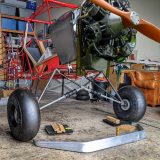
I fly my plane (a 150hp, no flaps Citabria) thusly: Vy is 70 and Vx is 50something. I have no use for either. I get the plane off the ground and put the top of the cowl bump on the horizon. After allowing it to accelerate I glance at the airspeed indicator and expect 80mph. Another glance a moment later and I should be seeing 1000 fpm (hence no reason to explore Vx). Those instrument values are treated as performance indicators. I also expect to reach 1000 AGL and turn crosswind at the end of the runway. If I'm not getting those numbers I have a problem. Note that these are sea level numbers. If it's high DA or I'm packing a load I do expect less performance. The high DA performance of the Citabria falls off rapidly. On a 6000' DA takeoff I can expect maybe 500fpm, and will pitch for 70 if the rocks and trees are not just hypothetical, and I go plenty of places they're not.
You state that the climbing turn to crosswind is dangerous but in my particular citabria I bank 45 degrees or more, letting the nose down a bit as I turn but it's still got a very healthy climb. Since I'm at 1000 AGL and right there over the departure end of the runway the "emergency turn back" would be cake. I would actually have to burn some altitude to keep from going long.
Before I continue, I have put in a TON of time doing real chandelles and lazy 8's (not this 30 degree crap we teach) and I've also been spinning my plane quite a bit recently. My plane will not bite me in a climbing turn of any bank and pitch clear into ridiculous territory. It will not stall power off with a normal deceleration. In cold air it just descends with stick full back as if it were a canard in a former life. In warm air it might nod a bit but no break and no tendency to fall off on a wing if the ball is in the middle. Departure stalls are damn near vertical and I cannot fathom how that could happen to a pilot who is not unconscious.
Back to that climbing turn. I'm at 80, which I have concluded is a great speed for climb and also what the heavy iron guys call "minimum maneuvering speed". So I have a bit more cushion during that WTF 3 seconds of disbelief that we should plan for. I'm also not watching the airspeed indicator in the turn. I again use that cowl bump, this time the tangent which is parallel to the horizon, and sweep it across the horizon. I'm more concerned with keeping the turn coordinated than a number on a gauge.
I have learned that the plane has two best glide speeds. 80 and 65. I've tested it over and over and 80 will give me the most distance and 65 gives me the most time. How do I know? Because I also use 80 in the pattern. Without flaps I don't use the typical Cessna 80,70,60. I keep 80 until my base to final turn is complete and then I pitch (and trim) for 65.
When I turn final and get that pitch set at 80 I can see the runway numbers sitting still over my cowl. When I pitch for 65 there is a slight delay and then I get a higher sink rate (the numbers start moving away from me). The VSI says I'll be aloft for longer, but I will not make it to the runway without adding power. If 65 were the "true for all conditions best glide" the runway numbers would disappear under my cowl instead of moving away from me, but they clearly do not.
You are spot on when you talk about unloading the wing in these pattern turns, especially the last two. I was torched on another forum for suggesting that you can unload the wing, because "everyone knows" a wing is always generating the same lift at a given airspeed. You've got it right: Point the plane at the ground and don't pull back. The wing is unloaded and can't stall regardless of bank angle.
The turn to crosswind will be using part of the wing's lift for horizontal component, and there will of course be induced drag. So while it's tempting to say that it will require additional back pressure to maintain Vy, the truth is you can't maintain the number on the airspeed indicator unless you reduce back pressure (accepting that the plane won't climb as well when you're turning). Remember that in our "normal" 360 degree or steep turns we expect to add power to maintain altitude. But we're already at full power here so the only thing we can do is reduce back force on the stick or the plane will slow down (and AoA increase).
You asked a question in a different thread about use of rudder in the turns. My Citabria takes a crap ton of rudder and some aileron to make coordinated turns, so I always have to be aware of how much is enough to coordinate the turn without using too much and slowing down that inside wing (REF: Wayne Handley's video about how that works out).
I fly my plane (a 150hp, no flaps Citabria) thusly: Vy is 70 and Vx is 50something. I have no use for either. I get the plane off the ground and put the top of the cowl bump on the horizon. After allowing it to accelerate I glance at the airspeed indicator and expect 80mph. Another glance a moment later and I should be seeing 1000 fpm (hence no reason to explore Vx). Those instrument values are treated as performance indicators. I also expect to reach 1000 AGL and turn crosswind at the end of the runway. If I'm not getting those numbers I have a problem. Note that these are sea level numbers. If it's high DA or I'm packing a load I do expect less performance. The high DA performance of the Citabria falls off rapidly. On a 6000' DA takeoff I can expect maybe 500fpm, and will pitch for 70 if the rocks and trees are not just hypothetical, and I go plenty of places they're not.
You state that the climbing turn to crosswind is dangerous but in my particular citabria I bank 45 degrees or more, letting the nose down a bit as I turn but it's still got a very healthy climb. Since I'm at 1000 AGL and right there over the departure end of the runway the "emergency turn back" would be cake. I would actually have to burn some altitude to keep from going long.
Before I continue, I have put in a TON of time doing real chandelles and lazy 8's (not this 30 degree crap we teach) and I've also been spinning my plane quite a bit recently. My plane will not bite me in a climbing turn of any bank and pitch clear into ridiculous territory. It will not stall power off with a normal deceleration. In cold air it just descends with stick full back as if it were a canard in a former life. In warm air it might nod a bit but no break and no tendency to fall off on a wing if the ball is in the middle. Departure stalls are damn near vertical and I cannot fathom how that could happen to a pilot who is not unconscious.
Back to that climbing turn. I'm at 80, which I have concluded is a great speed for climb and also what the heavy iron guys call "minimum maneuvering speed". So I have a bit more cushion during that WTF 3 seconds of disbelief that we should plan for. I'm also not watching the airspeed indicator in the turn. I again use that cowl bump, this time the tangent which is parallel to the horizon, and sweep it across the horizon. I'm more concerned with keeping the turn coordinated than a number on a gauge.
I have learned that the plane has two best glide speeds. 80 and 65. I've tested it over and over and 80 will give me the most distance and 65 gives me the most time. How do I know? Because I also use 80 in the pattern. Without flaps I don't use the typical Cessna 80,70,60. I keep 80 until my base to final turn is complete and then I pitch (and trim) for 65.
When I turn final and get that pitch set at 80 I can see the runway numbers sitting still over my cowl. When I pitch for 65 there is a slight delay and then I get a higher sink rate (the numbers start moving away from me). The VSI says I'll be aloft for longer, but I will not make it to the runway without adding power. If 65 were the "true for all conditions best glide" the runway numbers would disappear under my cowl instead of moving away from me, but they clearly do not.
You are spot on when you talk about unloading the wing in these pattern turns, especially the last two. I was torched on another forum for suggesting that you can unload the wing, because "everyone knows" a wing is always generating the same lift at a given airspeed. You've got it right: Point the plane at the ground and don't pull back. The wing is unloaded and can't stall regardless of bank angle.
Tue Sep 01, 2020 5:18 pm
Re: What the airplane wants to do.
Well done aftCG. Billy Howell had several Citabrias for zero timers, but I preferred the one 7AC that the other instructors avoided. Power to weight was closer to a loaded 235 hp Pawnee. Same with 150 hp Cubs we used for spray training, too peppy. He also had one 135 hp that the other instructors avoided. The only really powerful aircraft I spent considerable time in were Huey, Cobra, and 400 hp Stearman. 600 hp Air Tractor was really scary in small fields.
Primary training should take into account all possibilities of training airplanes the student might encounter. Load and high DA can somewhat simulate low power, but control pressure (sloppy vs. light) and airspeed are different. Unfortunately fewer 150s are still out there to rent, especially up high. Power increases safety until the fire goes out.
Primary training should take into account all possibilities of training airplanes the student might encounter. Load and high DA can somewhat simulate low power, but control pressure (sloppy vs. light) and airspeed are different. Unfortunately fewer 150s are still out there to rent, especially up high. Power increases safety until the fire goes out.
- contactflying offline
- Posts: 4972
- Joined: Wed Apr 03, 2013 7:36 pm
- Location: Aurora, Missouri 2H2
Download my free "https://tinyurl.com/Safe-Maneuvering" e-book.
DISPLAY OPTIONS
Who is online
Users browsing this forum: No registered users and 8 guests
Latest Features
-
-
Featured Bush Planes
As one of the undisputed legends of bush flying, the Cessna 180 hauls a…Read More -
Aircraft Ownership and Maintenance
9 modification mistakes aircraft owners make when trying to "bush out" their birds—why some…Read More -
Live to Tell
A Minnesota pilot is surprised to learn that the sudden asymmetric drag of an…Read More




Latest Knowledge Base
-
Destinations
Canada offers some of the most spectacular backcountry flying on the continent. Here's what you need to know before you go.Read More -
Safety and Survival
Hope that you never have to use your survival vest but knowing you have it and knowing how to use…Read More -
Destinations
A regional guide with ideas for winter camping destinations in California, Nevada, New Mexico, and Arizona.Read More -
Aircraft
Finding an affordable aircraft that can handle the backcountry for $80K or less? A challenge for sure, but with the…Read More



