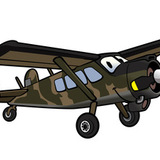
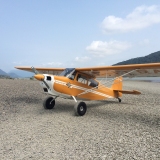
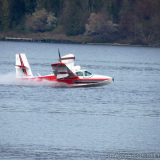
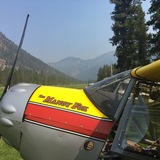
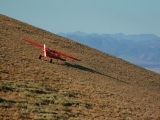
I see one around here on floats, floater guys say it works pretty good. PZL-104MA Wilga 2000 is the Lycoming variant developed in 1979 for the North America market along with the floats.
Here's some pictures:
http://forums.flyer.co.uk/viewtopic.php?f=67&t=72427One of our local pilots left this one on a local glacier. He'd put it on wheel/skis and was landing up there to paint landscapes when he got caught with a shifting wind on a takeoff run.
http://www.clubtread.com/sforum/imagePreview.asp?image=/forumPix/14000/14148.jpg&x=560&y=348&t=4904#Here's his story on it...........
While I painted on the Cheakamus, the wind picked up. Taking off from a glacier in a strong wind could be tricky, even dangerous, so I put down my watercolour, unfinished, and hurried John (Toronto photographer John Reeves) back into the plane.
As we taxied down the mountainside, the snow began sticking to the skis. Halfway in the run, I could see we’d never reach flying speed. I chopped the power, turned the plane and headed back up the slope.
“We’ll take another shot at it,” I radioed John over the headset.
On my first try, I had laid down tracks in the snow so this time, I swung the Wilga into the grooves. As we gained speed, I pulled full flaps, the lateral controls at the rear of the wings that create air resistance and lift the plane off the ground. Nothing happened. We were rattling down the glacier at 50 miles per hour. I glanced at the flaps. They dangled from the wings. Then I noticed the snow swirling past the window. That meant a tail wind had caught up to us and eliminated the air resistance. We careened off the tracks toward a gaping crevasse that sliced across the lower end of the glacier.
I had to make a split-second decision. If I cut the engine and stopped the propeller, our momentum would still carry us over the glacier and the plane would drop into the crevasse. I left the power on. We leaped into the air and slammed into the far wall of the glacier. A spasm of pain jolted me awake. Jagged strips of metal from the fuselage pinned my legs under the wrecked instrument panel. The engine had been rammed through the cockpit and had punched out the control panel. My shoulder harness had sprung open and my seat had been wrenched off its mounting. My hand still clutched the throttle. And my ring finger bled, cut to the bone. Probably, it had been caught between the throttle and the pitch control on the instrument panel.
— BCTV on Global Toni Onley crash landed his light plane on a glacier near Garibaldi Provincial Park in 1984.
I turned to John. His seat had been almost thrust out of the aircraft. He sat buckled into it, his head slumped forward, blood dripping from his mouth. I struggled to free my leg, then shouted, “John, are you all right?” Once or twice, he flinched, indicating he lived, though apparently suffering from massive internal injuries.
I reached over to John and slapped his face to revive him.
His eyes snapped open and he twisted in his shoulder harness. “What kind of a place is this?...I hope they have a good wine cellar.” He had lost his memory. “We crashed, John . . . we crashed.” He turned to the window. The Wilga was wedged into a narrow crevasse. It had jumped the first crevasse, and slotted into a second, narrower one. If the plane suddenly tilted backward, it would pitch us through the rear window and we’d tumble into the first crevasse, about 90 feet deep.
Fortunately, the blood trickling from John’s mouth only came from a cut lip. Except for a swollen cheek that made his face resemble that of a friendly, oversized chipmunk, he seemed all right. I helped him unbuckle his harness and he shifted to one of the other seats in the cabin.
John was peeking into the hole in the floor. With a crooked smile, he added, “Toni, I suppose you realize this crash scotches our story. CP Air isn’t going to publish anything that ends in an airplane crash.” He turned to me. “So what do we do now?”
“I turned on the emergency locator transmitter. We wait for help.”